
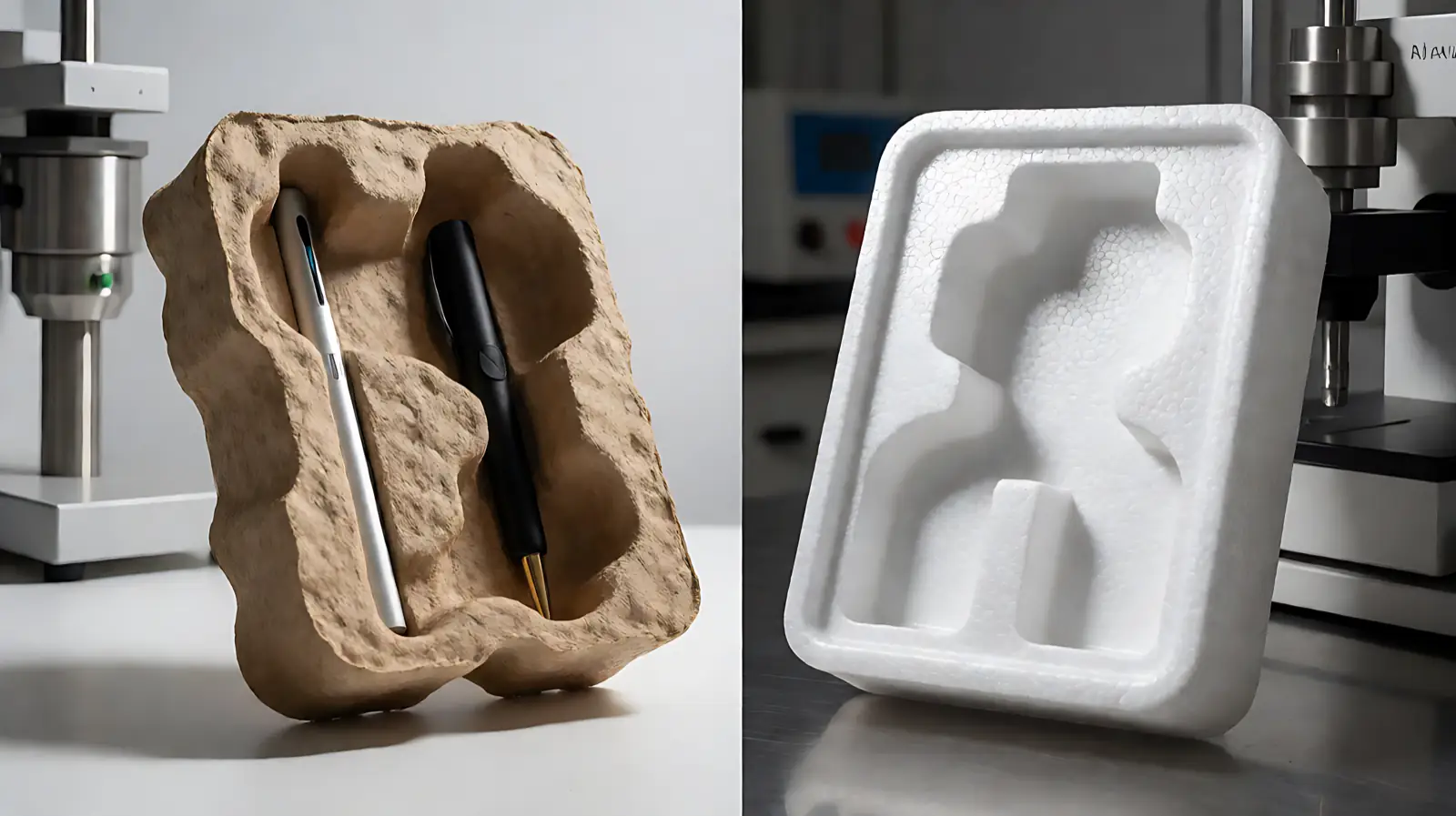
Molded Pulp vs EPE Foam Inserts: Cushioning & Drop Test Guide
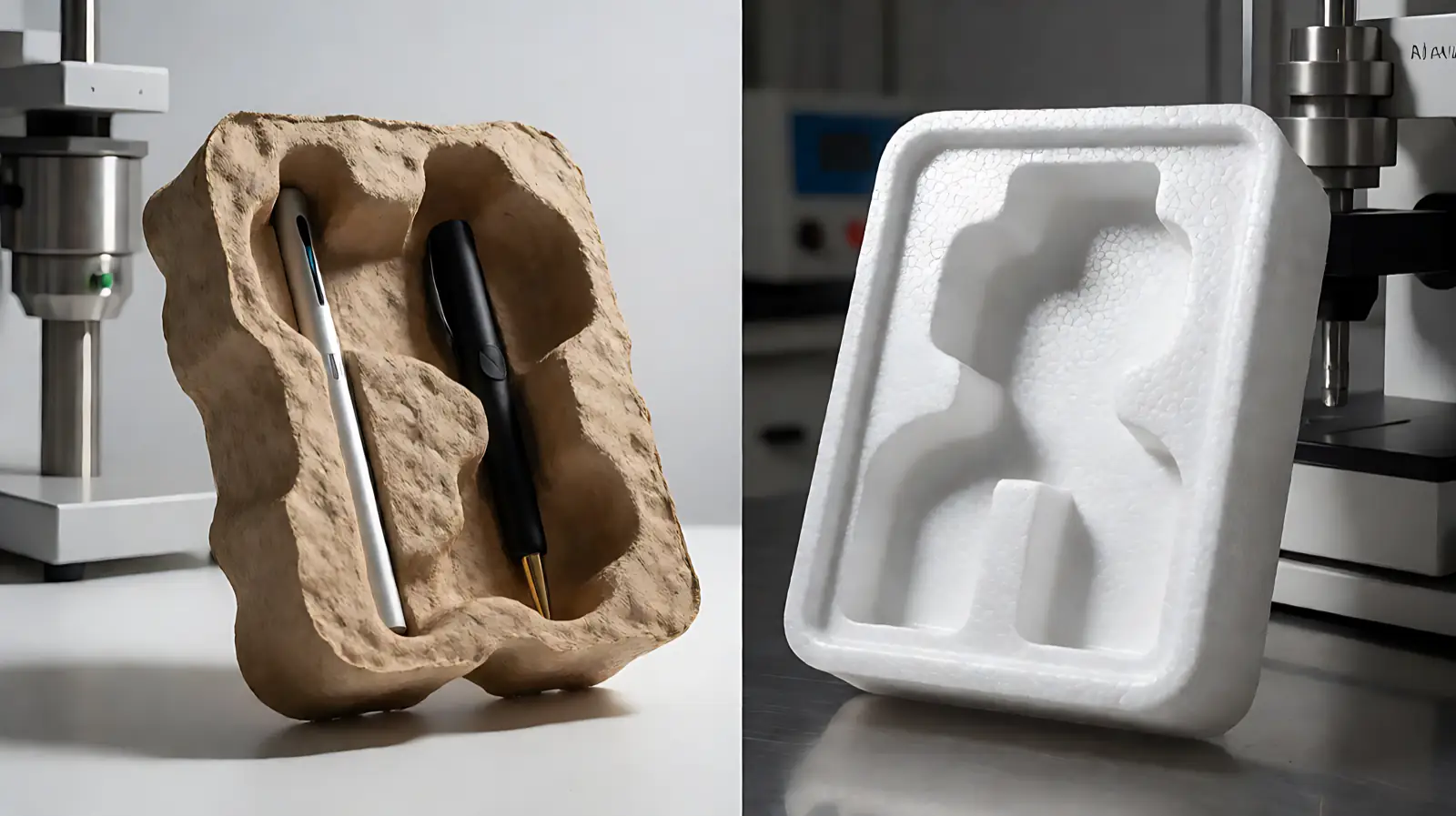
In direct-to-consumer (D2C) e-commerce and retail supply chains, exterior corrugated master cartons only provide perimeter containment. The true defense against drop shock, transit vibration, and courier impact lies in the internal protective packaging insert.
For decades, Expanded Polyethylene (EPE) foam has been the default engineering choice for cushioning consumer electronics, glassware, and precision instruments. EPE’s closed-cell polymer matrix delivers exceptional multi-drop elastic recovery and low vibration transmission.
However, global anti-plastic packaging regulations, retailer environmental scorecards, and consumer backlash against non-recyclable synthetic foams have accelerated the adoption of Thermoformed Molded Fiber Pulp.
Can molded sugarcane bagasse and bamboo fiber match the dynamic shock attenuation of synthetic polymers? This engineering guide compares molded pulp and EPE foam across peak deceleration ($G$-factor) cushion curves (ASTM D3332), progressive wall buckling physics, CNC tooling amortizations, and circular recyclability.
1. Quick Engineering Benchmark Matrix
| Protective Parameter | Thermoformed Wet-Press Molded Pulp | Die-Cut Expanded Polyethylene (EPE Foam) | Expanded Polystyrene (EPS / Styrofoam) |
|---|---|---|---|
| Material Origin | Sugarcane bagasse, bamboo, recycled paper | Petroleum-based low-density polyethylene | Expanded polystyrene plastic beads |
| Energy Absorption Mechanism | Progressive rib buckling & fiber compression | Closed-cell pneumatic elastic rebound | Brittle cell crush (single impact only) |
| Multi-Drop Rebound (Drop 2–5) | Moderate (Permanent deformation of rib wall) | Superior (> 90% elastic height recovery) | Catastrophic fracture / zero recovery |
| Curbside Recyclability | 100% curbside repulpable in paper bin | Non-recyclable in municipal kerbside bins | Banned in most progressive markets |
| Surface Abrasiveness | Ultra-smooth (Wet-press: zero scuffing) | Non-abrasive, soft cushion | Coarse beads can scuff painted surfaces |
| Static Loading Window | 0.5 to 2.5 psi (3.5 to 17 kPa) | 0.8 to 4.0 psi (5.5 to 28 kPa) | 1.5 to 6.0 psi |
| Tooling Investment (CapEx) | Moderate to High ($2,500 – $6,000 CNC molds) | Low ($400 – $1,200 steel rule die) | High ($3,000 – $8,000 aluminum injection) |
| Volume Break-Even Point | Cost-effective at > 5,000 units | Cost-effective at < 3,000 units | Cost-effective at > 10,000 units |
Compare cushioning solutions in our Custom Packaging Inserts Guide and Rigid Boxes Guide.
2. Dynamic Cushioning Physics: Elastic Compression vs. Progressive Buckling
The mechanical response to impact shock differs fundamentally between cellular foams and fibrous structures:
┌────────────────────────────────────────────────────────────────────────┐
│                   SHOCK ABSORPTION MECHANISM COMPARISON                │
├───────────────────────────────────┬────────────────────────────────────┤
│     EPE FOAM (ELASTIC SPRING)     │   MOLDED PULP (PROGRESSIVE BUCKLE) │
├───────────────────────────────────┼────────────────────────────────────┤
│                                   │                                    │
│   Impact Force ──► [EPE FOAM]     │   Impact Force ──► [PULP TAPER RIB]│
│                          │        │                          │         │
│   • Closed cells compress air     │   • Engineered angled wall bends   │
│   • Acts as a non-linear spring   │   • Fiber matrix friction absorbs  │
│   • Rebounds immediately to 95%   │     kinetic energy permanently     │
│     original thickness            │   • Sacrificial collapse shields   │
│   • Flawless for multi-drop shock │     delicate internal components   │
│                                   │                                    │
└───────────────────────────────────┴────────────────────────────────────┘
EPE Foam Cushioning
EPE consists of millions of microscopic closed gas pockets encapsulated by flexible polyethylene walls. When a package drops from 1.0 meter (simulating an ASTM D5276 drop test), the gas compresses adiabatically, absorbing kinetic energy and returning up to 90% of its initial height within seconds. This makes EPE the ideal choice for heavy industrial machinery (> 20 kg) or items subject to repetitive rough handling.
Molded Pulp Energy Dissipation
Molded pulp does not bounce like rubber. Instead, it absorbs shock through engineered mechanical geometries (draft ribs, chamfers, and crush beads):
- Under impact, the angled sidewalls buckle in a controlled manner, dissipating deceleration energy through internal cellulose fiber displacement.
- For typical consumer electronics (smartphones, audio gear, smart home sensors weighing under 3 kg), engineered wet-press molded pulp limits peak shock to under 40 G, safely below the fragile component damage boundary ($G_{crit} \approx 50\text{–}60\text{ G}$).
3. Product Fragility & ASTM D3332 Cushion Curves
Specifying cushion thickness requires plotting the product’s fragility boundary against dynamic cushion curves:
DYNAMIC CUSHION CURVE (30-Inch Drop Height)
Peak Deceleration (G)
  │
80 ────┐                           ┌──── (Under-cushioned: Bottoms Out)
  │    │                           │
60 ────┼───────────────────────────┼──── [FRAGILITY THRESHOLD: 50 G]
  │     \                         /
40 ──────\─────── OPTIMAL ───────/──────
  │       \    LOADING ZONE     /
20 ────────\───────────────────/────────
0 ────────────────────────────────────► Static Stress (psi)- Under-Cushioning (Bottoming Out): If the static bearing area is too small, impact pressure overwhelms the material, crushing it completely flat. The product experiences a severe spike in $G$-force, shattering internal glass or soldered circuit boards.
- Over-Cushioning: If the bearing area is too large, the cushion is too stiff and does not deform, acting like a solid anvil.
- The Molded Pulp Design Sweet Spot: Modern thermoformed pulp tooling incorporates differential wall thickness (1.5mm to 2.5mm) and stepped rib arrays that deliver progressive resistance, expanding the optimal static loading window across variable payload weights.
4. Manufacturing Processes: Dry-Press vs. Thermoformed Wet-Press
Not all molded pulp exhibits the rough, coarse texture of traditional egg cartons:
┌────────────────────────────────────────────────────────────────────────┐
│                   MOLDED PULP MANUFACTURING METHODS                    │
├───────────────────────────────────┬────────────────────────────────────┤
│      TRADITIONAL DRY-PRESS        │     THERMOFORMED WET-PRESS         │
├───────────────────────────────────┼────────────────────────────────────┤
│                                   │                                    │
│   • Slurry molded on wire mesh    │   • Slurry formed on fine mesh     │
│   • Dried in open convection oven │   • Transferred directly into heated│
│   • Rough, fuzzy, coarse surface  │     CNC metal molds (180°C–220°C)  │
│   • Loose dimensional tolerance   │   • High hydraulic press ironing   │
│     (± 1.5mm to 2.0mm)            │   • Razor-sharp tolerance (±0.3mm) │
│   • Industrial buffers, egg trays │   • Premium satin finish, zero dust│
│                                   │                                    │
└───────────────────────────────────┴────────────────────────────────────┘
For luxury cosmetics, perfumes, and consumer technology, Thermoformed Wet-Press Molded Fiber is mandatory. Both front and back surfaces are ironed under continuous heat and pressure, producing a silky, dust-free surface that eliminates the risk of fiber particles settling onto camera lenses or luxury packaging surfaces.
For corrugated box selection, review our Corrugated 3-Ply vs 5-Ply Engineering Guide.
5. Tooling Economics & Production Break-Even
Understanding tooling amortization prevents budget overruns on new product launches:
| Order Quantity | Molded Pulp Cost (Tooling + Run) | Pulp Effective Unit Cost | EPE Foam Cost (Die + Run) | EPE Effective Unit Cost |
|---|---|---|---|---|
| 1,000 units | $4,500 ($3,500 mold + $1,000 run) | $4.50 | $1,400 ($600 die + $800 run) | $1.40 |
| 5,000 units | $6,500 ($3,500 mold + $3,000 run) | $1.30 | $4,600 ($600 die + $4,000 run) | $0.92 |
| 10,000 units | $8,500 ($3,500 mold + $5,000 run) | $0.85 | $8,600 ($600 die + $8,000 run) | $0.86 |
| 50,000 units | $21,000 ($3,500 mold + $17,500 run) | $0.42 | $40,600 ($600 die + $40,000 run) | $0.81 |
- Low-Volume Advantage: For short runs under 3,000 units, EPE foam is vastly more economical due to inexpensive steel rule dies.
- High-Volume Scaling: At 10,000 units and above, molded pulp’s inexpensive raw materials (rapidly renewable sugarcane bagasse) deliver a 40% to 50% unit cost advantage, easily amortizing initial CNC tooling costs.
6. Sustainable Procurement & Sourcing Checklist
When selecting protective packaging inserts:
- Determine Payload Mass & Critical Fragility: For fragile items < 5 kg, specify thermoformed wet-press molded pulp; for heavy industrial engines or batteries > 20 kg, specify cross-linked EPE foam.
- Evaluate Environmental Compliance: In the EU and North American retail networks, non-recyclable foam inserts face packaging penalty fees and consumer scrutiny.
- Specify Zero-Dusting Fiber Compounds: Ensure molded pulp utilizes refined long-fiber bagasse and bamboo blends to eliminate particulate dusting.
- Validate Nested Shipping Density: Molded pulp trays nest tightly together (draft angle 3°–5°), reducing inbound warehouse pallet space by up to 70% compared to bulky rigid foam blocks.
Build Sustainable Unboxing with CraftPack Global
CraftPack Global engineers custom protective packaging inserts, combining high-precision CNC wet-press molded fiber trays and technical foam fabrications tailored to your product dielines.
Contact Our Protective Packaging Team to request dielines, cushion curve testing data, and custom prototype tooling quotations.