
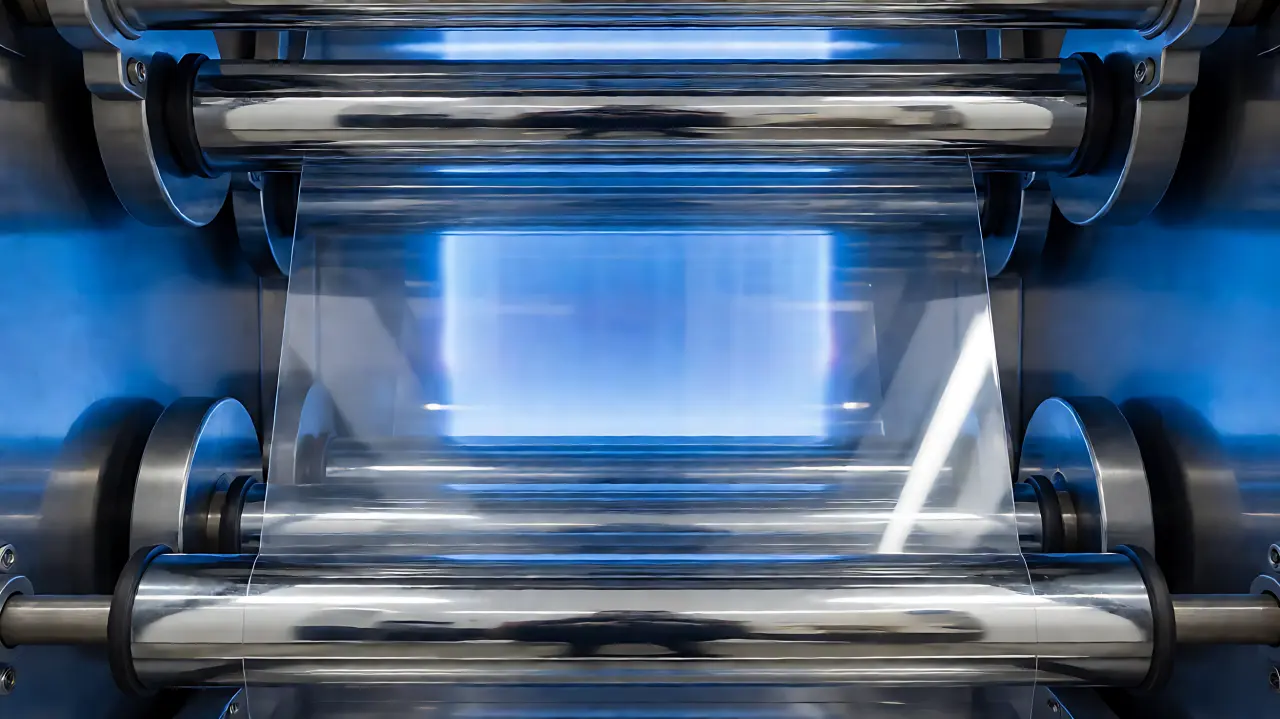
EB-PVD vs Sputtering: Thin-Film Barrier Metallization Guide
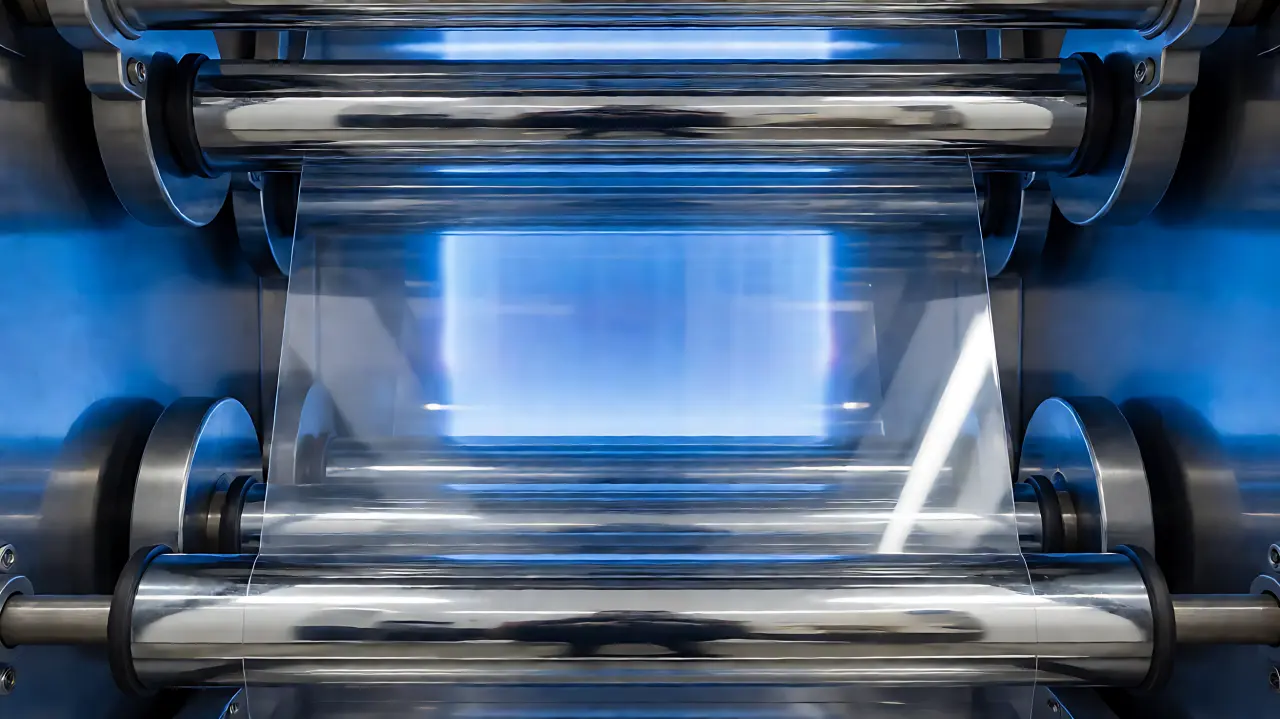
In high-barrier flexible packaging—such as coffee valve bags, military rations, medical diagnostics, and vacuum insulation panels—thin-film vacuum metallization bridges the gap between bulky aluminum foils ($7 - 9,\mu\text{m}$) and clear polymeric films. By depositing an ultra-thin nanometer-scale metal layer (typically pure aluminum, $30 - 50\text{ nm}$), converters suppress oxygen transmission rates (OTR) and water vapor transmission rates (WVTR) by up to three orders of magnitude.
Achieving extreme barrier performance without pinholing or flex-cracking depends on the vacuum deposition physics: Thermal / Electron-Beam Physical Vapor Deposition (EB-PVD) versus DC / RF Magnetron Sputtering.
Physical Vapor Deposition: Thermodynamic Mechanisms
Thermal / EB-PVD Evaporation                 Magnetron Sputtering (Ion Plasma)
┌───────────────────────────────────────┐   ┌───────────────────────────────────────┐
│ Moving Film Web (10-15 m/s)           │   │ Moving Film Web (0.5-2.0 m/s)         │
├───────────────────────────────────────┤   ├───────────────────────────────────────┤
│ High Vacuum (< 10⁻⁴ mbar)             │   │ Argon Plasma Discharge (~ 10⁻³ mbar)  │
├───────────────────────────────────────┤   ├───────────────────────────────────────┤
│ Thermal Aluminum Vapor Flux (0.2 eV)  │   │ Ejected Energetic Metal Atoms (2-10 eV│
├───────────────────────────────────────┤   ├──────────────────────────────────────┤
│ Resistance Boat / Electron Beam Melt  │   │ Water-Cooled Target Cathode (Magnet)  │
└───────────────────────────────────────┘   └───────────────────────────────────────┘
                 ▼                                              ▼
   Fast deposition rate, economic;             High adatom kinetic energy; dense,
   Higher micro-pinhole incidence.             defect-free atomic lattice bonding!
1. Thermal & Electron-Beam Physical Vapor Deposition (EB-PVD)
- Deposition Physics: Solid aluminum wire is continuously fed into heated intermetallic ceramic evaporation boats ($1,400^\circ\text{C} - 1,500^\circ\text{C}$) or targeted by high-energy electron beams under high vacuum ($< 10^{-4}\text{ mbar}$). The molten metal evaporates, creating an upward vapor plume that condenses onto the chilled polymer web passing overhead.
- Adatom Energy: The evaporated aluminum atoms possess low kinetic energy ($\approx 0.1 - 0.3\text{ eV}$). Consequently, condensation is governed purely by thermal sticking coefficients, forming columnar grain structures with natural interstitial boundaries.
- Roll-to-Roll Throughput: Exceptional line speeds ($600\text{ to }1,000\text{ meters per minute}$), making thermal PVD the primary commercial process for standard metallized PET (VMPET) and metallized BOPP (VMBOPP).
2. Magnetron Sputtering
- Deposition Physics: Operates by introducing an inert process gas (typically Argon) at a controlled vacuum ($10^{-2}\text{ to }10^{-3}\text{ mbar}$). High voltage creates a low-temperature plasma glow discharge. Accelerated $Ar^+$ ions physically bombard a solid metal target (cathode), dislodging surface metal atoms via momentum transfer.
- Adatom Kinetic Energy: Sputtered atoms arrive at the substrate with substantial kinetic energy ($2 - 10\text{ eV}$), roughly 10 to 50 times higher than evaporated atoms.
- Atomic Peening & Density: The energetic impact drives surface atom mobility (atomic peening), filling vacancies and eliminating shadow-effect voids. The resulting film is ultra-dense, amorphous or fine-grained, with virtually zero macro-pinholes.
Performance & Adhesion Metrics
| Engineering Parameter | EB-PVD / Thermal Evaporation | Magnetron Sputtering | Testing Standard |
|---|---|---|---|
| Typical Coating Thickness | $30 - 50\text{ nm}$ ($\approx 300 - 500\text{ \AA}$) | $15 - 35\text{ nm}$ ($\approx 150 - 350\text{ \AA}$) | Ellipsometry / AFM |
| Optical Density (OD) | $2.2 - 2.8$ | $2.5 - 3.2$ | Tobias Densitometer |
| Deposition Web Speed | $600 - 1,000\text{ m/min}$ | $30 - 150\text{ m/min}$ | Line Tachometer |
| Metal-to-Film Bond Strength | $1.5 - 3.0\text{ N}/15\text{mm}$ | $> 4.5 - 6.5\text{ N}/15\text{mm}$ (Cohesive) | ASTM D3359 / Tape Test |
| Micro-Pinhole Density | $50 - 250\text{ pinholes/m}^2$ | $< 5\text{ pinholes/m}^2$ | Optical Light Table |
| Barrier OTR (on 12µm PET) | $0.8 - 1.5\text{ cc}/(\text{m}^2 \cdot 24\text{h})$ | $0.05 - 0.2\text{ cc}/(\text{m}^2 \cdot 24\text{h})$ | ASTM D3985 ($23^\circ\text{C}, 0%,\text{RH}$) |
| Barrier WVTR (on 12µm PET) | $0.5 - 1.2\text{ g}/(\text{m}^2 \cdot 24\text{h})$ | $0.05 - 0.15\text{ g}/(\text{m}^2 \cdot 24\text{h})$ | ASTM F1249 ($37.8^\circ\text{C}, 90%,\text{RH}$) |
In-Chamber Plasma Pre-Treatment & Adhesion Dynamics
Adhesion of the metallized layer to BOPP or BOPET substrates is a major quality bottleneck. Untreated films suffer from aluminum layer flaking during downstream adhesive lamination or Gelbo flex handling.
Prior to metallization, roll-to-roll coaters introduce an in-situ Plasma Pre-Treatment (Corona / Glow Discharge) zone:
$$\text{Bond Energy} \propto \text{Polar Surface Oxygen Concentration } [O_{\text{surface}}]$$
Exposing the polymer surface to an energetic $O_2 / Ar$ or $N_2$ plasma cleans low-molecular-weight oligomers, introduces active polar functional groups (carboxyl, carbonyl, and hydroxyl), and elevates substrate surface dyne levels from $< 38\text{ dynes/cm}$ to $> 54\text{ dynes/cm}$. In sputtering systems, energetic adatoms form direct covalent $Al-O-C$ bonds with the polymer backbone, preventing moisture-induced metal lift-off.
Selection Guidelines for High-Barrier Packaging
- Specify EB-PVD / Thermal Evaporation: For mainstream retail food packaging—including potato chips, chocolate wrappers, and standard coffee pouches—where high-speed manufacturing keeps costs competitive.
- Specify Sputtered Metallization: For ultra-sensitive military equipment, electronic moisture barrier bags (MBB), pharmaceutical blister backings, and vacuum insulation panels (VIP) requiring near-zero pinhole density and ultra-low permeation over decades.
Explore our VMPET vs aluminum foil barrier comparison and premium flat bottom box pouches. Contact CraftPack Global to engineer precision-metallized rollstock tailored to your barrier targets.