
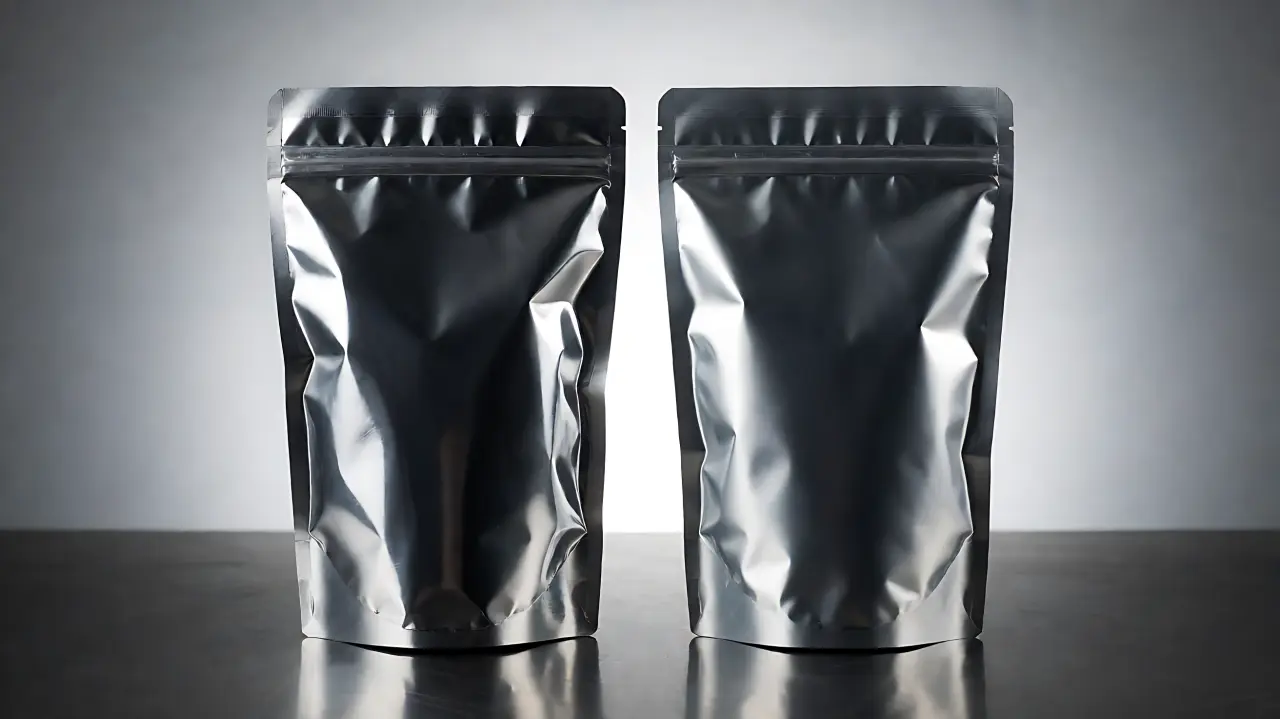
VMPET vs. Aluminum Foil: Barrier Science & Flexible Packaging Guide
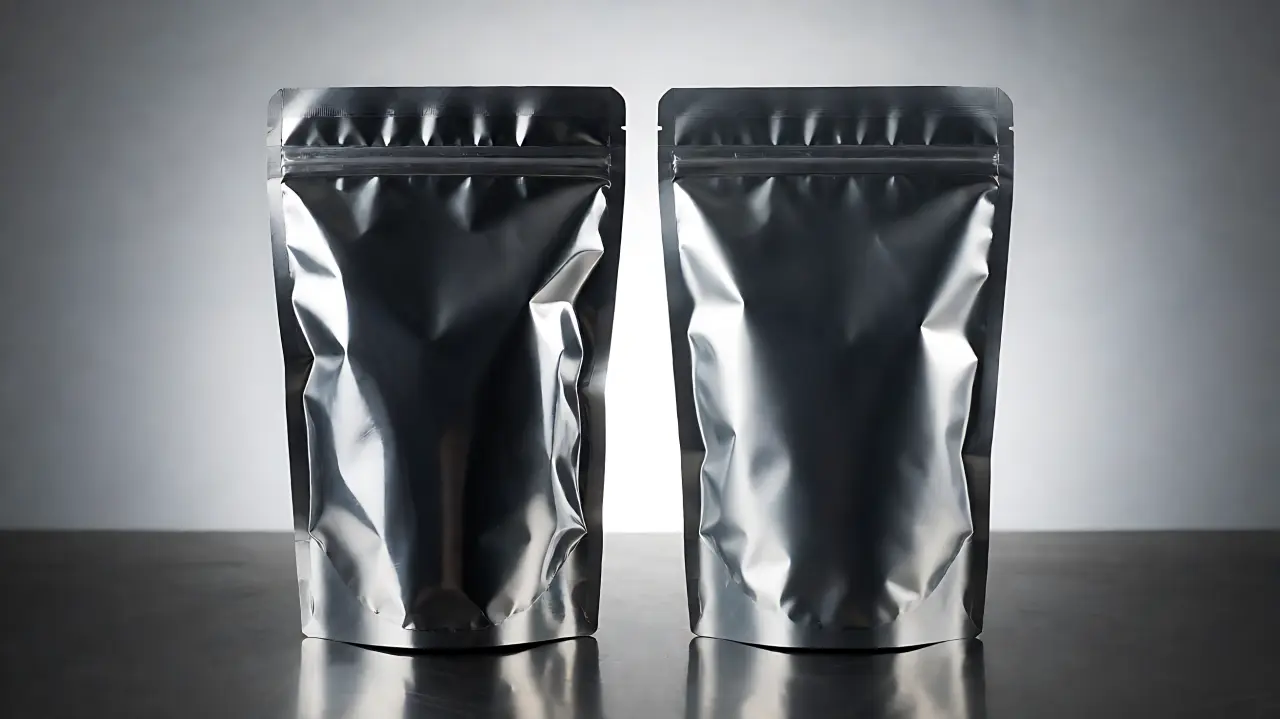
In high-barrier flexible packaging engineering, choosing between Vacuum Metallized Polyester (VMPET / MET-PET) and Solid Aluminum Foil (AluFoil / 0.007mm Al) represents one of the most critical procurement trade-offs in material science. Both substrate technologies are deployed across specialty coffee, dehydrated nutritionals, chemical reagents, and shelf-stable snacks to arrest oxygen permeation, moisture ingress, and ultraviolet photodegradation.
However, treating metallized films and aluminum foils as interchangeable compromises either barrier integrity or cost efficiency. While aluminum foil provides a near-absolute physical hermetic barrier, its vulnerability to flex-cracking during logistics and high material cost can undermine margins. Conversely, VMPET provides exceptional flex-fatigue endurance and substantial lightweighting at a fraction of the cost, but retains non-zero gas transmission rates under tropical relative humidity.
This technical guide delivers an engineering evaluation of VMPET vs. Aluminum Foil, comparing molecular deposition physics, ASTM barrier benchmarks, Gelbo flex-crack resistance, metal detection protocols, and lifecycle packaging economics.
1. Technical Matrix: VMPET vs. Solid Aluminum Foil
| Performance Parameter | Metallized Polyester (12µm VMPET) | Solid Aluminum Foil (7µm AL Foil) | Solid Aluminum Foil (9µm AL Foil) | High-Barrier EVOH Co-Ex (Legacy Plastic) |
|---|---|---|---|---|
| Barrier Technology | Physical Vapor Deposition (PVD ~40–60 nm Al) | Continuous Rolled Metal Sheet (7 µm pure Al) | Continuous Rolled Metal Sheet (9 µm pure Al) | Polymeric Symmetrical Core Co-extrusion |
| Optical Density (OD) | 2.2 to 2.8 OD | Total Opacity (>4.0 OD / 100% Light Block) | Total Opacity (>4.0 OD / 100% Light Block) | Transparent (< 0.1 OD) |
| WVTR (ASTM F1249, 38°C, 90% RH) | 0.5 to 1.2 g/m²/24h | < 0.01 g/m²/24h (Essentially Zero) | < 0.005 g/m²/24h (Zero) | 1.5 to 3.5 g/m²/24h (RH sensitive) |
| OTR (ASTM D3985, 23°C, 0% RH) | 0.8 to 1.5 cc/m²/24h | < 0.01 cc/m²/24h (Hermetic) | < 0.005 cc/m²/24h (Hermetic) | 0.3 to 0.8 cc/m²/24h (Dry state) |
| Gelbo Flex Resistance (ASTM F392, 270 cycles) | Minimal barrier loss (< 10% degradation) | Severe micro-pinholing (OTR increases 50×–200×) | Moderate pinholing (OTR increases 20×–50×) | Excellent flex endurance |
| Dead-Fold Retention | Elastic (Snaps back flat) | Permanent Dead-Fold (Molds to geometry) | Rigid Permanent Dead-Fold | Elastic (Springs back) |
| Metal Detector Line Compatibility | Compatible with high-frequency detectors | Incompatible (Requires post-pack X-ray) | Incompatible (Requires X-ray inspection) | Fully compatible |
| Cost per 1,000 sq. inches (MSI) | Baseline ($0.035 – $0.050 / MSI) | 1.8× to 2.4× VMPET Baseline | 2.2× to 3.0× VMPET Baseline | 1.4× to 1.9× VMPET Baseline |
To explore our complete lineup of custom multi-layer barrier bags, visit our Stand-up Pouches Category and Side Gusset Bags Category.
2. Microstructure & Deposition Physics: 40nm Nano-Layer vs. 7µm Solid Sheet
Understanding performance discrepancies requires analyzing cross-sectional material architectures:
Cross-Sectional Architecture Comparison:
12µm VMPET (Physical Vapor Deposition):      7µm Aluminum Foil Laminate:
┌──────────────────────────────────────┐     ┌──────────────────────────────────────┐
│  PET Base Film (12.0 µm)             │     │  PET or BOPA Print Web (12–15 µm)    │
├──────────────────────────────────────┤     ├──────────────────────────────────────┤
│  PVD Nano-Aluminum (~0.04–0.06 µm)   │     │  Polyurethane Adhesive Tie-Layer     │
├──────────────────────────────────────┤     ├──────────────────────────────────────┤
│  Polyurethane Adhesive Tie-Layer     │     │  Solid Rolled Aluminum Foil (7.0 µm) │
├──────────────────────────────────────┤     ├──────────────────────────────────────┤
│  Sealant PE or CPP Layer (60–100 µm) │     │  Sealant PE or CPP Layer (60–100 µm) │
└──────────────────────────────────────┘     └──────────────────────────────────────┘
Total Metal Thickness: ~0.00005 mm Total Metal Thickness: 0.00700 mm (140× thicker)-
VMPET Physical Vapor Deposition (PVD):
- High-grade oriented polyethylene terephthalate (OPET) film passes through a high-vacuum chamber ($10^{-4}$ mbar) at speeds up to 800 m/min.
- Pure aluminum wire is fed onto ceramic evaporation boats heated to 1,450°C, vaporizing into an atomic cloud that condenses onto the chilled PET web.
- The resulting aluminum crystal matrix forms a nanoscopic layer measuring only 40 to 60 nanometers (0.04–0.06 µm), corresponding to an Optical Density of 2.2–2.8. While microscopic voids and grain boundaries exist at the nanoscale, the metallic lattice forces gas molecules to travel through an elongated tortuous path, reducing gas diffusion by 98% relative to unmetallized PET.
-
Solid Aluminum Foil Rolling:
- Manufactured by continuous ingot casting followed by successive cold-rolling passes through lubricated steel finishing mills down to 6.35 µm to 9.0 µm thickness.
- Because it is a continuous polycrystalline metallic foil without polymeric interstitial gaps, pure aluminum foil has no molecular porosity. Gas transmission occurs solely if mechanical micro-pinholes are generated during cold rolling or downstream pouch conversion.
3. Flex-Crack Fatigue: The Gelbo ASTM F392 Vulnerability
While aluminum foil offers theoretically zero gas transmission in an uncreased laboratory state, commercial shipping subjecting pouches to vibrational road transit, pallet compressive creep, and handling reveals aluminum foil’s primary engineering weakness: flex-crack micro-pinholing.
Under ASTM F392 (Gelbo Flex Endurance Testing), pouches undergo repetitive 440° axial twisting combined with horizontal crushing:
Gas Permeation Degradation Under ASTM F392 Flex Cycles:
Oxygen Transmission Rate (cc/m²/day)
30.0 ┼                                              ╭── 7µm AluFoil (Severe Pinholing)
25.0 ┼                                             ╭╯
20.0 ┼                                            ╭╯
15.0 ┼                                           ╭╯
10.0 ┼                                          ╭╯
 5.0 ┼                                       ╭──╯
 1.0 ┼───────────────────────────────────────┴──────── VMPET (Flexible Nano-Lattice)
 0.0 ┴───────┬───────┬───────┬───────┬───────┬───────
0 50 100 150 200 250 300 Flex Cycles- Aluminum Foil Ductility Fatigue: Solid rolled aluminum foil work-hardens and shears under multi-axial flex stress. By 250 Gelbo flex cycles, a 7µm foil laminate typically develops between 15 and 45 micro-pinholes per $100\text{ cm}^2$, causing its Oxygen Transmission Rate to spike from $0.005\text{ cc}$ to over $20.0\text{ cc/m}^2/\text{day}$.
- VMPET Elastic Synergy: The oriented PET carrier film absorbs flex deformation elastically. Even after 270 full Gelbo cycles, the nano-deposited aluminum layer maintains adhesion with only localized micro-fractures, maintaining OTR below $1.8\text{ cc/m}^2/\text{day}$.
- Engineering Countermeasure for Foil: When absolute barrier properties are required in rigorous distribution chains, packaging engineers laminate a 15µm BOPA (Biaxially Oriented Polyamide / Nylon) buffer layer between the print web and the aluminum foil (
PET / BOPA / AL / PE), dissipating kinetic shear stresses and preserving foil integrity.
4. End-of-Line Quality Assurance: Metal Detection vs. X-Ray Inspection
A pivotal production-line factor that dictates substrate selection is inline food safety contamination detection:
-
VMPET Compatibility with Metal Detectors:
- Because the metallized coating is merely 50 nm thick, its electrical conductivity is insufficient to trigger balanced-coil electromagnetic metal detectors operating at standard food factory sensitivity settings (e.g., detecting 1.0 mm Ferrous, 1.2 mm Non-Ferrous, and 1.5 mm Stainless Steel spherical contaminants).
- Brands can fill, seal, and verify retail pouches through conventional inline metal detectors without false-positive rejections.
-
Aluminum Foil Requires X-Ray Inspection:
- The solid 7–9µm aluminum sheet creates massive electromagnetic shielding, blinding standard metal detectors.
- Manufacturers packaging within foil pouches must either run pre-fill metal detection of bulk ingredients or invest in capital-intensive downstream X-ray inspection systems, which inspect based on mass density differential rather than electromagnetic conductance.
5. B2B Selection Blueprint: Application Decision Matrix
                      Do you package products highly sensitive to
                         photodegradation or oxygen (OTR < 0.01)?
                                     │
                     ┌───────────────┴───────────────┐
                    YES                              NO
                     │                               │
       Does shelf life require >18 months     Is shelf life 6–12 months
       in extreme tropical environments?      with high logistics flexing?
                     │                               │
        ┌────────────┴────────────┐             ┌────┴──────────────────────────┐
       YES                        NO            │ Deploy 12µm VMPET Laminates:  │
        │                          │            │ - Specialty coffee beans      │
  Deploy 7–9µm Aluminum Foil:      │            │ - Potato chips & snacks       │
  - Infant nutrition milk powders  │            │ - Powdered energy mixes       │
  - Liquid aseptic fruit purees    │            │ - High-turnover pet treats    │
  - Aggressive solvent chemicals   │            └───────────────────────────────┘
  - Active pharmaceutical powders  │
  - Military ration packs (MREs)   └──────────> Consider High-Barrier Metallized
                                                BOPP or AlOx / SiOx Ceramic Film
Key Engineering Recommendations:
- Specify Optical Density on VMPET: When sourcing metallized films, do not specify merely “metallized PET.” Always specify an Optical Density range of 2.4 to 2.8 OD to guarantee tight metallic grain packing and consistent ASTM F1249 moisture barrier.
- Account for Nitrogen Flushing Cavity Shock: For nitrogen-flushed whole-bean coffee, foil pouches can develop stress fractures at sharp side-gusset fold vertices during sea container shipping. If using foil, incorporate a 15µm BOPA shock-absorbing film.
- Weight & Freight Optimization: VMPET structures weigh roughly 15% to 22% less than equivalent 4-ply foil structures (
PET/AL/PA/PE), lowering freight emissions and reducing European Extended Producer Responsibility (EPR) packaging waste fees under PPWR.
To discuss substrate testing and barrier specification for your brand’s pouch portfolio, contact our engineering team through our Stand-up Pouches Packaging Division.