
Custom Packaging Inserts Guide: EVA Foam vs Molded Pulp
In premium packaging design, what holds the product inside the box is just as crucial as the graphics printed on the exterior. An exquisite rigid gift box or high-grade shipping carton means very little if the internal items rattle, scratch against each other, or arrive misaligned after long-haul transit.
Custom interior packaging inserts—often called box fitments, trays, or cradles—perform two indispensable functions:
- Mechanical Protection: They absorb transit g-forces, isolate fragile glass or precision electronic components, and prevent internal collision during carrier sorting drops.
- Curated Unboxing Geometry: They present every component of a product set in an intentional, aesthetically balanced orientation the moment the lid is lifted.
However, selecting the right insert material requires balancing brand positioning, environmental sustainability, tooling costs, and unit economics.
This guide provides a comprehensive comparison between the four dominant packaging insert technologies: EVA foam, molded sugarcane/paper pulp, EPE foam, and thermoformed blister trays.
1. High-Density EVA Foam (Ethylene-Vinyl Acetate)
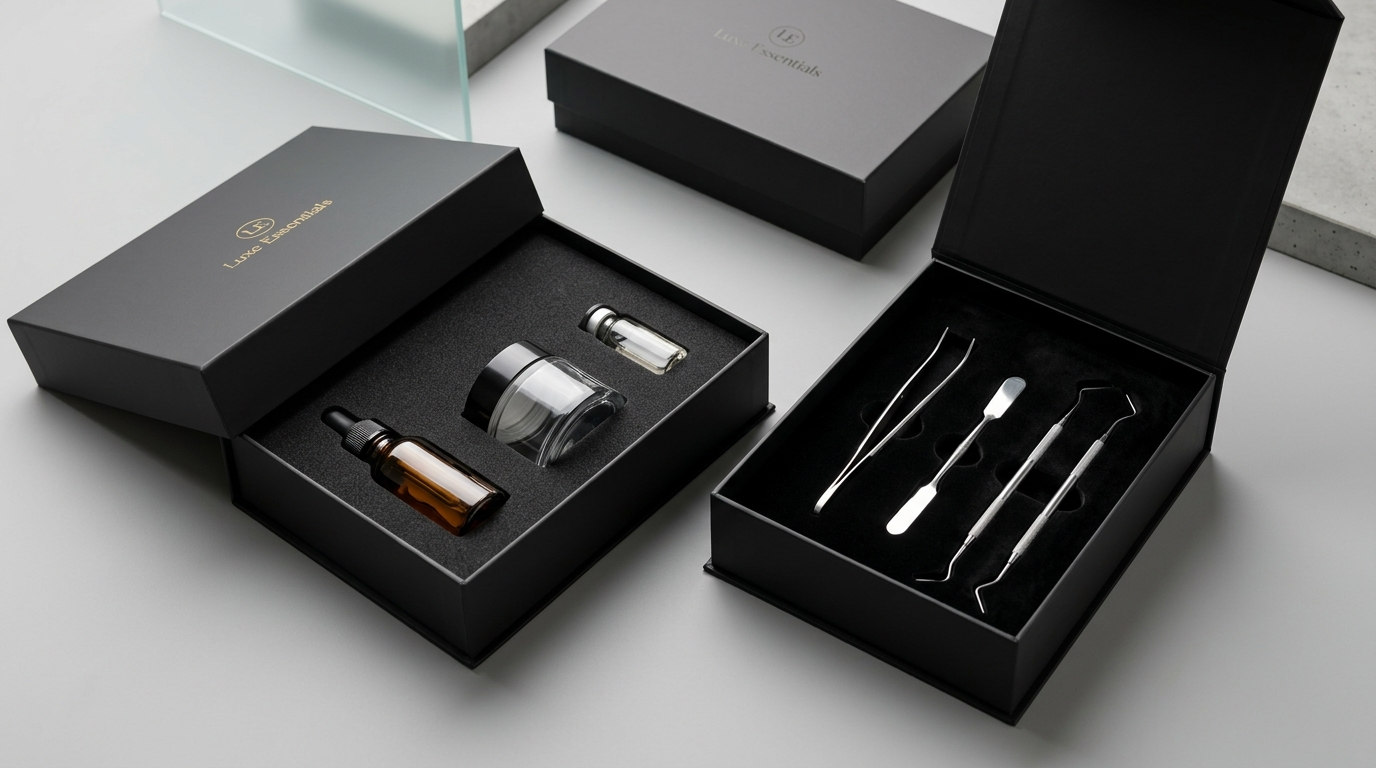
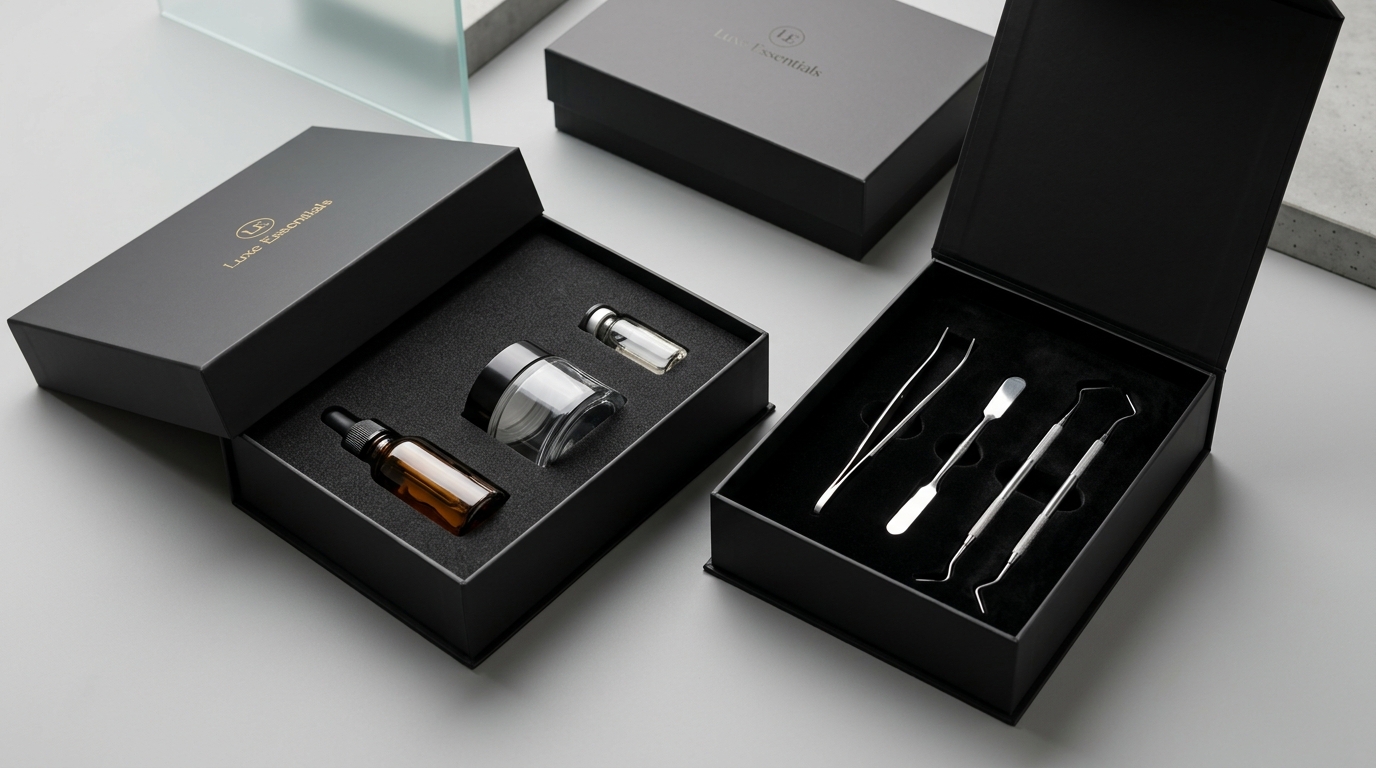
EVA foam is the premier standard for luxury retail unboxing, fine cosmetics, jewelry, and high-end consumer electronics.
Material Characteristics & Manufacturing
- Physical Feel: Dense, micro-cellular closed-cell foam with a smooth, velvety, rubber-like elasticity. Unlike cheap open-cell packing sponges, EVA does not crumble, flake, or shed particulate dust.
- Precision Fabrication: Produced via CNC flash cutting, high-speed waterjet cutting, or precision steel-rule die punching. Cavities match the exact 3D CAD dimensions of the product with tolerances down to $\pm 0.5\text{ mm}$.
- Aesthetic Laminations: EVA foam is frequently topped with a laminated layer of black velvet (flocking), fine PU leather, or printed card stock to conceal the foam texture and convey bespoke luxury.
Best Used For:
- Glass cosmetic dropper bottles, perfumes, and luxury skincare sets.
- High-value electronics, precision optical lenses, and medical instruments.
- Pair with custom printed gift bags and rigid setup boxes for VIP retail kits.
2. Molded Pulp Trays (Sugarcane Bagasse & Recycled Paper)
As global regulations crack down on petroleum plastics and brands strive for zero-waste targets, molded fiber and sugarcane pulp have emerged as the fastest-growing sustainable insert category.
Material Characteristics & Manufacturing
- Raw Materials: Sourced from rapid-renewal agricultural waste (sugarcane bagasse, bamboo fibers) or 100% recycled paper slurry.
- Thermoformed Wet-Press Technology: Modern high-precision wet-press tooling creates ultra-smooth surfaces on both sides with crisp contour draft angles (unlike coarse egg-carton dry-press pulp).
- End-of-Life: 100% Curbside Recyclable and backyard compostable (biodegrading naturally within 90 days).
Best Used For:
- Eco-conscious electronics brands replacing plastic trays.
- Clean beauty skincare jars, solid shampoo bars, and organic wellness supplements.
- Complements sustainable shipping programs featured in our EU PPWR compliance guide.
3. EPE Foam (Expanded Polyethylene)
EPE (pearl cotton) is a semi-rigid, lightweight closed-cell foam engineered primarily for shock absorption and heavy item cushioning.
Material Characteristics & Manufacturing
- Physical Feel: White or charcoal resilient foam with distinct tiny expanded beads. Extremely lightweight with exceptional multi-impact rebound memory.
- Protection Dynamics: Absorbs repetitive drops and vibrational energy better than rigid plastics, making it the preferred shock-dampening buffer for heavy freight.
- Cost Efficiency: Tooling and raw material costs are significantly lower than dense EVA foam.
Best Used For:
- Industrial master carton cushioning for items weighing 5 kg to 30 kg+.
- Corner protector blocks for furniture, lighting fixtures, and fragile machinery.
- Pair with heavy-duty outer cartons discussed in our 3-ply vs 5-ply corrugated box guide.
4. Thermoformed Blister Trays (PET / PP / Flocked PS)
Thermoformed plastic trays are manufactured by heating a thin sheet of plastic and vacuum-forming it over an aluminum mold.
Material Characteristics & Manufacturing
- Physical Feel: Thin, rigid, contoured plastic shells (0.3 mm to 0.8 mm thickness).
- Functional Advantages: Can be engineered with integrated undercut friction tabs (snap-fits) that firmly grip products so they cannot dislodge even if the box is turned upside down.
- Finishes: Available in crystal-clear transparent PET, medical-grade white PP, or velvet-flocked polystyrene (PS).
Best Used For:
- Retail blister packs, pharmaceutical ampoules, and multi-component toy kits.
- High-speed automated assembly lines where pick-and-place robots snap products into trays in seconds.
Comprehensive Insert Comparison Matrix
| Evaluation Parameter | High-Density EVA Foam | Molded Sugarcane Pulp | Resilient EPE Foam | Thermoformed Blister (PET/PS) |
|---|---|---|---|---|
| Visual / Tactile Luxury | Ultra-Luxury (5/5) | Modern Sustainable (4/5) | Industrial / Utility (2/5) | Commercial / Technical (3/5) |
| Environmental Recyclability | Difficult to recycle curbside | 100% Biodegradable & Recyclable | Recyclable in LDPE stream | Recyclable in PET stream |
| Tooling & Mold Investment | Very Low ($50–$150 die steel) | High ($1,200–$2,500 CNC mold) | Very Low ($80–$200 die) | Moderate ($400–$900 aluminum mold) |
| Optimal Order Volume | 500 to 5,000 pcs (High agility) | 5,000 to 50,000+ pcs | 1,000 to 20,000 pcs | 3,000 to 50,000 pcs |
| Shock Absorption Capacity | Excellent for compact dense items | Moderate (rigid structural cradle) | Superior for heavy shock/vibration | Moderate (relies on air spacing) |
| Frictional Anti-Scratch | Non-abrasive (especially velvet-lined) | Smooth; non-scratch | Very soft | Can cause surface scuffing on gloss |
Prototyping Rules: Getting Custom Inserts Right the First Time
- Always Supply Physical Product Samples or 3D STEP Files: Never design insert cavities using estimated catalog dimensions. Physical prototypes or high-precision 3D files ensure exact clearance tolerances (typically adding $+0.5\text{ mm}$ for easy insertion and extraction).
- Design Ergonomic Finger Pull Notches: If an insert cavity fits a heavy jar or phone snugly, consumers cannot pry it out with their fingernails. Always incorporate semi-circular finger access cutouts or a satin ribbon lift pull.
- Account for Box Lid Tolerance: Ensure the tallest point of your product sits flush or $1.0\text{ mm}$ below the top surface of the insert tray. If the product protrudes, the outer box lid will press directly against the fragile item during pallet stacking.
Review exterior box structures in our guide to luxury rigid boxes vs folding cartons.
Engineer Precision Packaging with CraftPack Global
The right interior insert transforms an ordinary cardboard box into an unforgettable unboxing experience while safeguarding your products across continents. Whether you need velvet-flocked EVA foam, eco-certified molded pulp trays, or resilient shipping buffers, the CraftPack Global Team provides precision CAD modeling, rapid physical prototyping, and mass production tailored to your exact specifications.