
Water-Based vs Solvent Inks in Film Printing: B2B Guide
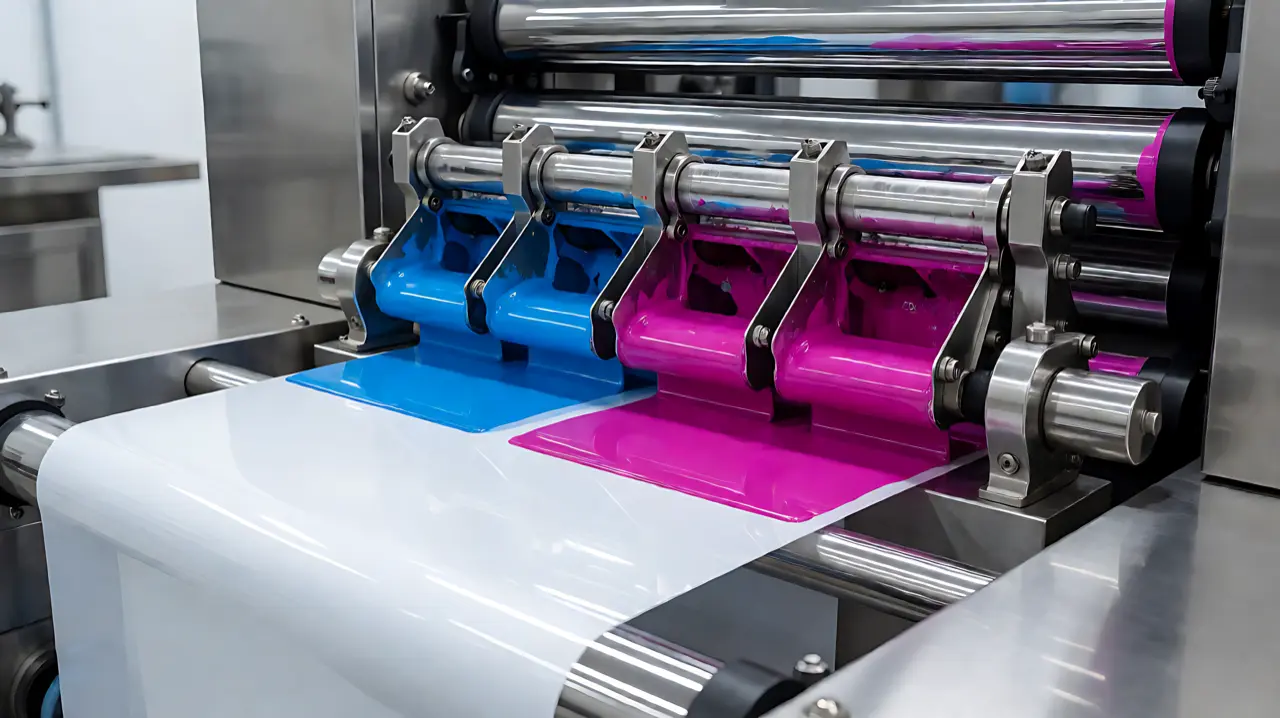
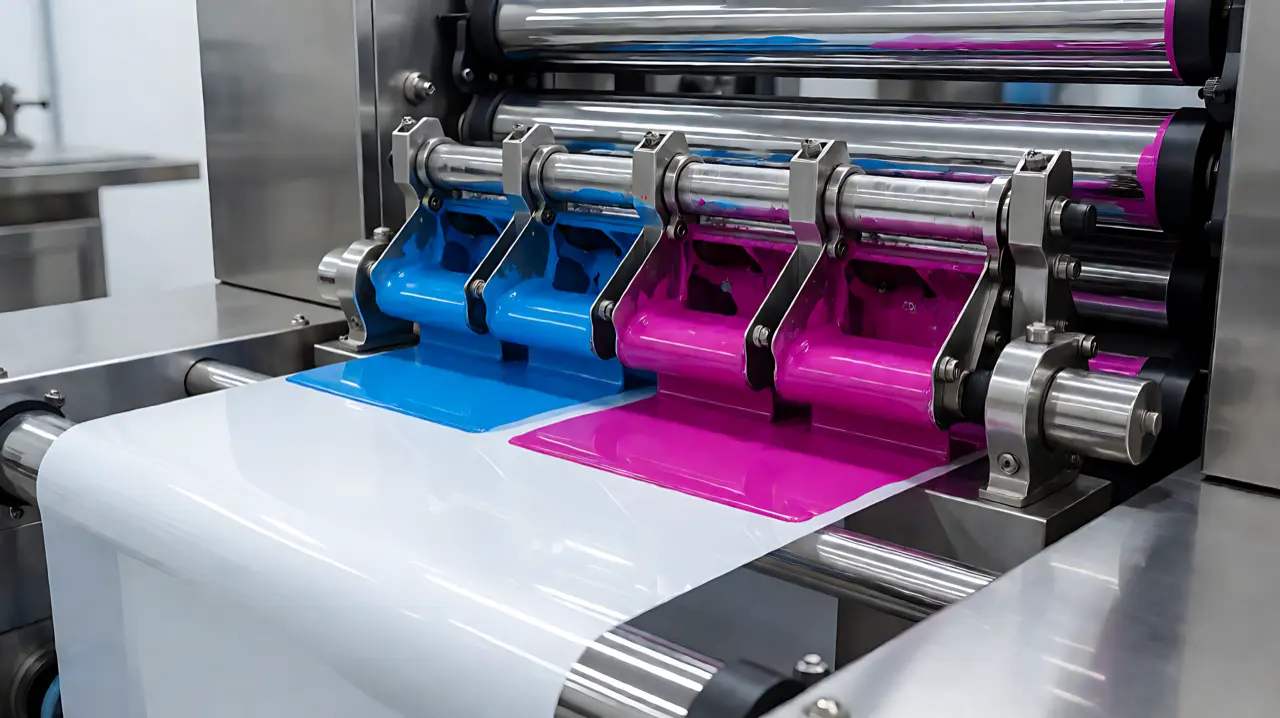
In the global flexible packaging printing industry—dominated by high-speed rotogravure and central impression (CI) flexographic presses—printing inks represent both the visual face of consumer branding and the greatest environmental compliance challenge.
Historically, solvent-based inks (formulated with organic solvents such as ethyl acetate, ethanol, and isopropanol) have dominated non-porous polymer printing. Solvents evaporate almost instantaneously under hot-air blowers, wet low-surface-energy films easily, and deliver exceptional optical density at press speeds exceeding 400 meters per minute.
However, solvent inks come with immense regulatory liabilities: massive Volatile Organic Compound (VOC) emissions, costly regenerative thermal oxidizers (RTOs), fire hazards, and the risk of residual solvent migration causing chemical off-flavors in packaged food.
As sustainability mandates tighten globally under the EU Industrial Emissions Directive (IED) and US Clean Air Act, water-based inks have emerged as the primary eco-friendly alternative for flexible film printing.
This technical guide analyzes the physical chemistry, thermodynamic drying kinetics, corona treatment requirements, and food contact safety profiles of water-based versus solvent-based inks on flexible packaging substrates.
1. Technical Comparison: Water-Based vs. Solvent-Based Ink Chemistry
| Engineering Metric | Water-Based Inks (Aqueous Systems) | Traditional Solvent-Based Inks | Radiation-Curable UV/EB Inks |
|---|---|---|---|
| Primary Carrier Fluid | Water (60%–75%) + Co-solvents (5%–15% alcohol) | Ethyl Acetate, Ethanol, Isopropanol (60%–75%) | 100% Reactive Monomers / Oligomers |
| VOC Emissions | Ultra-Low (< 50 to 150 g/L VOC) | High (600 to 750 g/L VOC) | Zero VOCs |
| Latent Heat of Vaporization | High ($2,260\text{ kJ/kg}$ for water) | Low ($370\text{ kJ/kg}$ for ethyl acetate) | N/A (Polymerizes via photochemical cure) |
| Drying Energy Demand | 3x to 5x higher thermal drying capacity | Baseline (Rapid low-temperature evaporation) | Electrical UV LED or Electron Beam |
| Press Speed on Non-Porous Film | 200 to 350 m/min (Requires extended ovens) | 350 to 500+ m/min | 250 to 400 m/min |
| Required Substrate Surface Energy | $\ge 42\text{ to }46\text{ dynes/cm}$ (Intensive Corona) | $\ge 38\text{ dynes/cm}$ (Standard Corona) | $\ge 40\text{ to }42\text{ dynes/cm}$ |
| Residual Solvent Odor / Taint | Zero organic solvent odor | Risk of ethyl acetate retention | Risk of photoinitiator odor |
| Safety & Workplace Atmosphere | Non-flammable; non-hazardous storage | Highly flammable (Requires ATEX explosion-proofing) | Skin sensitization risks from monomers |
| Food Contact Compliance (Swiss Ord.) | High safety; minimal migration risks | Strictly regulated (ASTM F1884 gas chromatography) | Requires low-migration photoinitiators |
For printed commercial carrier bags and custom-printed retail packaging, explore our Plastic Carrier Bags Category and Stand-Up Pouches.
2. Thermodynamics of Drying Kinetics: The Water Challenge
The greatest engineering hurdle when printing on non-porous films (such as BOPP, BOPET, and BOPA) with water-based inks is the physics of water evaporation:
Carrier Evaporation Energy Demand:
Ethyl Acetate (Solvent):
[████] 370 kJ/kg Latent Heat of Evaporation (Dries rapidly at 50°C)
Water (Aqueous):
[████████████████████████] 2,260 kJ/kg Latent Heat (6x higher energy to evaporate!)
1. The Energy Gap
- Ethyl acetate possesses a latent heat of vaporization of just $370\text{ kJ/kg}$ and a boiling point of 77°C. A standard inter-color drying tunnel operating at 45°C to 55°C flashes off the solvent in milliseconds.
- Water requires $2,260\text{ kJ/kg}$—more than six times the thermal energy—and has a boiling point of 100°C. If excess residual water remains on the film web before the next print station, colors bleed, trapping water inside lamination layers that subsequently causes bubbling and delamination.
2. Press Engineering Countermeasures
To run water-based inks at commercial flexo press speeds (250–350 m/min) without blistering heat-sensitive films like PE or shrink sleeves, press manufacturers engineer high-performance drying systems:
- High-Velocity Impingement Air Nozzles: Increasing boundary-layer air velocity from 30 m/s to 50–60 m/s shears away the stagnant boundary layer of humid air above the ink film.
- Short-Wave Infrared (NIR) Heaters: Near-infrared radiation penetrates directly into the aqueous ink film, selectively heating water molecules without raising the temperature of the underlying polymer film above its glass transition temperature ($T_g$).
3. Surface Tension & Wetting Dynamics: Corona Treatment
Water has a remarkably high surface tension of $72.8\text{ dynes/cm}$ (mN/m) at 20°C due to intermolecular hydrogen bonding. In contrast, non-polar untreated polypropylene (BOPP) has a surface energy of only $29\text{ dynes/cm}$, while untreated polyethylene (PE) is approximately $31\text{ dynes/cm}$:
Wetting Contact Angle Physics:
Low Surface Energy Film (<38 dynes):     High-Corona Film (>42 dynes) + Surfactants:
     Droplet Beads Up (No Wetting)           Droplet Flattens (Uniform Solid Film)
            ╭─────────╮                             ╭───────────────╮
           │  Bead     │                           ──┴───────────────┴──
──────────┴───────────┴──────────        ─────────────────────────────────────
Poor Adhesion / Pinhole Voids Crisp Dot Reproduction / Strong Bond- The Young-Dupré Wetting Rule: For an ink to spread uniformly and create a coherent film, the surface energy of the substrate must exceed the surface tension of the liquid ink by at least 8 to 10 dynes/cm.
- Surfactants & Co-Solvents: Ink formulators add specialty silicone or acetylenic diol surfactants to lower the surface tension of aqueous inks down to 28–32 dynes/cm.
- In-Line Corona Treatment: Flexible film lines running water-based inks must integrate dual-side high-frequency electronic corona treaters, ionizing ambient air into ozone and grafting polar carboxyl (-COOH) and hydroxyl (-OH) groups onto the plastic surface. Surface energy must be maintained consistently between 42 and 46 dynes/cm to guarantee ink transfer without mottling or pinholing.
4. Food Safety & Residual Solvent Migration (ASTM F1884)
In food, coffee, and pharmaceutical packaging, consumer sensory contamination is a primary liability:
1. Gas Chromatography Testing (ASTM F1884)
When printing with solvent-based inks, trace solvents frequently become trapped beneath outer lamination films or migrate during rollstock rewinding (known as “set-off” migration from the printed side to the unprinted food-contact sealant side).
- Packaging converters must monitor residual solvent retention using head-space gas chromatography (ASTM F1884).
- Food brand standards (such as the Nestlé Guidance Note on Packaging Inks) enforce strict limits: total residual solvent must not exceed $10\text{ mg/m}^2$, with individual solvents like toluene strictly prohibited and ethyl acetate capped below $2\text{ mg/m}^2$.
2. The Aqueous Advantage
Water-based inks eliminate organic solvent taint entirely. Because the carrier fluid is water and food-grade ethanol, there are zero synthetic aromatic hydrocarbons to alter the delicate flavor notes of chocolate, milk powder, or specialty coffee.
5. Regulatory Compliance: VOC Reduction & Carbon Accounting
- EU Industrial Emissions Directive (IED 2010/75/EU): Enforces strict VOC emission caps for printing facilities consuming more than 15 tonnes of solvent annually. Plants converting to water-based inks drastically reduce VOC emissions, eliminating the need for multi-million-dollar Regenerative Thermal Oxidizers (RTOs) that consume massive quantities of natural gas.
- Scope 1 & Scope 2 Decarbonization: Eliminating RTO natural gas incineration slashes a printing plant’s direct Scope 1 carbon footprint, helping multinational consumer packaged goods (CPG) brands hit their 2030 corporate sustainability metrics.
6. Sourcing & Print Specification Checklist
When transitioning flexible packaging graphics from solvent to water-based systems, verify these technical requirements with your converter:
- Anilox Roller Volume: Water-based inks contain higher pigment concentrations; specify high-count ceramic laser-engraved anilox rollers (e.g., 350 to 500 lines/cm with cell volume 2.5 to 3.5 cm³/m²) to avoid ink over-transfer.
- Substrate Corona Verification: Require in-line dyne pen verification ensuring surface tension is maintained at $\ge 42\text{ dynes/cm}$ throughout the production run.
- Rub and Tape Adhesion Testing: Mandate ASTM D3359 cross-hatch tape adhesion testing (Level 4B or 5B) and Sutherland ink rub resistance tests (ASTM D5264) to confirm chemical anchoring.
- Regulatory Declaration: Request a formal Statement of Composition verifying compliance with the Swiss Ordinance (SR 817.023.21) and FDA 21 CFR 175.300 for food packaging printing.
To explore brilliant, high-definition water-based printing on recyclable barrier pouches, consult the CraftPack Global prepress and printing engineering team.