
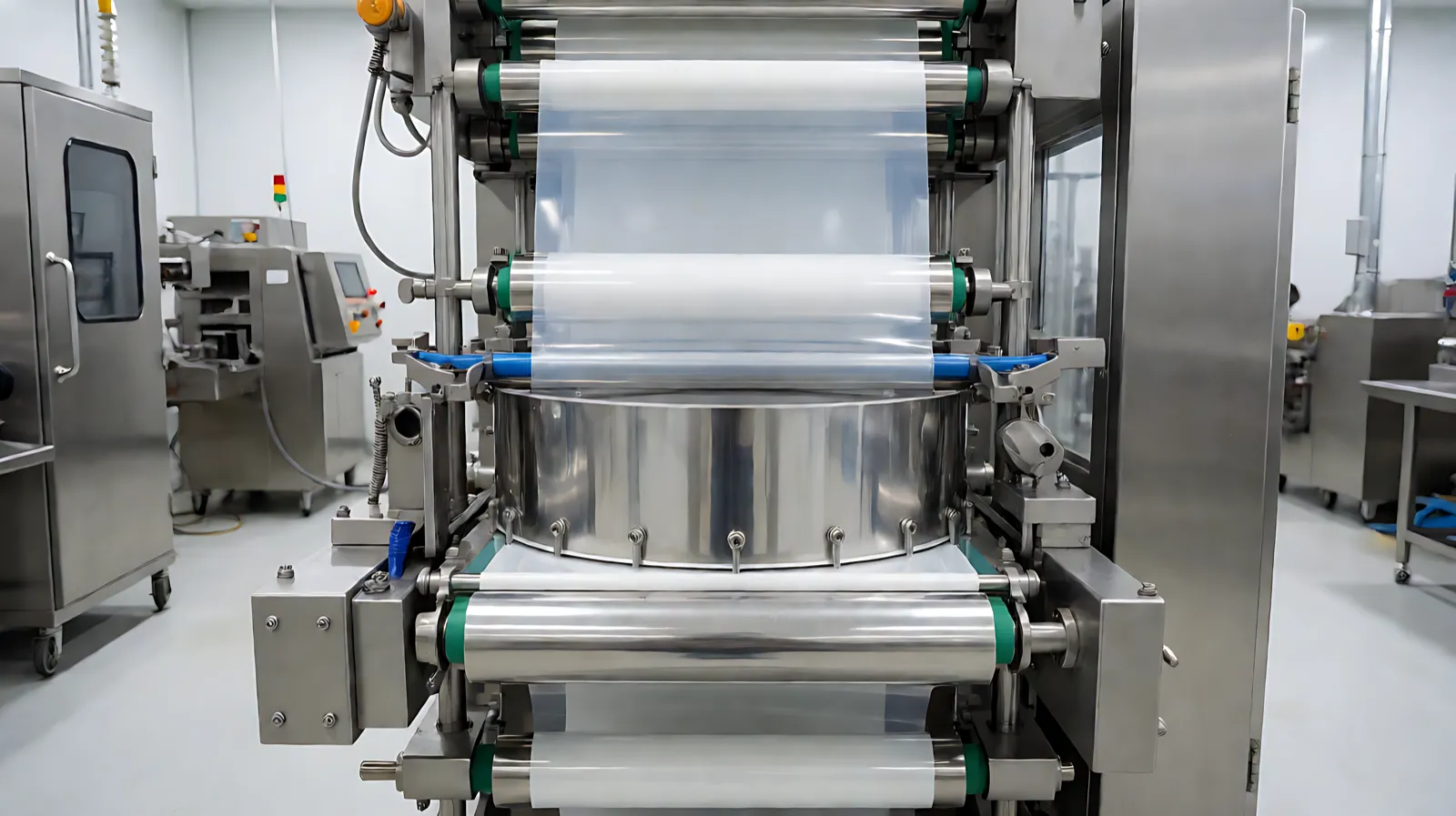
VFFS Rollstock Film Engineering: COF and Hot Tack Guide
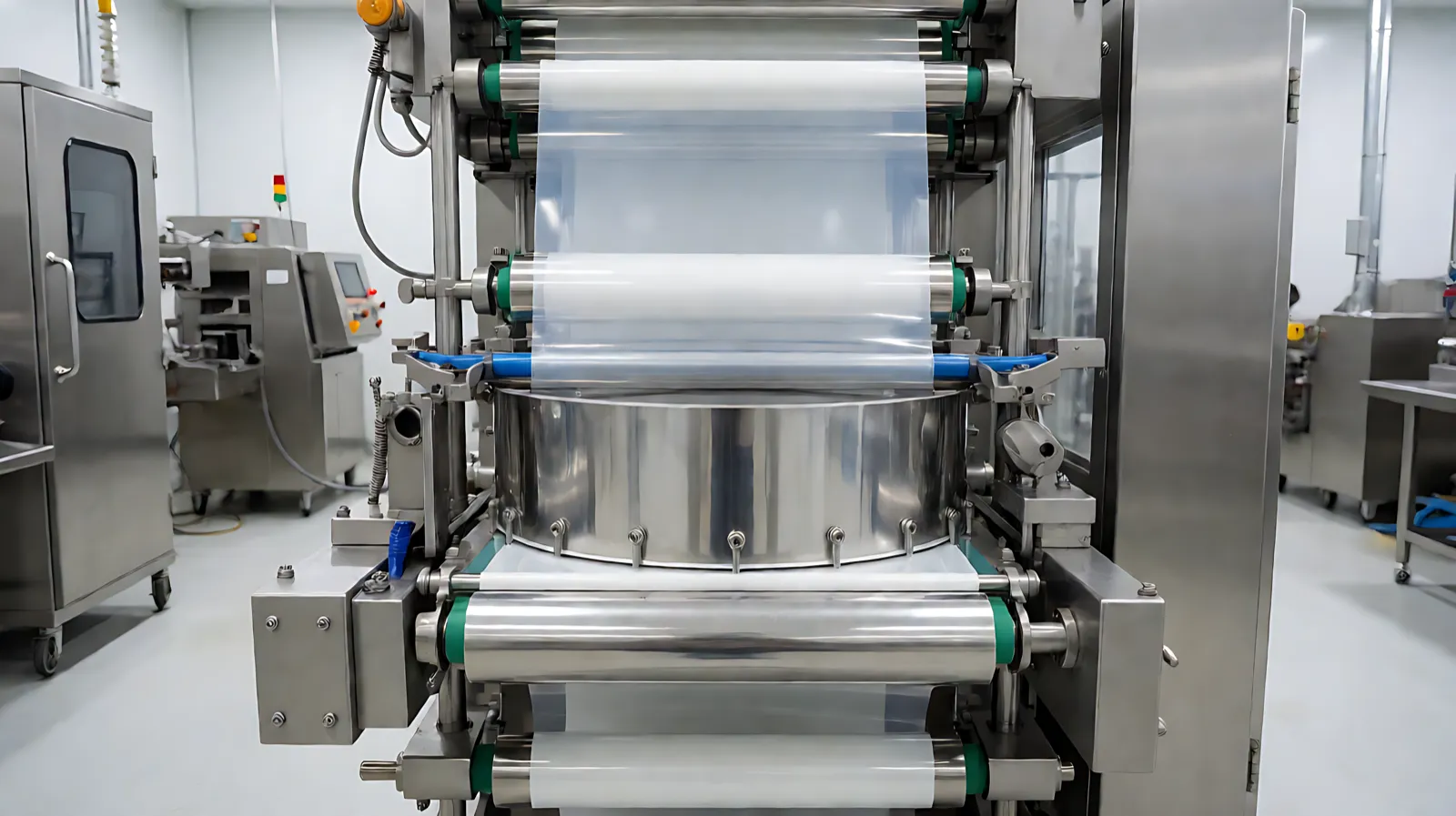
In industrial flexible packaging, automated Vertical Form-Fill-Seal (VFFS) packaging lines represent the backbone of high-speed dry food, snack, powder, and frozen logistics. High-throughput machines (Bosch, Matrix, Ishida, Ilapak) routinely cycle at 80 to 180 pouches per minute.
At these machine speeds, flexible laminated rollstock film is pulled over a stainless steel forming shoulder, wrapped into a tube, vertically fin-sealed, bottom-sealed by cross-jaws, filled with dropping product mass, and top-sealed in fractions of a second.
When rollstock film is poorly formulated, packaging lines suffer catastrophic downtime: film jams on the forming collar, tracking wander, bag stretching, pinhole leakers, or bottom drops where hot seal seams blow open under falling product weight.
Solving these operational failures requires mastering three core polymer physical parameters: Coefficient of Friction (COF), Hot Tack Strength, and Seal-Through-Contamination.
1. Quick Engineering Benchmark Matrix
| Parameter / Metric | Industry Target Specification | Failure Mode: Below Spec | Failure Mode: Above Spec |
|---|---|---|---|
| Kinetic COF (Film-to-Metal, ASTM D1894) | 0.20 to 0.30 | Film slips uncontrollably; feed roll overshoots | Film drags and binds on collar; web stretch/snag |
| Static COF (ASTM D1894) | 0.25 to 0.35 | Instant slip / registration wander | High startup motor jerk; film tear on start |
| Hot Tack Strength (ASTM F1921) | > 3.5 N / 15mm at 250ms dwell | Bottom seam blows open when product drops | Narrow temperature window; jaw sticking |
| Heat Seal Window | 30°C to 45°C operating breadth | Process sensitivity; thermal drift leaks | Burn-through of outer PET/BOPP layer |
| Seal-Through-Contamination | Clean seal through fat/powder film | Pinhole leak paths; MAP gas loss; oxygen ingress | Excessive resin haze / reduced film clarity |
| Slip Additive Package | Erucamide / Oleamide (Migratory) or Silica | High friction; metal galling on forming shoulder | Slip blooming, ink peeling, poor lamination bond |
Explore custom rollstock laminate structures in our Stand-Up Pouches Category and explore closure engineering in our Pouch Zipper Profiles Guide.
2. Dynamic Physics: The VFFS Forming Cycle & Forming Shoulder
The VFFS line imposes intense mechanical shear and thermal stress onto the multi-layer flexible film:
┌────────────────────────────────────────────────────────────────────────┐
│                   VFFS FILM PATHWAY & CRITICAL STRESS POINTS           │
├────────────────────────────────────────────────────────────────────────┤
│                                                                        │
│   [ Rollstock Unwind ] ──► Tension Dancers ──► Eye-Mark Photocell      │
│                                                     │                  │
│                                                     ▼                  │
│                                           ╔═══════════════════╗        │
│                                           ║  Forming Shoulder ║        │
│                                           ║ (Stainless Steel) ║        │
│                                           ╚═══════════════════╝        │
│                                                     │  STRESS POINT 1: │
│                                                     │  COF Friction    │
│                                                     ▼                  │
│                                           ┌───────────────────┐        │
│                                           │ Vertical Fin Seal │        │
│                                           └───────────────────┘        │
│                                                     │                  │
│             [ Product Dump: 500g Grains ] ──────────┼──► STRESS 2:     │
│                                                     │    Hot Tack      │
│                                                     ▼    Impact      │
│                                           ╔═══════════════════╗        │
│                                           ║ Horizontal Jaws   ║        │
│                                           ║ (Bottom/Top Seal) ║        │
│                                           ╚═══════════════════╝        │
│                                                                        │
└────────────────────────────────────────────────────────────────────────┘
1. Coefficient of Friction (COF) Mechanics
As the flat film web rounds the complex curvature of the forming shoulder, the inside sealant layer (typically polyethylene or polypropylene) slides directly against polished stainless steel.
- If COF is too high (>0.35): Friction causes the film to stutter, stretch, or wrinkle. Tension spikes cause the registration eye-mark to wander out of alignment, resulting in off-center cutoffs.
- If COF is too low (<0.15): The film slips excessively through the pull belts, overshooting the feed cycle and causing seal jaws to strike printed artwork.
- Chemical Formulation: To stabilize COF, converters blend migratory slip additives (Erucamide or Oleamide) combined with anti-block silica particles. Slip molecules migrate to the film surface over 24–48 hours, creating a microscopic lubricating monolayer.
3. Hot Tack Strength (ASTM F1921) vs. Ultimate Seal Strength
A critical mistake in flexible film procurement is confusing Ultimate Seal Strength (ASTM F88) with Hot Tack Strength (ASTM F1921).
- Ultimate Seal Strength: Measured after the plastic seal has completely cooled and recrystallized at room temperature (typically 24 hours later).
- Hot Tack Strength: The mechanical tensile strength of the seal while the polymer is still in a semi-molten state (within 100 to 500 milliseconds of jaw opening).
Hot Tack Curves: Standard LDPE vs Metallocene mLLDPE:
──────────────────────────────────────────────────────────────────────────
Temperature (°C)    Standard LDPE Hot Tack    Metallocene mLLDPE Hot Tack
──────────────────────────────────────────────────────────────────────────
110°C               0.8 N / 15mm (No seal)    2.8 N / 15mm (Initiation)
120°C               1.8 N / 15mm              5.2 N / 15mm (Peak Plateau)
130°C               3.1 N / 15mm (Peak)       5.5 N / 15mm
140°C               2.2 N / 15mm (Burn Drop)  5.1 N / 15mm (Broad Plateau)
150°C               1.1 N / 15mm              4.6 N / 15mm
──────────────────────────────────────────────────────────────────────────
In high-speed VFFS packaging, product is dropped into the bag immediately after the bottom seal jaws open. If the hot tack strength is below 3.0 N / 15mm, the kinetic impact of falling product will rupture the molten bottom seam, causing product dumping and packaging line shutdown.
Using Metallocene Linear Low-Density Polyethylene (mLLDPE) or Plastomer resins delivers a broad, flat hot tack plateau exceeding 5.0 N / 15mm across a 40°C temperature operating window.
4. Seal-Through-Contamination Mechanics
In powder packaging (flour, protein powder, milk powder) or oily foods (potato chips, roasted nuts, pet food), fine dust and fat aerosols inevitably coat the inner film surfaces prior to sealing.
Standard low-density polyethylene fails when contaminated: trapped fat globules prevent polymer chain entanglement, forming microscopic capillary leaks that destroy modified atmosphere (MAP) shelf life.
Engineered Sealant Solutions:
- Low-Initiation Plastomers: Resins with low melting points (85°C – 100°C) flow easily around trapped dust particles under jaw pressure, encapsulating solids within the amorphous polymer matrix.
- Ionomer Resins (DuPont Surlyn): The ionic cross-links in ionomer resins melt into a low-viscosity fluid that squeezes grease and oil droplets away from the sealing interface, achieving hermetic seals even through heavy liquid and fat contamination.
5. Converter Rollstock Quality Checklist
Before approving bulk production runs of VFFS barrier rollstock, ensure your converter verifies:
- COF Aging Stability: Test COF at 23°C and after 7 days of warehouse aging to verify slip additive blooming equilibrium.
- Splice Tape Tensile Strength: Ensure roll splices use high-tack polyester splicing tape that passes through the forming collar without snapping under web tension.
- Core Concentricity & Tension Profile: Unwind roll tension must follow a tapered taper-tension profile to prevent telescoping during high-speed unwind.
To engineer custom high-speed VFFS rollstock laminates for snacks, powders, or frozen foods, consult our technical engineers at CraftPack Global Contact.