
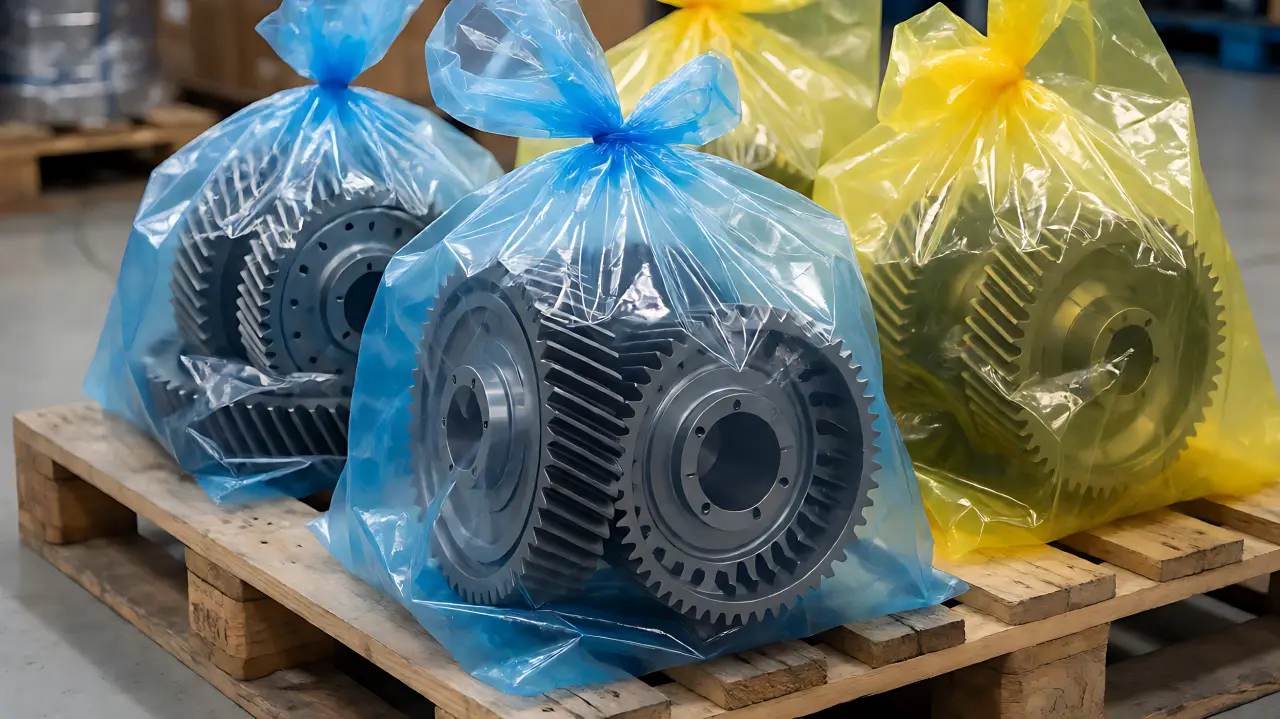
VCI Anti-Corrosion Films vs Rust Oils: Metal Packaging Guide
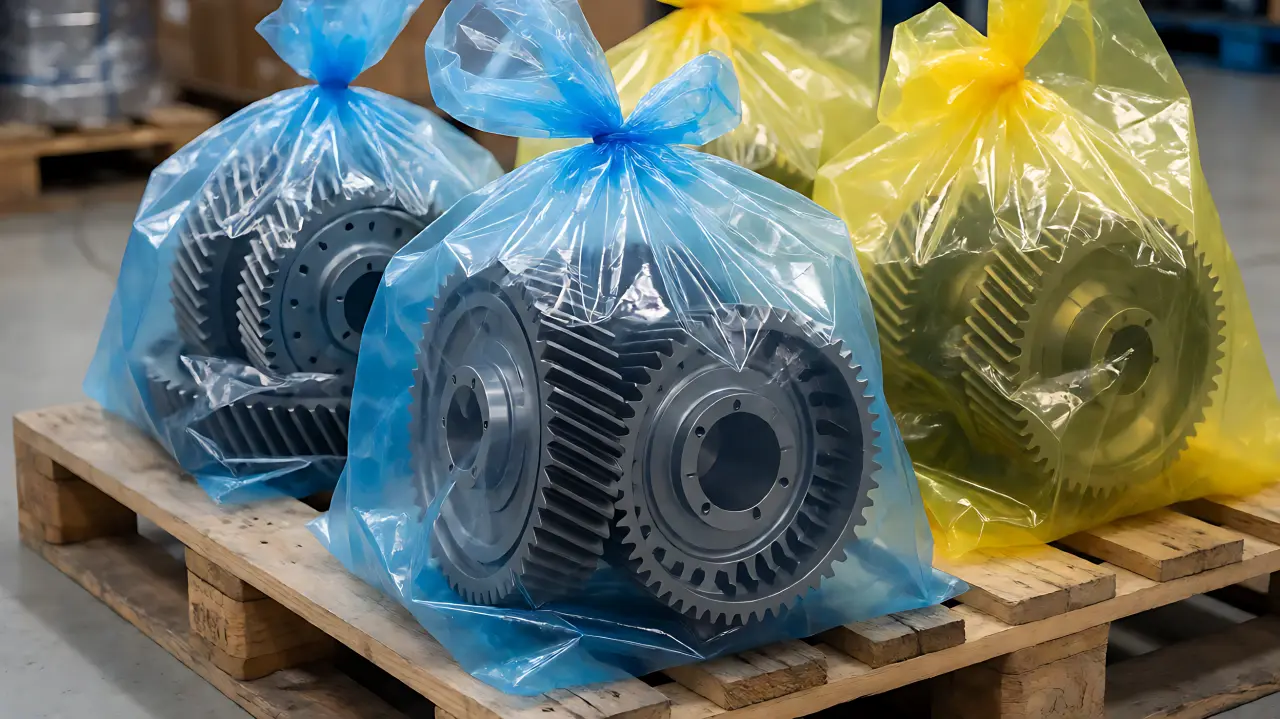
In industrial export logistics—such as maritime shipment of automotive transmissions, precision bearing assemblies, aerospace alloys, and raw steel coils—atmospheric moisture and salt air accelerate electrochemical corrosion. Ferrous oxidation ($4\text{Fe} + 3\text{O}_2 + 6\text{H}_2\text{O} \rightarrow 4\text{Fe}(\text{OH})_3$) destroys micro-inch surface finishes and causes scrap rates exceeding $5%$ during intercontinental transit.
Plant managers and logistics engineers face a critical operational trade-off: traditional Rust Preventative (RP) Oils / Greases vs. clean Vapor Corrosion Inhibitor (VCI) Polyethylene Packaging.
Chemical Mechanisms: Barrier vs. Volatile Passivation
Rust Preventative Oil (Physical Barrier)    VCI Poly Film (Molecular Passivation)
┌──────────────────────────────────────┐   ┌──────────────────────────────────────┐
│ Heavy Mineral Oil / Wax Layer        │   │ LDPE Film Extruded with VCI Salt     │
├──────────────────────────────────────┤   ├──────────────────────────────────────┤
│ Metal Substrate (Steel / Alloy)      │   │ Sublimated VCI Gas Vapor in Headspace│
└──────────────────────────────────────┘   ├──────────────────────────────────────┤
                 ▼                         │ Monomolecular Ionic Protective Shield│
   Physical barrier excludes O2/H2O;       ├──────────────────────────────────────┤
   Must be degreased with toxic solvents   │ Metal Substrate (Deep Cavities Reach)│
   at destination before assembly!         └──────────────────────────────────────┘
                                                              ▼
                                            Clean out of the bag; immediate use;
                                            Zero solvent washing required!
1. Rust Preventative (RP) Oils & Greases
- Mechanism: Forms a continuous liquid or waxy hydrocarbon film across the metal surface, physically blocking atmospheric moisture and oxygen from reaching the reactive metal surface.
- Process Burden: Applying oil requires messy dipping, spraying, or roller coating. Crucially, when parts arrive at destination assembly plants, the oil must be completely removed using heated aqueous wash lines or hazardous degreasing chemical solvents (VOC emissions, wastewater disposal costs, and labor delays).
- Inaccessibility: Oil cannot penetrate internal threads, blind holes, or complex internal gear labyrinths, leaving micro-crevices vulnerable to corrosion.
2. Vapor Corrosion Inhibitor (VCI) Films
- Sublimation Physics: VCI chemical compounds (primarily amine carboxylates, nitrites, or organic salts) compounded into low-density polyethylene (LDPE) slowly volatilize (sublime) from the polymer matrix into the enclosed package headspace.
- Monomolecular Passivation: The volatile ionic molecules saturate the enclosed air volume and electrostatically condense onto all exposed metal surfaces. They form an invisible, self-healing monomolecular layer (1 to 2 molecules thick) that alters the surface electrical potential:
- Anodic Inhibitors: Block metal dissolution by reinforcing passive oxide films.
- Cathodic Inhibitors: Suppress oxygen reduction and hydrogen evolution reactions.
- Self-Healing Capability: If the package is opened briefly for customs inspection and reclosed, the VCI chemicals re-sublime to re-establish the protective vapor equilibrium within 2 to 4 hours.
Technical & Financial Comparison
| Parameter | Rust Preventative Oil / Dip | VCI Polyethylene Film / Bags | Testing Standard |
|---|---|---|---|
| Corrosion Protection Method | Hydrophobic physical barrier | Vapor phase active ionic passivator | ASTM D1748 |
| Application Labor | High (Dipping / spraying / drying) | Low (Bagging / wrapping / heat seal) | Plant Time Study |
| Destination Cleaning | Mandatory (Aqueous wash / solvents) | Zero (Immediate assembly out of bag) | ISO 14001 Audit |
| Internal Cavity Defense | Ineffective (Air pockets unreached) | Highly effective (Gas fills all voids) | ASTM F1249 / NACE |
| Multimetal Compatibility | Limited (Oil tailored per metal) | Formulations for Fe, Cu, Al, brass | NACE TM0208 |
| Environmental Impact | Hazardous VOCs & wastewater disposal | 100% Recyclable standard LDPE stream | EU Packaging Waste |
| Protection Duration | 6 - 12 Months | 24 - 36 Months (Sealed enclosure) | MIL-PRF-22019E |
Enclosure Sizing & Vapor Equilibrium
The effectiveness of VCI packaging depends on maintaining vapor pressure equilibrium within the sealed volume:
$$P_{\text{VCI}} \ge P_{\text{crit}} \approx 10^{-3} - 10^{-5}\text{ mmHg}$$
To maintain this threshold over a 24-month export shipping cycle:
- Volumetric Ratio: Standard industrial guidelines dictate approximately $1\text{ m}^2$ of VCI film for every $1\text{ to }3\text{ m}^3$ of enclosed container volume. For parts with deep recesses, supplemental VCI foam emitters or VCI chipboard sheets should be inserted.
- Hermetic Enclosure: VCI molecules will dissipate if the outer bag is left open. The poly bag must be heat-sealed, taped, or stretch-wrapped to prevent continuous dilution by ambient air exchange.
- Moisture Equilibrium: Parts must be clean, dry, and cool ($< 40^\circ\text{C}$) before wrapping. Trapping warm moist air inside cold parts causes immediate water condensation before VCI vapor pressure reaches equilibrium.
Selection Guidelines
- Use VCI Bags & Liners: For precision automotive components, finished engine blocks, electronic circuit assemblies, stamping dies, and exported electrical control cabinets where destination degreasing costs exceed packaging material savings.
- Retain RP Heavy Greases: For outdoor unprotected storage of raw iron castings, exposed structural I-beams, or unsealed agricultural machinery stored in open yards.
Combine VCI poly bags with heavy-duty ecommerce mailers or custom pallet-sized box pouches to secure sensitive metal products throughout intercontinental distribution.