
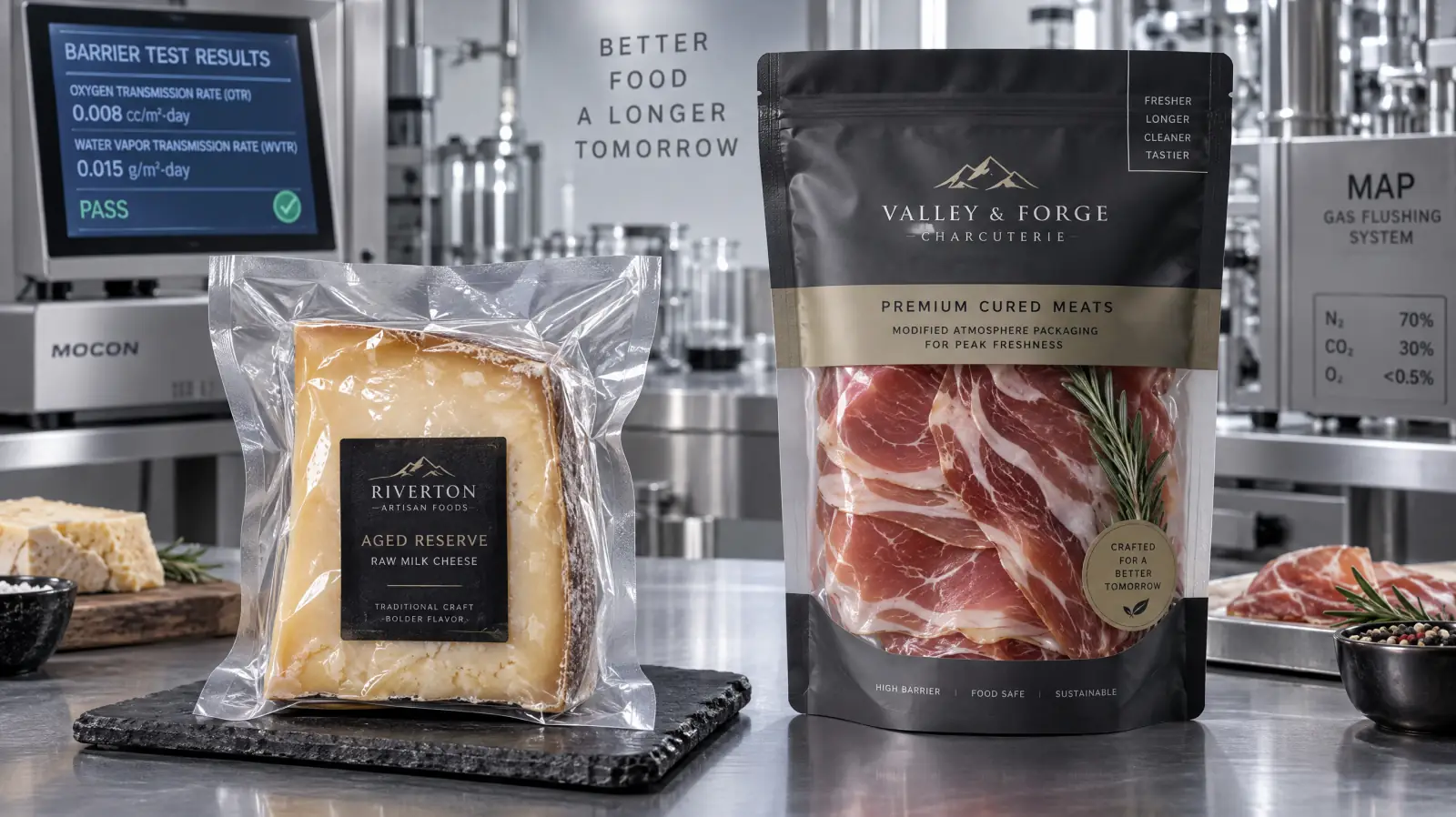
Vacuum Pouches vs Gas Flushing (MAP): Meat & Cheese Barrier Guide
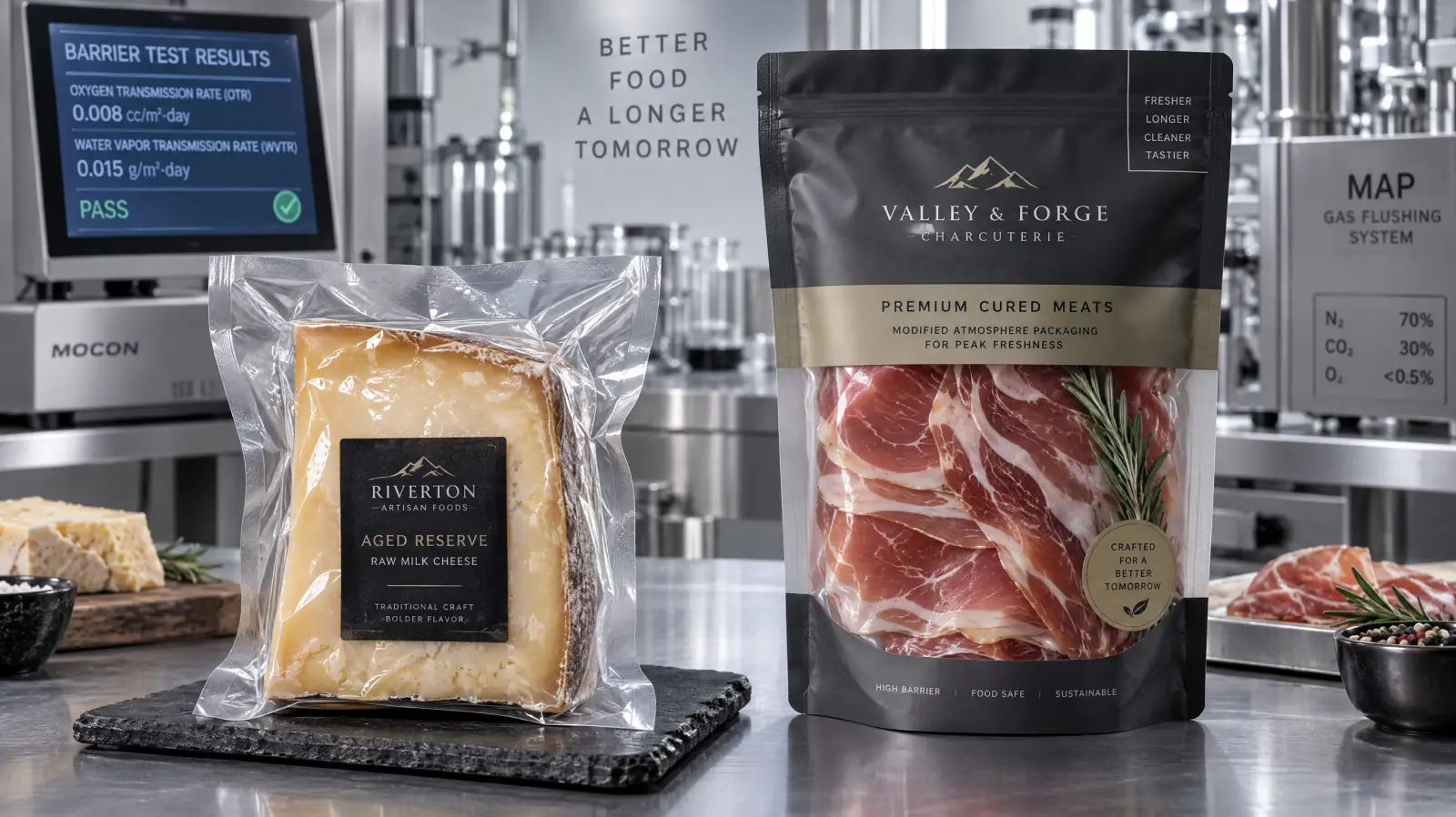
In commercial perishables distribution, extending shelf life while preserving cellular texture, color stability, and moisture is the cornerstone of profitability. Fresh proteins and cultured dairy products are inherently vulnerable to enzymatic degradation, lipid auto-oxidation, and aerobic microbial growth (such as Pseudomonas spp. and mold colonies).
To inhibit spoilage, food packaging engineers rely on two dominant protective preservation methodologies: High-Barrier Vacuum Packaging (VP) and Modified Atmosphere Packaging (MAP / Gas Flushing).
While both technologies aim to starve spoilage microorganisms of reactive oxygen, their physical mechanics, gas transmission rates, film coextrusions, and impact on product aesthetics differ fundamentally. This engineering guide evaluates vacuum pouches versus gas-flushed packaging across gas dynamics, barrier coextrusion physics, purge management, and capital operational expenditures.
1. Quick Engineering Comparison
| Preservation Parameter | High-Barrier Vacuum Pouch (VP) | Modified Atmosphere Packaging (MAP / Gas Flush) |
|---|---|---|
| Atmospheric Mechanism | Mechanical evacuation of 99.5%+ of internal gas | Evacuation followed by positive-pressure inert gas injection |
| Residual Oxygen Level ($O_2$) | < 0.1% to 0.5% | 0.2% to 2.0% (target depends on product gas blend) |
| Mechanical Pressure on Food | High atmospheric compressive load (~1.0 bar) | Zero compressive force (protective pillow or headspace) |
| Primary Film Structure | 7 to 9-layer coextruded PA/PE or PA/EVOH/PE | Multi-layer laminates: PET/EVOH/PE, BOPP/EVOH/PE, or tray lids |
| Oxygen Transmission Rate (ASTM F1927) | < 1.0 to 3.0 cc/m²/24hr at 23°C, 0% RH | < 0.5 to 2.0 cc/m²/24hr at 23°C, 0% RH |
| Moisture Vapor Rate (ASTM F1249) | < 2.0 to 5.0 g/m²/24hr at 38°C, 90% RH | < 1.5 to 3.0 g/m²/24hr at 38°C, 90% RH |
| Purge & Drip Loss Behavior | Squeezes free water out of muscle tissue into pouch | Retains cellular moisture within meat capillaries |
| Aesthetic Presentation | “Skin-tight”, wrinkled, compressed profile | Smooth, unwrinkled, pillow pouch or rigid tray visual |
| Best-Fit Products | Primal beef cuts, hard cheeses, cured salami, bone-in pork | Sliced deli meats, soft bloom-rind cheeses, fresh poultry |
Explore compatible barrier formats in our Stand-Up Pouches Category and Flat Bottom Pouches Category.
2. Atmospheric Mechanics: Evacuation vs. Gas Equilibrium
The fundamental difference lies in how internal gases interact with food cellular biology:
┌────────────────────────────────────────────────────────────────────────┐
│               ATMOSPHERIC REMOVAL VS GAS DISPLACEMENT                  │
├───────────────────────────────────┬────────────────────────────────────┤
│     HIGH-BARRIER VACUUM POUCH     │    MODIFIED ATMOSPHERE (MAP)       │
├───────────────────────────────────┼────────────────────────────────────┤
│                                   │                                    │
│   1. Product loaded in chamber    │   1. Product loaded in chamber     │
│   2. Deep vacuum pulls 99.5% air  │   2. Chamber evacuated to 10 mbar  │
│   3. Atmospheric pressure collapses│  3. Precision gas mix injected:    │
│      pouch walls tightly onto food│      • 70% N2 + 30% CO2 (Cheese)   │
│   4. Heat seal bar closes pouch   │      • 70% O2 + 30% CO2 (Red Meat) │
│                                   │   4. Hermetic seal under neutral P │
│   • Negative internal pressure    │   • Zero mechanical squeeze        │
│   • Complete absence of headspace │   • Controlled gas equilibrium     │
│                                   │                                    │
└───────────────────────────────────┴────────────────────────────────────┘
High-Barrier Vacuum Packaging (VP)
Vacuum packaging utilizes deep rotary or chamber vacuum machines pulling ambient pressure down to 5 to 15 mbar. When the chamber vents to atmospheric pressure, the flexible film collapses skin-tight over the product contours.
- Pros: Eliminates all gaseous voids where aerobic bacteria thrive. Minimizes package volume for shipping density.
- Cons: The atmospheric compression forces free liquid (purge) out of fresh meat fibers. For soft artisanal cheeses (like Brie, Camembert, or Fresh Mozzarella), the mechanical pressure crushes delicate rinds and deforms product geometry.
Modified Atmosphere Packaging (MAP)
MAP first evacuates the chamber, then immediately flushes the pouch with a tailored mixture of food-grade gases before sealing:
- Carbon Dioxide ($CO_2$): The primary antimicrobial agent. Dissolves into the aqueous and lipid phases of food, forming mild carbonic acid ($H_2CO_3$), which lowers surface pH and penetrates bacterial cell membranes to retard microbial reproduction.
- Nitrogen ($N_2$): An inert, non-reactive filler gas with extremely low water and oil solubility. It prevents pouch collapse (caving-in) as $CO_2$ dissolves into the food matrix.
- High Oxygen ($O_2$) Blends: Paradoxically utilized for fresh red meat (e.g., 70%–80% $O_2$ / 20%–30% $CO_2$) to maintain the oxygenated muscle protein oxymyoglobin, preserving the bright cherry-red retail color shoppers expect.
For more on inert gas dosing, review our technical analysis on Nitrogen Flushing vs Degassing Valves in Coffee Packaging.
3. Barrier Film Coextrusion Architecture
Neither process succeeds without specialized high-barrier polymer substrates. Meat fats and sharp cheese crystals demand extreme puncture resistance combined with gas impermeability:
┌────────────────────────────────────────────────────────────────────────┐
│          9-LAYER ASYMMETRIC BARRIER COEXTRUSION FOR PROTEINS           │
├───────┬────────────────────────────────────────────────────────────────┤
│ LAYER │ POLYMER COMPOSITION & PURPOSE                                  │
├───────┼────────────────────────────────────────────────────────────────┤
│ 1 (Out)│ Biaxially Oriented Polyamide (BOPA / Nylon, 15µm) - Puncture   │
│ 2     │ Tie Layer (Maleic Anhydride Grafted Copolymer)                 │
│ 3     │ Polyamide (PA 6/66) - Thermoforming & Mechanical Toughness     │
│ 4     │ Ethylene Vinyl Alcohol (EVOH 32 mol%, 5µm) - Ultra O2 Barrier   │
│ 5     │ Polyamide (PA 6/66) - EVOH Moisture Protection Shield          │
│ 6     │ Tie Layer                                                      │
│ 7     │ Linear Low-Density Polyethylene (LLDPE - Hexene/Octene)        │
│ 8     │ Metallocene Polyethylene (mPE) - Hot Tack & Seal Integrity     │
│ 9 (In)│ Low-Friction Food-Grade PE Contact Layer (with Slip Additive)   │
└───────┴────────────────────────────────────────────────────────────────┘
Why Polyamide (PA/Nylon) is Essential
Uncured bones, rib edges, and hard parmesan rind points puncture standard polyolefin bags. Blown coextrusion lines incorporate two layers of Polyamide (Nylon 6 / 66) to absorb dynamic drop shock and resist pinhole fatigue during sub-zero refrigeration and pallet transit.
EVOH vs. PVDC
While older vacuum bags utilized Polyvinylidene Chloride (PVDC), modern global export standards have shifted to EVOH (Ethylene Vinyl Alcohol copolymer). EVOH delivers an exceptional Oxygen Transmission Rate (OTR < 0.5 cc/m²/day), is fully halogen-free, complies with EU packaging waste regulations, and does not produce toxic dioxins during waste-to-energy incineration.
For extreme thermal processing conditions, compare these structures with our Retort Pouch Autoclave Engineering Guide.
4. Specific Food Applications: Meat vs. Cheese
                            FOOD SELECTION MATRIX
                                      │
                     What is the primary spoilage driver?
                                      │
                   ┌──────────────────┴──────────────────┐
             FRESH RED MEAT                        SPECIALTY CHEESE
        (Lipid Oxidation / Purge)             (Mold Growth / Off-Gassing)
                   │                                     │
           Is visual retail bloom               Does the cheese continue
           paramount at point of sale?          to ferment and off-gas CO2?
                   │                                     │
            ┌──────┴──────┐                       ┌──────┴──────┐
           YES            NO                     YES            NO
            │              │                      │              │
        CHOOSE MAP    CHOOSE VACUUM           CHOOSE MAP     CHOOSE VACUUM
       (80% O2 blend) (Primal storage)        (Pin-valve/    (Hard Cheddar,
       Preserves red  Zero purge leak,        Headspace)     Pecorino blocks)
       meat color     90+ day aging           Prevents burst 180+ day shelf
1. Fresh Beef, Lamb & Pork
- Primal & Sub-Primal Cuts (Processor to Butcher): Heavy vacuum shrink bags (70–90 µm) are undisputed champions. They allow wet-aging inside the bag for 60 to 90 days at 0°C to 2°C with minimal footprint.
- Consumer-Ready Retail Steaks: Vacuum packaging causes myoglobin to convert into deoxymyoglobin (a dark, purplish hue) which uneducated retail shoppers perceive as un-fresh. MAP with 75% $O_2$ / 25% $CO_2$ keeps the meat cherry-red for 8 to 14 days, driving retail conversion.
2. Cheeses (Hard vs. Soft & Shredded)
- Hard Blocks (Cheddar, Gouda, Parmesan): High structural resistance to compression makes high-barrier vacuum pouches ideal. They lock out ambient mold spores and prevent moisture evaporation, maintaining moisture weight for 12+ months.
- Pre-Shredded Cheeses: Subjecting shredded cheese to vacuum turns individual shreds into a dense, solid brick. Gas flushing with 100% $N_2$ or 70% $N_2$ / 30% $CO_2$ creates a loose pillow pouch where shreds remain free-flowing for end consumers.
- Living & Active Rind Cheeses (Brie, Swiss): Swiss cheese continues Propionibacterium fermentation in the pack, releasing natural $CO_2$. Vacuum bags balloon and burst under internal pressure. A barrier pouch with calculated permeability or MAP gas flush cushions this metabolic activity.
5. Economic & Operational Trade-Offs
| Operational Factor | Vacuum Packaging System | MAP Gas Flushing System |
|---|---|---|
| Machinery Capital Cost (CapEx) | Moderate ($15,000 – $80,000 for chamber/rotary) | High ($45,000 – $250,000 for thermoformer/traysealer) |
| Consumable Gas Utility (OpEx) | None (ambient vacuum evacuation only) | Ongoing cost for certified food-grade $CO_2$, $N_2$, $O_2$ cylinders/bulk tanks |
| Packaging Cycle Speed | 10 – 25 cycles/min (limited by deep vacuum pull) | 30 – 80 packages/min (faster flush and seal dynamics) |
| Shipping Logistics Density | Maximum density; zero dead space in master cases | Lower density; positive gas volume expands case requirements by 25–40% |
| Package Pinhole Sensitivity | Immediately noticeable: pouch loses tight cling | Undetected until spoilage occurs (requires gas analyzer checks) |
6. Packaging Engineer Specification Checklist
When formulating requests for quotation (RFQs) for high-barrier food packaging:
- Specify Target Shelf Life: Detail target storage duration (e.g., 45 days at 4°C for fresh poultry vs. 180 days at -18°C for frozen cuts).
- Define Puncture Risk: For bone-in ribs or shank cuts, specify minimum 90–120µm PA/PE film or reinforced puncture-resistant patch laminates.
- Verify Anti-Fog Performance: In cold display cases, temperature fluctuations cause water vapor condensation on clear viewing windows. Ensure inner PE sealant contains non-migratory antifogging surfactants.
- Mandate Gas Mixture QC: For MAP lines, audit residual oxygen using optical or electrochemical headspace analyzers (such as Dansensor CheckPoint) on every shift.
Source Certified High-Barrier Packaging from CraftPack Global
CraftPack Global engineers multi-layer coextruded barrier pouches, vacuum bags, and gas-flushed stand-up pouches with certified EVOH barrier cores, high-clarity anti-fog sealants, and precision print finishes.
Contact Our Barrier Specialists to request sample pouches, barrier transmission test data sheets, and custom production dielines.