
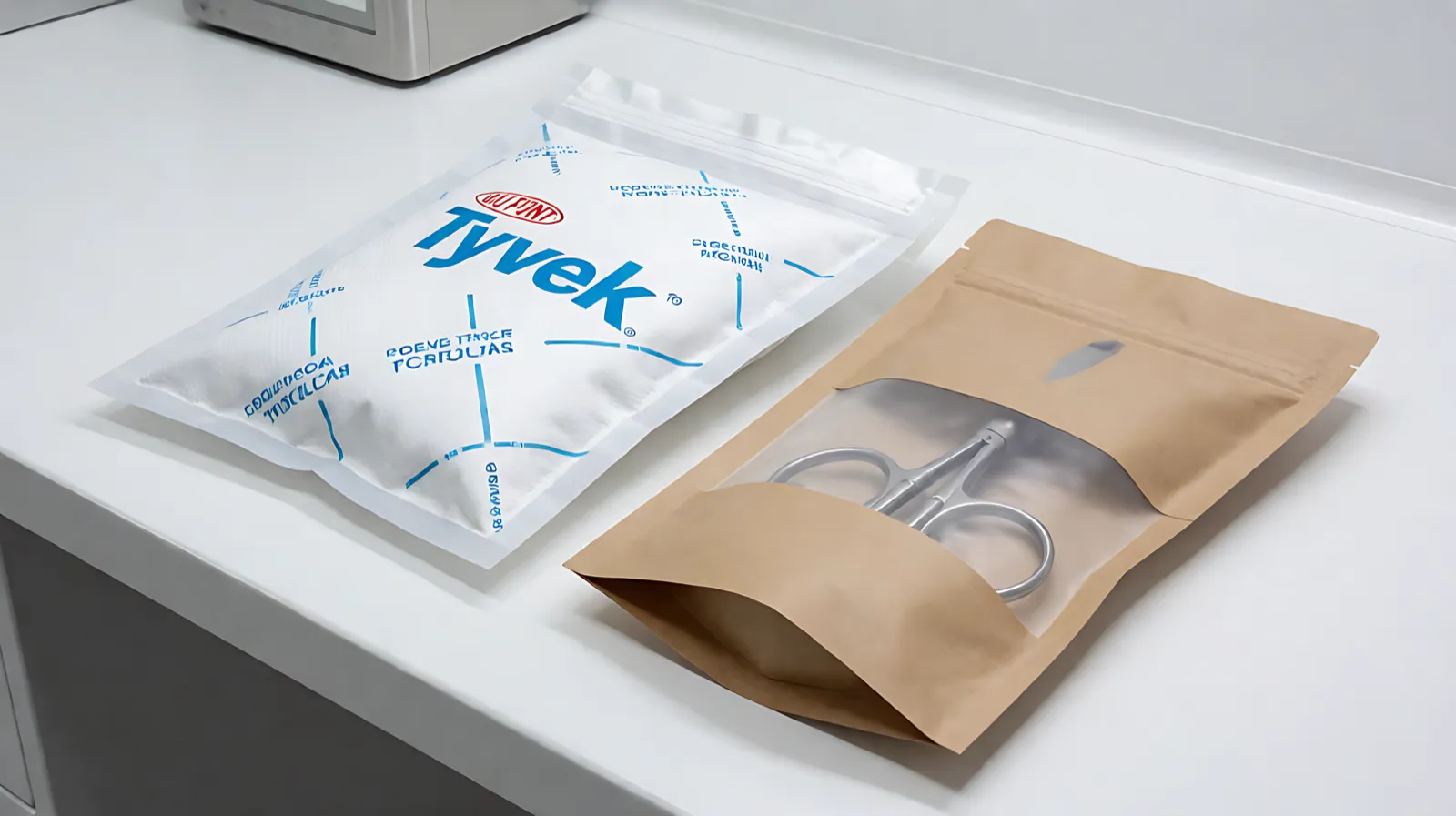
Tyvek vs Medical Kraft: Sterile Packaging Guide (ISO 11607)
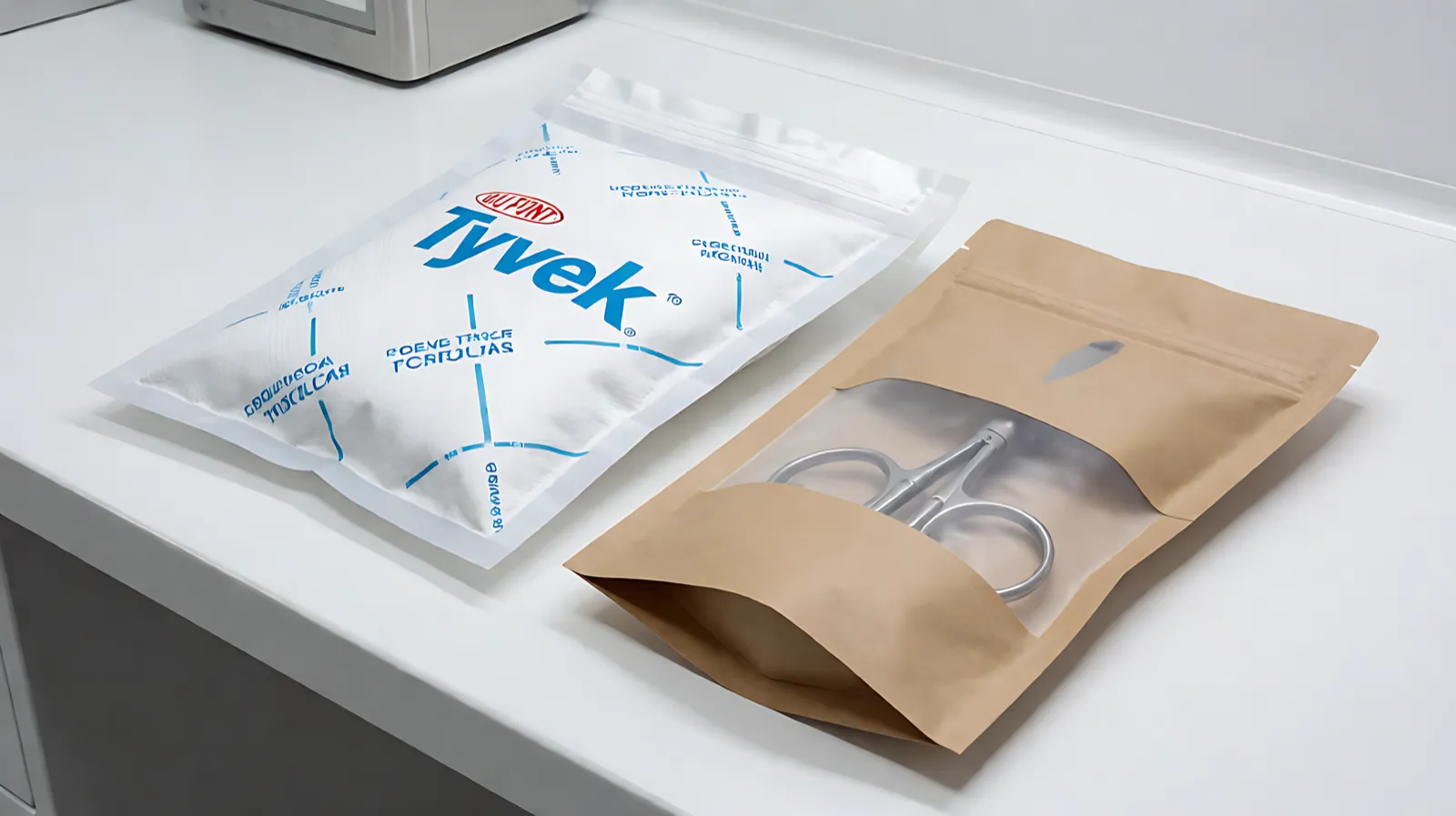
In the manufacturing of disposable medical devices, surgical instruments, and diagnostic kits, packaging is classified by international regulatory bodies (FDA, EU MDR) as a Sterile Barrier System (SBS). Under ISO 11607-1 and ISO 11607-2, a sterile barrier must fulfill two non-negotiable requirements:
- Allow the sterilant gas or steam to penetrate into the package to achieve a Sterility Assurance Level (SAL) of $10^{-6}$.
- Maintain complete microbial barrier integrity against airborne pathogens and bacteria over a multi-year shelf life until the moment of clinical use.
For decades, medical device converters have relied on two primary porous substrates: DuPont™ Tyvek® (flash-spun high-density polyethylene) and Medical-Grade Kraft Paper (Cellulose/Synthetic Blends).
Choosing the appropriate porous web dictates sterilization compatibility, burst resistance during air transport, particle generation during peeling, and total unit cost. This guide provides an ISO 11607 engineering comparison.
1. Quick Engineering Benchmark Matrix
| Performance Attribute | DuPont™ Tyvek® (1073B / 1059B / 2FS) | Medical-Grade Kraft Paper (60–80 GSM) |
|---|---|---|
| Material Base | 100% High-Density Polyethylene (HDPE) nonwoven | Pure bleached virgin cellulose fibers |
| Microbial Barrier (ASTM F1608) | Log Reduction Value (LRV) > 5.0 (Near absolute) | LRV 2.5 to 3.5 (Acceptable under controlled conditions) |
| Puncture & Tear Resistance | Extreme (Elmendorf tear > 400 mN) | Low to Moderate (Prone to puncture by sharp edges) |
| Fiber Tear / Particle Shedding | Zero fiber shedding (Cohesive clean peel) | Risk of cellulosic fiber shedding into sterile field |
| Sterilization: Ethylene Oxide (EtO) | Superior (Rapid gas outgassing, short aerate) | Excellent (Standard porous diffusion) |
| Sterilization: Gamma / E-Beam | Fully compatible (Up to 50 kGy radiation) | Compatible (Slight paper embrittlement) |
| Sterilization: Steam Autoclave | Limited (Max 127°C; 1073B only with care) | Superior (High heat tolerance up to 134°C) |
| Moisture Resistance | Hydrophobic (Zero wet-strength degradation) | Hydrophilic (Loses burst strength if wetted) |
| Cost Profile | Premium ($$$) | Cost-Effective ($) |
Explore complementary medical film formats in our Commercial Plastic Bags Category and learn about thermal sterilization parameters in our Retort Pouch Science & 121°C Autoclave Engineering Guide.
2. Microscopic Structure & Microbial Barrier Physics
The fundamental functional difference between Tyvek and medical paper lies in fiber bonding and tortuous path geometry:
┌────────────────────────────────────────────────────────────────────────┐
│                   MICROSCOPIC FIBER STRUCTURE & PATHWAYS               │
├───────────────────────────────────┬────────────────────────────────────┤
│   DUPONT™ TYVEK® (FLASH-SPUN HDPE)│   MEDICAL-GRADE KRAFT PAPER        │
├───────────────────────────────────┼────────────────────────────────────┤
│                                   │                                    │
│   Continuous 0.5–10µm Filaments   │   Short 2–4mm Wood Pulp Fibers     │
│   Hot-calendered bonded points    │   Hydrated hydrogen bonds          │
│                                   │                                    │
│    Microbe (0.5µm)                 │    Microbe (0.5µm)                 │
│         │                         │         │                          │
│         ▼                         │         ▼                          │
│   ╭─╮ ╭─╮ ╭─╮ ╭─╮                 │   ───   ───   ───                  │
│   ╰─╯ ╰─╯ ╰─╯ ╰─╯ Tortuous Maze   │    │     │     │ Direct Capillary  │
│   ╭─╮ ╭─╮ ╭─╮ ╭─╮ Path            │   ────── ───── ────── Channel Risk │
│   ╰─╯ ╰─╯ ╰─╯ ╰─╯                 │                                    │
│         X (Trapped 99.999%)       │         ? (Marginal Filtration)    │
│                                   │                                    │
│   • Hydrophobic polymer           │   • Hydrophilic cellulose          │
│   • Random filament matrix        │   • Porous binder network          │
│   • No paper dust particles       │   • Can shed cellulosic fibers     │
└───────────────────────────────────┴────────────────────────────────────┘
1. DuPont Tyvek Tortuous Path
Tyvek is produced by flash-spinning continuous strands of pure high-density polyethylene, which are randomized into a dense web and bonded under heat and pressure without chemical binders. This creates an intricate three-dimensional tortuous path. While sterilant gas molecules ($C_2H_4O$) navigate easily through the web, microbial spores (Bacillus atrophaeus) are physically intercepted and captured with a 99.999% filtration efficiency.
2. Medical Kraft Paper Filtration
Medical kraft is engineered from virgin wood fibers refined to minimize chemical extractables. Porosity is maintained via calibrated permeability (Bendtsen or Gurley standards). While certified medical paper provides a validated microbial barrier under standard hospital storage, exposure to moisture or high ambient humidity can cause cellulose fibers to swell, altering pore sizes and potentially allowing bacterial wicking.
3. Peel Strength, Seal Mechanics, and Aseptic Presentation
Under ISO 11607-1, an aseptic opening must occur cleanly without generating airborne particulate matter or fiber tears that could contaminate the surgical field.
Comparison of Peel Seal Behavior (ASTM F88 / EN 868-5):
──────────────────────────────────────────────────────────────────────────
Parameter                 Tyvek / Coex Film Pouch   Medical Paper / Film Pouch
──────────────────────────────────────────────────────────────────────────
Recommended Seal Temp     120°C – 140°C             160°C – 190°C
Seal Peel Strength (N/15mm) 2.5 N to 5.0 N          1.5 N to 3.5 N
Peel Mechanism            True Adhesive / Cohesive  Polymer-to-fiber delam
Fiber Tear Occurrence     < 0.01% (Clean Peel)      Risk of fiber tear (>2%)
Visual Seal Transfer      Continuous frosted white  Irregular transfer line
──────────────────────────────────────────────────────────────────────────
When peeling a Tyvek pouch, the seal separates smoothly along the heat-seal adhesive layer. In contrast, opening paper-based pouches carries a higher risk of paper delamination, where paper fibers tear away from the sheet and remain adhered to the film. In delicate cardiovascular, orthopedic, or ophthalmic surgeries, loose cellulosic fibers represent a dangerous foreign-body contamination hazard.
4. Sterilization Modality Compatibility
                       STERILIZATION COMPATIBILITY
                                    │
                    Which sterilization method is used?
                                    │
        ┌───────────────────────────┼───────────────────────────┐
        ▼                           ▼                           ▼
   Ethylene Oxide             Gamma / E-Beam              Steam Autoclave
   (EtO Gas)                  (Radiation)                 (121°C–134°C)
        │                           │                           │
  Tyvek or Paper              Tyvek Recommended           Medical Kraft
  (Tyvek gives faster         (Paper turns brittle         (Tyvek melts
gas aeration cycle) at high radiation) at >128°C)- Ethylene Oxide (EtO): Both substrates breathe EtO gas effectively. However, Tyvek’s synthetic structure adsorbs significantly less residual EtO and ethylene chlorohydrin (ECH), cutting warehouse aeration degassing times by 40% to 60%.
- Radiation (Gamma / Electron Beam): Radiation cross-links and degrades cellulose chains, causing paper to yellow and become brittle. Tyvek retains superior tensile strength and elongation after 25–50 kGy radiation exposure.
- Steam Autoclave (121°C – 134°C): Standard HDPE melts at approximately 135°C. For hospital autoclave trays and dental instruments exposed to high-pressure superheated steam, medical-grade paper remains the gold standard.
5. Specification & Procurement Decision Matrix
-
Choose DuPont Tyvek when:
- Packaging heavy, bulky, or sharp medical implants (orthopedic screws, trocars, stents).
- Sterilizing via EtO, Gamma, or Low-Temperature Hydrogen Peroxide Gas Plasma (VHP / Sterrad®).
- Cleanroom particulate-free aseptic presentation is mandatory.
- Multi-year shelf life (5 to 10 years) under variable global logistics climates is required.
-
Choose Medical-Grade Kraft Paper when:
- Packaging lightweight, non-critical medical consumables (gauze swabs, syringes, tubing sets, non-invasive drapes).
- Sterilizing via high-temperature steam autoclave.
- Unit packaging cost is the primary procurement constraint for high-volume public tender contracts.
To request cleanroom sample pouches, custom chevron heat-seal pouches, or technical validation documentation, contact our sterile packaging engineering team at CraftPack Global Contact.