
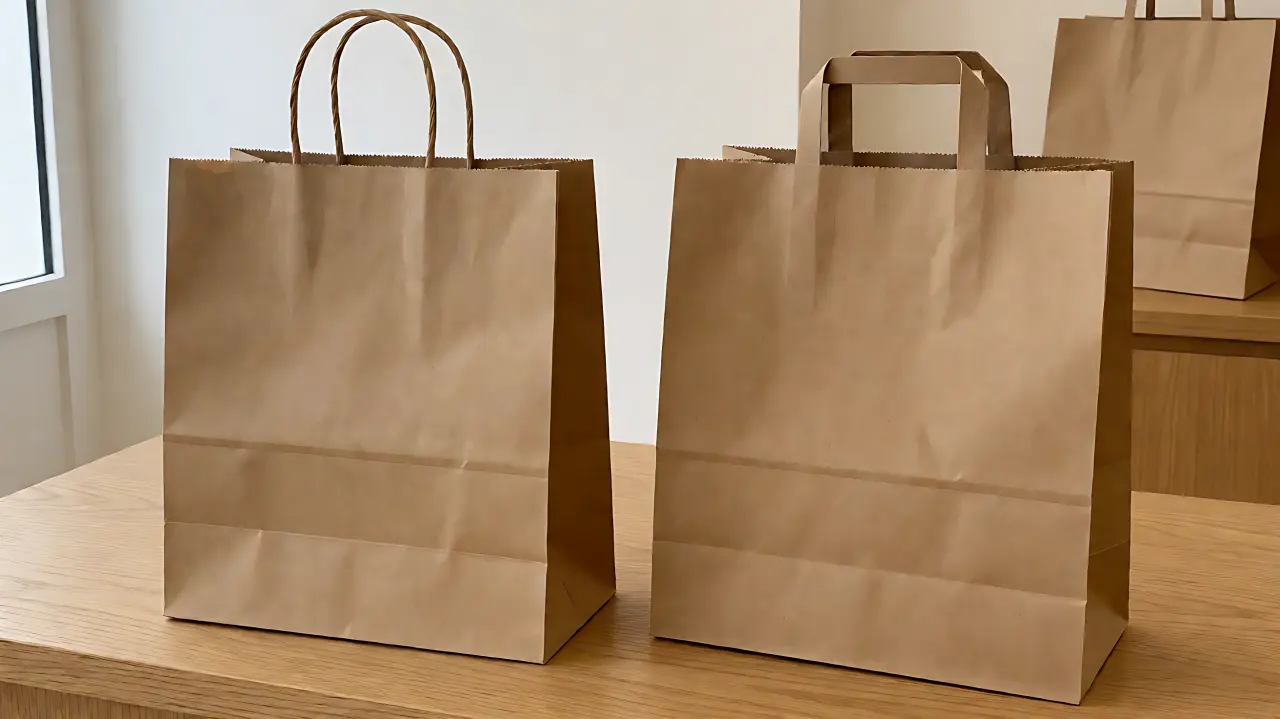
Twisted Paper vs. Flat Handle Kraft Bags: Retail Shopping Bag Guide
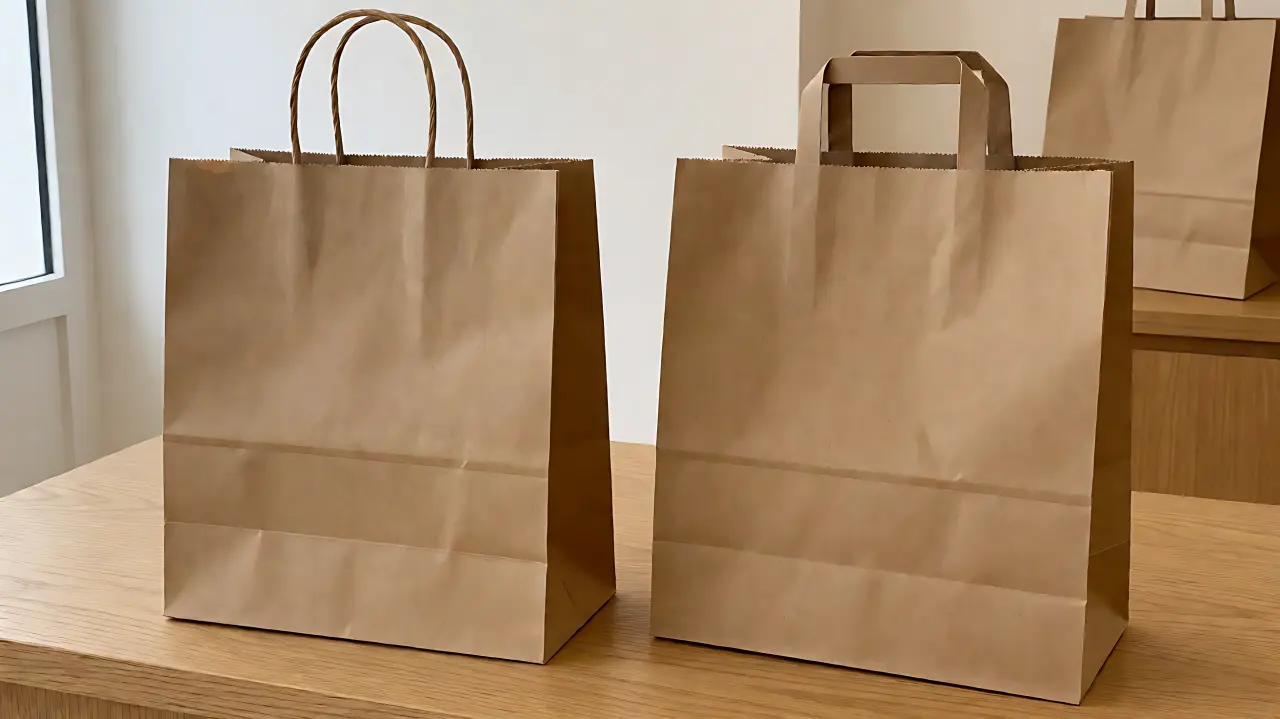
In retail shopping, boutique apparel, and quick-service restaurant (QSR) takeaway packaging, kraft paper carrier bags are the primary canvas for brand identity and consumer utility. As global bans on single-use plastic carrier bags accelerate across North America and the European Union under PPWR, commercial paper bags have transitioned from utilitarian sacks to high-volume engineering assets.
When configuring automated paper bag production, the central mechanical decision centers on handle architecture: Twisted Paper Cord Handles versus Flat Folded Paper Handles.
While both variants utilize 100% repulpable virgin or recycled kraft fibers, their structural load paths, ergonomic contact pressure, automated converting speeds, and palletization freight densities diverge sharply.
This guide provides an engineering analysis of Twisted Paper vs. Flat Handle Kraft Bags, evaluating tensile failure modes, patch adhesive shear, ergonomic carrying comfort, carton packing volumes, and cost-per-thousand economics.
1. Technical Matrix: Twisted Paper vs. Flat Handle Kraft Bags
| Specification Parameter | Twisted Paper Cord Handle | Flat Folded Kraft Handle | Die-Cut Punched Handle | Cotton / Poly Rope Handle (Eurotote) |
|---|---|---|---|---|
| Handle Substrate | Spun virgin kraft paper fibers (3.5–5.0 mm Ø) | Multi-ply folded kraft paper tape (12–15 mm width) | Integrated bag wall cut-out | Braided cotton or PP yarn |
| Tensile Failure Load (ASTM D828) | 120 N to 180 N per handle (12–18 kg) | 90 N to 140 N per handle (9–14 kg) | 60 N to 90 N (Tear sensitive) | 200 N to 300 N (20–30 kg) |
| Palm Contact Pressure (at 10 kg load) | High (~18.2 N/cm² — Cords dig into skin) | Low (~5.1 N/cm² — Wide load distribution) | Moderate (~8.5 N/cm²) | Low to Moderate (~6.5 N/cm²) |
| Patch Adhesion Shear Resistance | > 150 N (Heavy cross-ply glue patch) | > 120 N (In-line continuous glue patch) | N/A (Integral punch) | Anchored via knot or eyelet |
| Carton Shipping Packing Density | Moderate (Protruding cords add bulk) | High (+25% to 35% more bags per carton) | Ultra-High (+50% bags/carton) | Low (Bulky rope bundles) |
| Automated Converting Machine Speed | 180 to 260 bags/minute | 220 to 320 bags/minute | 250 to 350 bags/minute | Semi-automatic (~20–40 bags/min) |
| Municipal Recyclability (CEPI / PTS) | 100% Curbside Single-Stream Paper | 100% Curbside Single-Stream Paper | 100% Curbside Single-Stream | Requires manual rope separation |
| Cost Index per 1,000 Bags | Baseline (1.0× — Retail Standard) | 0.80× to 0.88× Baseline (Economic QSR) | 0.65× to 0.75× Baseline | 2.2× to 4.5× Baseline |
To inspect our automated manufacturing capabilities and stock sizes, browse our Paper Shopping Bags Category and Food Service Bags Category.
2. Structural Mechanics & Ergonomic Pressure Distribution
The consumer experience of carrying a heavily loaded paper shopping bag is governed by Newtonian contact mechanics:
$$\text{Contact Pressure } (P) = \frac{\text{Downward Gravitational Force } (F)}{\text{Handle Contact Surface Area } (A)}$$
Ergonomic Palm Contact Mechanics Comparison:
Twisted Cord Handle (Concentrated Pressure):    Flat Folded Handle (Distributed Comfort):
┌──────────────────────────────────────┐     ┌──────────────────────────────────────┐
│            [Consumer Hand]           │     │            [Consumer Hand]           │
│                 ▼  ▼                 │     │         ▼  ▼  ▼  ▼  ▼  ▼  ▼          │
│                ╭────╮                │     │     ┌──────────────────────┐         │
│                │ ◉  │ Cord Ø 4.0 mm  │     │     │                      │ Width   │
│                ╰────╯                │     │     └──────────────────────┘ 14.0 mm │
│  Area: ~5.5 cm²                      │     │  Area: ~19.6 cm²                     │
│  Pressure @ 10kg: ~18.2 N/cm²        │     │  Pressure @ 10kg: ~5.1 N/cm²         │
│  Result: Cord bites into fingers.    │     │  Result: Comfortable prolonged carry.│
└──────────────────────────────────────┘ └──────────────────────────────────────┘-
Twisted Cord Pressure Concentration:
- Twisted handles are formed by spinning narrow strips of high-tensile virgin kraft paper into dense cylindrical cords (diameter $3.5\text{ to }5.0\text{ mm}$).
- While the cords exhibit exceptional tensile strength under pure axial load, their circular geometry creates a tiny contact footprint across the consumer’s palmar skin. Under an 8–10 kg shopping load (e.g., fashion apparel or multiple wine bottles), the localized pressure spikes to 15–20 N/cm², creating noticeable finger discomfort during transit walks exceeding 5 minutes.
-
Flat Folded Handle Cushioning:
- Flat handles are produced by multi-layer folding of 100–120 GSM kraft ribbon into a flat strap measuring 12 mm to 15 mm in width.
- The planar profile increases contact surface area by 3.5×, dropping palm contact pressure to roughly 5.1 N/cm². This ergonomic advantage makes flat handles the undisputed standard for grocery, bakery, and takeaway food service where consumers carry heavy meal containers.
3. Adhesive Patch Dynamics: In-Line Thermal vs. PVA Shear
A shopping bag handle rarely fails by paper fiber snapping; instead, catastrophic failure almost always occurs at the glue patch bond:
Handle Reinforcement Patch Anatomy:
┌────────────────────────────────────────────────────────┐
│  Bag Upper Lip / Top Turnover Hem                      │
├────────────────────────────────────────────────────────┤
│  ┌──────────────────────────────────────────────────┐  │
│  │  Kraft Reinforcement Patch Paper (120–140 GSM)   │  │
│  │  ░░░░░░░░░░░░░░░░░░░░░░░░░░░░░░░░░░░░░░░░░░░░░   │  │ <── Metallocene Hot-Melt
│  │  ═════ Handle Stem Anchored Underneath ═════     │  │     or High-Tack PVA Glue
│  └──────────────────────────────────────────────────┘  │
└────────────────────────────────────────────────────────┘- Twisted Handle Patches: Due to the concentrated cylindrical thickness of twisted cords, the kraft backing patch must withstand severe peeling leverage. Machine builders utilize heavy 120–140 GSM unbleached kraft patches bonded with high-temperature metallocene hot-melt adhesives. The patch is compressed under pneumatic rollers to prevent adhesive creep when exposed to hot takeaway steam or humid climates.
- Flat Handle Flush Geometry: Because the flat handle lies completely coplanar with the bag wall, the glue line experiences pure shear stress rather than peel leverage. This allows high-speed automated bag machines to apply water-based polyvinyl acetate (PVA) emulsion adhesives at line speeds exceeding 300 bags per minute, reducing converting energy and chemical costs.
4. Logistics, Carton Packing & Freight Economics
In high-volume B2B supply chains, shipping costs often rival the unit price of the packaging itself.
Because flat handles fold completely flush against the bag body without cylindrical protrusions:
- Carton Stacking Optimization: A standard $60\times 40\times 40\text{ cm}$ master shipper carton accommodates 250 twisted-handle bags versus 350 to 375 flat-handle bags of identical bag dimensions.
- Container Volume Savings: For ocean freight (40ft High Cube containers), switching a retail QSR chain from twisted to flat handles yields a 28% reduction in total cubic meters (CBM), eliminating multiple shipping containers annually and substantially lowering the landed carbon footprint.
5. Strategic Procurement Selection Blueprint
                     What is your primary commercial sector?
                                     │
                     ┌───────────────┴───────────────┐
          Apparel, Cosmetics, Retail            Food Service, Bakery, Takeaway
             (Visual Prestige Priority)            (Mass Volume & Freight Priority)
                     │                               │
         Do customers perceive upright       Are orders heavy or carrying hot
           bag aesthetics as premium?          takeaway food containers?
                     │                               │
        ┌────────────┴────────────┐             ┌────┴──────────────────────────┐
       YES                        NO            │ Deploy Flat Handle Bags:      │
        │                          │            │ - Food delivery & QSR chains  │
  Deploy Twisted Cord Bags:        │            │ - High-turnover grocery       │
  - Fashion boutiques              │            │ - Supermarket bakery racks    │
  - Department stores              │            │ - Heavy meal takeaway combos  │
  - Premium electronics            │            └───────────────────────────────┘
  - Bookstores & gift shops        │
  - Trade show promotional sacks   └──────────> Consider Internal Folded Handles
                                                or Die-Cut SOS Flat Bottom Bags
Key Engineering Checklist:
- Specify Virgin vs. Recycled Paper: If opting for recycled content (e.g., 40%–100% PCW kraft), increase bag basis weight by 10–15 GSM (e.g., upgrading from 90 GSM virgin to 105 GSM recycled) to offset short-fiber burst strength loss.
- Handle Glue Formulation: For hot food takeaway, mandate hot-melt adhesives with a softening point of $\ge 85^\circ\text{C}$ to prevent steam-induced handle detachment.
- 100% Plastic-Free Certification: Ensure handles contain no internal synthetic monofilament core, verifying CEPI compliance for curbside paper repulping.
Request custom dimension prototypes and stress-tested samples directly through our Paper Shopping Bags Division.