
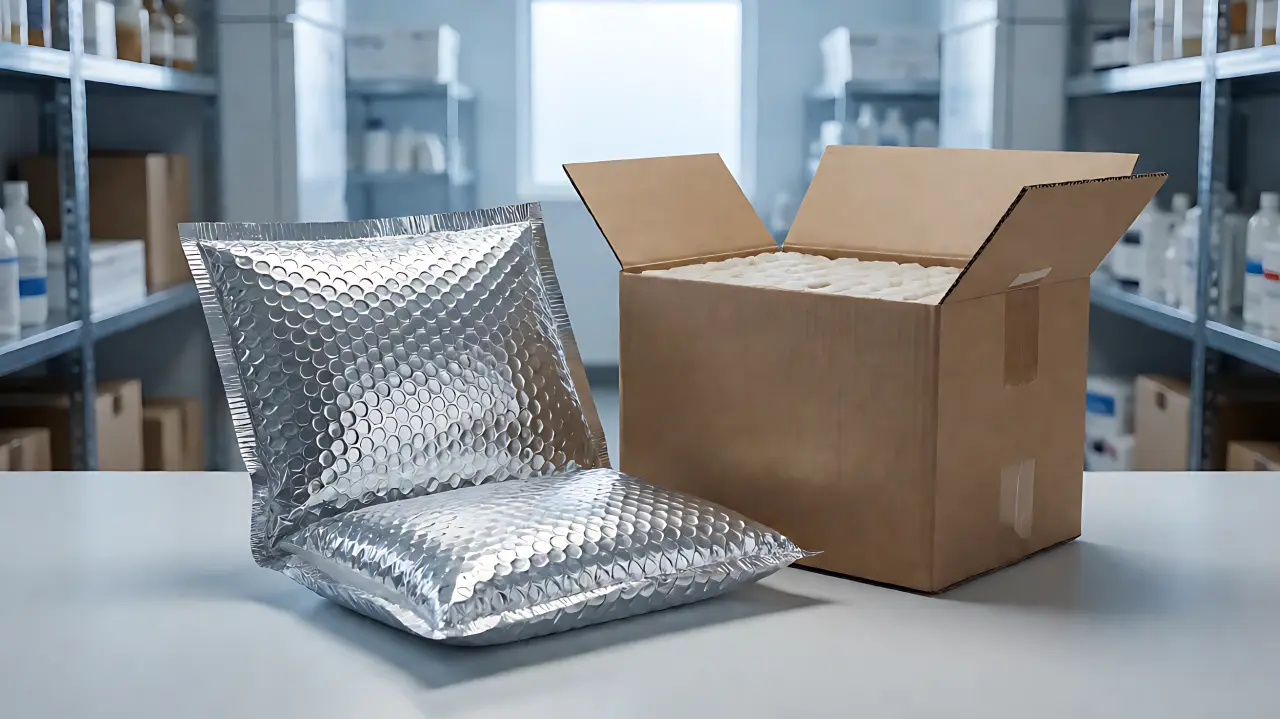
Insulated Foil Mailers vs. Cotton Liners: Cold Chain Guide
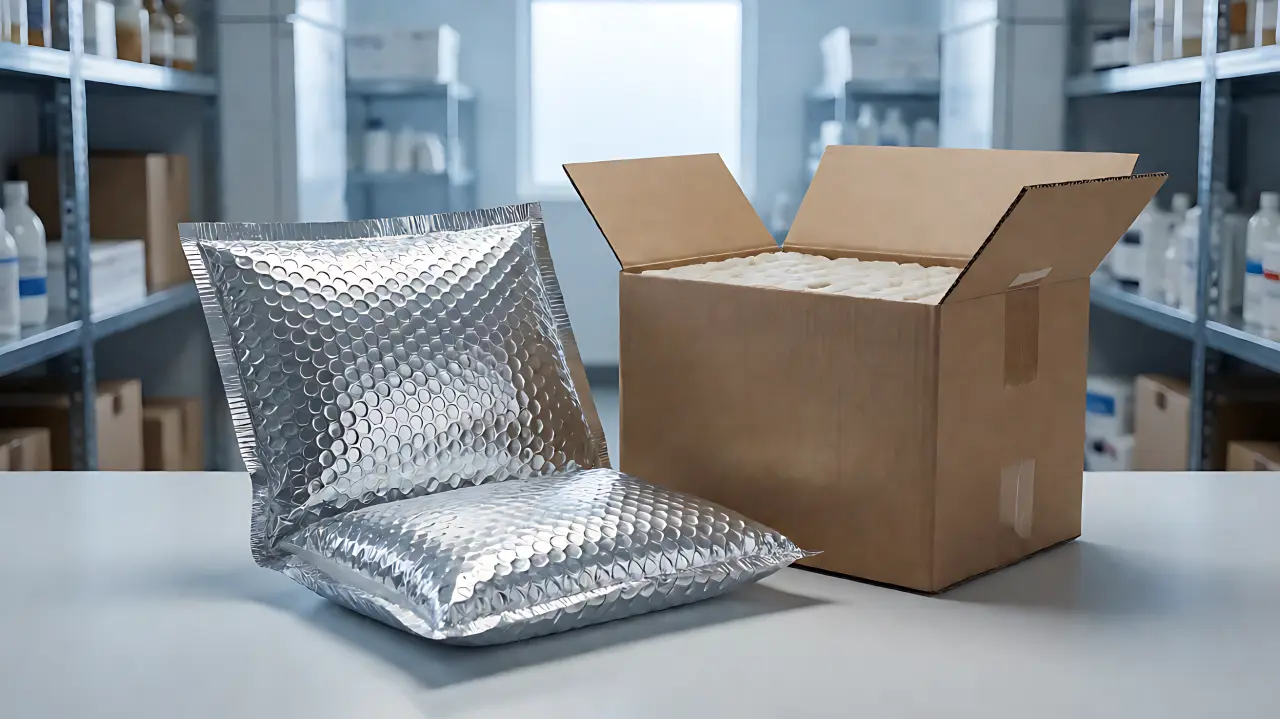
In temperature-controlled direct-to-consumer (D2C) and e-commerce distribution—spanning artisan chocolates, temperature-sensitive biologics, artisanal cheese, meal kits, and specialty seafood—maintaining product integrity across a 24- to 48-hour transit window is a critical engineering requirement. Cold chain failure results in microbial spoilage, cosmetic melting, and expensive customer replacement claims.
Historically, cold chain logistics relied on bulky, non-biodegradable Expanded Polystyrene (EPS / Styrofoam) coolers. However, stringent municipal landfill bans, corporate ESG commitments, and exorbitant dimensional weight (DIM) freight penalties have rendered rigid EPS unviable for modern e-commerce.
Today, cold chain logistics engineers evaluate two leading flexible insulation alternatives: Reflective Metallized Foil Bubble Mailers and Recycled Cotton Fiber Thermal Liners.
This technical guide provides an engineering evaluation of Foil Bubble Mailers vs. Recycled Cotton Liners, analyzing ISTA 7D thermal profiles, R-value insulation ratings, heat transfer physics, refrigerant mass ratios, and curbside end-of-life recyclability.
1. Technical Matrix: Insulated Foil Mailers vs. Recycled Cotton Liners
| Performance Parameter | Reflective Foil Bubble Mailer | Recycled Cotton Fiber Box Liner | Kraft Paper Honeycomb Liner | Rigid EPS Foam Cooler (Legacy) |
|---|---|---|---|---|
| Primary Insulation Mechanism | Radiant heat reflection (Low emissivity) | Conductive & convective dead-air entrapment | Trapped air pockets in paper cells | Cellular closed-cell conduction block |
| Material Composition | Metallized PET laminated to LDPE bubble | Post-industrial recycled denim / cotton fiber | Multi-ply kraft paper with paper batting | 100% Expanded Polystyrene |
| Effective Thermal R-Value | R-1.1 to R-1.5 (Thin profile ~3–5mm) | R-3.2 to R-4.2 (Dense profile ~20–25mm) | R-2.0 to R-2.8 (15–20mm profile) | R-4.0 to R-5.0 (25–38mm rigid wall) |
| Thermal Conductivity ($k$-value) | High overall core ($~0.045\text{ W/m}\cdot\text{K}$) | Low ($0.033\text{ to }0.038\text{ W/m}\cdot\text{K}$) | Moderate ($0.040\text{ to }0.046\text{ W/m}\cdot\text{K}$) | Very Low ($0.030\text{ W/m}\cdot\text{K}$) |
| ISTA 7D Thermal Window (Summer Profile) | 12 to 24 Hours (< 10°C hold) | 36 to 48+ Hours (< 4°C hold) | 24 to 36 Hours (< 8°C hold) | 48 to 72 Hours (< 4°C hold) |
| Warehouse Storage Space (Unexpanded) | Ultra-Compact (Flat mailers save 80% space) | Bulky rolls / batts (Moderate storage) | Moderate storage space | Catastrophic bulk (EPS cannot flatten) |
| Moisture Absorption / Condensation Risk | Impermeable (Zero moisture absorption) | Hygroscopic (Requires poly wrap barrier) | Paper weakens if condensation pools | Impermeable |
| Municipal Curbside Recyclability | Difficult (Multi-material film/bubble) | 100% Curbside Paper / Biodegradable | 100% Curbside Paper Recyclable | Non-recyclable in curbside stream |
| Packaging Unit Cost Index | Baseline (1.0× — Cost Leader) | 1.8× to 2.5× Baseline | 1.6× to 2.2× Baseline | 1.3× to 1.7× Baseline + High Freight |
To review our complete lineup of high-performance shipping solutions, visit our E-commerce Mailers Category.
2. Thermodynamics: Radiant Heat Barrier vs. Conductive Resistance
Understanding performance differences requires analyzing the three modes of thermal transfer:
Heat Transfer Physics in Cold Chain Envelopes:
Reflective Foil Bubble Mailer (Radiation Block):   Recycled Cotton Liner (Conduction/Convection Block):
┌──────────────────────────────────────┐          ┌──────────────────────────────────────┐
│  Sunlight & Ambient Infrared Heat    │          │  Intense Ambient Heat Wave (38°C)    │
│       ↓↓↓↓↓↓↓↓↓↓↓↓↓↓↓↓↓↓             │          │       ↓↓↓↓↓↓↓↓↓↓↓↓↓↓↓↓↓↓             │
│  ┌────────────────────────────────┐  │          │  ┌────────────────────────────────┐  │
│  │ 97% Radiant Heat Bounced Away  │  │          │  │ Dense Cotton Fiber Entrapment  │  │
│  │ ⇡⇡⇡ (Reflective VMPET Outer)   │  │          │  │ ░░░░░░░░░░░░░░░░░░░░░░░░░░░░░░ │  │
│  ├────────────────────────────────┤  │          │  │ Dead air pockets arrest        │  │
│  │ 3mm PE Bubble Layer (Low R)    │  │          │  │ molecular kinetic conduction   │  │
│  └────────────────────────────────┘  │          │  └────────────────────────────────┘  │
│  Cold Payload Inside (Quick Heat Soak│          │  25mm Thickness Absorbs Heat Influx  │
│  via physical air conduction)        │          │  Cold Payload Inside (Preserved 48h) │
└──────────────────────────────────────┘ └──────────────────────────────────────┘-
Reflective Radiant Barriers (Foil Bubble):
- Metallized polyester possesses an emissivity value of $\epsilon \approx 0.03$, meaning it reflects up to 97% of ambient radiant infrared radiation.
- Foil mailers excel when shipments sit in direct sunlight on tarmac loading ramps or consumer doorsteps. However, the thin 3/16“ polyethylene air bubble core provides limited conductive insulation ($R \approx 1.2$). Once heat penetrates via physical conduction, the internal temperature rises rapidly unless supplemented with ample gel packs.
-
Conductive & Convective Dead-Air Trapping (Cotton Liners):
- Recycled cotton insulation consists of entangled cellulose fibers derived from post-industrial denim and apparel trimmings.
- The microscopic fiber network immobilizes millions of tiny air pockets, virtually eliminating convective air currents and suppressing molecular kinetic conduction ($k \approx 0.035\text{ W/m}\cdot\text{K}$).
- At a standard 20 mm to 25 mm thickness, cotton liners match the insulating R-value of rigid 1-inch EPS foam, absorbing thermal shocks over multi-day transit without radiant film layers.
3. Refrigerant Payload Calculations: ISTA 7D Summer Simulation
The true economic cost of cold chain shipping includes the refrigerant mass (gel ice packs or dry ice) required to hold payload temperatures below critical spoilage thresholds ($4^\circ\text{C}$ for dairy/meat; $15^\circ\text{C}$ for chocolate).
Under ISTA Standard 7D (72-Hour Temperature Test for Transport Packaging):
ISTA 7D 48-Hour Summer Ambient Temperature Curve:
Ambient Temp (°C)
40 ┼                      ╭──────────────╮
35 ┼         ╭────────────╯              ╰────────────╮
30 ┼        ╭╯                                        ╰╮
25 ┼───────╭╯                                          ╰───────
   0       6      12      18      24      30      36      42   48 Hours
Refrigerant Ratio Requirements (for a 2.5 kg Food Payload):
- Using 3mm Foil Bubble Mailer (Target: < 8°C for 24h):
- Required Gel Refrigerant Ratio: 1.0 to 1.2 kg gel per kg product.
- Total Gel Weight: $\approx 2.5\text{ to }3.0\text{ kg}$.
- Usable Transit Limit: Maximum 18 to 24 hours (overnight air express only).
- Using 25mm Recycled Cotton Box Liner (Target: < 4°C for 48h):
- Required Gel Refrigerant Ratio: 0.5 to 0.7 kg gel per kg product.
- Total Gel Weight: $\approx 1.25\text{ to }1.75\text{ kg}$.
- Usable Transit Limit: Reliable across 48 to 60 hours (ground freight transit).
Cost Insight: While the cotton box liner costs roughly $0.80–$1.20 more than a foil mailer, saving 1.5 kg of gel refrigerant mass reduces outbound express shipping postage by $3.50–$6.00 per parcel, yielding immediate net operational savings.
4. End-of-Life Environmental & Disposal Compliance
In modern e-commerce, consumer sentiment regarding disposal friction directly drives unboxing reviews and retention rates:
-
Foil Bubble Mailers:
- Composed of metallized PET film permanently heat-laminated to LDPE air bubbles.
- Because metal, PET, and PE cannot be mechanically separated by municipal recycling equipment, foil bubble mailers are non-recyclable in standard curbside bins, requiring consumers to discard them in municipal trash.
-
Cotton Fiber Thermal Liners:
- Manufactured with 100% natural textile fibers wrapped in compostable kraft paper or perforated recyclable PE film.
- Consumers can cut open the sleeve, compost the cotton fibers in garden mulch or municipal composters (biodegrading within 60–90 days), and place the outer corrugated carton directly into single-stream paper recycling.
5. Cold Chain Procurement Decision Tree
                       What is your required transit duration?
                                     │
                     ┌───────────────┴───────────────┐
             Under 24 Hours (Next-Day)            24 to 48+ Hours (2-3 Day Ground)
                     │                               │
         Is the payload highly perishable     Does product require strict
           (< 4°C meat/dairy/pharma)?           sub-4°C cold chain safety?
                     │                               │
        ┌────────────┴────────────┐             ┌────┴──────────────────────────┐
       YES                        NO            │ Deploy 25mm Cotton Box Liners:│
        │                          │            │ - Premium grass-fed meats     │
  Deploy Hybrid Foil Mailer        │            │ - Fresh prepared meal kits    │
  with High-Density Gel Packs      │            │ - Temperature-stable vaccines │
  or Switch to Insulated Box       │            │ - High-value artisanal cheese │
                                   │            └───────────────────────────────┘
  Deploy Foil Bubble Mailers:      │
  - Artisanal chocolate confections│
  - Cosmetics & serums in summer   │
  - Probiotics & dry vitamins      │
  - Overnight local bakery orders  └──────────> Deploy Honeycomb Paper Mailers
                                                for ambient transit protection
For customized thermal transit testing protocols and sample evaluations, connect with our packaging specialists through our E-commerce Mailers Packaging Group.