
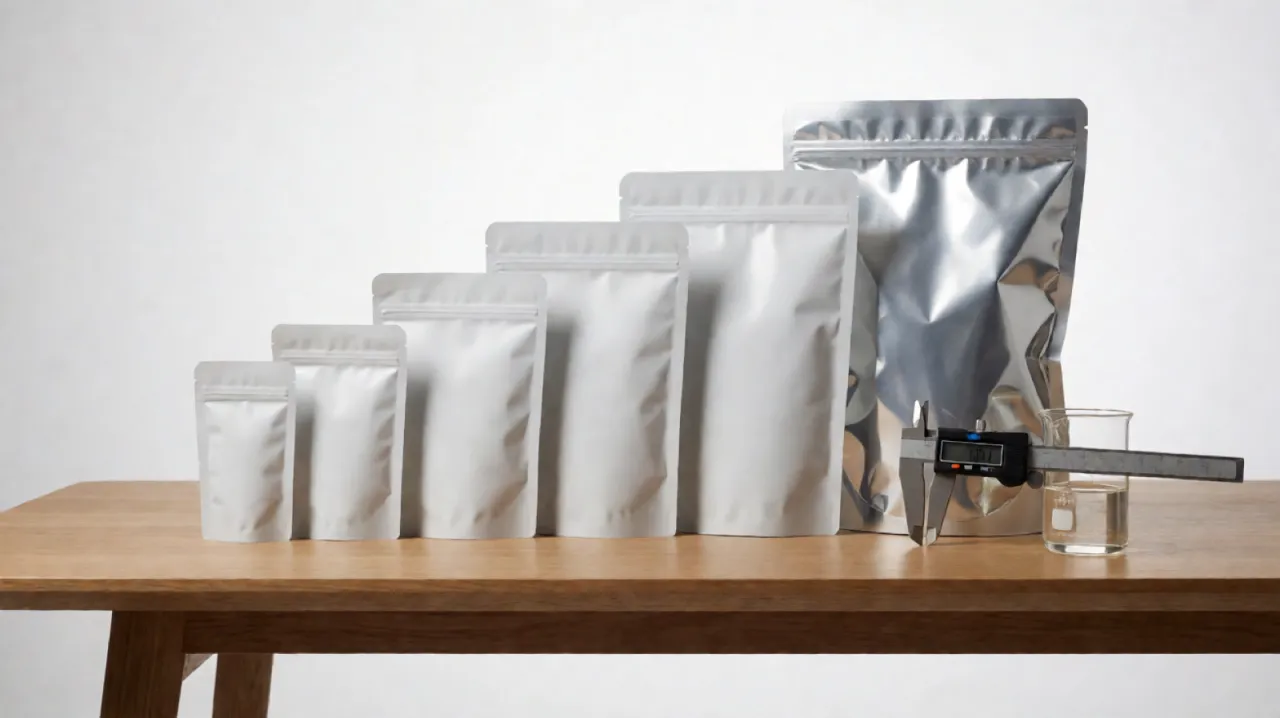
Stand-Up Pouch Sizing Guide: Capacity, Volume & Dimensions
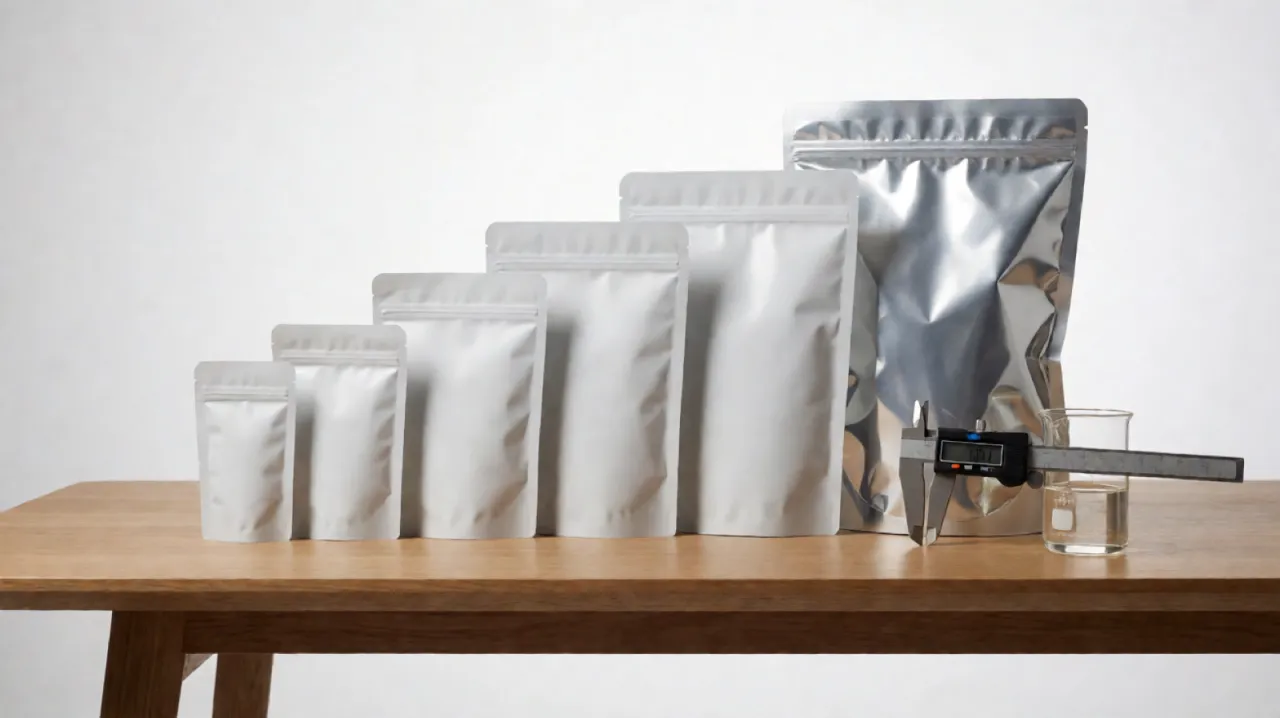
The most frequent and costly mistake made when procuring custom stand-up pouches is conflating net weight (mass) with volumetric pouch capacity.
A brand founder ordering pouches for a 250-gram (8.8 oz) product often assumes that any “8 oz pouch” will fit their payload. In reality, Product Bulk Density ($\rho$) dictates physical space requirements:
- 250 grams of Whole Bean Coffee ($\rho \approx 0.38\text{ g/ml}$) occupies approximately 658 ml of internal volume.
- 250 grams of Whey Protein Powder ($\rho \approx 0.65\text{ g/ml}$) occupies approximately 385 ml of internal volume.
- 250 grams of Coarse Bath Salt ($\rho \approx 1.25\text{ g/ml}$) occupies only 200 ml of internal volume.
Ordering packaging based purely on mass without calculating product density leads to one of two expensive failures: pouches that burst at the zipper line during automated sealing, or pouches that look half-empty on retail shelves, provoking consumer dissatisfaction.
This engineering guide provides packaging engineers and procurement teams with the mathematical formulas, structural deductions, and comprehensive dimension charts required to specify stand-up pouches accurately.
The Geometry of a Stand-Up Pouch: Measuring $W \times H + BG$
Standard industry notation expresses stand-up pouch dimensions as: $$\text{Width }(W) \times \text{Height }(H) + \text{Bottom Gusset }(BG)$$
Stand-Up Pouch Dimension Anatomy:
┌──────────────────────────────────────────────┐ ◄─ Top Edge
│      Top Heat Seal (15 – 20 mm)              │
│  [ Tear Notch ]                              │
│      Zipper Track (12 – 15 mm)               │
├──────────────────────────────────────────────┤ ◄─ Maximum Fill Line (Zipper Base)
│ ◄- 8mm -►                              ◄- 8mm-►
│ Side Seal                            Side Seal
│                                              │
│               Usable Filling                 │
│                 Compartment                  │
│                                              │
│                                              │
├──────────────────────────────────────────────┤
│      Bottom Gusset Seal / Doyen Curve        │
└──────────────────────────────────────────────┘ ◄─ Bottom Fold
       ▲                                ▲
       └────── Bottom Gusset (BG) ──────┘
Critical Dimensional Deductions: Outer Size vs. Usable Cavity
When you specify a pouch measuring $150\text{ mm} \times 230\text{ mm} + 80\text{ mm}$, those numbers represent the flat, exterior cut edge. The interior usable filling cavity is considerably smaller:
- Width Deduction: Subtract two side heat seals (typically 8 mm to 10 mm per side). A 150 mm wide pouch provides an effective filling aperture width of 130 mm to 134 mm.
- Height Deduction:
- Top trim above zipper: 18 mm to 22 mm.
- Resealable zipper mechanism: 12 mm to 15 mm.
- Recommended headspace clearance: Minimum 15 mm to 25 mm beneath the zipper track to prevent product contamination on sealing bars.
- Effective Filling Height = $\text{Total Height} - \mathbf{50\text{ mm to }65\text{ mm}}$.
- Bottom Gusset Representation: In North America, $BG$ is occasionally quoted as the “half-gusset” or folded depth (e.g. $+ 40\text{ mm}$), whereas in international converting standards, $BG$ represents the total open base footprint (e.g. $+ 80\text{ mm}$). Always confirm with your supplier whether the bottom gusset dimension is total open base or folded depth.
Bottom Gusset Formats: Doyen vs. K-Seal vs. Plow Bottom
The mechanical behavior of the pouch base determines whether the filled package stands vertical or tilts forward on retail shelves:
Bottom Gusset Styles:
Doyen (Round Bottom)          K-Seal (Corner Angles)        Plow Bottom (Folded Base)
┌───────────────────────┐     ┌───────────────────────┐     ┌───────────────────────┐
│                       │     │                       │     │                       │
│                       │     │                       │     │                       │
│    ╭─────────────╮    │     │    \               /  │     │                       │
└────╰─────────────╯────┘     └─────\─────────────/───┘     └───────────────────────┘
(Curved perimeter seal) (Angled corner seals) (Seamless wrap-around)- Doyen Seal (Round Bottom / U-Seal):
- The original round-bottom design. A curved heat seal bonds the front and back panels to the inverted gusset web.
- Best Use: Light to medium loads (28g to 500g / 1 oz to 1 lb).
- Characteristic: Exceptional stability for lightweight items like snacks, confectionery, and tea.
- K-Seal (Corner Angle Seal):
- Features angled 45-degree heat seals at both bottom corners, directing product down into the base.
- Best Use: Heavier products (500g to 2 kg / 1 lb to 4.4 lbs).
- Characteristic: Minimizes the “front-tipping” tendency of heavy items by forcing the base to spread into a wider footprint.
- Plow Bottom (Corner Seal / Straight Bottom):
- The front face web wraps continuously underneath to form the base without an exterior bottom perimeter seal.
- Best Use: Dense granular powders, bath crystals, fine ground grains.
- Characteristic: 100% of the interior base volume is accessible to product settling.
Calculating Required Volume Using Bulk Density
To find the correct pouch size, determine your product’s loose bulk density using a simple graduated cylinder: $$\text{Bulk Density } (\rho) = \frac{\text{Mass of Product (g)}}{\text{Volume Occupied in Cylinder (ml)}}$$
Bulk Density Values Across Common CPG Categories
| Product Category | Typical Bulk Density ($\text{g/ml}$) | Volume Required for 250g Payload | Recommended Gusset Style |
|---|---|---|---|
| Puffed Snacks / Popcorn | 0.08 – 0.15 | 1,650 – 3,100 ml (Massive cavity) | Doyen Seal |
| Beef Jerky / Dried Fruit | 0.22 – 0.32 | 780 – 1,130 ml | Doyen Seal |
| Whole Bean Coffee | 0.35 – 0.42 | 595 – 715 ml | Doyen / K-Seal |
| Ground Coffee | 0.45 – 0.55 | 455 – 555 ml | K-Seal |
| Rolled Oats / Granola | 0.40 – 0.50 | 500 – 625 ml | Doyen / K-Seal |
| Whey / Plant Protein Powder | 0.55 – 0.70 | 355 – 455 ml | K-Seal / Plow |
| Organic Superfood Powders | 0.60 – 0.75 | 330 – 415 ml | K-Seal |
| Granular Sugar / Fine Salts | 0.90 – 1.05 | 240 – 280 ml | Plow Bottom |
| Himalayan Bath Crystals | 1.15 – 1.35 | 185 – 220 ml | Plow Bottom |
The Universal Pouch Sizing Formula
To allow for automated filling funnel clearance, gas flushing, and zipper closure, apply a 20% to 25% headspace multiplier: $$\text{Target Internal Volume (ml)} = \left( \frac{\text{Net Weight Target (g)}}{\text{Bulk Density (g/ml)}} \right) \times 1.25$$
Comprehensive Stand-Up Pouch Sizing Reference Chart
The following matrix cross-references standardized industry dimensions against usable volumetric capacity and common food fills:
| Standard Size Tier | Metric Dimensions ($W \times H + BG$) | Imperial Dimensions ($W \times H + BG$) | Usable Capacity | Typical Product Match |
|---|---|---|---|---|
| 1 oz (28g) / Sample | 85 × 130 + 50 mm | 3.35“ × 5.10“ + 2.0“ | 70 – 90 ml | Single-serve spices, gummies, trail seed packs |
| 2 oz (56g) / Mini | 100 × 150 + 60 mm | 4.00“ × 6.00“ + 2.36“ | 140 – 175 ml | Matcha powder, saffron, dried berries, facial masks |
| 4 oz (113g) / Snack | 120 × 200 + 70 mm | 4.75“ × 7.85“ + 2.75“ | 320 – 380 ml | Energy bites, loose tea, premium jerky (2–3 oz) |
| 8 oz (227g) / Standard | 150 × 230 + 80 mm | 5.90“ × 9.05“ + 3.15“ | 650 – 750 ml | 250g whole bean coffee, granola, confection bites |
| 12 oz (340g) / Retail | 160 × 260 + 80 mm | 6.30“ × 10.25“ + 3.15“ | 900 – 1,050 ml | 12 oz roasted coffee, 500g bath salts, protein blends |
| 16 oz (454g / 1 lb) | 180 × 290 + 90 mm | 7.10“ × 11.40“ + 3.55“ | 1,350 – 1,550 ml | 1 lb coffee beans, 500g nutritional powder, dog treats |
| 32 oz (907g / 2 lbs) | 210 × 310 + 100 mm | 8.25“ × 12.20“ + 3.95“ | 2,200 – 2,500 ml | 1 kg protein tubs, bulk dry legumes, animal kibble |
| 5 lbs (2.25 kg) / Bulk | 260 × 380 + 120 mm | 10.25“ × 15.00“ + 4.75“ | 5,000 – 5,800 ml | Bulk institutional food service, 5 lb pet food |
Automated Packaging Line Clearances
If your facility operates automated rotary pouch-fill-seal machinery (such as Toyo Jidoki, Bossar, or Matrix lines), mechanical tolerances require strict clearance parameters:
- Aperture Opening Angle: The ratio of bottom gusset depth to pouch width ($BG / W$) must not exceed 0.65. Deeper gussets can cause vacuum suction cups to misalign during the pick-and-place opening cycle.
- Headspace Clearance for Funnel Drop: Filling funnels require at least 35 mm to 45 mm vertical drop clearance beneath the open zipper to prevent product dust from coating inner seal areas (which causes leaky hermetic seals).
- Nitrogen Flushing Headspace: If running modified atmosphere packaging (MAP) for roasted coffee or nuts, reserve an additional 10% to 15% headspace volume to permit gas exchange needles to displace residual oxygen without blowing powder out of the pouch rim.
Prototyping & Physical Fit Validation
Never commit to mass cylinder engraving or rotogravure tooling before conducting physical fill trials:
- Order a Physical Sample Pack: Test real product filling, settling, and vibration compaction inside unprinted stock pouches of varying dimensions.
- Perform Drop & Burst Testing: Drop filled bags from 1.2 meters (4 feet) to verify that corner seals and bottom gussets absorb hydraulic deceleration shock without rupturing.
Explore our versatile catalog lines, including custom stand-up pouches, standard stand-up pouches, and premium stand-up pouches.
To calculate custom dielines, request unprinted pouch samples for volumetric testing, or review custom barrier laminates for your formulation, connect directly with our engineering team at the CraftPack Global Contact Team.