
Liquid Spout Pouch Testing: ASTM D5276 Drop & ASTM F1140 Burst Guide
In the global shift from rigid blow-molded bottles (HDPE/PET) to lightweight flexible packaging, liquid spout pouches have captured market share across home care refills, automotive fluids, baby food purees, and functional beverages. Replacing a rigid jug with a pouch reduces plastic resin consumption by up to 75% and cuts freight carbon emissions substantially.
However, liquids behave fundamentally differently from dry powders or solid goods during distribution. When a corrugated master carton is dropped from a tailgate or subjected to violent transit vibrations, liquid within a flexible pouch cannot absorb shock elastically—it acts as an incompressible fluid, generating intense hydraulic shock waves (“water hammer” effect).
If pouch heat seals, film laminates, or spout fitment weld zones have microscopic structural flaws, this kinetic wave results in catastrophic burst failures.
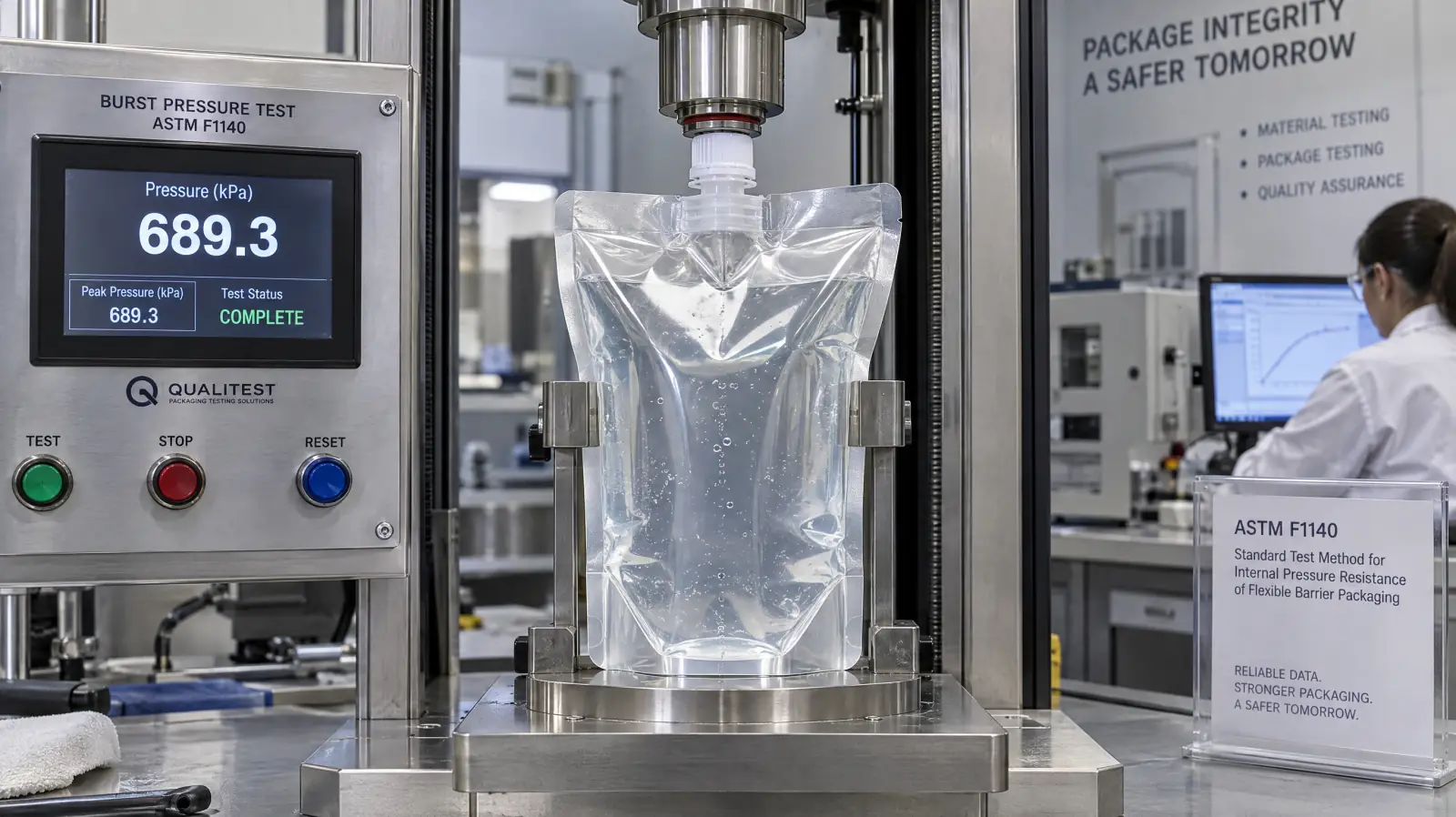
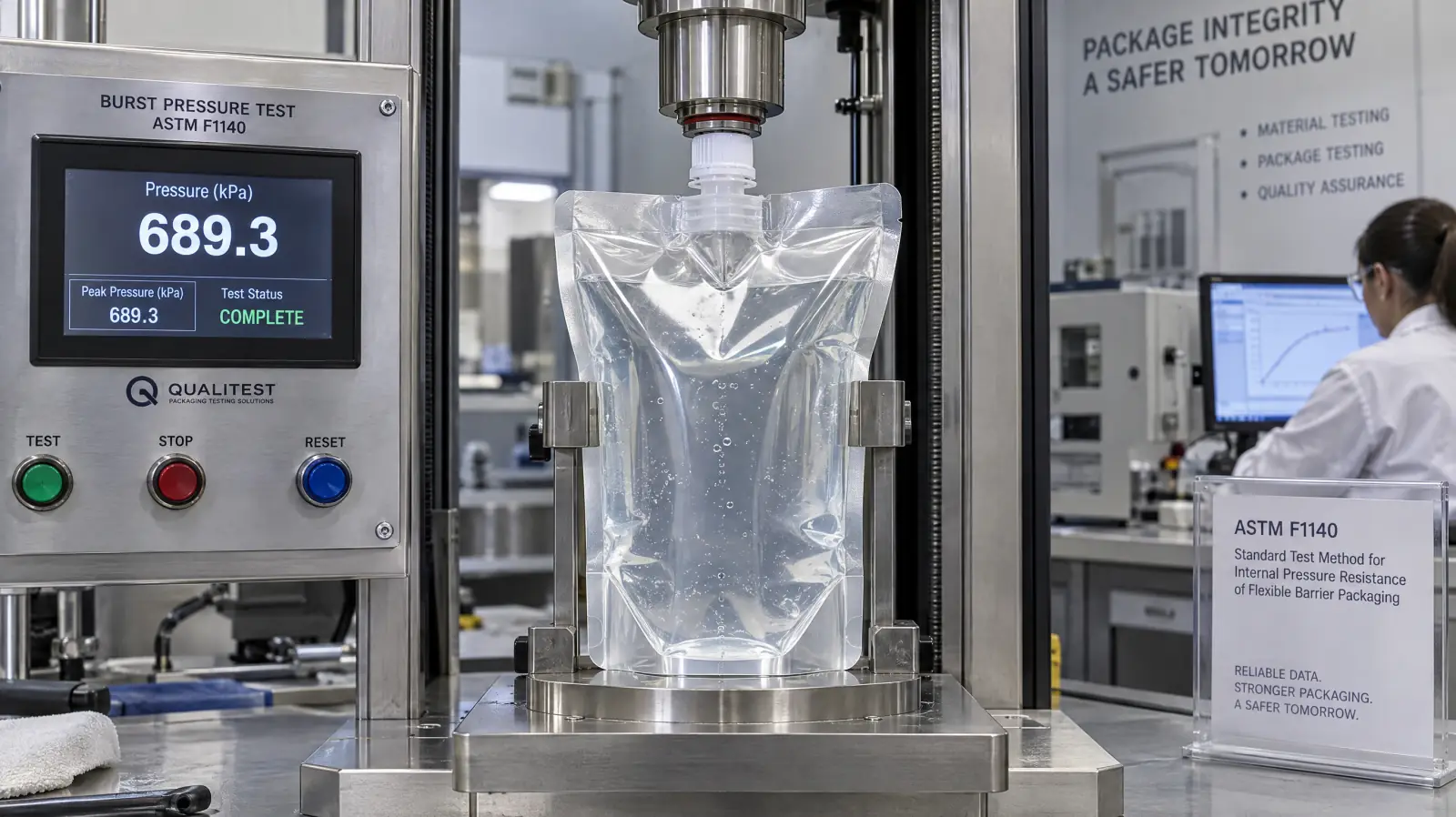
To guarantee zero-leakage distribution, packaging engineers rely on two rigorous testing standards: ASTM D5276 (Free-Fall Drop Testing) and ASTM F1140 / ASTM F2054 (Internal Pressurization & Burst Testing). This guide analyzes test protocols, failure modes, fitment welding physics, and resin rheology.
1. Quick Engineering Benchmark Matrix
| Performance Attribute | ASTM D5276 Free-Fall Drop Test | ASTM F1140 / F2054 Burst Pressure Test |
|---|---|---|
| Primary Failure Mode Tested | Dynamic hydraulic shock & corner puncture | Static & creep pressure tensile seal failure |
| Test Mechanism | Vertical free-fall onto rigid steel impact plate | Pneumatic inflation to burst or hold threshold |
| Standard Fall Height | 1.2 meters to 1.8 meters (dependent on package mass) | N/A (regulated pneumatic inflation rate) |
| Pass/Fail Threshold | 100% survival on 5-drop sequence (Zero micro-leaks) | ≥ 0.35 to 0.55 MPa (50 to 80+ psi) |
| Critical Stress Zone | Bottom gusset fold corners & fitment junction | Transverse side seal borders & fitment feather edge |
| Governing Package Standard | ISTA 3A / ASTM D4169 distribution cycle | ASTM F1140 (Unrestrained) / ASTM F2054 (Restrained) |
| Key Mitigating Resins | High-puncture mLLDPE & BOPA (Nylon) | High-melt-strength plastomer sealants |
Compare structural designs in our Spout Fitment Engineering Guide and Stand-Up Pouches Category.
2. Hydraulic Shock Dynamics: The “Water Hammer” in Flexible Pouches
When an air-filled or gas-flushed pouch impacts a solid floor, internal gases compress, absorbing kinetic energy like an air cushion. In contrast, when a 1-liter liquid pouch drops from 1.5 meters, liquid behaves as an incompressible hydraulic ram:
┌────────────────────────────────────────────────────────────────────────┐
│                   DROP IMPACT HYDRAULIC PRESSURE DYNAMICS              │
├────────────────────────────────────────────────────────────────────────┤
│                                                                        │
│               [ DROP IMPACT: 1.5 METERS ONTO HARD STEEL ]              │
│                                                                        │
│                                   ▼                                    │
│                 ┌───────────────────────────────────┐                  │
│                 │          SPOUT FITMENT            │                  │
│                 │      ▲                     ▲      │                  │
│                 │      │ HYDRODYNAMIC WAVES  │      │                  │
│                 │      │ REFLECT TO CORNERS  │      │                  │
│                 │      │                     │      │                  │
│                 │   ┌──┴─────────────────────┴──┐   │                  │
│                 │   │                           │   │                  │
│                 │   │    LIQUID CORE INERTIA    │   │                  │
│                 │   │    (Incompressible Mass)  │   │                  │
│                 │   │                           │   │                  │
│                 │   └──┬─────────────────────┬──┘   │                  │
│                 │      ▼                     ▼      │                  │
│                 └───────┬───────────────────┬───────┘                  │
│                         │   IMPACT POINT    │                          │
│                         ▼                   ▼                          │
│                 ═════════════════════════════════════ (Steel Floor)    │
│                                                                        │
│   1. Floor stops bottom pouch film in < 2 milliseconds.                │
│   2. Liquid momentum generates internal pressure wave: 15–25 bar peak. │
│   3. Fluid forces radiate outward into bottom gusset intersection welds│
│      and upward into the rigid spout boat fitment base.                │
│                                                                        │
└────────────────────────────────────────────────────────────────────────┘
The greatest stress concentrations occur at two geometric discontinuities:
- The Spout Base Wings (“Boat” Fitment): The transition line between rigid molded plastic (high modulus of elasticity) and flexible film (low modulus).
- The K-Seal or Round Gusset Intersection: The intersection where 2 layers of film abruptly transition into 4 layers at the bottom gusset.
3. ASTM D5276 Drop Testing Protocol
The standard protocol simulates accidental human handling drops and automated warehouse conveyor falls:
ASTM D5276 DROP ORIENTATION ROTATION
┌─────────────────┐   ┌─────────────────┐   ┌─────────────────┐
│   FLAT BOTTOM   │   │  45° BASE WELD  │   │  SIDE EDGE GUSSET
│   (Gusset Face) │   │  (Corner Impact)│   │  (Shear Force)  │
│        ▼        │   │        ▼        │   │        ▼        │
│   ═══════════   │   │   ═══════════   │   │   ═══════════   │
│   Step 1        │   │   Step 2        │   │   Step 3        │
└─────────────────┘ └─────────────────┘ └─────────────────┘- Conditioning (ASTM D4332): Prior to drop testing, liquid pouches must be conditioned at 23°C ± 1°C at 50% RH for 24 hours. For cold-chain products, samples are conditioned at 4°C or -18°C to test low-temperature polymer embrittlement.
- Drop Height Parameters:
- 0.1 kg – 0.5 kg fill weight: 1.50 meters drop height.
- 0.5 kg – 1.5 kg fill weight: 1.20 meters drop height.
-
1.5 kg (heavy-duty detergents/oils): 1.00 meter drop height.
- The 5-Drop Test Sequence: A single specimen must endure:
- Flat bottom drop (tests bottom gusset delamination).
- Front panel flat drop (tests hydraulic hoop stress).
- Back panel flat drop (tests seam peeling).
- 45° angle corner drop (tests stress concentration on the corner weld).
- Top spout-down drop (tests fitment neck shear).
4. ASTM F1140 & ASTM F2054 Internal Pressurization Testing
Pneumatic burst testing identifies the weakest seal zone and quantifies seal strength under uniform load:
┌────────────────────────────────────────────────────────────────────────┐
│               BURST TEST COMPARISON: F1140 vs F2054                    │
├───────────────────────────────────┬────────────────────────────────────┤
│     ASTM F1140 (UNRESTRAINED)     │      ASTM F2054 (RESTRAINED)       │
├───────────────────────────────────┼────────────────────────────────────┤
│                                   │                                    │
│             ┌───────┐             │          ═══════════════ [Plate]   │
│          /             \          │          ───────────────           │
│         |   BALLOONS   |          │         [ FLAT UNIFORM ]           │
│          \             /          │          ───────────────           │
│             └───────┘             │          ═══════════════ [Plate]   │
│                                   │                                    │
│   • Pouch expands into sphere     │   • Rigid plates constrain pouch   │
│   • Stresses center panel more    │     thickness to 12.5mm or 25mm    │
│   • Good for quick pass/fail      │   • Isolates 100% stress to the    │
│     production floor checks       │     perimeter perimeter seal lines │
│                                   │   • True quantitative seam audit   │
│                                   │                                    │
└───────────────────────────────────┴────────────────────────────────────┘- Creep-to-Fail Test (ASTM F1140): Pouch is pressurized to 80% of its ultimate burst value and held for 30 seconds. Pressure drop is measured to verify that seal creep rate is zero.
- Slow Pressurization Burst: Pressure increases linearly at 1.0 psi/sec until seal rupture occurs. Premium liquid pouches must withstand > 45 psi (3.1 bar) unrestrained, and > 70 psi (4.8 bar) under restrained ASTM F2054 plates.
5. Spout Fitment Sealing: Wing Design & Thermal Welding
The most critical operation in liquid pouch converting is sealing the injection-molded polyethylene fitment into the pouch:
FITMENT "BOAT" CROSS-SECTION & WELD ZONE
           ┌──────┐
           │ SPOUT│ (Threaded Neck)
           └──────┘
      ┌────────────────┐
      │  BOAT SHOULDER │
   ┌──┴────────────────┴──┐
◄──┤ FEATHERED WING TIPS  ├──►  <-- Tapers to 0.2mm edge
   └──────────────────────┘
   ════════════════════════
   POUCH FILM SEALANT LAYER
1. Feathered Wing Geometry
Inferior fitments use blunt-edged oval bases that create a sharp 90-degree step at the pouch boundary, creating a pinhole leak channel. High-performance boat fitments taper gradually to a razor-sharp 0.2mm edge, allowing the molten film sealant to wrap smoothly around the plastic without air voids.
2. Multi-Stage Thermal Sealing
Achieving 100% hermetic weld around a thick plastic base requires a 3-stage stepped heating profile:
- Stage 1 (Pre-Heat, 180°C–200°C): Softens the thick rigid PE fitment body without overheating the outer PET print film.
- Stage 2 (Fusion Weld, 195°C–215°C at 4.5 bar): High-pressure shaped sealing jaws fuse the inner LLDPE pouch film with the fitment wings, creating molecular polymer interdiffusion.
- Stage 3 (Cold Water Quench, 15°C–20°C): Immediately chills the molten weld under continuous clamp pressure, preventing post-seal crystallization shrinkage and stress embrittlement.
3. Melt Flow Index (MFI) Matching
A common cause of burst failure is mismatched rheology:
- If the pouch inner PE has an MFI of 1.0 g/10min while the fitment has an MFI of 7.0 g/10min, the fitment melts too quickly and squeezes out before the pouch sealant reaches fusion temperature.
- CraftPack Global engineers specify matched resin grades with narrow MFI deltas (ΔMFI ≤ 1.5) to guarantee cohesive polymer bonding.
6. Engineered Laminate Structures for Liquid Endurance
To endure hydraulic drop surges, flexible barrier films require oriented polyamides for tensile puncture absorption paired with metallocene PE:
┌────────────────────────────────────────────────────────────────────────┐
│            HEAVY-DUTY LIQUID SPOUT BARRIER LAMINATE (150µm)            │
├───────┬────────────────────────────────────────────────────────────────┤
│ LAYER │ COMPONENT & FUNCTION                                           │
├───────┼────────────────────────────────────────────────────────────────┤
│ Outer │ 12µm Biaxially Oriented Polyethylene Terephthalate (BOPET)     │
│ Core  │ 15µm Biaxially Oriented Polyamide (BOPA / Nylon 6)             │
│       │ -> Absorbs dynamic hydraulic water hammer kinetic shocks       │
│ Base  │ 120µm High-Strength Metallocene LLDPE (mLLDPE Plastomer)       │
│       │ -> Provides extreme hot tack and elasticity during drop impact │
└───────┴────────────────────────────────────────────────────────────────┘
For hot-fill or boiling liquids, review our autoclave-rated solutions in the Retort Pouch Science Guide.
7. Quality Assurance Checklist for Liquid Packaging Buyers
Before signing off on liquid packaging production:
- Request ASTM D5276 Drop Reports: Insist on testing with the actual specific gravity and viscosity of your liquid formulation (water behaves differently than viscous gel or oil).
- Audit Fitment Leakage with Vacuum Decay: Use ASTM F2338 non-destructive vacuum decay testing on pre-production runs.
- Verify ISTA 3A Carton Vibration: Test master shippers under random multi-axis transit vibration to detect pouch-on-pouch surface abrasion.
Secure Certified Zero-Leakage Spouted Pouches
CraftPack Global engineers liquid pouches with custom-molded boat fitments, automated ultrasonic pre-sealing, and complete ASTM D5276 laboratory drop qualification.
Contact Our Liquid Packaging Engineers to request dielines, fitment samples, and tailored burst testing documentation.