
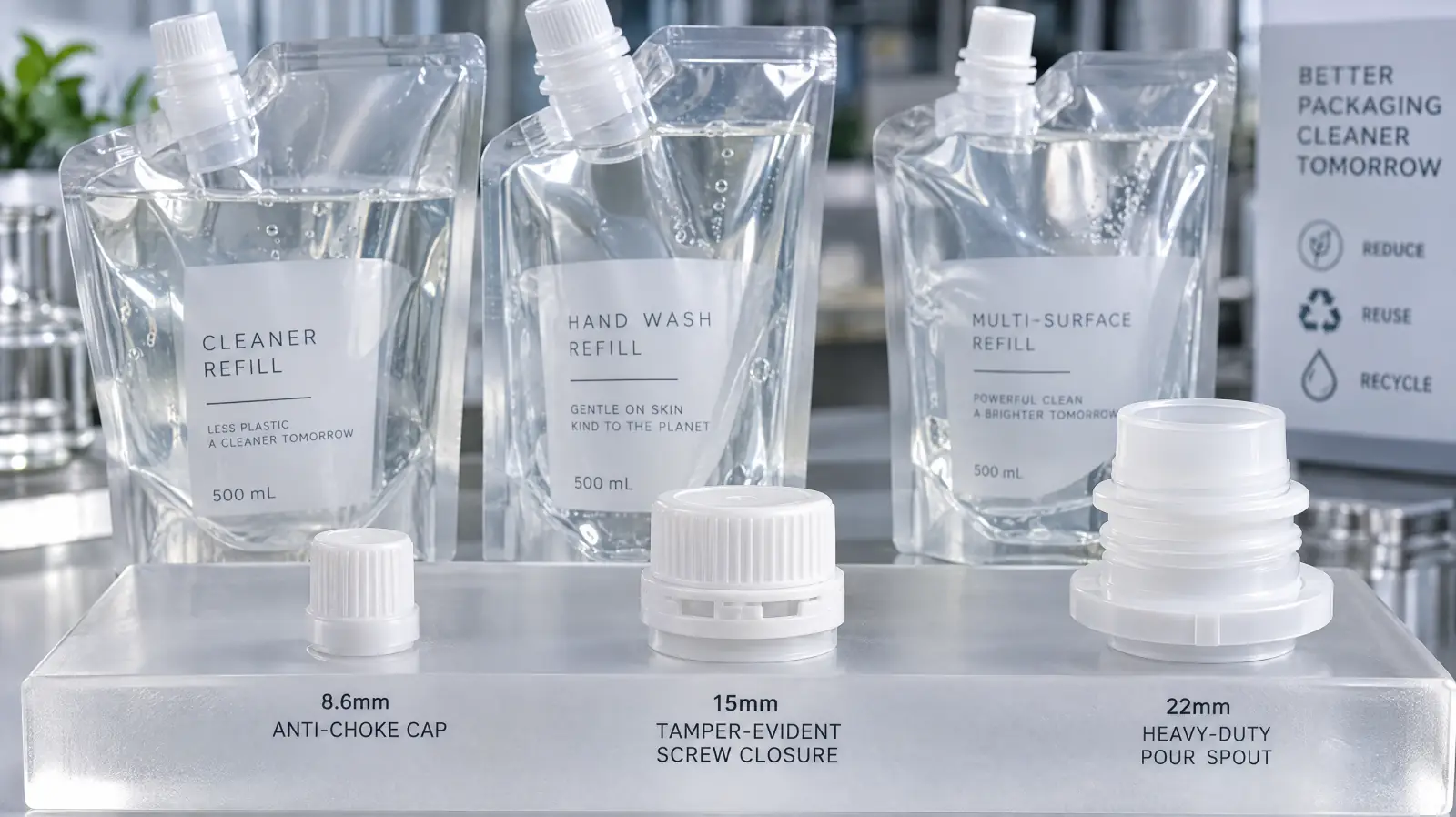
Spout Fitment Engineering: 8.6mm, 15mm & 22mm Closures
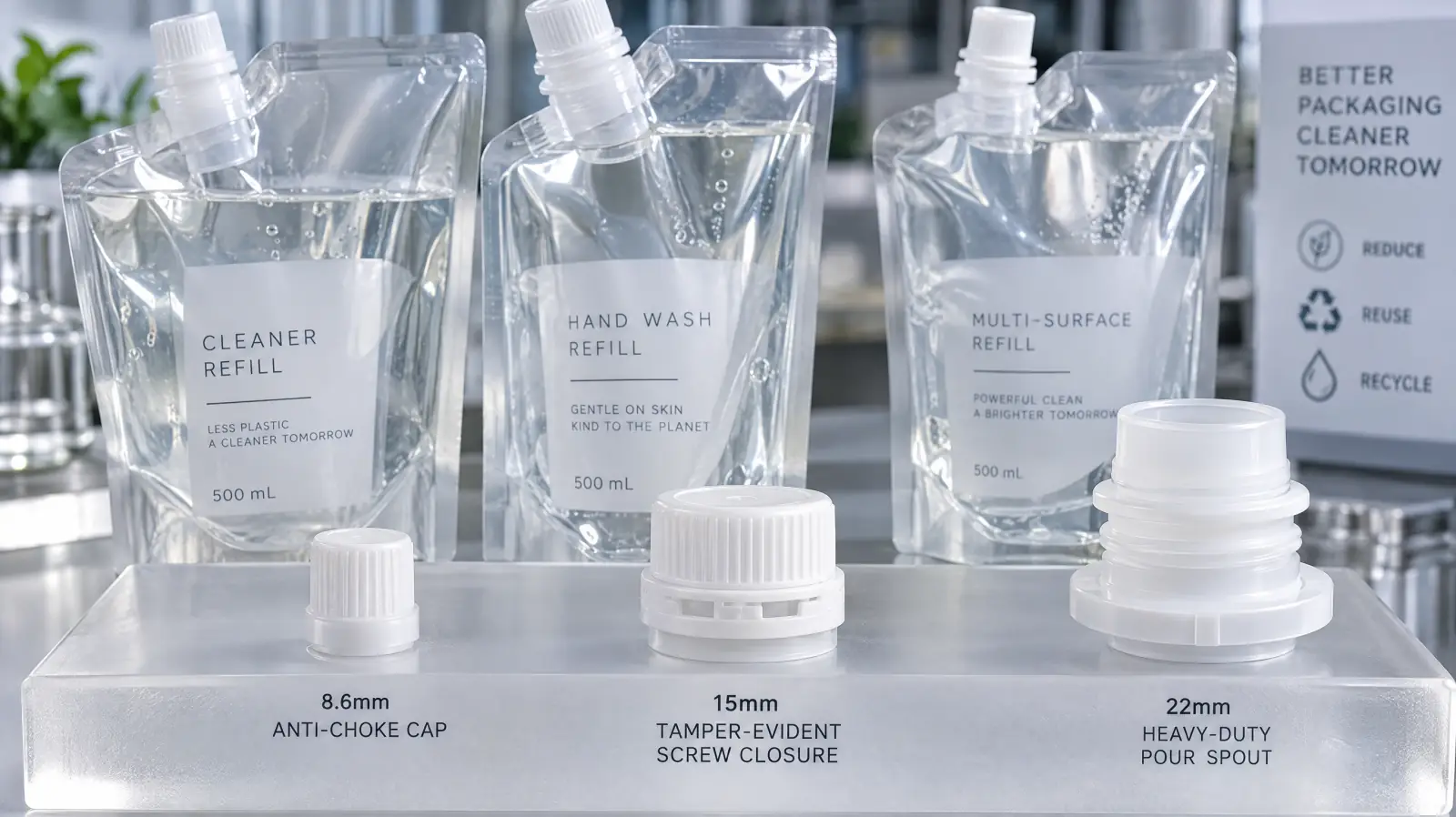
In the fast-growing flexible liquid packaging sector, transition from rigid blow-molded bottles to spouted barrier pouches offers compelling logistical savings: 85% less inbound freight volume, 70% lower plastic mass, and superior product evacuation exceeding 99%.
However, the functional success of a liquid pouch hinges upon a single high-stress component: the injection-molded spout fitment.
If the fitment diameter is too narrow, viscous liquids glug and clog during dispensing. If the weld base is poorly engineered, hydraulic shock during pallet drops causes seam blowouts at the pouch shoulder. And if the cap design violates regional child safety norms, products face immediate regulatory bans.
This technical engineering guide breaks down spout fitment selection across three industry-standard inner diameters—8.6 mm, 15 mm, and 22 mm—analyzing weld-base canoe geometry, anti-choke compliance, automated filling mechanics, and hydraulic burst testing.
1. Quick Selection Matrix: Spout Diameters & Applications
| Nominal Fitment Caliber | Inner Bore Diameter | Primary Target Viscosity | Optimal Pouch Volume | Standard Cap Configurations | Key Industry Use Cases |
|---|---|---|---|---|---|
| 8.6 mm / 9.0 mm | $8.6 \pm 0.2\text{ mm}$ | Low to Medium (Water to Puree) | 100 ml to 500 ml | Anti-Choke (ventilated), Tamper-Evident | Baby food purees, sports energy gels, fruit smoothies, juices |
| 15 mm / 16 mm | $15.0 \pm 0.3\text{ mm}$ | Medium to High (Gels, Soaps, Sauces) | 500 ml to 2.5 L | Tamper-Evident Screw, Flip-Top, Pull-Push | Laundry detergent refills, hand soaps, mayonnaise, motor oil |
| 22 mm / 33 mm | $22.0 – 33.0\text{ mm}$ | High / Chunky / Heavy Liquid | 2.5 L to 10.0 L | Heavy-Duty Threaded, Butterfly Tap, Spigot | Bulk food service oils, industrial lubricants, chemical refills |
Explore liquid pouch formats in our Stand-Up Pouches Category and compare options in our Spout Pouches vs Rigid Bottles Guide.
2. Anatomy of a Spout Fitment: The Canoe Base Weld
The connection point between a rigid plastic fitment and flexible laminated film is the most vulnerable transition zone in packaging engineering. Under dynamic transit, liquid shifts rapidly, concentrating hydraulic pressure directly at the fitment base.
┌────────────────────────────────────────────────────────────────────────┐
│                   INJECTION-MOLDED SPOUT ANATOMY                       │
├────────────────────────────────────────────────────────────────────────┤
│                                                                        │
│   [ 1. Tamper-Evident Screw Cap / Flip-Top ]                           │
│   [ 2. Threaded Spout Neck (Neck Finish: 8.6mm / 15mm / 22mm) ]        │
│   [ 3. Automated Gripper Flange (Supports Filling Machine Clamps) ]    │
│   [ 4. Tapered "Canoe-Shaped" Base ] ◄── Critical Stress Dissipation   │
│        /──────────────────────────────\                                │
│       /     Dual Ultrasonic Energy     \                               │
│      /           Director Ribs          \                              │
│                                                                        │
└────────────────────────────────────────────────────────────────────────┘
Why the “Canoe” Geometry Is Essential
Standard round tubes cannot be reliably heat-sealed between two flat sheets of barrier film. When flat film converges around a sharp cylinder, a triangular capillary micro-void forms on both flanks, leading to pinhole liquid leaks.
To eliminate this, liquid packaging fitments feature aerodynamic canoe wings:
- Gradual Angle of Convergence: The canoe tapers to a knife-edge tip on both lateral extremes, allowing the converging film layers to press flat against the polymer base without crease stress.
- Polymer Compatibility: The fitment resin must precisely match the pouch’s inner sealant layer:
- For Polyethylene-based pouches: Use Low-Density Polyethylene (LDPE) or LLDPE fitments.
- For Retort / Hot-Fill Polypropylene pouches: Use Random Copolymer Polypropylene (R-PP) fitments.
- Energy Director Ribs: Molded micro-ridges concentrate heat during thermal conduction or ultrasonic sealing, melting resin outward to fill microscopic voids.
3. Detailed Diameter Breakdown
1. The 8.6mm Fitment: Purees, Juices & Child Safety
The 8.6mm inner bore is the global standard for on-the-go snack pouches and infant nutrition:
- Controlled Flow Rate: Limits fluid delivery speed, allowing toddlers and athletes to consume purees without choking or splashing.
- Child Safety (Anti-Choke Compliance): In accordance with BS EN 14350 and US CPSC 16 CFR Part 1501 regulations, caps intended for children under 36 months must incorporate anti-asphyxiation features:
- Oversized Outer Diameter: Minimum diameter exceeding 32 mm to 35 mm, preventing the cap from passing through an infant airway testing cylinder.
- Ventilated Geometry: Slotted air channels permit breathing even in the tragic event of accidental aspiration.
2. The 15mm Fitment: The Workhorse for Refill Pouches
As consumer packaged goods brands eliminate single-use plastic bottles, the 15mm spout pouch has become the dominant format for home-care refills:
- Smooth, Glug-Free Decanting: A 15mm bore allows ambient air to enter the pouch simultaneously as viscous liquid pours out, preventing violent vacuum surging when refilling narrow pump bottles.
- Flow Performance: Dispenses 1 liter of laundry detergent or olive oil in under 6 to 8 seconds.
- Tamper-Evident Ring: An injection-molded ratchet band fractures with an audible snap upon first rotation, guaranteeing product purity for high-value organic oils or cosmetics.
3. The 22mm–33mm Fitment: Foodservice & Bulk Decanting
Designed for heavy-duty commercial applications (3 to 10 liters):
- High-Throughput Pouring: Capable of decanting bulk cooking oils, automotive DEF fluids, liquid egg mixes, and pancake batters in commercial kitchens.
- Optional Dispensing Valves: Can be paired with push-button butterfly valves, push-pull taps, or silicone zero-drip duckbill check-valves for shelf-stable bag-in-box dispensers.
4. Filling Automation: Through-the-Spout vs. Top-Open Filling
When engineering a spouted pouch packaging line, manufacturers choose between two operational methodologies:
METHOD A: PRE-INSERTED SPOUT (THROUGH-THE-SPOUT FILLING)
┌──────────────┐     ┌──────────────┐     ┌──────────────┐
│  PRE-VALVED  │ ──> │ HIGH-PRESSURE│ ──> │  AUTOMATED   │
│  EMPTY POUCH │     │ NEEDLE FILL  │     │ CAPPING HEAD │
└──────────────┘     └──────────────┘     └──────────────┘
• Factory pre-welds spout with hermetic seal integrity
• Cleanroom filling; zero liquid splashing on seal zones
• Best for low-to-medium viscosity fluids

METHOD B: TOP-OPEN FILLING (CAPPED FITMENT INSERTION)
┌──────────────┐     ┌──────────────┐     ┌──────────────┐
│ POUCH WITH   │ ──> │ GRAVITY DUAL │ ──> │ THERMAL JAWS │
│ CAPPED SPOUT │     │ WIDE-MOUTH   │ ──> │ SEAL TOP RIM │
└──────────────┘     └──────────────┘     └──────────────┘
• Product filled through open top cavity; spout is pre-capped
• Allows chunky solids (salsa, stews, pulpy fruit)
• Requires post-fill ultrasonic wash to prevent seal contamination- Through-the-Spout Benefits: Eliminates top heat-sealing at your packaging facility. The pouch arrives pre-sealed on all edges; liquid is injected at high speed directly through the bore, followed by automated cap torqueing.
- Torque Consistency: Precision capping chucks apply 1.2 to 2.4 N·m of dynamic torque to ensure leak-free seals without stripping plastic threads.
5. Barrier Chemistry & Drop-Test Engineering
Liquids subject flexible packaging films to continuous hydraulic pressure and chemical corrosion:
- Surfactant Resistance & ESCR: Aggressive liquid soaps and motor additives contain wetting agents that attack polymer amorphous regions, causing Environmental Stress Crack Resistance (ESCR) failure. Fitment polymers must incorporate stress-crack resistant hexene or octene copolymer resins.
- ASTM D5276 Drop Testing: A fully filled 1-liter spouted pouch must survive three successive 1.5-meter (5-foot) free-fall drops onto polished steel plates (flat face impact, bottom gusset impact, and 45-degree shoulder impact) without seal delamination or fitment cracking.
- Multi-Ply Barrier Formulation:
- For oxygen-sensitive drinks:
PET 12µm / AL Foil 7µm / OPA (Nylon) 15µm / LLDPE 100µm. - For chemical/detergent liquids:
PET 12µm / OPA 15µm / High-Tack Heavy LLDPE 120µm. - Recyclable mono-material: High-barrier MDO-PE / PE barrier pouches paired with 100% PE fitments for full circular recycling.
- For oxygen-sensitive drinks:
6. Engineering RFP Checklist for Liquid Pouches
- Liquid Density & Viscosity: Report dynamic viscosity in centipoise ($cP$) across 20°C and 40°C.
- Target Net Fill Volume: 100ml, 500ml, 1.0L, 2.5L, or 5.0L.
- Bore Caliber: 8.6mm (puree/beverage), 15mm (refill/soap/oil), or 22mm (bulk food service).
- Cap Specification: Anti-choke ventilated, tamper-evident tear band, or flip-top dispenser.
- Placement: Top center vs 45-degree ergonomic corner shoulder.
- Thermal Processing: Ambient fill, hot fill (85°C–90°C), or autoclave retort (121°C).
Partner with CraftPack Global for Liquid Packaging
From tamper-evident baby puree pouches to heavy-duty 5-liter detergent refill carriers, CraftPack Global engineers leak-proof fitments, custom barrier laminates, and high-speed filling line compatibility.
Contact Our Liquid Packaging Engineers today to request fitment samples, CAD engineering drawings, and volume quotations.