
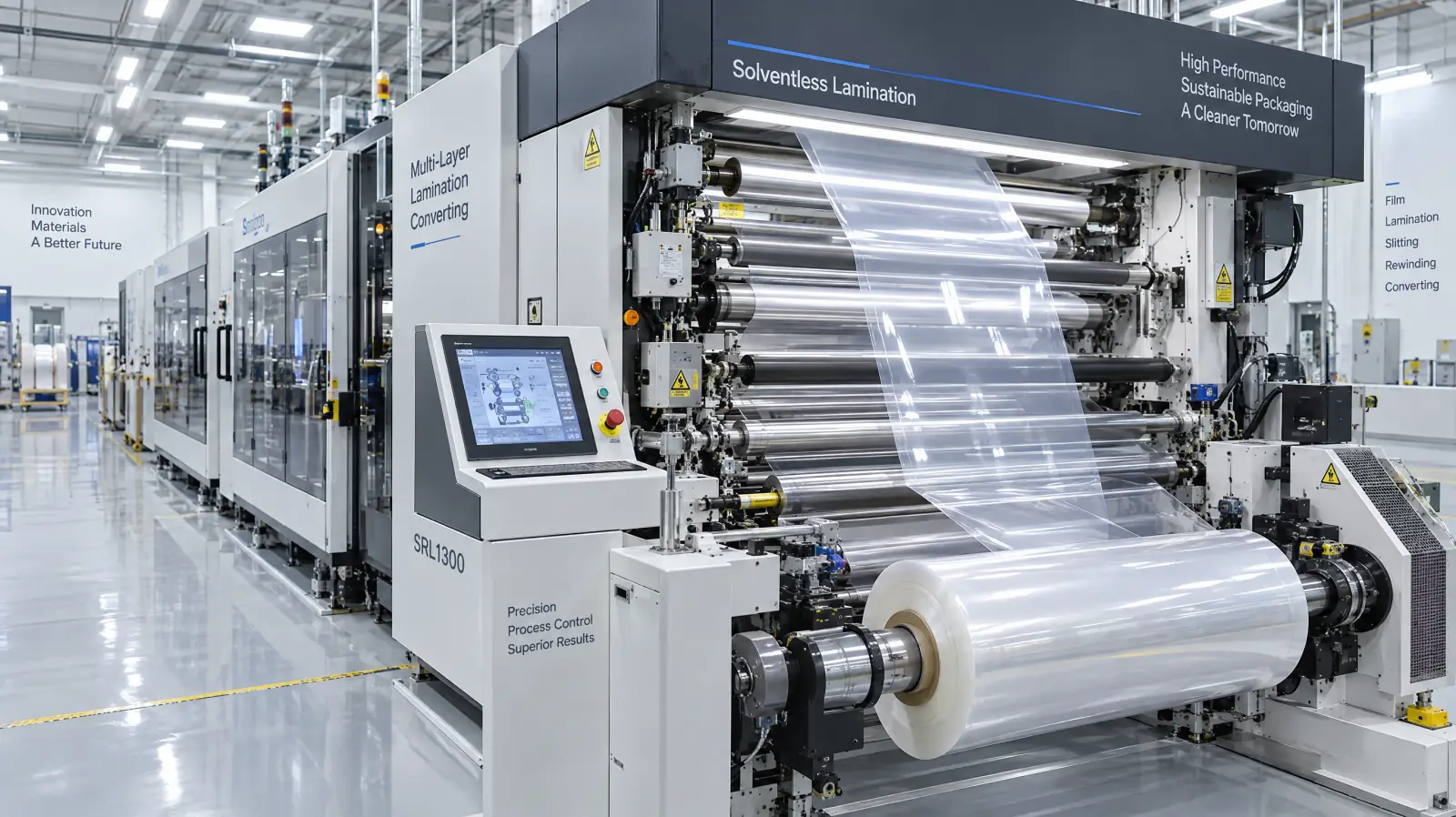
Solventless vs Solvent-Based Lamination: Food Safety & Bond Guide
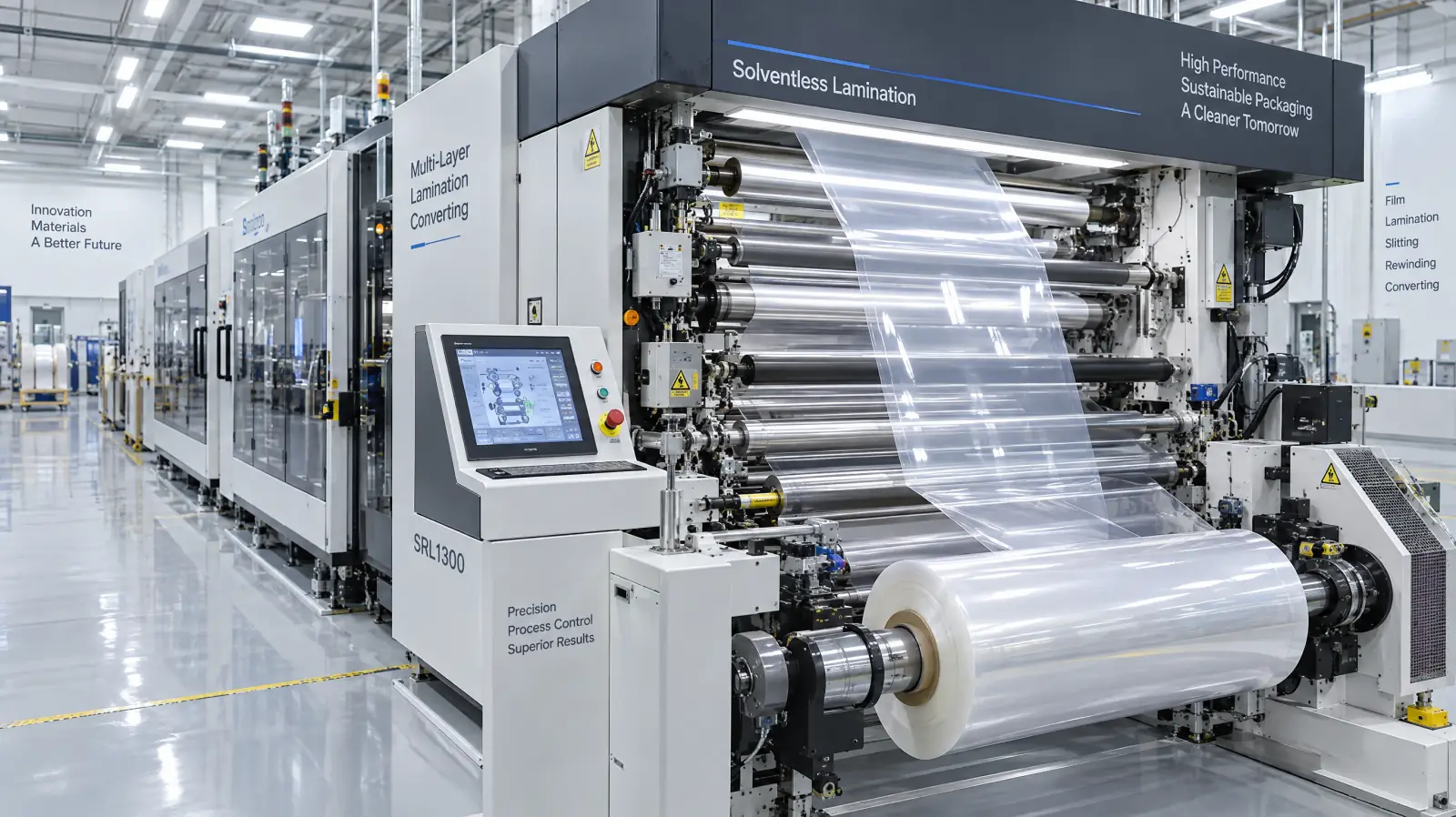
In flexible packaging converting, multi-layer barrier films are rarely manufactured as single extruded sheets. Achieving the required combination of tensile toughness, gas barrier impermeability, and heat-seal integrity requires bonding disparate substrates—such as Biaxially Oriented Polyester (BOPET), Aluminum Foil (AL), Biaxially Oriented Polyamide (BOPA), and Cast Polyethylene (PE)—into a unified composite web.
The chemical bridge holding these films together is the lamination adhesive system.
Historically, flexible packaging relied heavily on solvent-based lamination (SL) utilizing volatile organic solvents (primarily ethyl acetate). However, tighter environmental limits on Volatile Organic Compounds (VOCs), rising energy costs, and stringent food safety regulations on chemical migrant leaching have driven global converters toward solventless (solvent-free) lamination (SFL).
This engineering guide compares solventless and solvent-based lamination across polyurethane polymer chemistry, Primary Aromatic Amine (PAA) migration compliance (EU 10/2011 and FDA 21 CFR § 175.105), peel bond strength, and curing chamber kinetics.
1. Quick Engineering Benchmark Matrix
| Converting Parameter | Solventless Lamination (SFL) | Solvent-Based Lamination (SBL) |
|---|---|---|
| Adhesive Vehicle | 100% reactive solids (zero solvent) | 30%–45% solids diluted in Ethyl Acetate carrier |
| Drying Energy & Oven | Zero drying oven required (room temp nip) | Requires 15–25m heated drying tunnel (80°C–120°C) |
| Operating Press Speed | High speed (350 to 500+ m/min) | Moderate speed (180 to 280 m/min) |
| Adhesive Laydown Weight | 1.2 to 2.0 GSM (Micro-thin) | 2.5 to 4.5 GSM (Thicker solid laydown) |
| Primary Aromatic Amine Risk | Must control NCO/OH ratio & cure time | Lower PAA risk on aliphatic grades |
| Curing Time to Slit | 24 to 72 hours in 40°C heated curing room | Faster initial green bond (can slit in 12–24 hrs) |
| Aggressive Chemical Retort | Excellent for standard food/dry snacks | Superior for 121°C–135°C retort autoclaves |
| VOC Emissions & Carbon Footprint | Zero VOC emissions; 70% lower energy | High VOC (requires catalytic thermal oxidizer) |
Explore compatible barrier packaging formats in our Stand-Up Pouches Category and Retort Pouch Science Guide.
2. Chemical Mechanics: Cross-Linking vs. Solvent Evaporation
Understanding the bonding chemistry explains the differences in speed, energy, and migration:
┌────────────────────────────────────────────────────────────────────────┐
│               LAMINATION ADHESIVE COATING DYNAMICS                     │
├───────────────────────────────────┬────────────────────────────────────┤
│     SOLVENTLESS LAMINATION        │      SOLVENT-BASED LAMINATION      │
├───────────────────────────────────┼────────────────────────────────────┤
│                                   │                                    │
│   1. Polyol + Isocyanate (100%)   │   1. Polyurethane resin dissolved  │
│      pumped to heated meter rolls │      in 65% volatile Ethyl Acetate │
│   2. Calibrated 5-roller system   │   2. Gravure roll coats wet glue   │
│      spreads ultra-thin 1.5 GSM   │   3. Web passes 20m heated oven    │
│   3. Nip roller fuses webs at 50°C│      evaporating 99.9% solvent     │
│   4. Pouch web wound into roll    │   4. Heated calender nip bonds     │
│   5. 48-hr room cure forms PU     │      dry tacky resin to web 2      │
│                                   │                                    │
│   • ZERO VOC emissions            │   • High energy for drying oven    │
│   • Requires chemical cure time   │   • High initial mechanical tack   │
│                                   │                                    │
└───────────────────────────────────┴────────────────────────────────────┘
Solventless Polyurethane Chemistry
Solventless adhesives consist of two liquid components at 100% active solids:
- Part A (Isocyanate prepolymer, $-N=C=O$): Typically based on Diphenylmethane Diisocyanate (MDI).
- Part B (Polyol resin, $-OH$): Polyether or polyester polyol.
When mixed at precise stoichiometric ratios (e.g., 100:60 to 100:80) at 40°C–50°C, the isocyanate and hydroxyl groups react through addition polymerization, forming a cross-linked polyurethane elastomer: $$R-NCO + R’-OH \longrightarrow R-NH-COO-R’ \quad \text{(Polyurethane Linkage)}$$
Because there is no solvent vehicle to flash off, no heated drying tunnel is needed, saving substantial thermal electricity.
3. Food Contact Safety: Primary Aromatic Amines (PAAs)
The most critical regulatory compliance audit for solventless food packaging is Primary Aromatic Amine (PAA) migration:
UNREACTED MONOMER MIGRATION HAZARD
┌──────────────────────────────────────────────────────────────┐
│  Residual Unreacted MDI Isocyanate Monomer                   │
│  [ O=C=N - Benzene - CH2 - Benzene - N=C=O ]                 │
│                      │                                       │
│                      ▼ + Food Water (H2O Hydrolysis)         │
│  [ H2N - Benzene - CH2 - Benzene - NH2 ]                     │
│  4,4'-Methylenedianiline (4,4'-MDA) = CARCINOGENIC PAA       │
└──────────────────────────────────────────────────────────────┘- The Risk Mechanism: In aromatic solventless systems, if the converting line has poor stoichiometric metering or the laminated roll is sent to pouch slitting prematurely, unreacted monomeric isocyanate ($NCO$) remains free in the adhesive matrix. When liquid or moist food is filled into the pouch, moisture migrates through the inner PE film, hydrolyzing the isocyanate into Primary Aromatic Amines (PAAs) such as 4,4’-MDA, which are classified as potential human carcinogens.
- Regulatory Standards:
- EU Regulation (EU) 10/2011: Mandates that the total migration of Primary Aromatic Amines into food simulant must be undetectable, with a strict detection limit of < 0.01 mg/kg (10 parts per billion).
- FDA 21 CFR § 175.105: Sets rigorous standards for adhesives in direct and indirect contact with food.
- The Engineering Countermeasure: Converting facilities store wound master rolls in temperature-controlled curing rooms (35°C–45°C) for 48 to 72 hours. Elevated temperature accelerates chemical cross-linking until residual isocyanate content drops below the critical PAA migration safety threshold, verified via photometric or LC-MS/MS testing.
4. Bond Strength & Peel Resistance: ASTM D1876
Bond strength measures the force required to separate the laminated plies:
┌────────────────────────────────────────────────────────────────────────┐
│            TYPICAL T-PEEL BOND STRENGTHS BY SUBSTRATE PAIR             │
├──────────────────────┬──────────────────────┬──────────────────────────┤
│ SUBSTRATE PAIR       │ SOLVENTLESS (N/15mm) │ SOLVENT-BASED (N/15mm)   │
├──────────────────────┼──────────────────────┼──────────────────────────┤
│ BOPET / LLDPE        │ 4.5 – 6.5 (Film Tear)│ 4.5 – 6.5 (Film Tear)    │
│ BOPP / VM-CPP        │ 2.0 – 3.0 (Metal Lift│ 2.2 – 3.2 (Metal Lift)   │
│ BOPA (Nylon) / LLDPE │ 5.0 – 8.0 (Film Tear)│ 5.5 – 8.5 (Film Tear)    │
│ BOPET / AL FOIL / PE │ 3.5 – 5.0            │ **4.5 – 6.5 (Superior)** │
└──────────────────────┴──────────────────────┴──────────────────────────┘- Film Tear Failure (Cohesive Substrate Failure): In high-performing laminates, peel strength exceeds 4.0 N/15mm. At this force, the polymer film tears apart before the adhesive delaminates—the gold standard of laminate integrity.
- Metal Adhesion (Metallized BOPP/PET): When laminating metallized films, solventless adhesives exert minimal mechanical stress, preserving microscopic vacuum-deposited aluminum crystals without cracking the metal layer.
5. When to Choose Solvent-Based Over Solventless
While solventless lamination accounts for over 70% of standard snack and dry food packaging, solvent-based systems remain mandatory in demanding niches:
- Ultra-High Temperature Retort Autoclaves (121°C–135°C): Retort pouches containing wet pet food, ready meals, or soups endure 45 minutes of pressurized steam. Specialized epoxy- or polyester-based solvent adhesives resist thermal depolymerization and hot grease attack better than standard solventless polyurethanes.
- Aggressive Chemical Resistance: Products containing volatile free fatty acids, citrus oils (limonene), or industrial solvents can plasticize solventless polyurethane bonds over time. Solvent-based adhesives provide superior chemical cross-link density.
- High-Clarity Glass-Clear Film Lamination: For windowed bags displaying pasta or nuts, solvent-based adhesives flow out smoothly, eliminating the microscopic “orange peel” optical haze that can occur on high-speed solventless coating rolls.
For meat and cheese preservation requirements, see our Vacuum Pouches vs Gas Flushing Guide.
6. Procurement & Quality Assurance Checklist
When specifying multi-layer barrier laminates for food packaging:
- Request PAA Migration Test Certificates: Mandate LC-MS/MS test reports confirming non-detectable PAA migration (< 0.01 mg/kg) under EN 13130 guidelines.
- Specify Retort-Grade Chemistry for Autoclaves: Never allow standard aliphatic solventless adhesives on pouches intended for autoclave sterilization above 100°C.
- Audit Bond Strength per ASTM D1876: Require factory QA testing of 180° T-peel bond strength across the beginning, middle, and end of every production roll.
Certified Laminating Excellence with CraftPack Global
CraftPack Global operates precision multi-station solventless and solvent-based laminating lines equipped with real-time gravimetric adhesive dosing, automated web tension feedback, and validated thermal curing facilities.
Contact Our Technical Lamination Team to request barrier laminate sample swatches, PAA migration test documentation, and volume quotes.