
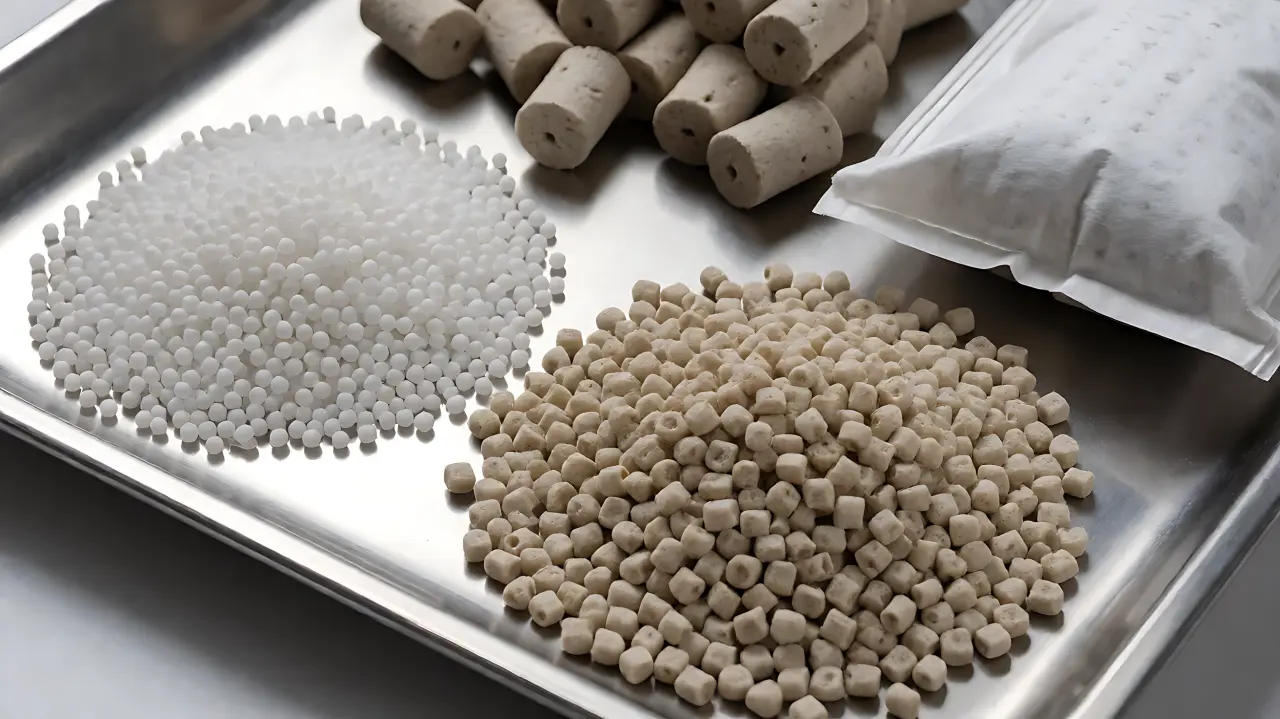
Silica Gel vs Molecular Sieve vs CaO Desiccants: Packaging Guide
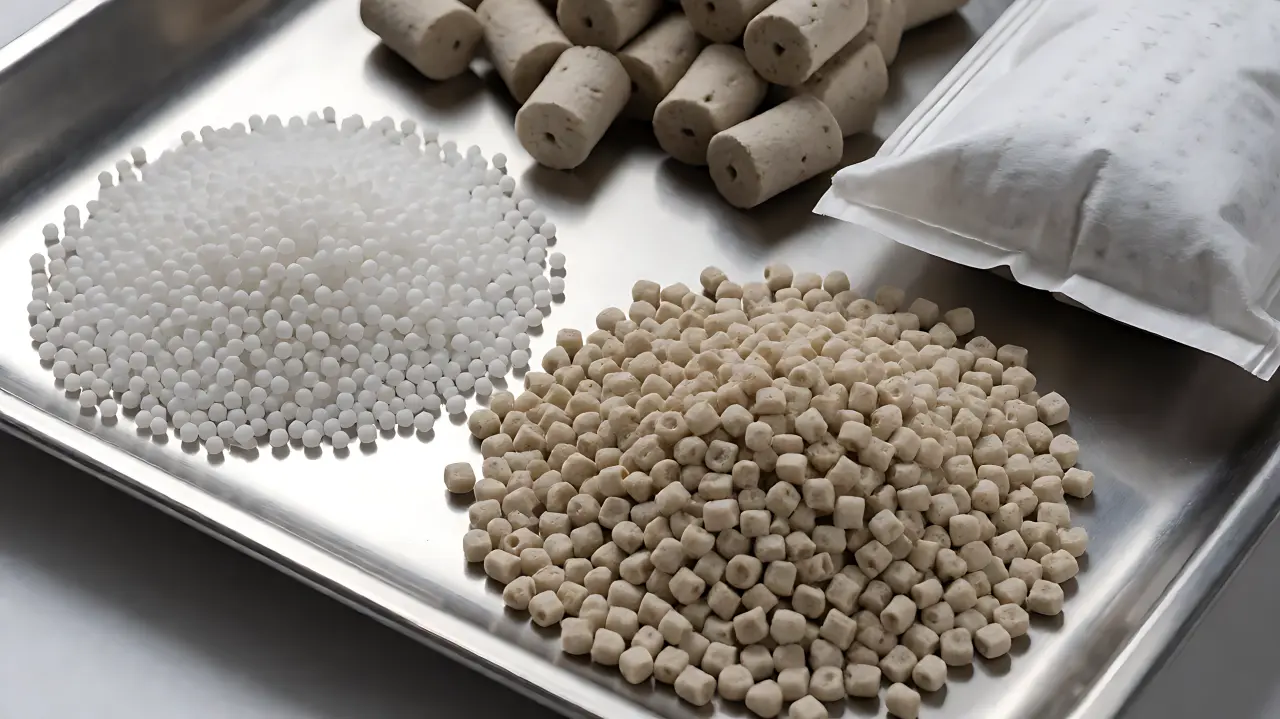
In moisture-critical protective packaging—spanning pharmaceutical diagnostics, optical assemblies, lithium-ion battery cells, and dehydrated snack foods—controlling ambient relative humidity (RH) inside sealed enclosures prevents hydrolytic chemical degradation, caking, mold development, and metal corrosion.
Desiccants are not universally interchangeable. Selecting between Silica Gel, Synthetic Zeolites (Molecular Sieve), and Calcium Oxide (Quicklime) depends directly on the target equilibrium relative humidity ($RH_{eq}$) and ambient storage temperature governed by MIL-D-3464E and DIN 55473.
Adsorption Isotherms & Chemical Mechanisms
The fundamental physics governing moisture uptake differs fundamentally between physical capillary condensation, crystalline cage trapping, and irreversible chemical hydration:
Adsorption Capacity (% Weight Gain of H2O) vs. Ambient Relative Humidity (% RH)
35% ┼                                                Silica Gel (Type A)
    │                                          ╭─────────────
30% ┼                                   ╭──────╯
    │                            ╭──────╯
20% ┼ ╭──────────────────────────╯             Molecular Sieve (4A)
    │ │
10% ┼ │                                        Calcium Oxide (Linear Hydration)
    │ │
 0% ┼─┴──────────────┴──────────────┴──────────────┴──────────────►
    0%              20%            40%            60%            80% RH
1. Silica Gel (Amorphous Silicon Dioxide, $\text{SiO}_2 \cdot n\text{H}_2\text{O}$)
- Mechanism: Physical adsorption via van der Waals forces and capillary condensation inside an interconnected network of microscopic pores ($20 - 30\text{ \AA}$ pore diameter).
- Behavior: Progressive S-shaped isotherm. At low relative humidity ($< 20%,\text{RH}$), silica gel absorbs moisture slowly and weakly. Its maximum capacity peaks at high humidity ($> 80%,\text{RH}$), where it can adsorb over $35%$ of its dry weight in water.
- Desorption Risk: Highly sensitive to temperature spikes. At temperatures above $50^\circ\text{C}$ (common in unventilated shipping containers), silica gel desorbs (releases) trapped moisture back into the headspace, creating condensation cycles.
2. Molecular Sieve (Crystalline Aluminosilicate Zeolite)
- Mechanism: Structural crystalline cage with precise, uniform sub-nanometer pore windows (Type 4A has uniform $4\text{ \AA}$ apertures, precisely matching water molecules).
- Behavior: Ultra-steep Type I isotherm. Molecular sieve scavenges water aggressively even at ultra-low relative humidity ($< 10%,\text{RH}$), driving package headspace moisture down to $< 1\text{ ppm}$ ($RH < 1%$).
- Thermal Stability: Strongly retains adsorbed water at elevated temperatures up to $100^\circ\text{C}$, preventing thermal moisture dumping during desert freight.
3. Calcium Oxide (Quicklime, $\text{CaO}$)
- Mechanism: Chemical chemisorption rather than physical adsorption:
$$\text{CaO} + \text{H}_2\text{O} \longrightarrow \text{Ca}(\text{OH})_2 + 65.2\text{ kJ/mol}$$
- Behavior: Absorbs moisture regardless of ambient RH, continuing to react until chemical conversion to calcium hydroxide is complete (absorbing $\approx 28.5%$ by weight).
- Exothermic Expansion: The chemical conversion releases heat and causes the desiccant volume to swell by up to 2.5 times, requiring heavy-duty expandable sachet membranes (such as tear-resistant non-woven Tyvek) to prevent burst failures.
Technical Performance Matrix
| Engineering Metric | Silica Gel (Type A) | Molecular Sieve (Type 4A) | Calcium Oxide (Quicklime) | Testing Standard |
|---|---|---|---|---|
| Capacity at 10% RH | $5% - 7%$ wt | $18% - 21%$ wt | $15% - 25%$ (Time-dep) | DIN 55473 |
| Capacity at 40% RH | $20% - 24%$ wt | $21% - 23%$ wt | $28%$ wt | MIL-D-3464E |
| Capacity at 80% RH | $32% - 38%$ wt | $22% - 24%$ wt | $28.5%$ wt | ASTM E96 |
| Moisture Scavenging Speed | Moderate | Extremely Fast | Slow (Days to weeks) | Kinetic Uptake |
| Thermal Retention ($>50^\circ\text{C}$) | Poor (Desorbs moisture) | Excellent (Retains water) | Complete (Permanent bond) | Dynamic Vapor Sorption |
| Dusting / Friability | Low (Spherical beads) | Very Low (Pellets/Beads) | Moderate (Powder swelling) | Mil-D-3464E Friability |
| Relative Cost | Baseline ($1\times$) | $1.8\times - 2.5\times$ | $0.8\times - 1.2\times$ | Industrial Market Price |
MIL-D-3464E Desiccant Sizing Equations
Under military and industrial protective packaging specifications (MIL-D-3464E), desiccant quantities are defined in standardized Desiccant Units (U), where 1 Unit absorbs at least $3.0\text{ g}$ of water vapor at $20%,\text{RH}$ and $6.0\text{ g}$ at $40%,\text{RH}$:
$$U = \frac{V \cdot c_v + A \cdot \text{WVTR} \cdot t + D \cdot c_d}{28.35}$$
Where:
- $V$: Volume of internal enclosed void space ($\text{m}^3$ or $\text{ft}^3$).
- $c_v$: Moisture content of initial enclosed air at sealing temperature.
- $A$: Total external area of the flexible barrier enclosure ($m^2$).
- $\text{WVTR}$: Water vapor transmission rate of the barrier film ($\text{g}/(\text{m}^2 \cdot 24\text{h})$).
- $t$: Target storage duration (days).
- $D$: Mass of hygroscopic packaging dunnage (paperboard, wooden pallets, corrugate) enclosed in the pouch.
- $c_d$: Moisture release factor of dunnage.
When sealing products in high-barrier foil flat-bottom bags or hermetic stand-up pouches, the transmission term $A \cdot \text{WVTR}$ approaches zero, allowing precise desiccant loading without over-packing.
Application Recommendations
- Select Molecular Sieve 4A: For diagnostic reagent strips, pharmaceutical tablets, optoelectronics, and lithium battery shipping where RH must be held below $5%$ and where high desert container shipping temperatures would cause silica gel to release moisture.
- Select Silica Gel: For consumer dry electronics, apparel leather goods, and dry foods operating at moderate room temperatures where the goal is preventing condensation above $40%,\text{RH}$.
- Select Calcium Oxide (CaO): For dehydrated seaweed (nori), dry crispy crackers, and agricultural exports in Asia, where long transit times and slow, irreversible moisture scavenging keep products exceptionally crisp at low initial cost.
Contact CraftPack Global to calculate exact desiccant unit requirements and source automated sachet dispensing rolls for high-speed flexible pouch packaging lines.