
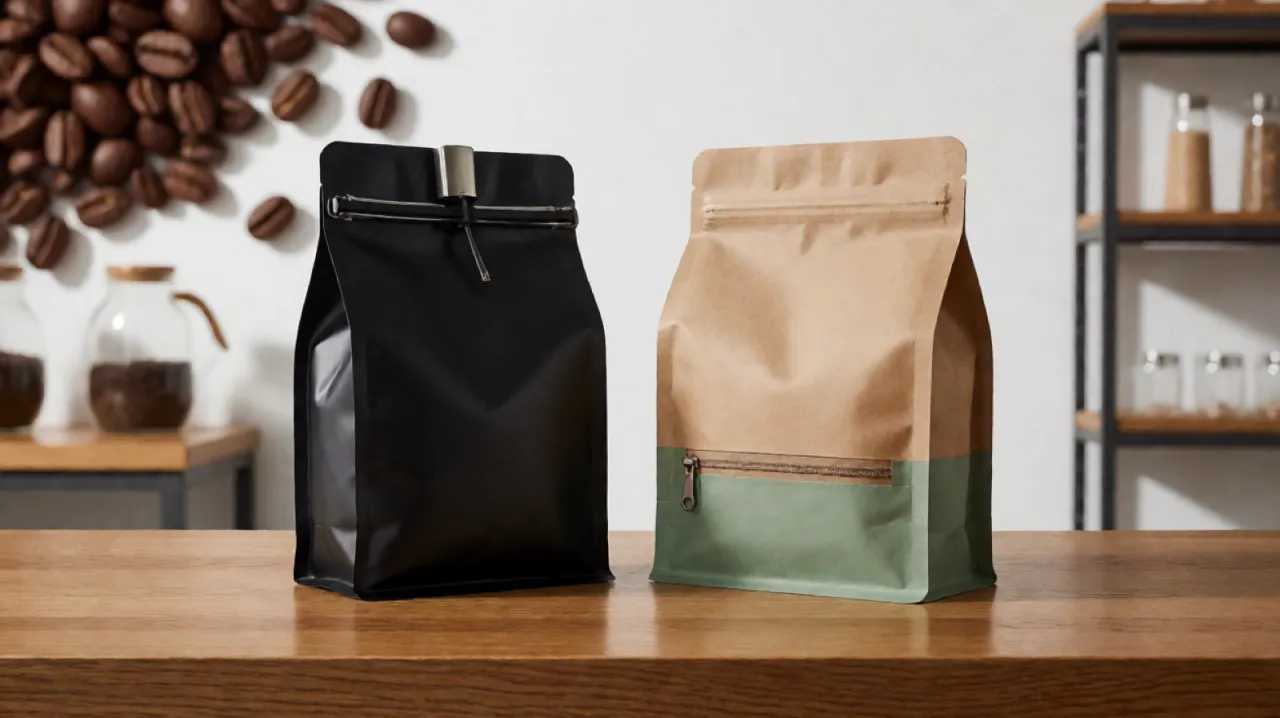
Side Gusset vs Flat Bottom Pouches: Coffee & Tea Roaster Guide
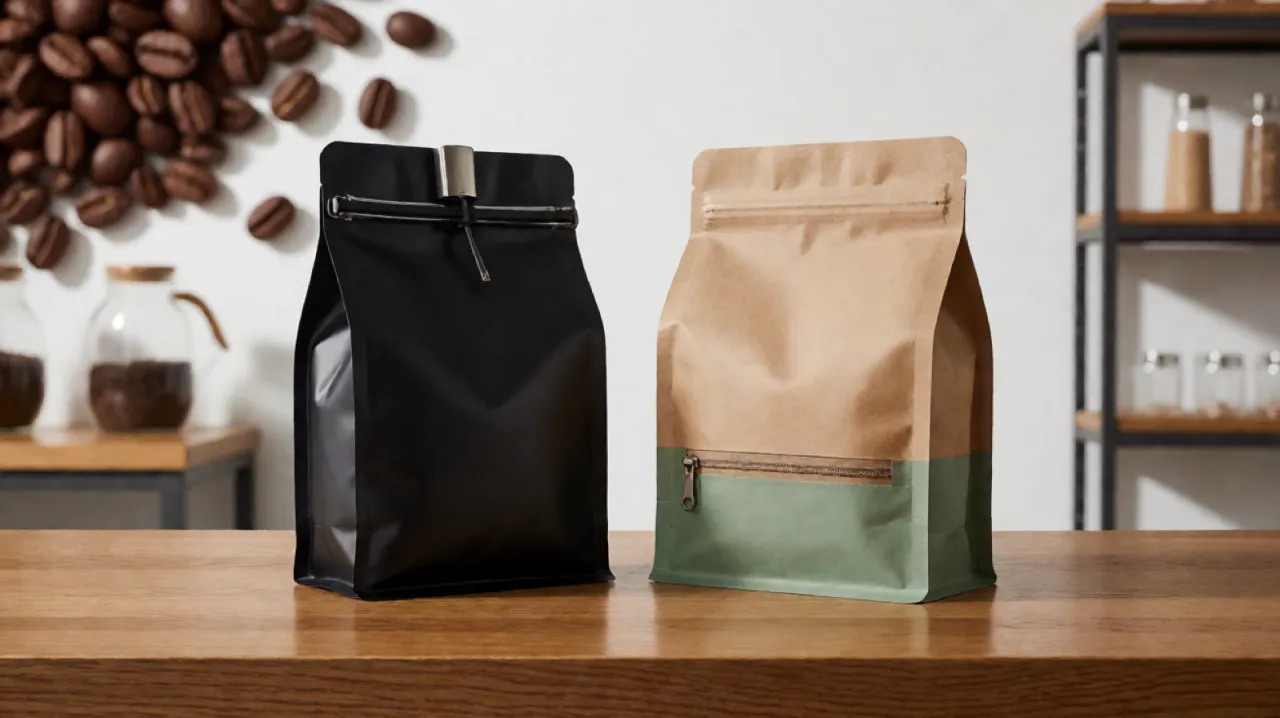
For specialty coffee roasters and premium loose-leaf tea packers, pouch geometry dictates far more than visual appeal. The structural format of your bag directly influences filling line throughput, palletization efficiency, carbon dioxide ($CO_2$) degassing dynamics, and whether your product stands proudly on retail shelves or slumps under settling weight.
While traditional side gusset bags have served as the dependable industry backbone for decades, modern flat bottom pouches (frequently termed box pouches or 8-side seal bags) have captured the high-end specialty market.
This technical guide compares both formats across structural engineering, degassing valve mechanics, filling line economics, and unit packaging costs to help roasters select the optimal format for their operations.
Structural Anatomy: Side Gusset vs. Flat Bottom
Understanding how each pouch is formed clarifies their operational strengths and mechanical limits.
Side Gusset Bag                      Flat Bottom Box Pouch
┌──────────────────┐                 ┌──────────────────┐
│  Top Heat Seal   │                 │  Pocket Zipper   │
├──────────────────┤                 ├──────────────────┤
│                  │                 │                  │
│   Front Panel    │ ◄- Side Gussets │   Front Panel    │ ◄- Independent Gussets
│                  │                 │                  │
├──────────────────┤                 ├──────────────────┤
│ Fold/Pinch Base  │                 │ Rectangular Base │ (True Flat Bottom)
└──────────────────┘                 └──────────────────┘
1. Side Gusset Bags (Folded & Quad-Seal Variations)
A side gusset bag features two side expansion folds tucked between a front and back panel.
- Base Structure: The bottom is formed either by a fold-over bottom seal (center-seal tube style) or a folded quad-seal edge. Because the bottom is not an independent geometric plane, the bag relies on the downward pressure of the product (whole beans or tea leaves) to push the gussets outward and establish a makeshift footing.
- Sealing & Closure: Once filled, the top is heat-sealed and typically folded downward twice, secured by an adhesive peel-and-stick tin tie, fold-down clips, or heat-sealed tape.
- Display Faces: Offers 4 printable surfaces (front, back, left gusset, right gusset).
2. Flat Bottom Pouches (8-Side Seal / Box Pouches)
A flat bottom pouch merges the structural stability of a rigid paperboard carton with the barrier and weight advantages of flexible film.
- Base Structure: It is manufactured with an entirely independent, completely flat rectangular base web bonded to four vertical perimeter seals. Even when completely empty, a flat bottom pouch stands fully upright without leaning.
- Sealing & Closure: Unlike side gusset bags, flat bottom pouches easily accommodate integrated pocket zippers (pull-tab tear strips) positioned below the top heat seal. Consumers pull the tab to open the pouch for the first time while keeping the internal press-to-close zipper intact.
- Display Faces: Provides 5 completely distinct printable panels (front, back, two side gussets, plus the bottom base panel, which serves as a prime canvas for scannable QR codes, roaster certifications, or disposal instructions).
For roasters planning their catalog architecture, review our dedicated side gusset bags and flat bottom bags specifications.
Degassing Dynamics and Valve Integration
Freshly roasted whole bean coffee releases substantial volumes of carbon dioxide—typically 2 to 5 liters of $CO_2$ per kilogram of coffee over the initial 72 to 120 hours post-roast. Without pressure relief, sealed bags quickly balloon and risk bursting seams during air transport or warehouse stacking.
Roasters rely on one-way degassing valves to expel $CO_2$ while preventing ambient oxygen ($O_2$) and moisture vapor from entering the package. Valve placement and performance differ between the two formats:
-
Side Gusset Bag Valve Considerations:
- The valve is typically applied to the upper-middle section of the front or rear face.
- On quad-seal formats, thermal seal jaws must maintain safe clearance from the corner seals (at least 15–20 mm) to avoid puncturing the barrier layer or distorting the heat seal line.
- For detailed engineering on valve membrane sensitivity, review our comprehensive coffee degassing valve packaging guide.
-
Flat Bottom Pouch Valve Considerations:
- The wide, planar front and rear faces of flat bottom pouches provide an ideal surface for automated ultrasonic or thermal valve insertion.
- Because the pocket zipper is isolated near the top trim, valves can be mounted comfortably below the zipper track without interfering with consumer opening gestures or reclosing action.
Filling Line Automation and Packaging Speed
Operational throughput on your production floor depends on whether you run continuous rollstock or pre-made pouches.
| Production Factor | Side Gusset Bags | Flat Bottom Pouches |
|---|---|---|
| Primary Automation Mode | Continuous Vertical Form-Fill-Seal (VFFS) or Pre-formed | Pre-made Pouch Automation (Rotary / Linear Carousel) |
| Packaging Line Speed | High (40–75 bags/min on automated VFFS) | Moderate (25–45 bags/min on rotary pick-and-place) |
| Material Format | Available as rollstock film or pre-formed pouches | Almost exclusively supplied as pre-formed pouches |
| Reclose Secondary Labor | Requires manual or inline tin-tie application | Zero extra labor (zipper pre-integrated) |
| Changeover Complexity | Quick collar and forming tube swaps | Multi-gripper adjustments for pouch width/depth |
If your roastery operates automated high-speed VFFS rollstock lines packing commercial wholesale volumes, side gusset rollstock offers the lowest operating cost per minute. However, if you pack specialty pre-made retail bags, flat bottom pre-formed pouches eliminate downstream tin-tie application labor while providing superior hermetic shelf-life.
Retail Merchandising & Shelf Footprint
Retail shelf space is expensive, and presentation directly influences brand perception:
- Vertical Shelf Stability: Side gusset bags can tilt forward or twist sideways as beans shift inside the bag during transit or retail handling. Flat bottom pouches maintain a rigid, cubical profile that stays square to the shopper, creating a consistent “billboard effect.”
- Shelf Packing Density: Flat bottom pouches fit snugly side-by-side with minimal wasted gap space between packages, enabling retailers to stock 12% to 18% more units per linear foot of shelf space compared to rounded or flared side gusset bags.
- Consumer Reclosability: Consumers often misalign tin ties or tear the paper backing over repeated daily use. The integrated pocket zipper on flat bottom pouches provides an airtight, audible tactile seal every time the consumer closes the bag.
Technical Comparison Matrix
The table below summarizes the key trade-offs roasters evaluate when comparing both packaging formats:
| Evaluation Metric | Side Gusset Bags | Flat Bottom (Box) Pouches |
|---|---|---|
| Standalone Stability | Moderate (depends on product weight) | Maximum (independent rigid base) |
| Printable Panels | 4 panels (front, back, 2 gussets) | 5 panels (front, back, 2 gussets, base) |
| Closure Mechanism | Tin tie, clip, or heat seal only | Integrated pocket zipper / press-to-close |
| Base Material Cost | Baseline (1.0x) | 1.25x – 1.45x (due to multi-web forming) |
| Palletization Density | Good (flexible settling) | Exceptional (stackable cube geometry) |
| Wholesale / Bulk Suitability | Excellent for 2 lb, 5 lb, and 2 kg bags | Best suited for 200g, 250g, 12 oz, and 1 kg |
| Degassing Valve Compatibility | Standard thermal insertion | High-precision ultrasonic or thermal |
| Recyclable Film Feasibility | Readily available in Mono-PE laminates | Available in Mono-PE & recyclable laminates |
Material Laminate Structures
Both formats require robust multi-layer barrier laminates to protect fragile roast aromas and prevent oxidation:
- High-Barrier Metallized Triplex (Commercial Standard):
- Matte BOPP (19 µm) / Metallized PET (12 µm) / LLDPE (70–90 µm)
- Properties: Oxygen Transmission Rate (OTR) $<0.5\text{ cc/m}^2/\text{day}$, Water Vapor Transmission Rate (WVTR) $<0.5\text{ g/m}^2/\text{day}$.
- Ultra-Barrier Foil Laminate (Maximum Shelf Life):
- PET (12 µm) / Aluminum Foil (7 µm) / BOPA Nylon (15 µm) / LLDPE (80 µm)
- Properties: Near-zero OTR and WVTR, impenetrable to UV light; ideal for long-distance international export.
- Circular Economy Mono-PE Laminates:
- Machine Direction Oriented PE (MDO-PE 25 µm) / EVOH-Barrier PE / Low-Density PE (80 µm)
- Fully recyclable within PE stream #4. For circularity guidelines, see our sustainable mono-material recyclable pouches guide.
For emerging brands seeking an entry-level format before committing to 8-side seal tooling, explore our versatile stand-up pouches as an accessible retail option.
Roaster Decision Framework
Use this operational rubric to finalize your packaging selection:
- Choose Side Gusset Bags when:
- You produce 2 lb to 5 lb (1 kg to 2.5 kg) bulk coffee bags for wholesale café distribution.
- Your production runs on high-speed automated VFFS rollstock lines.
- Cost per unit is paramount, and an external tin tie satisfies your target demographic.
- Choose Flat Bottom Pouches when:
- You market 200g to 340g (8 oz to 12 oz) specialty single-origin coffees or premium loose teas.
- You want an integrated resealable pull-tab pocket zipper without secondary packaging operations.
- Maximum shelf impact, five distinct branding surfaces, and upright stability are vital to your retail retail presence.
To review physical bag samples, engineer custom barrier barrier films, or test degassing valve options for your production facility, connect directly with the packaging specialists at the CraftPack Global Contact Team.