
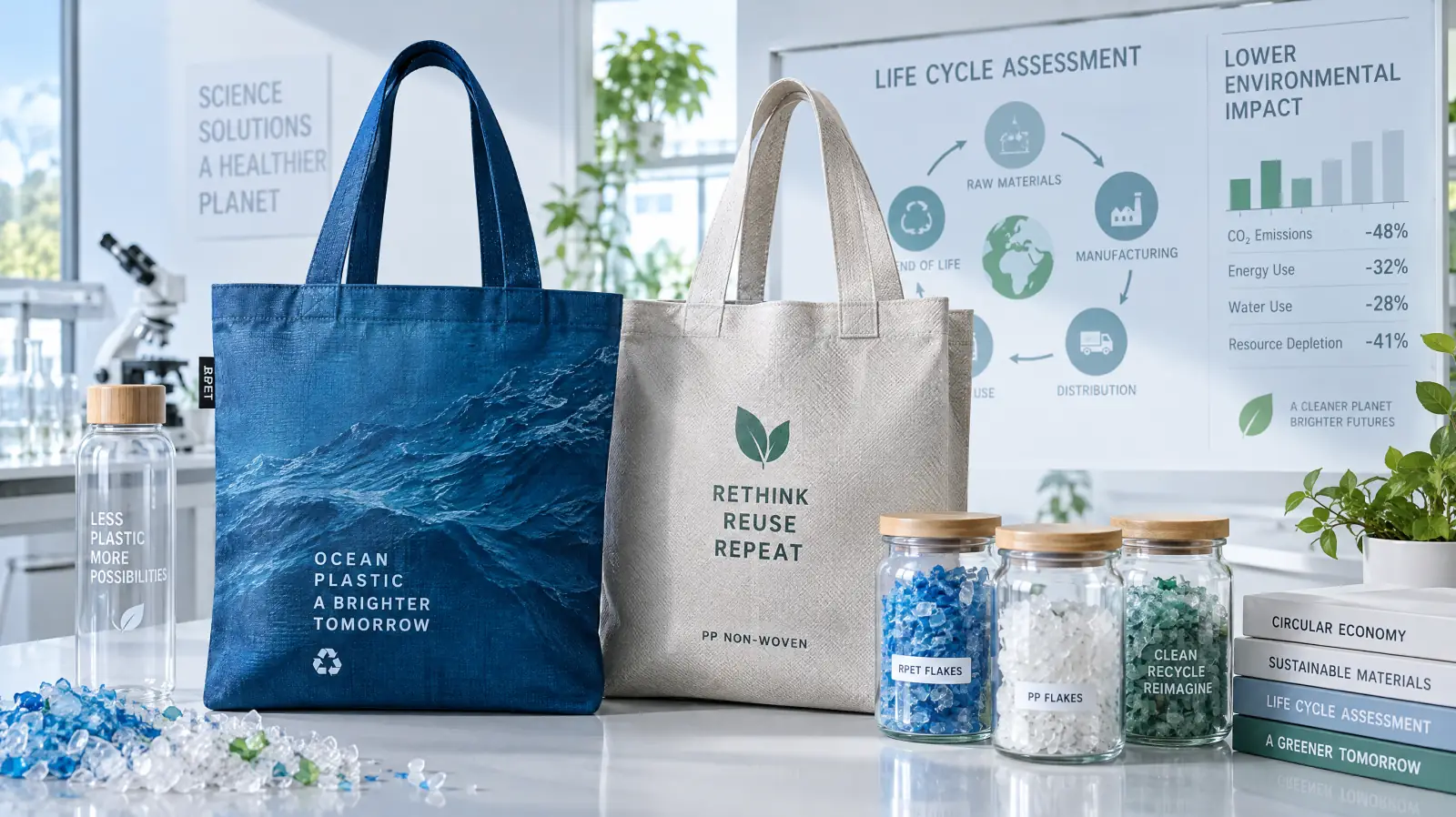
RPET vs PP Non-Woven: Reusable Bags LCA & Carbon Guide
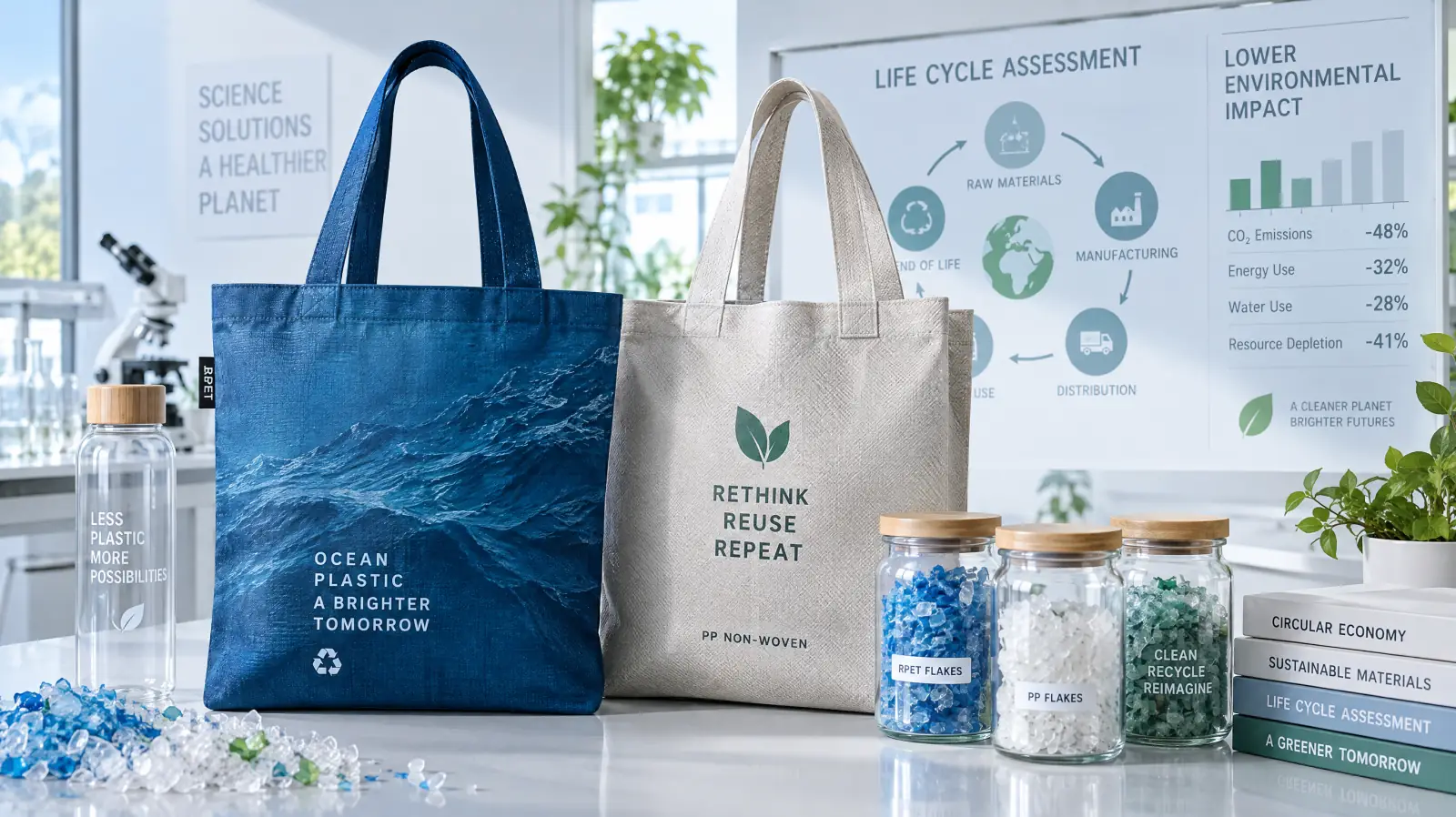
As retail brands, supermarket chains, and event organizers eliminate single-use plastic carrier bags, the demand for branded reusable shopping bags has surged worldwide. However, corporate sustainability officers and procurement managers face a critical scientific challenge: not all reusable bags deliver genuine carbon savings.
Under rigorous Life Cycle Assessment (LCA) methodologies—measuring cradle-to-grave greenhouse gas emissions ($kg\text{ }CO_2\text{ equivalent}$), water consumption, and cumulative energy demand—a reusable bag only becomes environmentally superior to a single-use bag if the consumer reuses it enough times to offset its higher initial manufacturing footprint.
Two synthetic reusable substrates dominate the commercial landscape: Recycled Polyethylene Terephthalate (RPET) made from recycled plastic beverage bottles, and Spunbond Polypropylene (PP) Non-Woven fabric.
This guide examines the comparative LCA data of RPET versus PP non-woven, calculating the exact break-even reuse threshold, Global Recycled Standard (GRS) verification protocols, and structural durability up to 20 kg.
1. Quick Summary: RPET vs. PP Non-Woven Reusable Bags
| Environmental & Technical Metric | Recycled PET (RPET) Fabric Bags | Spunbond PP Non-Woven Bags |
|---|---|---|
| Raw Material Origin | 100% Post-Consumer Recycled (PCR) water bottles | Virgin or partially recycled Polypropylene resin |
| Material Structure | Woven or stitch-bonded polyester textile | Spun-extruded continuous filaments thermally bonded |
| Fabric Weight (GSM) | 120 – 160 GSM | 70 – 120 GSM |
| Carbon Footprint per Bag | Low to Moderate (~0.18 – 0.26 kg $CO_2\text{e}$) | Moderate (~0.22 – 0.32 kg $CO_2\text{e}$) |
| LCA Break-Even Reuse Cycles | 8 to 12 uses (to beat single-use plastic) | 11 to 14 uses (to beat single-use plastic) |
| Tensile & Tear Resistance | Superior; woven polyester fibers resist tearing | Moderate; can puncture under sharp box corners |
| Print Reproduction | Photo-quality sublimation & heat transfer | Screen printing, flexo, or BOPP film lamination |
| Ocean Plastic Diversion | Diverts 3 to 6 plastic bottles from landfills per bag | Primarily utilizes fossil-derived polymer |
| Unit Cost Profile | $0.45 – $0.95 per bag | $0.25 – $0.55 per bag (Ultra-economical) |
Explore our complete reusable collection in the Reusable Bags Category and compare options in our RPET Recycled Tote Bags Guide.
2. Life Cycle Assessment (LCA) Science & The Break-Even Paradox
Life Cycle Assessments conducted by the UK Environment Agency and the Danish Environmental Protection Agency reveal an inconvenient truth: manufacturing a heavy, durable reusable bag consumes significantly more raw materials, thermal energy, and transportation fuel than a lightweight 15-micron single-use bag.
┌────────────────────────────────────────────────────────────────────────┐
│              LCA REUSE BREAK-EVEN THRESHOLD COMPARISON                 │
│   Number of times a bag must be reused to equal 1 single-use HDPE bag │
├────────────────────────────────────────────────────────────────────────┤
│                                                                        │
│   Single-Use HDPE Bag     : 1 Use (Baseline)                           │
│   Bleached Kraft Paper Bag: 3 - 7 Uses (High pulping energy & water)   │
│   RPET Recycled Bottle Bag: 8 - 12 Uses (Displaces virgin petroleum)   │
│   PP Non-Woven Bag        : 11 - 14 Uses (Thermally bonded polymer)    │
│   Conventional Cotton Tote: 130 - 175 Uses (Severe irrigation & land)  │
│   Organic Cotton Tote     : >200 Uses (Lower agricultural crop yields) │
│                                                                        │
└────────────────────────────────────────────────────────────────────────┘
Why RPET Wins the Synthetic LCA Race
- Diverting Waste from Landfills: Because RPET utilizes recycled post-consumer polyethylene terephthalate flakes, it bypasses the high-emission crude oil refining and catalytic cracking steps required to synthesize virgin polypropylene resin.
- Embodied Energy Reduction: Recycling PET uses approximately 65% to 70% less energy than producing virgin polymer, allowing an RPET bag to achieve carbon neutrality against single-use carriers in as few as 8 to 10 grocery shopping trips.
- The Cotton Fallacy: While cotton feels natural, its agricultural life cycle requires thousands of liters of irrigation water, toxic pesticides, and land clearing, making cotton totes among the most carbon-intensive packaging products manufactured today unless used continuously for over two years.
3. Material Science: Textile Engineering & Structural Durability
Beyond environmental metrics, a reusable carrier bag must deliver commercial durability across repeated loading cycles:
┌────────────────────────────────────────────────────────────────────────┐
│                   FABRIC CONSTRUCTION COMPARISON                       │
├────────────────────────────────┬───────────────────────────────────────┤
│          RPET WOVEN / STITCH   │         SPUNBOND PP NON-WOVEN         │
├────────────────────────────────┼───────────────────────────────────────┤
│                                │                                       │
│   • Interlaced polyester yarns │   • Continuous random PP filaments    │
│   • Silky, flexible drape      │   • Thermal point-bonded diamond grid │
│   • Machine washable at 30°C   │   • Sponge-like stiffness & bulk      │
│   • Withstands 20 kg carry load│   • Best for 8 - 12 kg loads          │
│   • 100% circular recycled     │   • Low-cost giveaway champion        │
│                                │                                       │
└────────────────────────────────┴───────────────────────────────────────┘
1. RPET Fabric Architecture
Recycled PET bottles are sorted, ground into flakes, washed, melted into pellets, and extruded through spinnerets into fine continuous filament yarns:
- Tensile Strength: High molecular weight polyester chains provide unmatched tensile strength, allowing custom RPET shopping bags to carry up to 18 to 22 kg without seam failure.
- Graphic Definition: The ultra-smooth polyester fibers allow full-bleed, 300 DPI heat-transfer sublimation printing, reproducing vibrant photographic brand imagery.
2. Spunbond PP Non-Woven Architecture
In spunbond manufacturing, molten polypropylene resin is extruded through thousands of tiny dies onto a moving conveyor belt, forming a loose web of random fibers that are immediately pressed between heated calender rollers with an engraved diamond pattern:
- Cost Efficiency: Produces a thick, tactile fabric in a single high-speed inline process, making custom PP non-woven bags the most cost-effective branded carrier for trade shows, retail events, and grocery chains.
4. Handle Reinforcement: Preventing Seam Failure
The primary failure point of reusable shopping bags is the junction where the handle meets the top hem:
┌────────────────────────────────────────────────────────────────────────┐
│                   HANDLE STITCHING CONFIGURATIONS                      │
├────────────────────────────────┬───────────────────────────────────────┤
│    STANDARD PARALLEL STITCH    │     REINFORCED "BOX-X" CROSS-STITCH   │
├────────────────────────────────┼───────────────────────────────────────┤
│                                │                                       │
│          ││        ││          │          ││        ││                 │
│          ││        ││          │          ││        ││                 │
│       ───┼┼────────┼┼───       │       ───┏━┓──────┏━┓───              │
│       ───┼┼────────┼┼───       │          ┃ ╳ ┃      ┃ ╳ ┃ (Cross-Box)  │
│                                │       ───┗━┛──────┗━┛───              │
│   • 2 horizontal stitch lines  │   • Double-folded hem + Box-X stitch  │
│   • Fails at 8 - 10 kg tension │   • Holds 20+ kg dynamic shock load   │
│   • Economy promotional grade  │   • Commercial supermarket standard   │
│                                │                                       │
└────────────────────────────────┴───────────────────────────────────────┘- The “Box-X” Stitch: Essential for heavy grocery bags. The handle webbing descends 40mm into the folded bag hem, where high-tensile nylon thread forms a rectangular box crossed by diagonal stitches, dissipating kinetic tension across four vectors.
- Bottom Wrap Handles: For ultimate heavy-duty carriers, handle straps run continuously beneath the floor of the bag, cradling the entire bottom load like a sling.
5. Global Recycled Standard (GRS) Verification
With greenwashing lawsuits rising in North America and Europe, brands cannot simply claim a bag is “made from recycled bottles” without verified third-party documentation:
- Chain of Custody (CoC): The Global Recycled Standard (GRS v4.0) tracks recycled material from the recycling plant through spinning, weaving, cutting, and bag assembly.
- Transaction Certificates (TC): For every production batch shipped, CraftPack Global provides an official Scope Certificate (SC) and shipment Transaction Certificate (TC) issued by accredited certification bodies (such as Control Union or Intertek), legally proving the percentage of verified post-consumer recycled content.
6. Sizing & Specification Matrix
| Format | Dimensions (W x G x H) | Material Spec | Safe Working Load | Optimal Use Case |
|---|---|---|---|---|
| Promotional Tote | 38 x 42 cm (Flat, no gusset) |
80 GSM PP Non-Woven | 5.0 – 7.5 kg | Trade shows, book fairs, corporate literature giveaways |
| Standard Retail | 32 x 15 x 38 cm |
100 GSM PP Non-Woven | 8.0 – 12.0 kg | Department stores, boutique apparel, footwear retail |
| Heavy Supermarket | 35 x 20 x 40 cm |
140 GSM RPET Woven | 15.0 – 20.0 kg | High-volume grocery shopping, multi-item farm markets |
| Insulated Cooler | 33 x 18 x 38 cm |
RPET + 2mm EPE Foam + Foil | 12.0 – 15.0 kg | Chilled meal delivery, frozen food supermarket runs |
Source Certified Reusable Packaging with CraftPack Global
Whether you require cost-effective custom PP non-woven bags for an upcoming global expo or premium GRS-certified custom RPET shopping bags for a national retail rollout, CraftPack Global provides certified manufacturing, precision color matching, and full chain-of-custody documentation.
Contact Our Sustainable Packaging Team today to request GRS compliance packs, fabric swatches, and factory-direct volume quotes.