
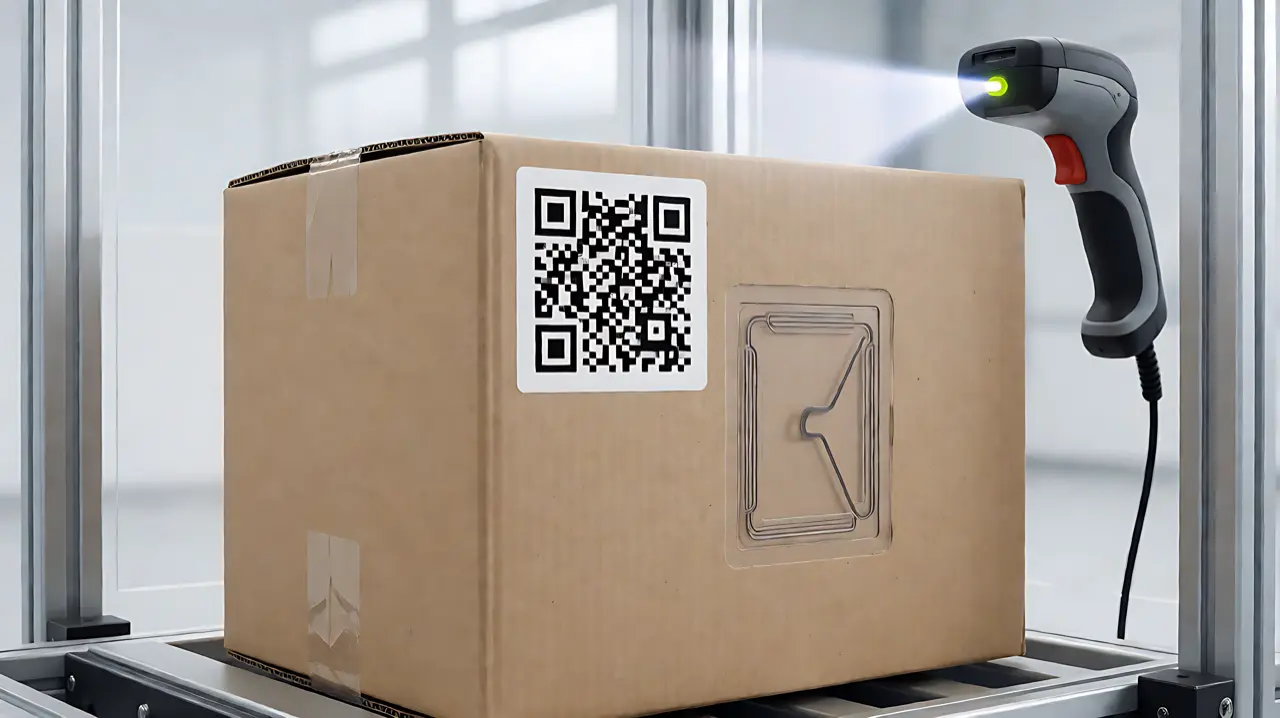
RFID Inlays vs Barcodes in Logistics Packaging: B2B Guide
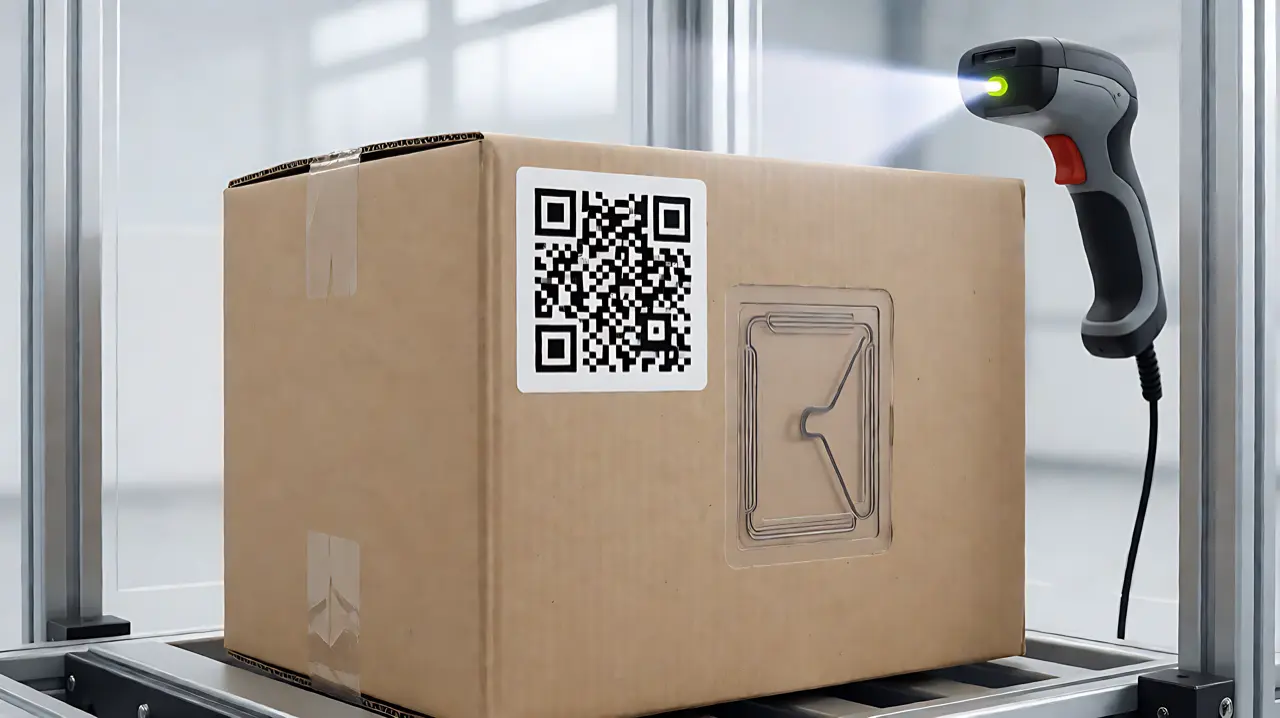
In modern global supply chains, omnichannel fulfillment centers, automated distribution hubs, and cross-border e-commerce logistics, tracking inventory velocity and package provenance has become the primary operational differentiator. When a shipment of 500 cartons arrives at an intake dock, how quickly and accurately those items are received dictates warehouse labor overhead, inventory accuracy, and customer fulfillment latency.
For over four decades, optical barcodes—first linear 1D barcodes (UPC/EAN, Code 128) and more recently 2D matrix codes (QR codes, GS1 DataMatrix)—have served as the universal, near-zero-cost standard of inventory identification.
However, optical barcodes have one insurmountable physical bottleneck: they require line of sight and individual manual scanning.
The rapid deployment of Ultra-High Frequency (UHF) RFID inlays directly integrated into corrugated cartons, e-commerce poly mailers, and FIBC bulk bags has transformed logistics velocity. UHF RFID enables simultaneous, non-line-of-sight bulk reading of hundreds of items per second as pallets roll through warehouse portal readers.
This technical guide evaluates the physics, read rates, RF interference challenges (liquid and metal attenuation), tag insertion engineering, and return-on-investment (ROI) economics of RFID inlays versus optical barcodes.
1. Technology Comparison: UHF RFID Inlays vs. 1D & 2D Optical Barcodes
| Engineering Metric | RAIN UHF RFID Inlays (860–960 MHz) | 2D GS1 DataMatrix / QR Codes | Traditional 1D Barcodes (Code 128) |
|---|---|---|---|
| Operating Physics | Electromagnetic backscatter radio waves | Optical visual pattern recognition | Optical reflection of contrasting laser lines |
| Line-of-Sight Requirement | NO LINE OF SIGHT NEEDED (Reads through boxes) | Mandatory: Camera must point at code | Mandatory: Scanner must align with bars |
| Bulk Read Velocity | Up to 700 to 1,000 tags per second | 5 to 15 codes/sec (High-res overhead cameras) | 1 code per scan (Sequential manual laser) |
| Pallet Verification Speed | 2 to 3 seconds (Pallet rolls through dock door) | 60 to 180 seconds (Manual depalletization) | 120 to 300 seconds (Manual individual scanning) |
| Read Range | Up to 8 to 12 meters (With passive antennas) | 0.1 to 1.5 meters | 0.1 to 0.8 meters |
| Data Rewritability | Read / Write (Can update status & tracking history) | Static Read-Only (Fixed printed pattern) | Static Read-Only |
| Environmental Durability | Survives dirt, dust, and scuffing (Hidden in box) | Fails if scuffed, torn, or obscured by tape | Fails if surface is scratched or wrinkled |
| RF Interference Vulnerability | Subject to attenuation near liquids & metals | Immune to RF fields (Light-dependent only) | Immune to RF fields |
| Incremental Unit Packaging Cost | $0.035 to $0.065 per tag (Inlay + insertion) | Near Zero (< $0.001 ink printing cost) | Near Zero |
For high-volume shipping envelopes and automated e-commerce packaging, explore our E-commerce Mailers Category and heavy-duty logistics options.
2. Reading Physics: Electromagnetic Backscatter vs. Optical Line of Sight
The operational difference between technologies stems from fundamental physics:
Warehouse Intake Velocity Comparison:
Optical Barcodes (Sequential Line-of-Sight):
[Worker] ──(Points Laser)──> [Box 1] ... 3s ... [Box 2] ... 3s ... [Box 3] (500 units = ~25 mins)

UHF RFID Portal (Electromagnetic Bulk Sweep):
[Forklift with Pallet of 500 Boxes] ──(Passes RFID Portal)──> [Portal sweeps 500 tags in 2.5 seconds!]
1. RAIN UHF RFID (860–960 MHz EPC Gen2 / ISO 18000-63)
Passive RFID tags contain no internal battery. When an interrogation reader emits an electromagnetic wave through its panel antennas, the tag’s etched aluminum antenna captures the RF energy via inductive/radiative coupling. The tag’s microchip (silicon die smaller than a grain of salt) powers on and modulates the reflected signal—a process known as backscatter modulation—transmitting its unique 96-bit or 128-bit Electronic Product Code (EPC) back to the reader in microseconds.
2. Optical Constraints
Barcodes rely on optical contrast. If a shipping label is folded around a carton edge, obscured by stretch wrap, smudged with warehouse grime, or facing the interior core of a pallet, an optical camera cannot read it. Workers must physically break down (depalletize) the shipment to manually scan each label, creating costly warehouse bottlenecks.
3. Radio Frequency Challenges: The Metal & Liquid Attenuation Factor
While RFID delivers immense speed, RF physics introduces specific operational challenges:
RF Propagation Interferences:
Dielectric Water Absorption:                  Electromagnetic Metal Reflection:
    RF Signal ──► [Liquid Container]              RF Signal ──► [Aluminum Foil / Can]
                       ▼                                             ▼
          Signal Absorbed as Heat!                      Signal Bounces & Cancels Phase!
Tag fails to wake up (<1m range) Creates "Dead Zones" (Nulls)- Water & Liquid Attenuation: Water is a polar dielectric liquid that absorbs UHF radio waves (resonant near 1 GHz). When shipping bottled beverages, liquid laundry detergents, or wet canned pet food, the liquid absorbs the interrogator signal, reducing tag read range from 10 meters down to under 1 meter.
- Metal Reflection & Detuning: Metallic surfaces (aluminum foil flexible barrier pouches, tin cans, steel drum liners) reflect RF signals, altering the antenna’s input impedance (detuning) and causing signal cancellation.
- Packaging Engineering Countermeasures:
- Flag Tags & Standoff Inlays: Placing the antenna on a 5mm paperboard flag tab extending away from the liquid/metal surface restores electromagnetic coupling.
- Tuned Antennas: Modern IC chips (such as Impinj Monza R6-P or NXP UCODE 9) incorporate auto-tuning circuitry that dynamically adjusts internal capacitance to match surrounding dielectric constants.
4. Integration into Packaging: Wet Inlays vs. Direct Corrugated Insertion
Converting factories integrate RFID into logistics packaging through three primary methods:
RFID Packaging Integration Architectures:
1. Exterior Pressure-Sensitive Label:    2. Embedded Corrugated Flute Insertion:
┌────────────────────────────┐          ┌────────────────────────────┐
│ Corrugated Box Surface     │          │ Outer Kraft Liner          │
│ [Thermal Label + Inlay]    │          │ [RFID Inlay Hidden in Flute│ <-- 100% Invisible & Tamper-Proof!
└────────────────────────────┘          │ Inner Kraft Liner          │
└────────────────────────────┘- Exterior RFID Smart Labels: An RFID wet inlay (PET carrier film with etched aluminum antenna and chip) is sandwiched between a white thermal transfer face stock and release paper. Automated print-and-apply label applicators print human-readable text and 2D barcodes onto the face while encoding the RFID chip in-line at speeds up to 100 cartons/minute.
- Embedded Corrugated Inlays: The inlay is inserted directly between the corrugated fluting and outer linerboard during corrugator manufacturing. The RFID tag becomes completely invisible and tamper-proof inside the cardboard wall, protected from external abrasions and moisture.
5. Economic Break-Even & Supply Chain ROI
The decision to adopt RFID in packaging centers on total supply chain economics:
- The Unit Cost Differential: Printing a 2D barcode costs less than $0.001. A UHF RFID smart label costs approximately $0.035 to $0.060 depending on annual procurement volume.
- Where the ROI Justifies the Investment:
- Labor Savings: Reducing pallet check-in times from 20 minutes down to 3 seconds slashes warehouse labor expenses by over 80%.
- Inventory Accuracy: Standard barcode-tracked warehouses average 92% to 95% inventory accuracy due to human scanning errors; RFID-enabled facilities maintain 99.5%+ accuracy, virtually eliminating out-of-stock lost sales.
- Retail Mandates: Global retail giants (Walmart, Target, Zara, Decathlon) mandate RFID tagging on all incoming apparel, home goods, and electronics cartons, levying chargeback fines on suppliers that fail to comply.
6. Logistics Sourcing & Inlay Specification Checklist
When engineering RFID-enabled shipping packaging for your supply chain, specify:
- Target Inlay Geometry: Select Auburn University ARC-certified inlay designs (e.g., ARC Category A, B, or C approved for specific retail categories).
- IC Chip Generation: Mandate latest-generation chips (Impinj M700/M800 series or NXP UCODE 9) offering high receive sensitivity ($-24\text{ dBm}$) for dense pallet reads.
- Dual-Technology Hybrid Labels: Combine UHF RFID with an optical GS1 DataMatrix code and human-readable alphanumeric text to ensure readability at facilities lacking RFID hardware.
- Encoding Verification: Require packaging suppliers to provide 100% in-line verification, ensuring zero dead/unresponsive chips in finished shipping cartons.
To develop custom RFID-integrated shipping cartons and smart logistics packaging tailored to your supply chain, connect with CraftPack Global’s smart packaging division.