
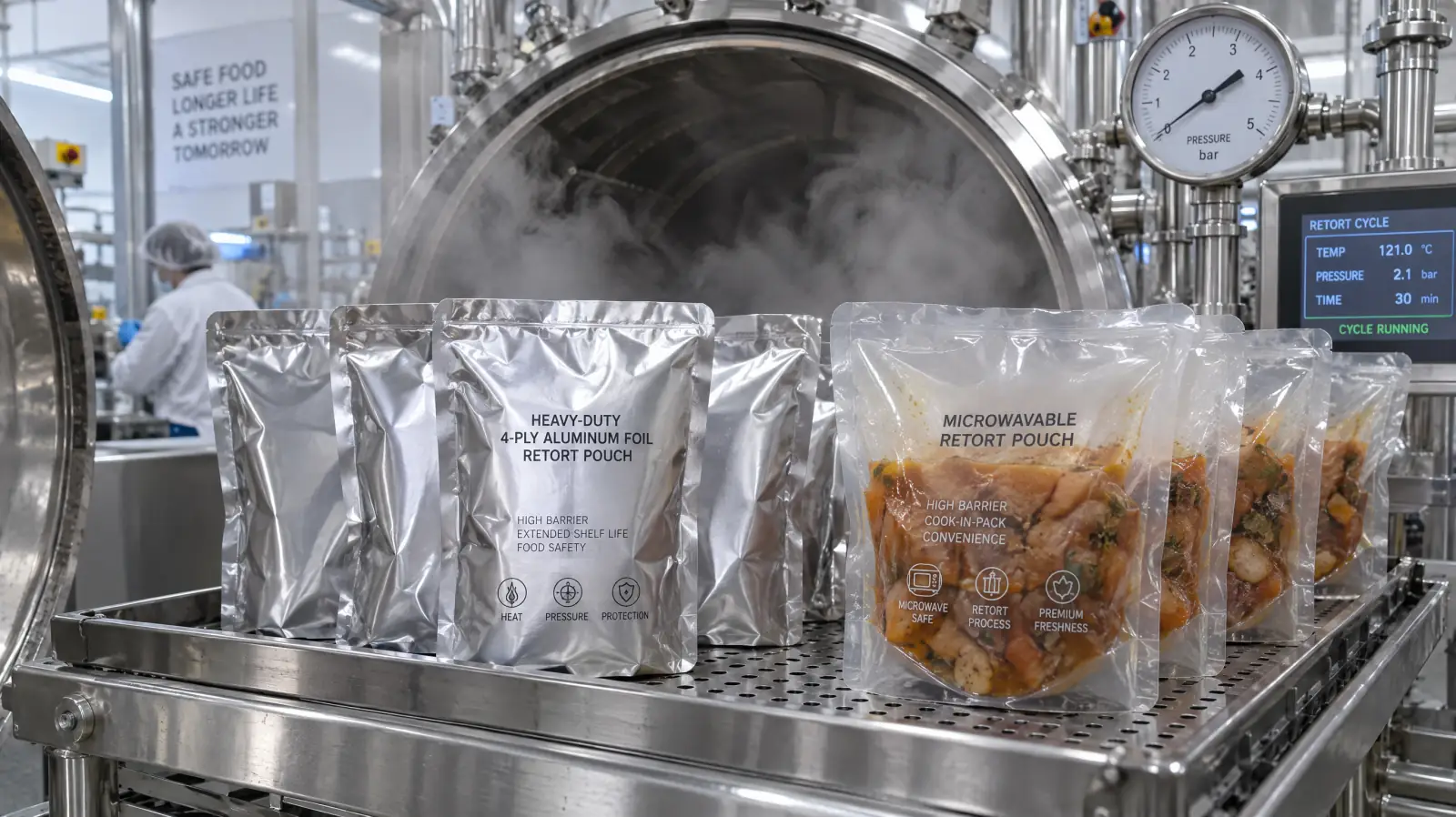
Retort Pouch Science: 121°C Autoclave & Barrier Engineering
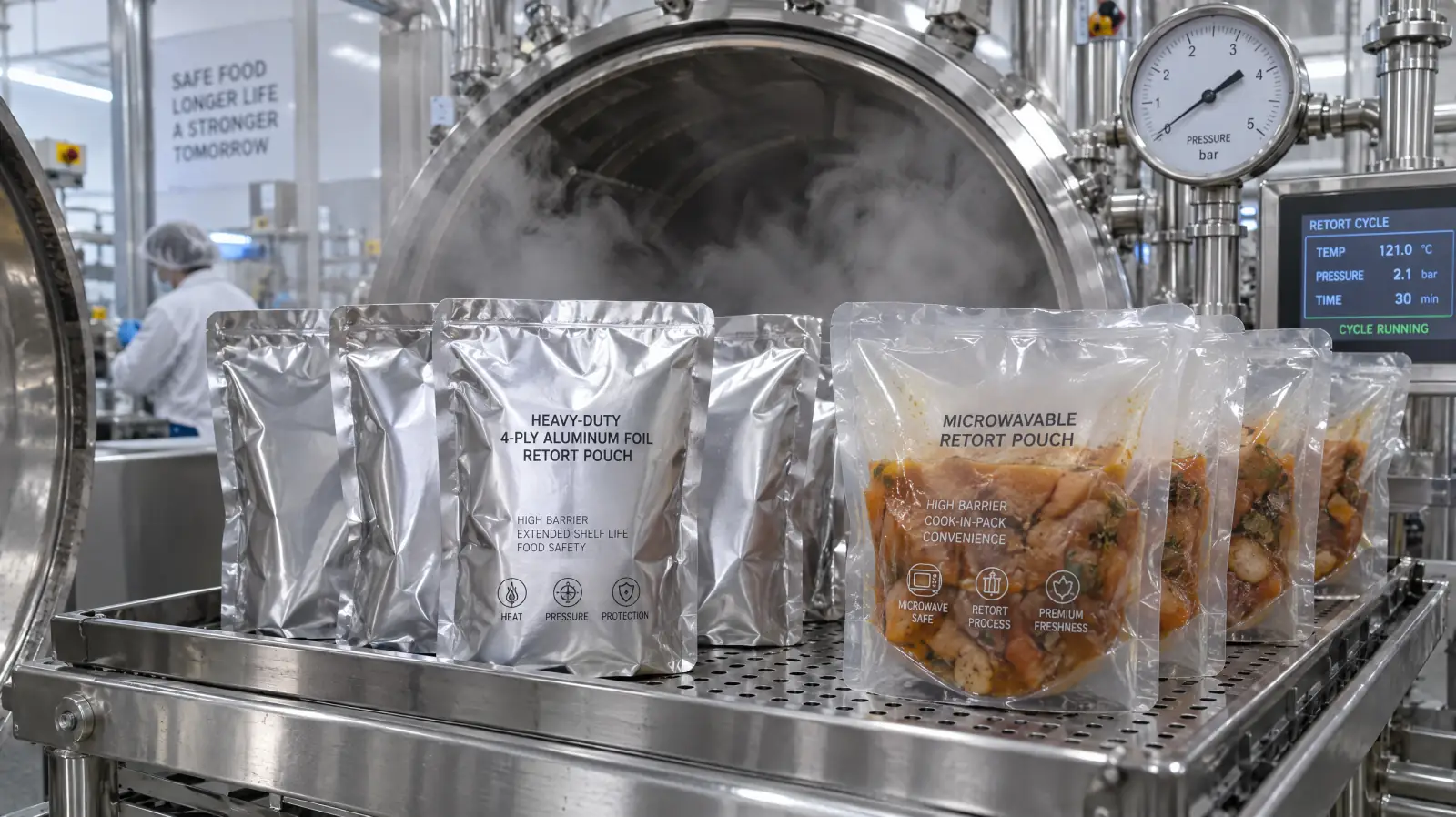
In the commercial food processing and pet wet food sectors, the retort pouch represents one of the greatest packaging engineering achievements of the modern era. Originally developed by the US Army Natick Research Laboratories to replace heavy metal C-ration cans for military combat meals, retort pouches have become the global standard for ambient shelf-stable ready-to-eat (RTE) meals, gourmet curries, seafood, baby nutrition, and wet pet delicacies.
However, engineering flexible packaging capable of surviving the brutal conditions of an industrial autoclave is exceptionally demanding: continuous exposure to saturated steam at 121.1°C (250°F) under 2.5 bar hydrostatic pressure for 30 to 60 minutes, followed by rapid pressurized cold-water quench cooling.
Standard packaging adhesives liquefy, ordinary polyethylene (PE) sealants melt, and microscopic foil pinholes cause fatal bacterial contamination.
This comprehensive technical guide breaks down retort pouch material science, contrasting traditional 4-ply aluminum foil structures with advanced clear microwavable SiOx barriers, analyzing thermal death time ($F_0$ sterilization values), autoclave counter-pressure dynamics, and seal burst testing.
1. Quick Comparison: 4-Ply Foil Retort vs. Clear Microwavable Retort
| Structural & Processing Factor | Traditional 4-Ply Foil Retort Pouch | High-Barrier Clear Microwavable Retort Pouch |
|---|---|---|
| Typical Film Architecture | PET / BOPA (Nylon) / AL Foil / R-CPP |
PET-SiOx or AlOx / BOPA (Nylon) / R-CPP |
| Oxygen Transmission (OTR) | Absolute Zero ($< 0.05\text{ cc/m}^2/\text{day}$) | Ultra-Low ($0.5 – 1.2\text{ cc/m}^2/\text{day}$) |
| Light & UV Barrier | 100% Total Optical Block (Protects lipids) | Transparent; product visible to consumers |
| Microwave Heating Compatibility | Zero (Arcing hazard; must decant into bowl) | 100% Microwave-Safe (Heat directly in pouch) |
| Post-Seal Metal Detection | Incompatible; requires X-ray inspection | Fully compatible with inline metal detectors |
| Retort Sterilization Temperature | Up to 125°C – 131°C (Ultra-high retort) | Up to 121.1°C (Standard autoclave retort) |
| Target Ambient Shelf Life | 24 to 36+ Months (Zero degradation) | 12 to 18 Months |
| Primary Commercial Use Cases | Military MREs, tuna chunks, curries, pet gravy | Single-serve pasta, rice bowls, organic baby food |
Explore our pouch formats in the Stand-Up Pouches Category and compare options in our Retort Pouches vs Cans Guide.
2. Thermal Processing Science: The $F_0$ Value & Counter-Pressure
Retort packaging achieves commercial sterility without chemical preservatives by destroying pathogenic microorganisms—specifically the heat-resistant spores of Clostridium botulinum:
┌────────────────────────────────────────────────────────────────────────┐
│                   INDUSTRIAL AUTOCLAVE RETORT CYCLE                    │
├────────────────────────────────────────────────────────────────────────┤
│ Temperature (°C)                                     Pressure (Bar)    │
│  121°C ────┌───────────────────────────────┐          3.0 Bar          │
│            │  STERILIZATION HOLD (Fo >= 6) │                           │
│            │  (121.1°C at 2.4 bar)         │                           │
│  100°C ───/                                 \                          │
│          /                                   \─── Cooling Quench       │
│   20°C ─/ Heat-Up Phase                       \── 25°C Finished        │
│        └─────────────────────────────────────────► Time (Minutes)      │
│        0          15              45             60                    │
└────────────────────────────────────────────────────────────────────────┘
The $F_0$ Sterilization Equivalent
In food microbiology, the $F_0$ value represents the equivalent time (in minutes) at 121.1°C required to produce a specific level of microbial destruction:
- The “Botulinum Cook”: Requires an $F_0 \ge 3.0$ minutes (a 12-decimal reduction of C. botulinum spores).
- Commercial Safety Target: Industrial RTE processors typically aim for an $F_0$ between 6.0 and 8.0 to eliminate spoilage thermophiles (Bacillus stearothermophilus) while minimizing heat-induced loss of food nutrients, texture, and flavor.
The Physics of Autoclave Counter-Pressure
During the heating hold at 121°C, water inside the food boils and turns to steam, creating severe internal pressure inside the sealed pouch. If ambient retort pressure drops, the pouch will expand violently like a balloon and rupture at the seams.
- Counter-Pressure Regulation: High-precision retorts inject compressed air into the autoclave chamber, maintaining external pressure at 2.2 to 2.6 bar throughout the cycle. This counter-pressure matches the internal vapor pressure of the pouch, preventing mechanical seal fatigue and micro-channeling.
3. Film Architecture Breakdown: Why Every Ply Matters
A retort pouch is an interdependent multi-layer composite bonded with specialized two-component polyurethane aliphatic retort adhesives:
┌────────────────────────────────────────────────────────────────────────┐
│                   4-PLY FOIL RETORT LAMINATE STRUCTURE                 │
├────────────────────────────────────────────────────────────────────────┤
│                                                                        │
│ [ 1. Outer Reverse-Printed PET (12µm) ] ◄── Thermal & Scuff Resistance │
│ ────────────────────────────────────────────────────────────────────── │
│ [ 2. Biaxially Oriented Polyamide - BOPA / Nylon (15µm) ] ◄── Puncture │
│ ────────────────────────────────────────────────────────────────────── │
│ [ 3. Soft-Temper Aluminum Foil (9µm) ] ◄── Impermeable Gas/Light Block │
│ ────────────────────────────────────────────────────────────────────── │
│ [ 4. High-Performance Cast Polypropylene - R-CPP (70-80µm) ] ◄── Seal │
│                                                                        │
└────────────────────────────────────────────────────────────────────────┘- Outer PET Layer (12µm): Provides dimensional stability during thermal expansion and serves as the reverse-printing substrate for high-resolution rotogravure graphics.
- BOPA Nylon Interlayer (15µm): The critical mechanical shock absorber. Retort foil easily develops pinhole micro-fractures under repeated bending (flex-cracking). The high-elongation nylon layer cushions the aluminum foil and provides high puncture resistance against sharp bone fragments in meat products.
- Aluminum Foil Core (9µm): Provides an absolute barrier against oxygen, moisture, light, and bacteria, allowing foods to remain shelf-stable at room temperature for over 2 years.
- Retort-Grade Cast Polypropylene (R-CPP, 70–80µm): Standard blown polyethylene (PE) cannot be used because its melting point ($105^\circ\text{C} - 125^\circ\text{C}$) is below retort temperatures. Cast Polypropylene (CPP) melts at $160^\circ\text{C} - 168^\circ\text{C}$ and is formulated with elastomeric impact modifiers to maintain hermetic seal strength exceeding 40 N / 15 mm.
4. Clear Microwavable Retort: The SiOx & AlOx Frontier
For modern retail consumers, decanting a curry or chili from an aluminum pouch into a separate bowl for microwaving represents unnecessary friction. To solve this, CraftPack Global engineers transparent, microwave-safe retort pouches:
- Ceramic Vacuum Deposition (SiOx & AlOx): A sub-micron layer of silicon oxide ($SiO_x$) or aluminum oxide ($AlO_x$) is deposited in a high-vacuum plasma chamber onto PET base film.
- Performance Parity: Delivers an Oxygen Transmission Rate ($OTR < 1.0\text{ cc/m}^2/\text{day}$) that rivals metal foil, while permitting full electromagnetic microwave energy transmission.
- Consumer Advantage: Consumers simply tear a top notch and place the self-standing pouch directly into the microwave for 90 seconds.
5. Quality Assurance: Burst Pressure & Channel Leak Testing
Retort packaging failures carry immense product recall liability. In accordance with FDA 21 CFR Part 113 regulations for low-acid canned foods, pouches must pass strict pre- and post-thermal quality control testing:
┌────────────────────────────────────────────────────────────────────────┐
│                   RETORT POUCH QC TESTING SUITE                        │
├────────────────────────────────┬───────────────────────────────────────┤
│    BURST PRESSURE (ASTM F1140) │     DYE PENETRATION (ASTM F1929)      │
├────────────────────────────────┼───────────────────────────────────────┤
│                                │                                       │
│   • Internal air pressurization│   • Syringe injects optical dye into  │
│   • Restrained plate fixture   │     pouch seal perimeter              │
│   • Minimum burst threshold:   │   • Inspects under UV light for       │
│     > 0.28 MPa (40.6 psi)      │     microscopic capillary channels    │
│   • Validates seal weld fusion │   • Zero dye migration tolerance      │
│                                │                                       │
└────────────────────────────────┴───────────────────────────────────────┘- Restrained Plate Burst Testing (ASTM F1140 / F2054): A needle pressurizes the pouch between rigid parallel plates. High-performance retort seals must withstand internal pneumatic pressure exceeding 0.25 to 0.35 MPa before rupturing.
- Residual Headspace Air Control: Packaging lines must utilize vacuum deaeration or steam flushing prior to sealing. Total internal non-condensable air volume must be controlled to under 8 to 10 ml; excessive trapped air expands in the autoclave, risking seal delamination.
6. Retort Packaging Specification Matrix
| Food Application | Target Net Weight | Recommended Pouch Format | Barrier Construction | Retort Temperature / Time |
|---|---|---|---|---|
| Ready-to-Eat Curries & Stews | 250g – 400g | Stand-Up Pouch with Tear Notch | 4-Ply PET / BOPA / AL / R-CPP |
121.1°C for 35 – 45 min |
| Microwavable Rice & Quinoa | 200g – 300g | Stand-Up Pouch with Micro-Vent | 3-Ply PET-SiOx / BOPA / R-CPP |
121.1°C for 28 – 35 min |
| Cat & Dog Wet Food Loaf | 85g – 150g | 3-Side Seal Flat Pouch | 4-Ply PET / BOPA / AL / R-CPP |
121.1°C for 40 – 50 min |
| Bulk Institutional Soups | 2.5 kg – 5.0 kg | Heavy Quad-Seal Box Pouch | 4-Ply Heavy PET / BOPA / AL / R-CPP 120µm |
121.1°C for 65 – 85 min |
Engineer Certified Retort Solutions with CraftPack Global
From foil military-grade MRE pouches to transparent microwave-ready stand-up barrier pouches, CraftPack Global provides certified high-temperature packaging materials, technical sealing parameter support, and FDA compliance documentation.
Contact Our Thermal Processing Packaging Engineers today to request retort material swatch cards, technical dielines, and production quotations.