
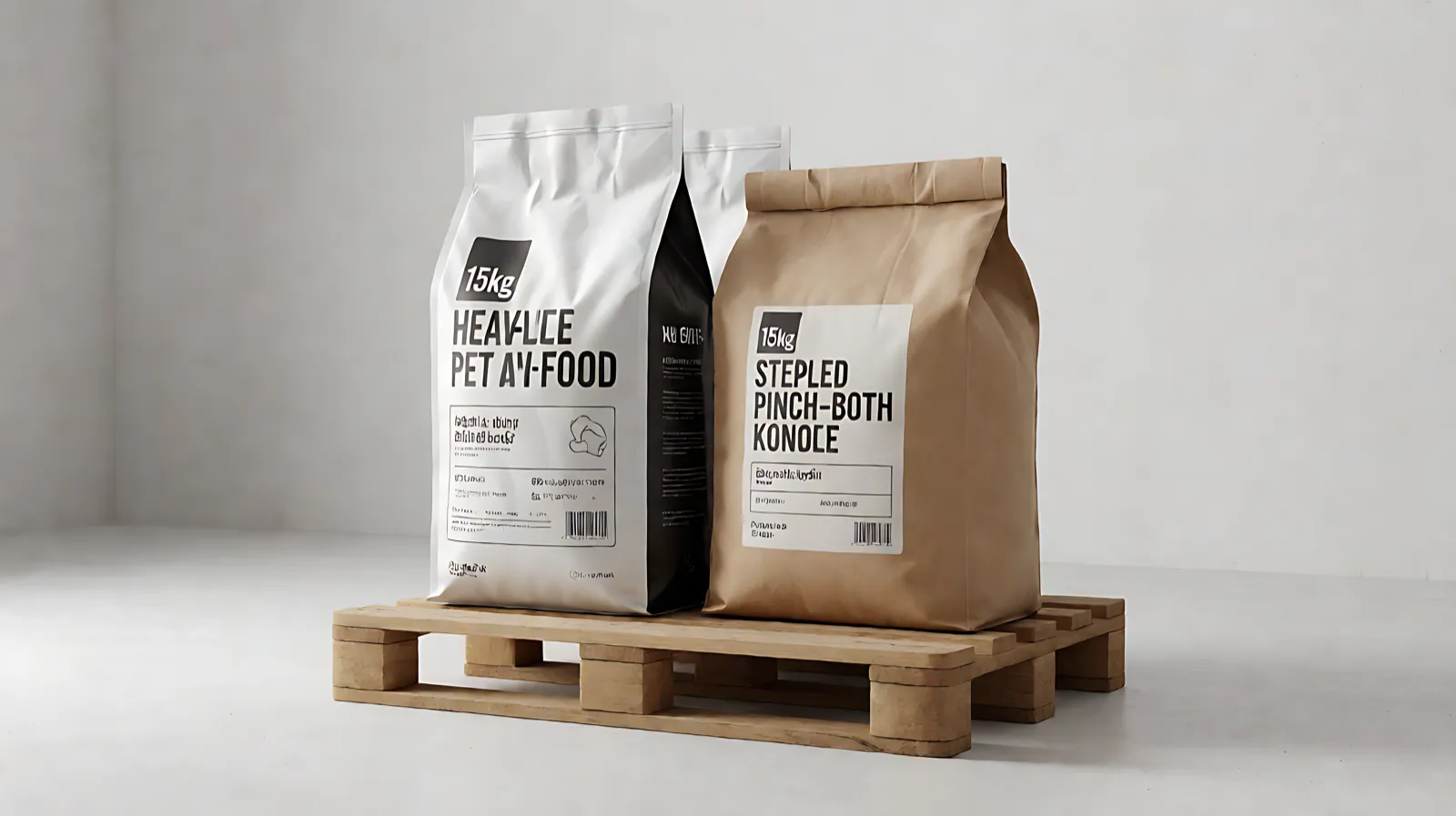
Quad Seal vs Pinch Bottom Heavy Sacks: 10kg to 25kg Bag Guide
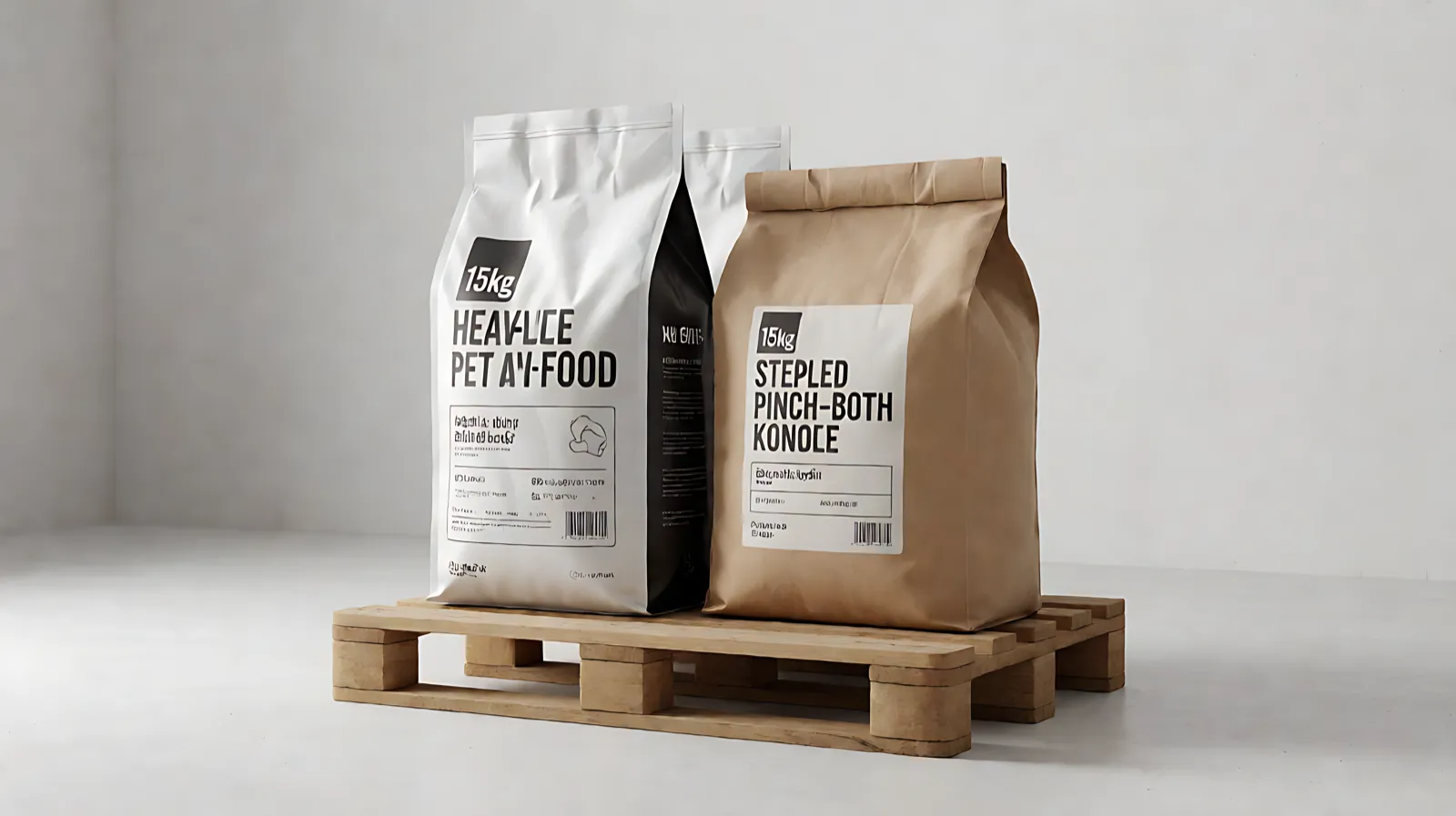
In heavy-duty packaging for 10 kg to 25 kg bulk products—such as premium pet kibble, animal feed, specialty agricultural seeds, dry milk powders, and industrial chemicals—packaging failure during palletized shipping carries severe financial consequences. A ruptured bag can contaminate an entire ocean freight container or lead to rejected warehouse shipments.
Two dominant heavy-duty packaging architectures compete for large-format packaging: Quad-Seal Box Pouches (4-Corner Seal Flexible Bags) and Multi-Wall Pinch-Bottom Open-Mouth (PBOM) Kraft Sacks.
While quad-seal flexible plastic bags provide 360-degree high-barrier protection and premium retail shelf gloss, pinch-bottom paper sacks offer superior automated filling speeds, breathable de-aeration, and flat rectangular pallet-stacking column geometry.
This engineering guide evaluates material structures, palletizing friction, drop impact durability, and filling line economics for 10kg to 25kg bulk packaging.
1. Quick Engineering Benchmark Matrix: Quad Seal vs. Pinch Bottom PBOM
| Engineering Parameter | Quad-Seal Flexible Plastic Pouch (10–25kg) | Multi-Wall Pinch-Bottom Kraft Sack (PBOM) | BOPP Laminated PP Woven Sack |
|---|---|---|---|
| Material Construction | 3-to-4 layer laminate (PET / OPA / PE or Coex PE) | 2-to-4 plies of high-extensible sack kraft + PE liner | Circular woven PP fabric + BOPP reverse print |
| Moisture & Oxygen Barrier | Exceptional (OTR < 1.0, WVTR < 0.5) | Moderate (Requires inner HDPE/aluminum tube) | Moderate (Woven tape pinholes at needle seams) |
| Closure Method | Heat-sealed top with heavy-duty slide zipper | Stepped pinch-top with hot-melt reactivation | Sewn crepe tape stitch or ultrasonic seal |
| Sift-Proof Performance | 100% Hermetic & Sift-proof | High sift-proof (Staggered glue seams) | Prone to needle-hole powder weeping |
| Pallet Column Stacking Stability | Moderate (Smooth poly surfaces require anti-slip varnish) | Superior (High coefficient of friction, square bricks) | Moderate (Requires anti-skid woven texture) |
| De-Aeration During Filling | Requires micro-slits or maze labyrinth channels | Natural fiber porous de-aeration (Zero bursting) | Rapid through weave pores |
| ASTM D5276 Drop Impact (1.8m) | High (High-tensile nylon OPA absorbs drop shock) | High (Clupak extensible kraft absorbs kinetic drop) | Exceptional (Tensile strength > 900 N) |
| Packaging Cost Index | 1.8x to 2.4x (Premium retail appearance) | 1.0x (Baseline benchmark) | 1.1x to 1.3x |
| Primary Industry Applications | Ultra-premium pet food, specialty retail kibble | Bakery flour, dry dairy powder, seeds, chemicals | Heavy animal feed, rice, fertilizer, bulk grains |
Explore our heavy-duty product configurations across the Flat Bottom Category and BOPP Woven Sacks Line.
2. Structural Mechanics & Palletizing Architecture
The physical profile of a filled 15kg or 25kg bag dictates how securely it stacks onto a standard $1200\text{ mm} \times 1000\text{ mm}$ Euro or ISO pallet.
┌────────────────────────────────────────────────────────────────────────┐
│             CROSS-SECTIONAL STRUCTURAL COMPARISON (15kg FILL)          │
├───────────────────────────────────┬────────────────────────────────────┤
│   QUAD-SEAL FLEXIBLE POUCH        │   PINCH-BOTTOM KRAFT SACK (PBOM)   │
├───────────────────────────────────┼────────────────────────────────────┤
│         Corner Heat Seals (4x)    │          Stepped Pinch Top Fold    │
│       ╭───┬───────────┬───╮       │        ╭─────────────────────────╮ │
│       │   │  Product  │   │       │        │   Pre-applied Hot Melt  │ │
│       │   │  Cavity   │   │       │        ╰────────────┬────────────╯ │
│       │   │           │   │       │                     │              │
│       ╰───┴───────────┴───╯       │        ┌────────────┴────────────┐ │
│         Flat Reinforced Base      │        │  Multi-Wall Kraft Plies │ │
│                                   │        │  (2-4 Plies Extensible) │ │
│   • 4 corner seals create rigid   │        │                         │ │
│     structural vertical columns   │        └────────────┬────────────┘ │
│   • 100% barrier against fats/oils│                     │              │
│   • Rounded profile can bulge on  │        ╭────────────┴────────────╮ │
│     lower pallet layers           │        │   Stepped Pinch Bottom  │ │
│                                   │        ╰─────────────────────────╯ │
│                                   │        • Rectangular brick profile │
│                                   │        • Interlocking pallet stack │
└───────────────────────────────────┴────────────────────────────────────┘
The Quad-Seal Advantage: Four Vertical Reinforcement Columns
A quad-seal bag is constructed with heat seals along all four vertical corner folds, in addition to top and bottom closures. These four longitudinal welds act as structural corner posts:
- Torsional Resistance: They prevent the bag from slouching, collapsing, or rolling outward on supermarket display shelves.
- Graphic Real Estate: The absence of a center back fin-seal leaves all four vertical panels (front, back, left gusset, right gusset) completely seamless for continuous, photo-quality rotogravure printing.
- Fat & Oil Barrier: In premium pet food containing 18% to 24% crude fat, the continuous co-extruded plastic and nylon laminate prevents lipid migration, oil staining, and rancidity.
For comparison with 8-side seal box pouches, see our Quad-Seal vs 8-Side Seal Guide.
The Pinch-Bottom PBOM Advantage: The Stable Pallet “Brick”
Multi-wall pinch-bottom sacks feature stepped paper plies coated with pre-applied hot-melt adhesives. During automated closing on an automated bag hanger line, the top flaps are folded over and reactivated under radiant heat and pressure bars:
- Zero Sift Needle Holes: Unlike sewn-open-mouth (SOM) bags that use sewing needles that puncture through the paper, pinch closures are 100% sift-proof, making them mandatory for fine infant milk formula and starch powders.
- High Friction & Stacking Geometry: Natural kraft paper has a static coefficient of friction ($\mu_s \approx 0.55$ to $0.65$), compared to smooth plastic film ($\mu_s \approx 0.25$ to $0.35$). Bags interlock tightly in 5-bag or 7-bag windmill patterns without shifting or sliding off pallets during transport. For pallet stability formulas, review our BOPP Woven Polypropylene Sacks Palletizing Guide.
3. High-Speed Auger Filling & De-Aeration Dynamics
When filling fine powder or dense granular products at 15 to 30 bags per minute on automated packaging lines, trapped air is the primary operational bottleneck.
De-Aeration Physics during Auger Filling:
──────────────────────────────────────────────────────────────────────────
Bag Format               Air Escape Mechanism            Line Speed / Risk
──────────────────────────────────────────────────────────────────────────
Multi-Wall Kraft Sack    Natural porosity of kraft plies 25 to 35 bags/min
                         Air escapes through fibers       Zero ballooning risk
Quad-Seal Plastic Bag    Airtight film blocks air         10 to 18 bags/min
                         Requires maze labyrinth vents    Must allow settling
BOPP Woven PP Sack       Air vents through weave pores    20 to 30 bags/min
                         Slight powder weeping risk       Rapid settling
──────────────────────────────────────────────────────────────────────────
The “Ballooning” Hazard in Heavy Plastic Pouches
Because quad-seal pouches are composed of airtight, non-porous polymer barriers, filling 20kg of product in 1.5 seconds injects massive volumes of displaced air into the pouch. If the top is sealed immediately, the pouch resembles an over-inflated balloon:
- It cannot be flattened for pallet stacking.
- Under compressive pallet loads (1,000 kg per pallet), the trapped air pressure causes bottom corner seal blowouts.
The Solution: Labyrinth Lamination De-Aeration Channels Converters introduce microscopic offset pinholes or tortuous “maze” channels in the inner sealant layer. This allows air to vent out under palletizing pressure while preventing moisture or insects from entering.
4. Drop Impact Physics: ASTM D5276 Testing (1.8m)
Under international shipping qualification standards (ASTM D5276 / ISO 22248), 15kg to 25kg bags undergo free-fall drop tests from 1.8 meters (6 feet) across three orientations: flat face, side gusset, and bottom end.
Absorbing Kinetic Energy: Extensible Kraft vs. Biaxially Oriented Nylon
- In Multi-Wall Sacks: High-extensible kraft paper (such as Clupak-treated Scandinavian sack kraft) exhibits 7% to 9% tensile elongation before rupture. When dropped, the paper fibers stretch dynamically, converting kinetic impact energy into elastic strain without tearing.
- In Quad-Seal Laminates: Converters incorporate Biaxially Oriented Polyamide (BOPA / Nylon, 15µm) laminated between outer PET and inner LLDPE. Nylon delivers exceptional dart impact toughness (> 1,200g) and puncture resistance, preventing tears from sharp animal bone shards or crushed pellets.
5. Decision Framework for Plant Managers & Brand Procurement
┌─────────────────────────────────────────────────────────────────────────┐
│               10KG TO 25KG BULK PACKAGING SELECTION TREE                │
└─────────────────────────────────────────────────────────────────────────┘
                                     │
                   Does your product contain high fat/oil
                   (> 12%) or require hermetic moisture barrier?
                                     │
                     ┌───────────────┴───────────────┐
                    YES                              NO
                     │                               │
             Is retail shelf display           Is high filling speed
          and brand aesthetics critical?      (> 20 bpm) & pallet stability
                     │                        the primary operational priority?
             ┌───────┴───────┐                       │
            YES              NO              ┌───────┴───────┐
             │               │              YES              NO
        Quad-Seal       BOPP Woven       Pinch-Bottom     Standard
Box Pouch PP Sack (Lined) Kraft (PBOM) Woven Sack- Premium Pet Food (10kg–15kg): Specify Quad-Seal Pouches with matte finish, laser scoring, and heavy-duty press-to-close zippers. Pair with our Pet Food Packaging Flat Bottom Pouches Guide.
- Dry Bakery Ingredients & Food Powders (20kg–25kg): Choose Multi-Wall Pinch Bottom Kraft Sacks with inner poly barrier tubes.
- Agricultural Bulk Grains & Fertilizers (25kg–50kg): Choose high-tensile Custom BOPP Waminated PP Woven Tote Bags.
6. Frequently Asked Questions (FAQ)
Can quad-seal bags include reclosable zippers for 15kg pet food?
Yes. Large format quad-seal bags frequently feature heavy-duty slide zippers or hook-to-hook Velcro-style closures. Hook-to-hook closures are particularly effective because kibble crumbs and dust do not clog the plastic fastening teeth.
What is the typical lead time and MOQ for custom-printed quad-seal heavy bags?
Because heavy quad-seal bags require high-tensile wide-web rotogravure presses and specialized bag-making formers, standard production minimum order quantities (MOQ) start around 10,000 to 15,000 bags per design, with production lead times averaging 3 to 4 weeks.
How do multi-wall kraft bags compare to plastic bags in total carbon footprint (LCA)?
Unbleached virgin kraft paper sacks carry a lower cradle-to-gate carbon footprint than multi-layer plastic pouches and are 100% kerbside recyclable in conventional paper recycling streams. However, for high-fat animal proteins requiring barrier integrity, paper sacks require multi-material plastic liners that complicate mono-stream recycling.
Need detailed engineering specifications, drop test certificates, or custom dielines for your 10kg–25kg bulk packaging project? Contact CraftPack Global’s bulk packaging engineers today.