
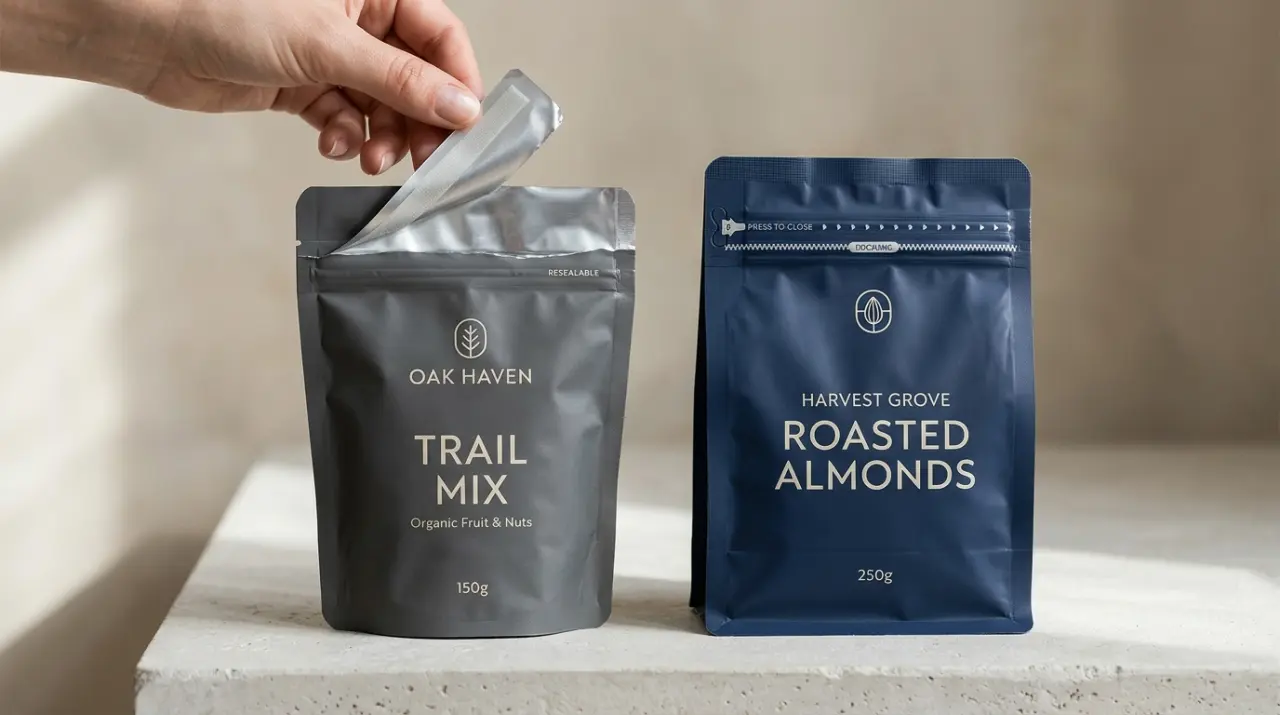
Peel-and-Reseal Labels vs Zippers: Flexible Packaging Closures
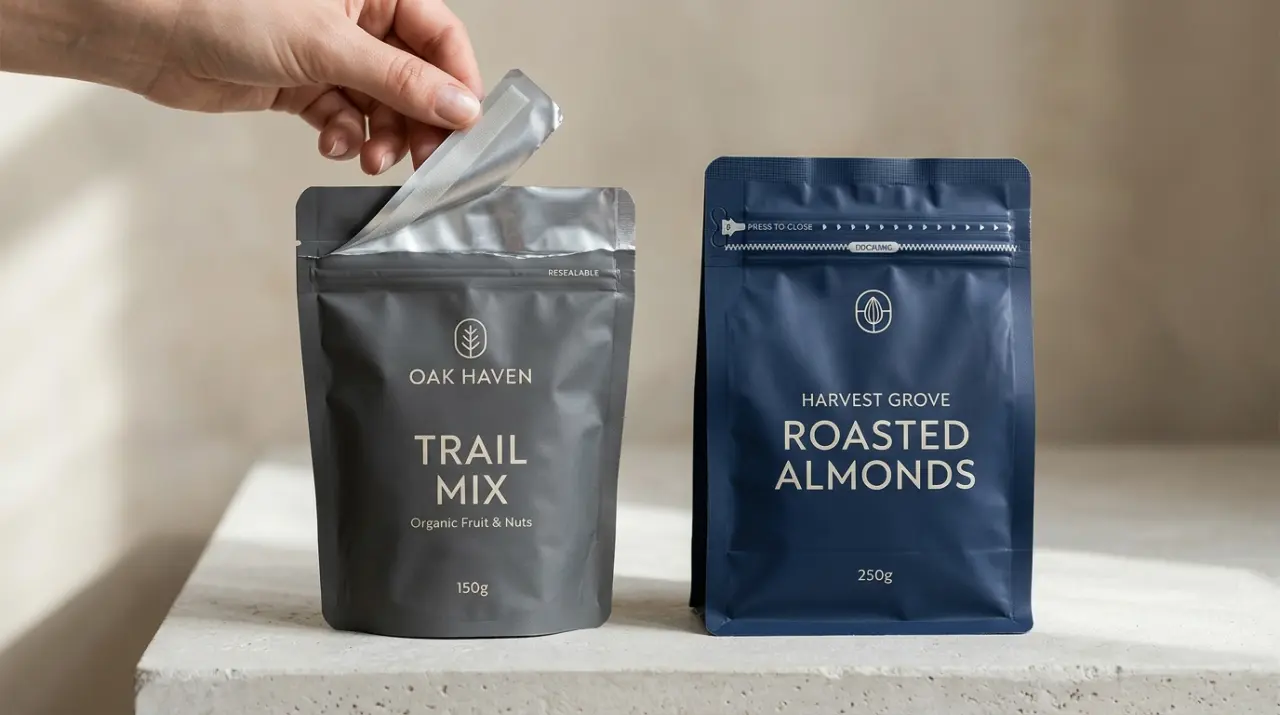
In modern consumer packaged goods (CPG)—from wet wipes and confectionery to shredded cheese, sliced deli meats, and portioned snacks—reclosable packaging balances consumer convenience with food freshness. The two preeminent reclosure technologies are Pressure-Sensitive Peel-and-Reseal (Peel & Reseal) Labels and Mechanical Press-to-Close (PTC) Zippers.
While mechanical zippers provide high mechanical tensile strength for heavy-fill products ($> 500,\text{g}$), peel-and-reseal systems offer unmatched high-speed horizontal flow-wrapping productivity and lightweight material efficiency. Selecting the optimal closure mechanism requires balancing packaging line speeds, hermetic barrier needs, and repeated peel kinetics.
Structural Mechanics & Anatomy
Peel-and-Reseal Flap Architecture           Press-to-Close Zipper Cross-Section
┌───────────────────────────────────────┐   ┌───────────────────────────────────────┐
│ Top Biaxially Oriented PP / PET Label │   │ Male Profile Flange (Co-extruded PE)  │
├───────────────────────────────────────┤   ├───────────────────────────────────────┤
│ Controlled-Tack Acrylic PSA Adhesive  │   │ Interlocking Hook / Arrow Head        │
├───────────────────────────────────────┤   ├───────────────────────────────────────┤
│ Laser-Scored Outer Barrier Film Flap  │   │ Female Cavity / Groove Profile        │
├───────────────────────────────────────┤   ├───────────────────────────────────────┤
│ Intact Inner Barrier / Heat Seal Web  │   │ Ultrasonic Crush Points at Side Seals │
└───────────────────────────────────────┘   └───────────────────────────────────────┘
                 ▼                                              ▼
   Rollstock inline application (400+ ppm);    Cross-web insertion; slower line speeds;
   Clean acoustic peel; lightweight.           Robust internal burst pressure resistance.
1. Peel-and-Reseal Label Engineering
- Adhesive Chemistry: Utilizes solvent-free emulsion or hot-melt acrylic Pressure-Sensitive Adhesives (PSA) formulated for clean, non-stringing peel from polyolefin surfaces. The adhesive must exhibit balanced viscoelastic properties: high tack for instant resealing and controlled peel resistance ($1.5 - 3.5,\text{N}/25\text{mm}$) across at least 15 to 30 consecutive open-close cycles.
- Precision Laser Scoring: Integrated inline or pre-converted rollstock utilizes controlled $\text{CO}_2$ laser scoring ($10.6,\mu\text{m}$) to cut precisely through the outer print web without compromising the underlying sealant web or aluminum/EVOH barrier barrier foil.
- Tamper-Evidence Integration: Incorporates micro-perforations or destructive security bridges along the label pull-tab. Upon the initial pull, the security tabs rupture with visible fiber tears or plastic deformation, assuring the consumer of product integrity.
2. Mechanical Zipper Mechanics
- Co-Extruded Resins: Low-Density Polyethylene (LDPE) or Polypropylene (PP) male-and-female profiles engineered with optimized flange thicknesses ($80 - 150,\mu\text{m}$) for rapid thermal or ultrasonic welding onto the pouch interior walls.
- Interlocking Engagement: Male arrow-heads physically deform into the female undercut recess, generating positive mechanical retention forces ($> 15,\text{N}/50\text{mm}$) capable of containing internal product sloshing and weight.
- Ultrasonic Crush Zones: At pouch side seams, high-frequency ultrasonic horns ($20,\text{kHz}$) crush and melt the thick profile into flat polymer pads, preventing capillary oxygen and moisture leaks at the zipper perimeter.
Engineering & Performance Metrics
| Physical Parameter | Pressure-Sensitive Peel & Reseal | Press-to-Close (PTC) Zipper | Test Method |
|---|---|---|---|
| Initial Opening Peel Force | $2.5 - 4.5,\text{N}/25\text{mm}$ | $5.0 - 12.0,\text{N}/50\text{mm}$ | ASTM D903 / ASTM D1876 |
| Reseal Retention (Cycle 10) | $\ge 70%$ of initial tack | $100%$ (mechanical lock) | Modified FINAT FTM 1 |
| Maximum Packaging Line Speed | Up to $450,\text{packages/min}$ (HFFS) | $60 - 120,\text{pouches/min}$ (VFFS/Premade) | Line Tachometer |
| Powder / Crumb Contamination | High vulnerability (loses tack) | Moderate-High (retains lock if de-flaker used) | Visual / Peel Test |
| Weight Added Per Pack | Negligible ($< 0.5,\text{g}$) | Moderate ($1.5 - 4.5,\text{g}$) | Analytical Balance |
| Hermetic Headspace Retention | Moderate (moisture wipe lock) | Superior (full gas barrier with seal) | ASTM F2096 (Bubble Leak) |
| PPWR Packaging Reduction | $-12%$ to $-25%$ polymer mass | Baseline | Direct Mass Audit |
Adhesive Rheology & Contamination Resilience
The primary failure mode of peel-and-reseal packaging is adhesive fouling from food particulates, crumbs, free fats, or moisture droplets:
$$\text{Tack Loss} \propto \frac{\text{Surface Coverage of Contaminant}}{\text{Adhesive Contact Area}}$$
- For Powdered or High-Fat Products: Fine spices, grated cheese, or bakery flours disperse across the tacky adhesive boundary upon repeated openings, neutralizing polymer chain entanglement. In such environments, mechanical zippers (especially powder-resistant ribbed profiles or hook-and-loop closures) provide vastly superior functional longevity.
- For Moist & Wiped Goods: Wet wipes and sliced deli provisions benefit from hydrophobic silicone-modified acrylic adhesives that maintain tack even when exposed to water droplets, preserving moisture retention without bulky hardware.
Application Decision Matrix
Is product weight > 500g or high-volume dry powder/fatty solids?
   ├── YES ──> Choose Press-to-Close Zipper (Mechanical retention, zero tack loss)
   └── NO  ──> Are packaging line speeds > 150 packs/min or is mono-material lightweighting critical?
                 ├── YES ──> Choose Peel-and-Reseal Label (High HFFS line speed, minimal resin)
└── NO ──> Evaluate consumer tactile ergonomics and pouch volume- Choose Peel-and-Reseal: For sliced cheese shingle packs, bakery biscuits, pocket-size wet wipes, and confectionery bags where ultra-fast HFFS flow-wrap line output and reduced packaging weight are paramount.
- Choose Press-to-Close Zippers: For premium pet food bags, coffee flat bottom pouches, protein powders, and lawn care chemicals requiring robust vertical bursting resistance.
Read our analysis on pouch zipper profiles for powder-proof closures and browse our custom stand-up pouches. Consult CraftPack Global’s packaging engineers to specify the right closure chemistry for your product profile.