
Patch Handle vs. Fold-Over Die-Cut Bags: Tensile Strength Guide
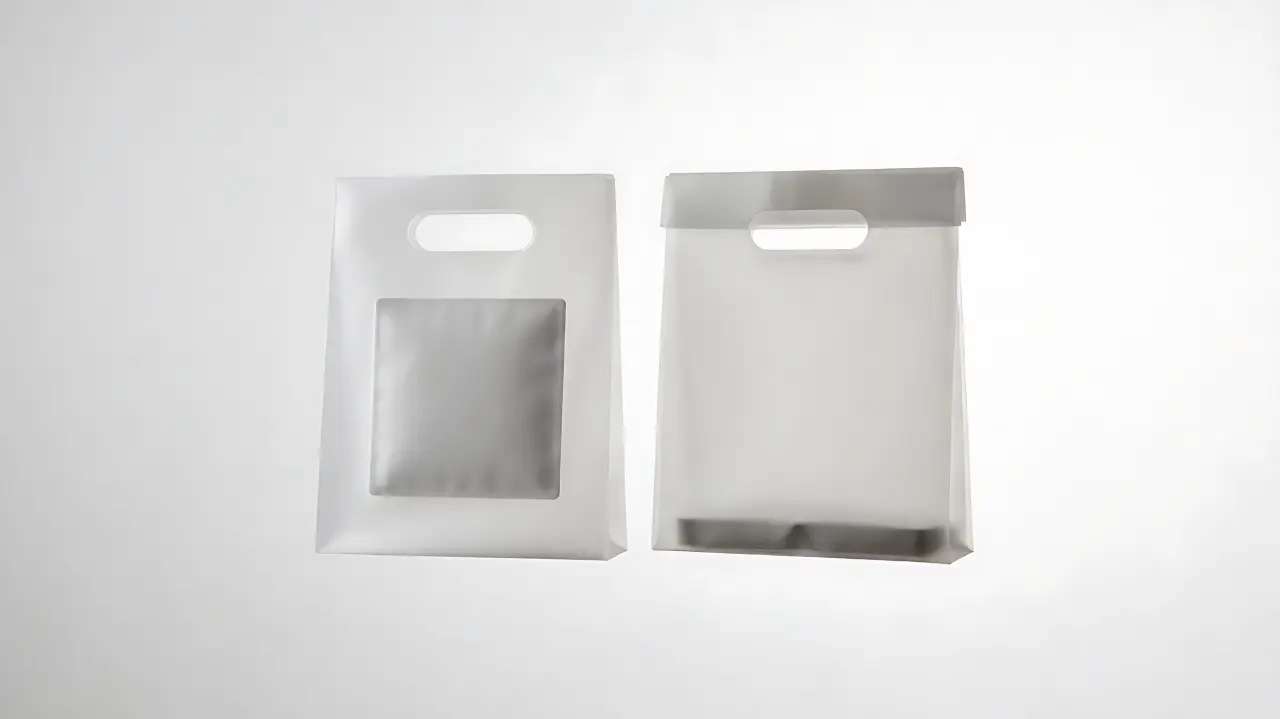
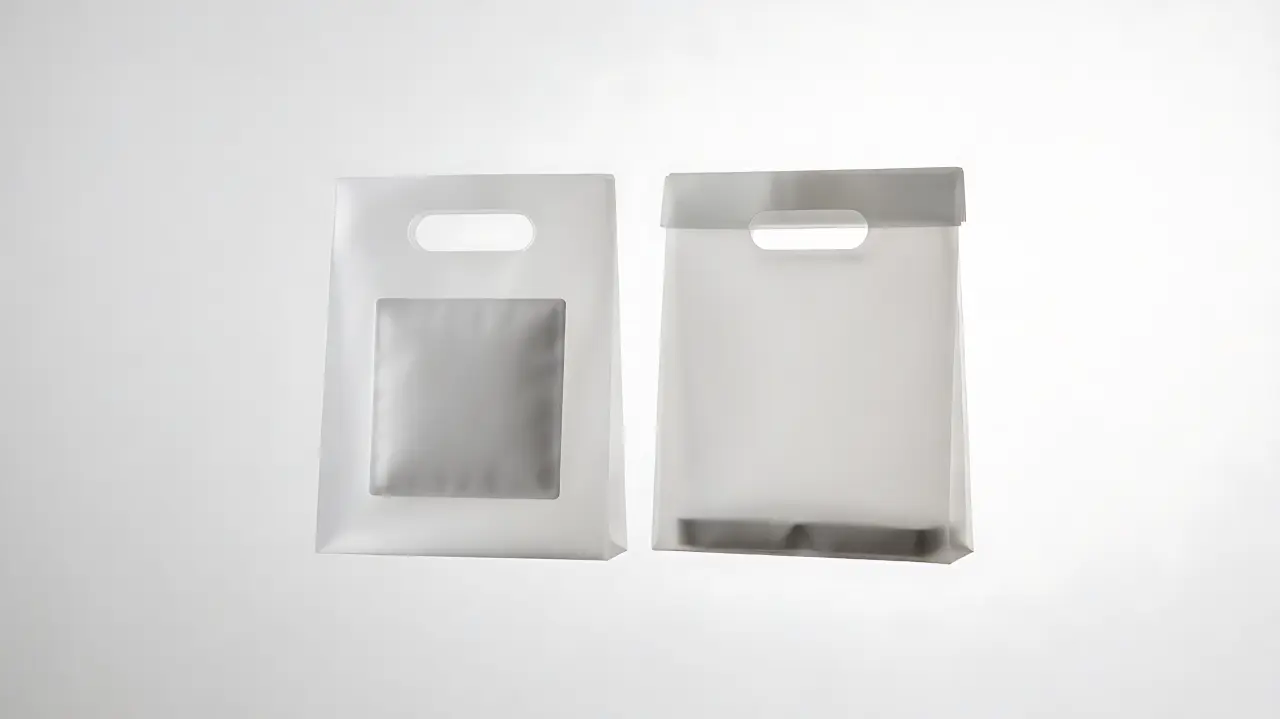
In retail fashion, trade show events, department stores, and boutique consumer goods, the die-cut handle plastic carrier bag is an ubiquitous packaging staple. Valued for its sleek, flush silhouette and cost efficiency, the die-cut handle eliminates external protruding cords while showcasing edge-to-edge branding.
However, unreinforced die-cut carrier bags suffer a notorious mechanical failure: handle necking and elongation failure. Under retail loads of 5 kg to 10 kg (such as heavy shoe boxes, winter garments, or trade catalogs), the localized stress concentrated at the top curve of an oval hand hole exceeds the yield point of standard Low-Density Polyethylene (LDPE). The plastic stretches into a thin, painful ribbon, cuts into consumer fingers, and ultimately tears open.
To prevent handle elongation while optimizing plastic resin weight, packaging converters deploy two competing reinforcement architectures: Heat-Welded Patch Handles and Turnover Top Fold-Over Handles.
This technical guide provides an engineering analysis of Patch Handle vs. Fold-Over Die-Cut Bags, evaluating ISO 527 tensile yield behavior, film gauge optimization, converting machine speeds, and regulatory compliance under the EU Packaging and Packaging Waste Regulation (PPWR).
1. Technical Matrix: Patch Handle vs. Fold-Over Die-Cut Carrier Bags
| Performance Parameter | Heat-Welded Patch Handle Bag | Fold-Over Top (Turn-Top) Bag | Unreinforced Simple Die-Cut | Flexible Soft-Loop Handle Bag |
|---|---|---|---|---|
| Reinforcement Geometry | Localized rectangular patch welded inside | Continuous double-folded 50–75mm top hem | None (Single sheet of body film) | Separately extruded welded loop strap |
| Reinforcement Substrate | 60µm to 90µm heavy-gauge virgin LDPE patch | 2-ply fold of bag body film (2× base gauge) | Single base film gauge | Extruded 120µm LDPE strap |
| Max Safe Carrying Load (ISO 527) | 8.0 kg to 14.0 kg | 7.0 kg to 12.0 kg | 2.5 kg to 4.5 kg (Severe necking) | 12.0 kg to 18.0 kg |
| Stress Distribution Around Cutout | High shear resistance (Cross-welded border) | Uniform tensile sharing across 2-ply web | Concentrated at top notch radius | Direct shear on weld points |
| Total Polymer Resin Mass (Tare Weight) | Low (Resin added only at handle zone) | Moderate (+15% to 22% total film mass) | Lowest (Prone to tearing) | Moderate |
| Bag Opening Usability / Top Hem Stance | Body film stays flexible; flat opening | Stiff, self-standing open top hem | Floppy opening | Open top |
| Converting Line Production Speed | 120 to 180 bags/minute | 180 to 250 bags/minute | 250 to 350 bags/minute | 90 to 140 bags/minute |
| PPWR Single-Polymer Recyclability | 100% Mono-LDPE (Zero glue / adhesives) | 100% Mono-LDPE (Homogeneous) | 100% Mono-LDPE | 100% Mono-LDPE |
| Unit Manufacturing Cost Index | Baseline (1.0× — Retail Benchmark) | 0.92× to 0.98× Baseline | 0.70× to 0.78× Baseline | 1.25× to 1.45× Baseline |
To view our complete retail carrier and plastic bag capabilities, visit our Plastic Carrier Bags Category.
2. Tensile Stress Distribution & Plastic Necking Physics
When a consumer lifts a 10 kg bag, the entire load hangs from the oval die-cut aperture (standard dimensions: $75\text{ mm width} \times 20\text{ mm height}$):
Finite Element Tensile Stress Concentration at Die-Cut Handle:
Unreinforced Die-Cut (Plastic Necking):          Reinforced Patch Handle (Stress Dissipation):
┌──────────────────────────────────────┐        ┌──────────────────────────────────────┐
│       Top Lip of Bag                 │        │       Top Lip of Bag                 │
│              ▲  ▲                    │        │              ▲  ▲                    │
│          ╭──────────╮                │        │  ┌───────╭──────────╮───────┐        │
│          │  XXXXXX  │ Concentrated   │        │  │ 80µm  │          │ Heavy │ Patch  │
│          ╰──────────╯ Peak Stress    │        │  │ LDPE  ╰──────────╯ Welded│ Anchor │
│              ▼  ▼     (Yield >12MPa) │        │  └───────▲──────────▲───────┘        │
│  Result: Plastic stretches into thin │        │  Stress radiated into wide patch base│
│  ribbon; tears under 4 kg load.      │        │  Zero necking up to 12+ kg load.     │
└──────────────────────────────────────┘ └──────────────────────────────────────┘-
Unreinforced Polyethylene Yield Point:
- Standard blown LDPE film exhibits a tensile yield strength of roughly 10 to 14 MPa (ISO 527-3).
- Around the sharp edge of an unreinforced 45µm die-cut hole, the localized tension creates a classic necking phenomenon: polymer chains slip irreversibly, narrowing the film thickness from 45µm down to less than 15µm. The thin band digs into the consumer’s fingers like wire and fails catastrophically with minimal tear resistance.
-
The Heat-Welded Patch Cushion:
- A patch handle bag automatically feeds an independent 70µm to 90µm thick LDPE reinforcing patch on the inside of the web, heat-welding it with a patterned waffle or cross-hatch thermal die before punching the die-cut hole through both layers simultaneously.
- The combined handle area achieves a solid thickness of 120µm to 140µm, distributing tensile shear across a $140\times 80\text{ mm}$ structural zone. Tensile stress remains well below the plastic yield limit, preventing elongation even when carrying heavy shoe boxes or beverage containers.
3. Film Gauge Math: Resin Lightweighting & PPWR Compliance
In high-volume procurement, packaging weight directly dictates resin costs and European Extended Producer Responsibility (EPR) eco-modulation fees:
Polymer Resin Consumption Comparison (for a 400 × 500 mm Carrier Bag):
1. Fold-Over Top Bag (45µm Body):
   - Total Web Cut Length: 500 mm + 75 mm (Turn-over fold) = 575 mm
   - Total Resin Mass: ~32.4 grams per bag

2. Patch Handle Bag (45µm Body):
   - Total Web Cut Length: 500 mm flat length (No fold required)
   - Body Film Mass: ~28.2 grams
   - Localized Patch Mass (140 × 80 mm @ 80µm): ~1.8 grams
   - Total Resin Mass: ~30.0 grams per bag
- Net Plastic Savings: ~7.4% Virgin Resin Reduction- Resin Economy: While fold-over bags require simple automated mechanical tucking, folding a 75 mm hem doubles the plastic across the entire horizontal width of the bag, including areas far away from the handle that experience zero load.
- Targeted Efficiency of Patch Handles: The patch handle applies structural thickness exclusively where mechanical stress concentrates, reducing total virgin polymer consumption across multi-million-bag production runs while achieving equal or superior burst strength.
4. Converting Automation & Esthetic Trade-Offs
Choosing between patch and fold-over designs also influences visual retail presentation:
-
Fold-Over Top (Crisp Architectural Stance):
- Because the 2-ply folded hem extends continuously across the entire top opening of the bag, the bag mouth possesses inherent flexural stiffness.
- When displayed on retail checkout counters, the bag stays naturally propped open, accelerating packaging throughput for sales associates. Furthermore, fold-over bags leave the exterior surface completely smooth with no visible heat-weld perimeter lines.
-
Patch Handle (Invisible Interior Reinforcement):
- The reinforcing patch is welded inside the bag. While modern thermal knurling tools minimize exterior aesthetic marks, a subtle outline of the rectangular patch is faintly perceptible on thin glossy films.
- However, for frosted matte LDPE or pigmented opaque retail bags, the patch is virtually invisible from the exterior, preserving uninterrupted, vibrant flexographic brand graphics.
5. Retail Procurement Selection Blueprint
                      What type of retail merchandise is being carried?
                                     │
                     ┌───────────────┴───────────────┐
             Medium-Heavy Goods                    Light-to-Medium Apparel
         (Shoes, Jeans, Catalogs, Gifts)              (Lingerie, Cosmetics, T-Shirts)
                     │                               │
         Do you prioritize minimal plastic   Do store associates require
          tare weight and resin savings?      bags that stay propped open?
                     │                               │
        ┌────────────┴────────────┐             ┌────┴──────────────────────────┐
       YES                        NO            │ Deploy Fold-Over Top Bags:    │
        │                          │            │ - Luxury boutique apparel     │
  Deploy Patch Handle Bags:        │            │ - Fast checkout retail        │
  - High-volume fashion chains     │            │ - Cosmetics & fragrance gift  │
  - Department store apparel       │            │ - Promotional gift bags       │
  - Electronics & footwear         │            └───────────────────────────────┘
  - Trade show literature bags     │
  - Recycled PCR-content carriers  └──────────> Deploy Soft-Loop Handle Bags
                                                for Maximum Shoulder Comfort
Key Technical Purchasing Checklist:
- Insist on Glue-Free Thermal Welds: Ensure the patch is bonded via 100% thermal fusion welding, avoiding hot-melt glues that disrupt mono-material polyethylene recycling streams under PPWR.
- Specify Metallocene Blends: Incorporate 15% to 25% metallocene LLDPE (mLLDPE) into the resin extrusion recipe to enhance puncture resistance around the die-cut radius.
- PCR Content Formulation: If sourcing Post-Consumer Recycled (PCR) plastic, specify a 55µm base gauge with an 85µm virgin patch to maintain certified 10 kg tensile carrying capacity.
Contact CraftPack Global to receive tailored gauge recommendations and production die templates via our Custom Plastic Carrier Bags Division.