
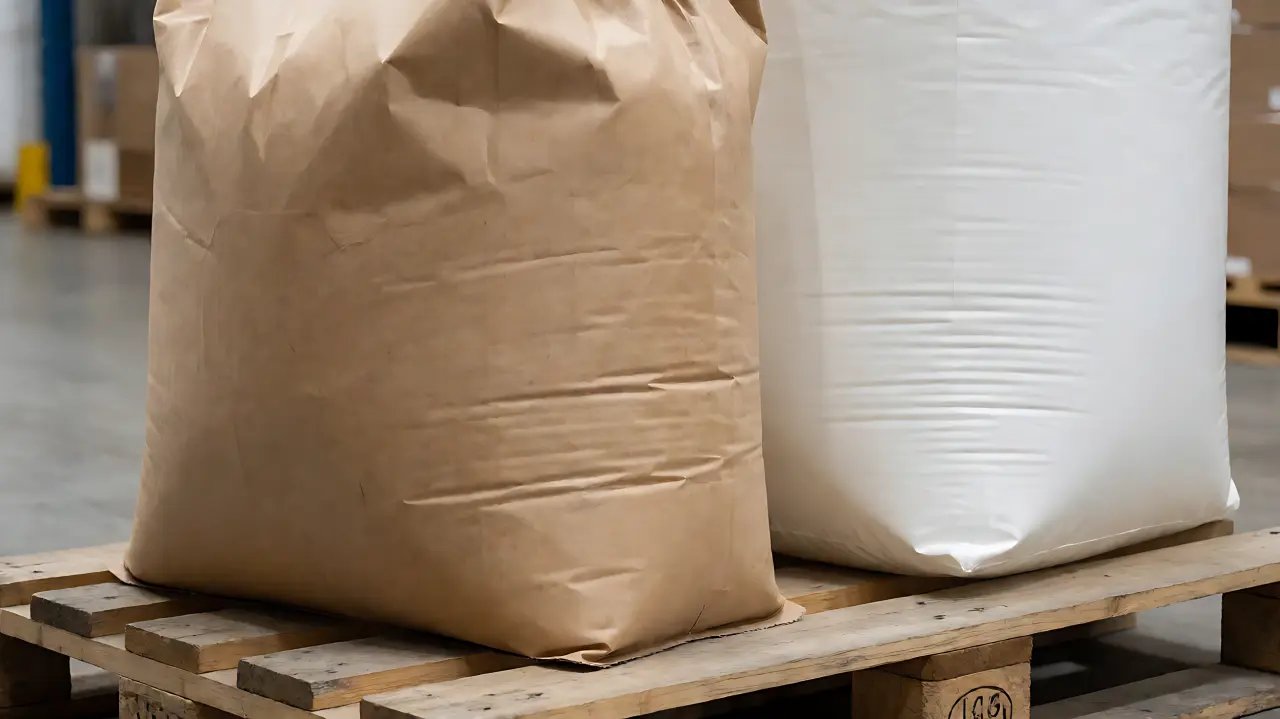
Pasted Valve Paper Sacks vs. PE Valve Bags: Powder Packaging Guide
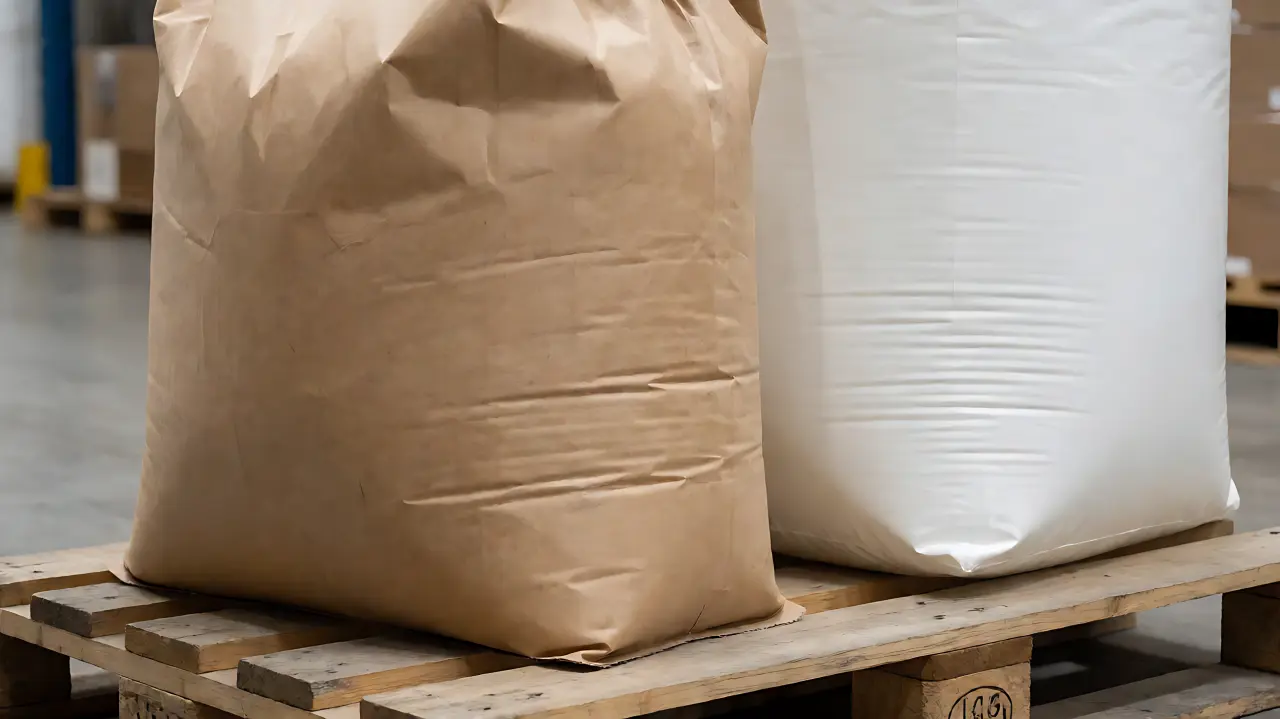
In industrial dry bulk packaging—spanning construction cement, chemical polymer masterbatches, agricultural minerals, tile adhesives, and commercial food starches—the 25 kg to 50 kg industrial valve sack is the dominant packaging vehicle for high-speed automated bagging lines.
Unlike open-mouth sacks that require post-fill sewing, taping, or thermal welding, valve sacks are pre-sealed at both top and bottom by the bag manufacturer, leaving only a small corner opening (the filling valve). When loaded onto rotary or in-line pneumatic packing spouts, the valve sack fills in seconds, self-closing as internal material pressure presses against the valve sleeve.
However, industrial plant managers face an essential engineering decision: Multiwall Pasted Valve Paper Sacks (PV Paper Bags) versus Tubular Polyethylene Form-Fill-Seal Valve Bags (PE Valve Bags).
This technical guide provides a comparative engineering evaluation of Pasted Valve Paper Sacks vs. PE Valve Bags, analyzing pneumatic fluidization de-aeration, moisture vapor barrier dynamics (DIN 55437), ultrasonic valve sealing, pallet stacking geometry, and circular recyclability.
1. Technical Matrix: Pasted Valve Paper Sacks vs. PE Valve Bags
| Specification Parameter | Multiwall Pasted Valve Paper Sack (PV Paper) | Heavy-Duty Polyethylene Valve Bag (Tubular PE) | Pinch Bottom Open Mouth (PBOM) | Form-Fill-Seal Tubular Rollstock (FFS) |
|---|---|---|---|---|
| Material Construction | 2 to 4 plies Clupak extensible kraft (70–90 GSM) | Co-extruded 3-ply heavy-gauge LDPE/LLDPE | Multi-ply kraft with hot-melt fold | Continuous tubular blown PE film |
| Pneumatic De-aeration Speed | Ultra-Fast (Air vents directly through paper pores) | Slow (Requires micro-perforations / maze vents) | Fast (Air escapes through open mouth) | Controlled via vacuum probes |
| Filling Spout Packing Speed | Up to 1,800 to 2,400 sacks/hour (Rotopacker) | 1,200 to 1,600 bags/hour | 600 to 1,000 bags/hour | 1,400 to 2,200 bags/hour |
| Moisture Vapor Barrier (WVTR) | Moderate to Low (Requires PE film inter-ply) | Near Impermeable (Hermetic moisture block) | Moderate (Depends on PE barrier ply) | Near Impermeable |
| Outdoor Pallet Storage Life | 0 Days (Must be stored under dry shelter) | 6 to 12 Months (100% Weatherproof / UV-rated) | 0 Days (Rain dissolves kraft paper) | 6 to 12 Months (Outdoor UV-rated) |
| Valve Sealing Mechanism | Internal self-closing sleeve or ultrasonic weld | Ultrasonic pinch-welded valve sleeve | Full-width hot-melt pinch closure | Thermal impulse weld |
| Square Brick Stacking Shape | Excellent (Rigid rectangular pallet stability) | Good (Requires de-aeration to prevent pillows) | Tapered bottom (Less uniform) | Good rectangular form |
| Municipal Recyclability | 100% Curbside Paper Recycling (CEPI 95%+) | 100% Mono-PE Film Stream (Clean recycling) | Paper stream (Requires liner split) | 100% Mono-PE Film Stream |
| Relative Packaging Cost | Baseline (1.0× — Bulk Economical) | 1.15× to 1.35× Baseline | 0.95× to 1.10× Baseline | 0.85× to 1.05× (High CapEx machinery) |
To explore our complete portfolio of heavy-duty commercial paper bags and multi-ply packaging, browse our Paper Shopping Bags Category and Flat Bottom Bags Category.
2. De-aeration Mechanics During High-Speed Pneumatic Filling
The primary physics challenge in 25 kg powder bagging is air displacement:
When an impeller or air-packer (such as a Haver & Boecker or Webster packing machine) fluidizes cement, flour, or talc with compressed air to pump 25 kg of powder through a Ø 50 mm filling nozzle within 3.5 seconds, up to 50 liters of pressurized fluidizing air enter the bag alongside the solid particles:
De-aeration Fluid Dynamics During Pneumatic Packing:
Pasted Valve Paper Sack (Porous Filtration):      Heavy-Duty PE Valve Bag (Labyrinth De-aeration):
┌──────────────────────────────────────┐          ┌──────────────────────────────────────┐
│  Pneumatic Nozzle Influx:            │          │  Pneumatic Nozzle Influx:            │
│  Powder + 50L Fluidizing Air         │          │  Powder + 50L Fluidizing Air         │
│          ▼▼▼▼▼▼▼▼▼▼                  │          │          ▼▼▼▼▼▼▼▼▼▼                  │
│  ┌────────────────────────────────┐  │          │  ┌────────────────────────────────┐  │
│  │ Natural Micro-Porous Paper Wall│  │          │  │ Solid Polyethylene Film        │  │
│  │ ⇡ ⇡ Air exhausts freely across │  │          │  │ ░░░░ Air cannot pass film ░░░░ │  │
│  │   entire bag surface area      │  │          │  │ Air forced into micro-maze     │  │
│  │   (Porosity 12–18 Gurley-sec)  │  │          │  │ labyrinth exhaust channels     │  │
│  └────────────────────────────────┘  │          │  └────────────────────────────────┘  │
│  Result: Instant settling into dense │          │  Result: Residual air causes      │
│  brick shape; zero pillowing.        │          │  "pillow bag" bulge on pallets.   │
└──────────────────────────────────────┘ └──────────────────────────────────────┘-
The Paper Porosity Advantage:
- High-porosity extensible kraft paper (e.g., Clupak or semi-extensible virgin fibers) exhibits natural air permeability measured at 10 to 18 Gurley seconds (ISO 5636-5).
- The entire surface of the paper sack acts as an exhaust filter: air molecules diffuse through the cellulose web while powder particles are physically trapped. Within 2 seconds of discharge, the sack depressurizes and forms a dense, compact rectangular brick that stacks flat on pallets.
-
The PE Labyrinth Challenge:
- Because polyethylene film is inherently impermeable to gases, air-packer exhaust cannot permeate the bag wall.
- PE bag manufacturers must engineer specialized labyrinth micro-vent channels along the bag seams. While these zig-zag channels allow pressurized air to escape under compaction rollers, rapid de-aeration takes longer, limiting maximum filling line speeds to approximately 65%–75% of paper sack throughput.
3. Atmospheric Moisture Protection: The Outdoor Storage Divide
While paper bags dominate packing speed, atmospheric humidity exposure represents their operational limitation:
- Paper Vulnerability: Even when laminated with a PE free-film barrier ply (
Kraft / PE / Kraft), moisture can enter through paper cut edges and valve seams. If pallets of cement, mortar, or hygroscopic fertilizers wrapped in stretch hood film sit in open construction yards under heavy rain, capillary wicking across outer paper plies eventually causes cement hydration and hard caking within 3 to 6 weeks. - PE Hermetic Impermeability: Co-extruded tubular PE bags manufactured with 120µm to 160µm mLLDPE film provide absolute moisture hermeticity ($WVTR < 0.2\text{ g/m}^2/\text{day}$). Construction materials and specialty chemicals packaged in PE valve bags can be stored outdoors on gravel lots in monsoon conditions for up to 12 months without moisture penetration or burst degradation.
4. Valve Closure Physics: Self-Closing Flap vs. Ultrasonic Welding
The cleanliness of industrial bagging operations depends on how effectively the valve opening seals post-discharge:
Valve Sealing Architectures:
Internal Tuck-in Self-Closing Valve:          External Ultrasonic Sonic-Sealed Sleeve:
┌──────────────────────────────────────┐     ┌──────────────────────────────────────┐
│  Pouch Corner Valve Flap             │     │  External PE Coated Valve Sleeve     │
│  ┌────────────────────────────────┐  │     │  ┌────────────────────────────────┐  │
│  │  Flexible Kraft/Film Flap      │  │     │  │ ══════ Horn Ultrasonic Weld ═══│  │ <── Hermetic
│  │  Pushed upward by powder       │  │     │  │ (20 kHz plunge horn welds      │  │     Solid
│  │  pressure inside the bag       │  │     │  │  sleeve shut in 350 ms)        │  │     Bond
│  └────────────────────────────────┘  │     │  └────────────────────────────────┘  │
│  Minor sifting ("dust puff") occurs  │     │  100% Zero Powder Sifting / Spillage │
│  during transit conveyor vibration.  │     │  Clean room / pharmaceutical grade.  │
└──────────────────────────────────────┘ └──────────────────────────────────────┘- Standard Self-Closing Sleeve: An internal paper or plastic flap folds inward. As powder fills the sack, internal hydrostatic weight presses the flap tightly against the bag roof. While cost-effective, fine powders ($< 100 \mu\text{m}$) can suffer minor dust sifting when pallets jostle during forklift handling.
- Ultrasonic Sealable Valve: The valve is fitted with an external tubular sleeve coated with heat-weldable polyethylene. Immediately upon discharging from the filling spout, a 20 kHz ultrasonic sonotrode horn clamps the sleeve, melting the PE polymer shut in 350 milliseconds. This creates a 100% dust-tight, moisture-hermetic seal required for hazardous chemical, food additive, and pharmaceutical excipient applications.
5. Industrial Packaging Selection Decision Flowchart
                   What dry bulk material are you packaging?
                                     │
                     ┌───────────────┴───────────────┐
          Building Materials & Minerals            High-Value Chemicals & Resins
         (Cement, Mortar, Sand, Flour)             (Polymers, Dyes, Fertilizer)
                     │                               │
        Are sacks stored outdoors on jobsites    Does the product cake under trace
         or shipped through tropical monsoons?    moisture or require zero dust?
                     │                               │
        ┌────────────┴────────────┐             ┌────┴──────────────────────────┐
       YES                        NO            │ Deploy PE Valve Bags          │
        │                          │            │ with Ultrasonic Valve Seal:   │
  Deploy Tubular PE Valve Bags:    │            │ - Plastic compounding pellets │
  - 100% waterproof barrier        │            │ - Food-grade starches         │
  - UV outdoor weatherproofing     │            │ - Hygroscopic fertilizers     │
  - Tear & puncture resistance     │            │ - Hazardous agrochemicals     │
                                   │            └───────────────────────────────┘
  Deploy Multiwall Pasted          │
  Valve Paper Sacks (PV Paper):    │
  - 2,000+ sacks/hour line speed   │
  - Ultra-fast de-aeration         │
  - Perfect rectangular palletizing│
  - 100% curbside repulpable       └──────────> Consider PE-Interply Laminated
                                                Pasted Paper Sacks
To configure custom valve dimensions, internal sleeve geometries, and anti-slip exterior finishes for your bagging plant, consult our industrial packaging engineers via our Paper Bag Solutions Group.