
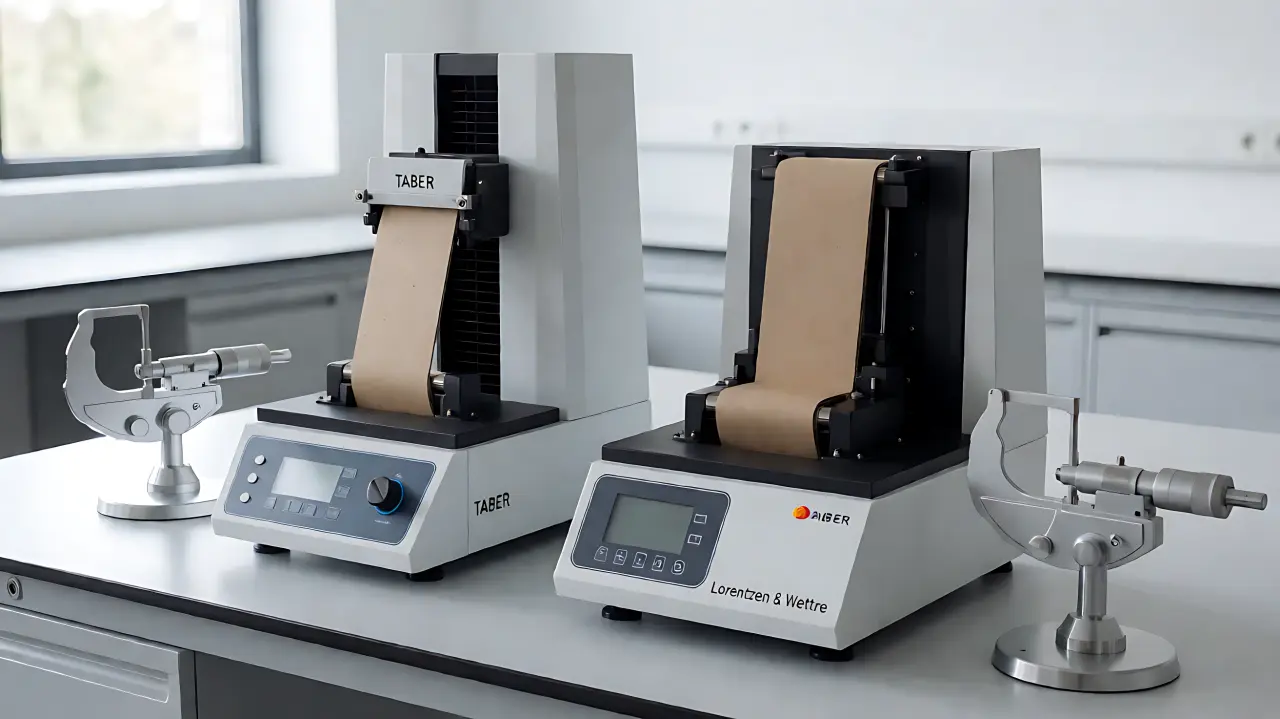
Paperboard Bending Stiffness: Taber vs Lorentzen & Wettre Guide
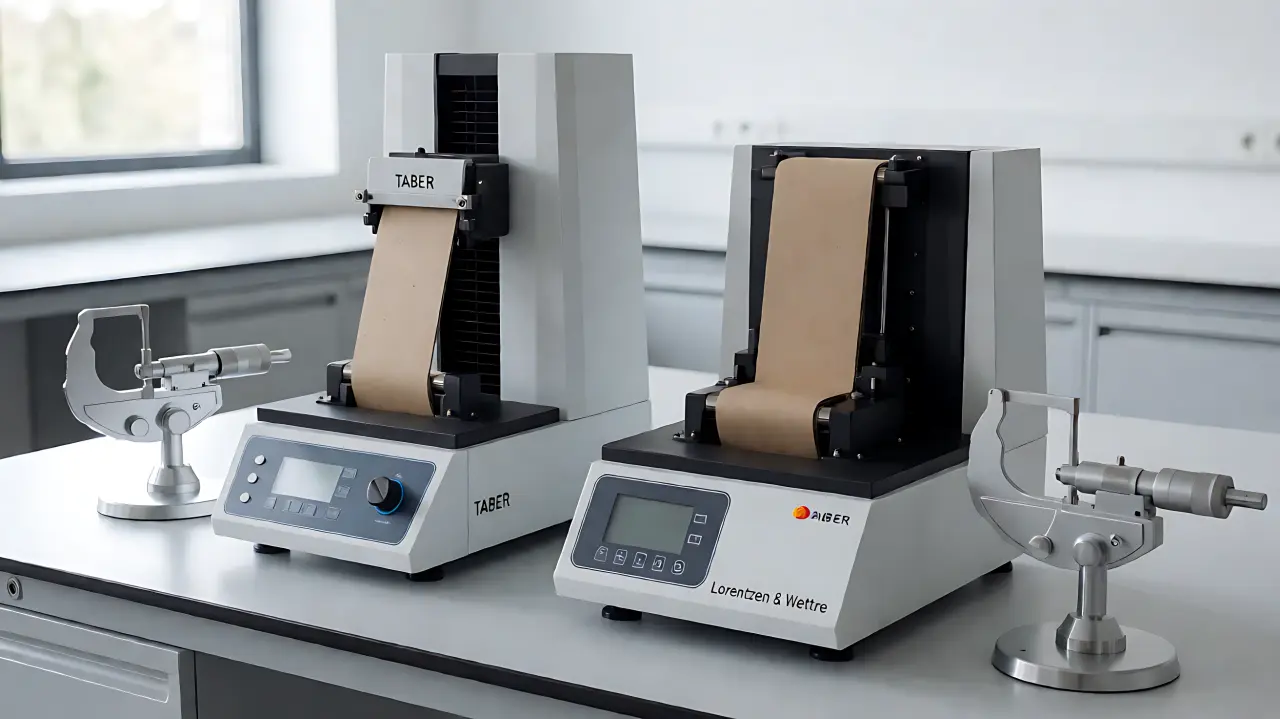
In retail folding carton packaging and luxury rigid setup boxes, paperboard stiffness governs whether a carton runs smoothly across high-speed cartoning machines ($300 - 600\text{ cartons/minute}$) or jams the folder-gluer feeder. Once on retail store shelves, insufficient bending stiffness leads to unsightly carton panel “bulging” under the hydrostatic pressure of granular or powdered contents (such as laundry detergent, cereal, or rice).
Specifying paperboard requires navigating two dominant global testing standards: Taber Stiffness (TAPPI T489) and Lorentzen & Wettre (L&W) Bending Resistance (ISO 2493).
Mechanical Physics: Bending Moment & Elastic Modulus
Paperboard stiffness ($S_b$) is not merely a function of basis weight (GSM) or caliper thickness ($t$); it represents the structural resistance of a beam to elastic deformation:
$$S_b = \frac{E \cdot I}{w} = \frac{E \cdot t^3}{12}$$
Where:
- $S_b$: Bending stiffness per unit width.
- $E$: Modulus of elasticity (Young’s modulus of cellulose fibers in MPa).
- $t$: Caliper (thickness) of the paperboard in micrometers ($\mu\text{m}$).
- $w$: Specimen width.
The cubic relationship with thickness ($t^3$) is the foundation of paperboard engineering: a mere $10%$ increase in caliper delivers a $33%$ increase in bending stiffness, whereas increasing fiber density without increasing thickness yields only marginal gains.
Taber 15° Deflection Method (TAPPI T489)    L&W 2-Point Bending Resistance (ISO 2493)
┌──────────────────────────────────────┐   ┌──────────────────────────────────────┐
│ Clamp holds bottom of 38.1 mm strip  │   │ Pneumatic clamp locks 38 mm strip    │
├──────────────────────────────────────┤   ├──────────────────────────────────────┤
│ Driven pendulum deflects top to 15°  │   │ Motorized blade bends strip 5° or 15°│
├──────────────────────────────────────┤   ├──────────────────────────────────────┤
│ Rollers apply force at 50 mm radius  │   │ Load cell records peak force in mN   │
├──────────────────────────────────────┤   ├──────────────────────────────────────┤
│ Output: Taber Stiffness Units (g·cm) │   │ Output: Bending Resistance (mN or N) │
└──────────────────────────────────────┘   └──────────────────────────────────────┘
Testing Protocol Comparison: Taber vs. L&W
| Engineering Metric | Taber Stiffness (TAPPI T489 / ASTM D5342) | Lorentzen & Wettre Bending Resistance (ISO 2493 / SCAN P29) |
|---|---|---|
| Bending Deflection Angle | Fixed $15^\circ$ deflection | Selectable $5^\circ$ (pure elastic) or $15^\circ$ (post-yield) |
| Test Span Length | Fixed $50\text{ mm}$ ($1.97\text{ in}$) | Variable: $5\text{ mm}$, $10\text{ mm}$, $25\text{ mm}$, or $50\text{ mm}$ |
| Measurement Unit | Taber Units ($\text{g}\cdot\text{cm}$ or $\text{mN}\cdot\text{m}$) | Millinewtons ($\text{mN}$) or Bending Moment ($\text{mN}\cdot\text{m}$) |
| Instrument Alignment | Mechanical pendulum counterweight | Electronic precision load cell transducer |
| Testing Duration | $\approx 15 - 25\text{ seconds}$ per sample | $< 5\text{ seconds}$ automated cycle |
| Dominant Global Usage | North America & Asian converting mills | European folding carton converters (ECMA / DIN) |
Mathematical Conversion Formula
While exact conversion depends on board furnish and ply stratification, the standard empirical correlation between Taber units ($g\cdot cm$) and L&W $15^\circ / 50\text{mm}$ resistance ($mN$) is:
$$\text{Resistance}{L&W (15^\circ, 50\text{mm})} (\text{mN}) \approx 9.807 \cdot \text{Stiffness}{\text{Taber}} (\text{g}\cdot\text{cm})$$
Fiber Anisotropy: MD vs. CD Stiffness Ratios
Paperboard is inherently anisotropic due to fiber orientation during wet-end paper machine forming. Cellulose fibers align predominantly in the Machine Direction (MD), making MD stiffness significantly higher than Cross-Direction (CD) stiffness:
$$\text{Anisotropy Ratio} = \frac{\text{Stiffness}{\text{MD}}}{\text{Stiffness}{\text{CD}}} \approx 1.8 - 2.5$$
Carton Crease Orientation Strategy:
┌──────────────────────────────────────┐
│  ◄──────────── MD ────────────►      │ <── Higher stiffness prevents side-panel bulging
│                                      │
│  ▲                                   │
│  │ CD                                │
│  ▼                                   │ <── Crease scores fold parallel to MD for clean,
└──────────────────────────────────────┘     crack-free 90° corners!
To prevent carton failures:
- Side-Panel Bulge Resistance: The main vertical panels of an upright folding carton must align with the Machine Direction (MD). This utilizes the higher MD bending modulus ($E_{\text{MD}}$) to resist outward hydrostatic pressures exerted by contents.
- Crease Score Cleanliness: Main crease lines are scored parallel to the MD. Bending along the cross direction (CD) bends individual fibers over the male-female score anvil without bursting outer coated plies.
Multi-Ply Paperboard Engineering: FBB vs. SBS vs. WLC
| Board Grade | Furnish Architecture | Bulk Density ($\text{cm}^3/\text{g}$) | Stiffness Efficiency ($S_b / \text{GSM}$) | Ideal Application |
|---|---|---|---|---|
| Folding Boxboard (FBB / GC1 / GC2) | Chemical pulp outer plies + Mechanical pulp middle core | High Bulk ($1.4 - 1.8$) | Highest (Thick mechanical core maximizes $t^3$) | Pharmaceuticals, cosmetics, confectionery |
| Solid Bleached Sulfate (SBS / GZ) | $100%$ Virgin bleached chemical kraft pulp throughout | Medium ($1.1 - 1.3$) | Moderate (Superior brightness & fold tear) | Luxury retail, chocolate gift boxes |
| White Lined Chipboard (WLC / GD2) | Recycled paper furnish with white chemical liner | Low Bulk ($1.0 - 1.2$) | Lower (Requires higher GSM to achieve same $t$) | Dry cereal boxes, hardware retail cartons |
Converting Runnability & Selection Guidelines
- High-Speed Automated Cartoning Lines ($> 400\text{ cpm}$): Require consistent L&W bending resistance within $\pm 7%$ across the master reel. Variations in board stiffness cause erratic suction-cup carton opening and flap tucking faults.
- Specifying Multi-Ply FBB (GC1): For brands transitioning away from plastics, FBB allows down-gauging basis weight by up to $15%$ compared to SBS while maintaining identical Taber stiffness due to its high-bulk mechanical pulp core.
Discover our full range of luxury paper shopping bags and greyboard caliper rigid boxes. Reach out to CraftPack Global to conduct certified Taber and L&W stiffness audits for your packaging specifications.