
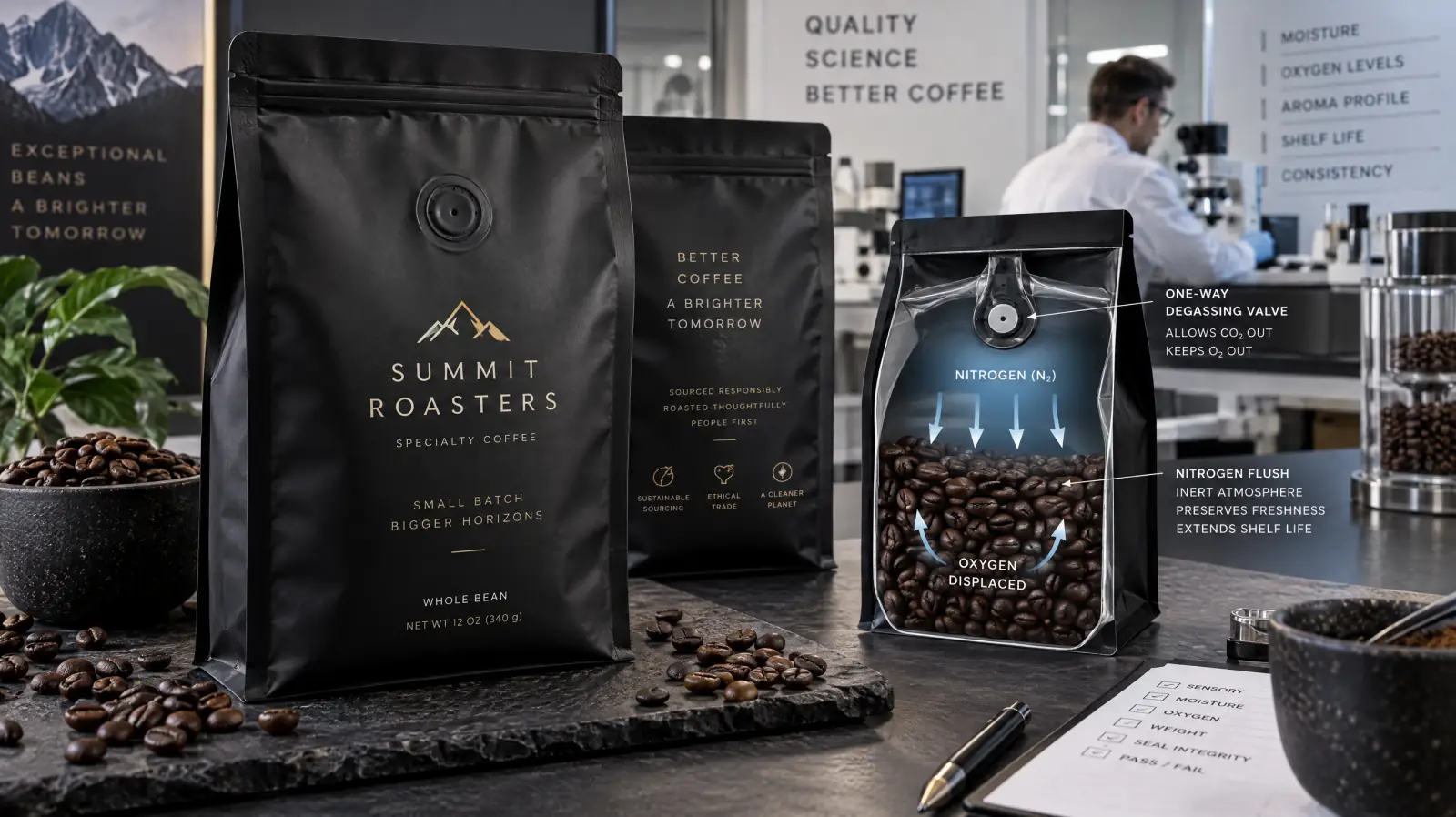
Nitrogen Flushing vs Degassing Valves: Coffee Packaging Science
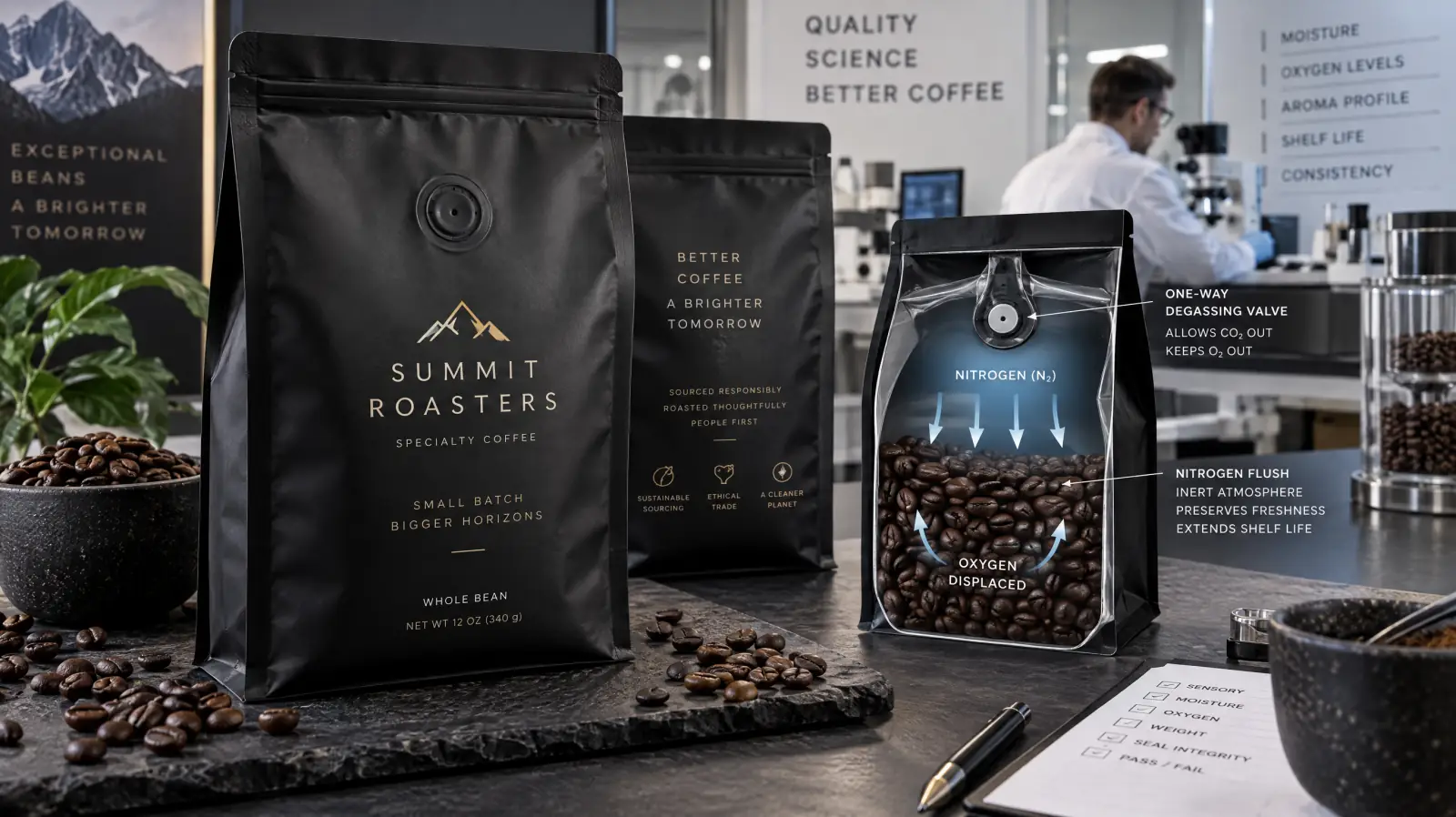
For specialty coffee roasters and commercial packaging operations, preserving roasted coffee freshness represents a delicate balance of physical chemistry and barrier engineering.
Immediately following the roasting process, freshly roasted whole beans release substantial volumes of carbon dioxide ($CO_2$)—frequently between 2 to 5 liters of gas per kilogram of coffee over the first 72 to 144 hours. If sealed in an airtight pouch without ventilation, internal pressure causes catastrophic bag ballooning and seam bursting. Conversely, if coffee is left exposed to ambient air, atmospheric oxygen ($O_2$) rapidly oxidizes delicate lipids and aromatic terpenes, staling the roast within 7 to 10 days.
To solve this dilemma, roasters rely on two packaging technologies: one-way degassing valves and modified atmosphere packaging (MAP) nitrogen flushing. While many roasters treat these as interchangeable options, they perform fundamentally different mechanical functions.
This guide delivers an engineering-grade breakdown of degassing valve mechanics, nitrogen gas displacement chemistry, residual oxygen targets ($<1%$), and how integrating both technologies maximizes specialty coffee shelf life up to 12 to 18 months.
1. Quick Summary: Degassing Valves vs. Nitrogen Flushing
| Technical Dimension | One-Way Degassing Valves | Nitrogen Flushing (MAP) |
|---|---|---|
| Primary Function | Pressure Relief: Releases venting $CO_2$ without letting outside air enter | Oxygen Displacement: Flushes atmospheric air with inert food-grade $N_2$ gas |
| Residual Oxygen Level | Typically 12% to 18% $O_2$ (unless combined with flush) | Sub-1% to 2% $O_2$ immediately at heat seal |
| Pouch Ballooning Prevention | 100% effective; continuous hydrostatic venting | Ineffective on its own (beans will still vent $CO_2$) |
| Aroma Volatile Retention | Moderate; allows lighter aromatic fractions to vent | Maximum; halts lipid oxidation and flavor staling |
| Equipment Requirement | Valve applicator module on pouch packing line ($3,000–$8,000) | Nitrogen generator / liquid dewar + gas injection nozzle ($8,000–$25,000) |
| Cost per Pouch | +$0.025 to $0.05 per valve (applied) | +$0.005 to $0.012 per flush (gas consumption) |
| Optimal Roastery Strategy | Mandatory for freshly roasted beans (<48 hrs off roast) | The Gold Standard: Combine both for export & wholesale distribution |
Compare pouch formats in our Stand-Up Pouches Category and Flat Bottom Bags Category.
2. The Chemistry of Roasted Coffee Degassing
During the roasting process, the pyrolysis of sucrose and organic acids generates immense thermal energy, transforming the coffee bean’s cellular matrix into a micro-porous sponge saturated with pressurized carbon dioxide.
┌────────────────────────────────────────────────────────────────────────┐
│                   ROASTED COFFEE DEGASSING TIMELINE                    │
├────────────────────────────────────────────────────────────────────────┤
│ Hours 0 - 24    : Peak outgassing (~40-50% of total gas volume released)│
│ Days 2 - 5      : Steady desorption of residual CO2 and light volatiles│
│ Days 7 - 14     : Gas release slows; bean matrix becomes vulnerable to  │
│                   oxygen absorption and staling                        │
└────────────────────────────────────────────────────────────────────────┘- Gas Volume: Dark roasts generate significantly higher $CO_2$ volume (up to 5.5 L/kg) compared to light roasts (2.0–3.0 L/kg) due to deeper cell wall degradation.
- Oxidation Risk: Atmospheric air contains 20.9% oxygen. When oxygen contacts bean lipids, it triggers oxidative rancidity, converting aromatic kahweol and cafestol into stale carboxylic acids and stale, cardboard-like notes.
- The Threshold: Sensory studies confirm that reducing pouch headspace oxygen to below 1.0% to 1.5% slows lipid oxidation rates by more than 85%.
3. How One-Way Degassing Valves Work
A one-way degassing valve is a miniature hydrodynamic check-valve ultrasonically heat-staked or thermally welded to the interior wall of a flexible barrier pouch.
┌────────────────────────────────────────────────────────────────────────┐
│                     ONE-WAY DEGASSING VALVE ANATOMY                    │
├────────────────────────────────────────────────────────────────────────┤
│                                                                        │
│   Outside Atmosphere (Blocked by Silicone Diaphragm)                   │
│   ───────────────────▼──────────────────────────────────────────────   │
│   [ Outer Cap with Vent Holes ]                                        │
│   [ Precision Silicone Elastomer Disc ] ◄── Sealed by Viscous Sealant  │
│   [ Micro-Dose Silicone Oil Layer ]     ◄── Prevents Atmospheric Influx│
│   [ Base Plate with Internal Filter ]   ◄── Prevents Dust Clogging     │
│   ───────────────────▲──────────────────────────────────────────────   │
│   Internal Pouch Pressure (CO2 vents outward when P_internal > P_open) │
│                                                                        │
└────────────────────────────────────────────────────────────────────────┘- The Sealing Fluid: A microscopic drop of high-viscosity, food-grade silicone oil sits between the flexible rubber disc and the valve seat, creating an airtight meniscus barrier.
- Opening Pressure (Differential Venting): When internal $CO_2$ pressure exceeds ambient pressure by 3 to 7 millibars (mbar), the elastomeric disc flexes upward, breaking the fluid seal and venting $CO_2$ through the exterior filter holes.
- Instant Resealing: Once pressure equalizes, the disc returns to the flat seat, instantly re-establishing the hermetic seal and preventing outside air, moisture, and ambient odors from contaminating the beans.
- Filter Mesh Protection: For ground coffee or high-chaff beans, valves incorporate an ultrasonic non-woven paper filter to prevent fine coffee particulates from jamming the sealing disc.
For detailed valve selection, explore our Coffee Degassing Valve Guide.
4. Nitrogen Flushing (MAP): Mechanism & Residual Oxygen Math
While a degassing valve prevents the bag from bursting, it does not remove the oxygen trapped inside during packaging. If you pack whole beans on a standard packaging line with a degassing valve but without gas flushing, the pouch seals with approximately 15% to 18% ambient oxygen in the headspace.
The Nitrogen Displacement Process
In Modified Atmosphere Packaging (MAP), ultra-pure nitrogen gas ($N_2 \ge 99.5%$) is injected directly into the pouch cavity immediately before ultrasonic or heat sealing:
- Lance Injection: A calibrated stainless-steel nozzle descends into the pouch, flooding the bottom cavity and displacing atmospheric oxygen upward and out of the bag mouth.
- Headspace Sweeping: A secondary gas curtain sweeps across the seal area as sealing jaws close, preventing ambient air back-suction.
- Inert Cushion: Nitrogen is chemically inert, odorless, and colorless. It does not react with coffee lipids, volatile aromas, or moisture.
Calculating Headspace Oxygen Concentration
Headspace oxygen concentration is measured using a needle-point optical or electrochemical oxygen sensor (Mocon headspace analyzer):
$$\text{Residual } O_2 % = \frac{\text{Volume of } O_2 \text{ remaining in pouch}}{\text{Total Headspace Gas Volume}} \times 100%$$
- Without Flush: Residual $O_2 \approx 18.5%$ $\rightarrow$ Shelf life: 2 to 3 months before noticeable flavor degradation.
- Standard Flush: Residual $O_2 \approx 2.0% - 3.5%$ $\rightarrow$ Shelf life: 6 to 9 months.
- Precision Multi-Stage Flush: Residual $O_2 < 0.8% - 1.0%$ $\rightarrow$ Shelf life: 12 to 18+ months with complete aroma preservation.
5. The Synergistic Hybrid Approach: Why Leading Roasters Use Both
The most successful specialty roasters and commercial export brands do not choose between valves and nitrogen flushing; they deploy them as an integrated freshness system:
┌────────────────────────────────────────────────────────────────────────┐
│               THE COMPLETE SPECIALTY COFFEE FRESHNESS SYSTEM           │
├────────────────────────────────────────────────────────────────────────┤
│                                                                        │
│   STEP 1: High-Barrier Tri-Laminate Substrate (PET / AL / PE or EVOH)  │
│           Prevents oxygen & moisture migration through pouch walls     │
│                                                                        │
│   STEP 2: In-Line Nitrogen Flush at Fill Head                          │
│           Displaces 98%+ of ambient oxygen prior to heat-sealing       │
│                                                                        │
│   STEP 3: Integrated One-Way Degassing Valve                           │
│           Safely vents high-volume CO2 without re-introducing oxygen   │
│                                                                        │
│   RESULT: Near-zero residual O2 (<1%) + Zero bag ballooning + 18-month │
│           freshness window for export shipping & retail shelf life     │
│                                                                        │
└────────────────────────────────────────────────────────────────────────┘
Why Nitrogen Flushing Alone Fails
If you flush a pouch with nitrogen to 0.5% $O_2$ but omit the degassing valve, freshly roasted beans will continue generating liters of $CO_2$. Within 24 to 48 hours, the sealed pouch will swell into a rigid cylinder, risking seam blowouts or retail rejection.
Why Degassing Valves Alone Are Insufficient for Long Distribution
If you apply a degassing valve but skip nitrogen flushing, the coffee vents $CO_2$ effectively, but the trapped 18% ambient oxygen continues degrading the coffee’s aromatic aldehydes and fruity esters. For local roasters delivering whole bean coffee for consumption within 14 days, a valve alone is often sufficient. But for grocery distribution, export shipments, or subscription models, nitrogen flushing is essential to prevent staling.
6. Pouch Structural Requirements for Nitrogen & Valve Packaging
Gas retention and pressure management require specialized flexible packaging film formulations:
- Hermetic Seal Integrity: Nitrogen will quickly leak out if heat seals have micro-voids. Sealing layers must incorporate high-hot-tack Metallocene LLDPE (mPE) capable of sealing through residual coffee dust or oil films.
- True Gas Barriers:
- Foil Laminates:
Matte BOPP / AL Foil 7µm / LLDPE 90µm(Oxygen Transmission Rate, $OTR < 0.1\text{ cc/m}^2/\text{day}$). - Metal-Free High-Barrier:
PET-SiOx or EVOH / LLDPE($OTR < 1.0\text{ cc/m}^2/\text{day}$). - Recyclable Mono-Material: Review our MDO-PE Recyclable Film Guide for sustainable mono-polyethylene structures compatible with degassing valves.
- Foil Laminates:
- Format Ergonomics:
- For 250g to 500g retail roasts: Stand-Up Pouches with Zipper.
- For 1kg to 2.5kg commercial roaster sizes: Flat Bottom Box Pouches or Side Gusset Bags with pocket zippers.
7. Roastery Implementation Checklist
- Measure Roaster Degassing Curves: Conduct off-roast pressure testing for your signature light, medium, and dark roasts.
- Calibrate Valve Placement: Ensure the valve is installed 25mm to 35mm below the zipper to avoid interference with automated filling heads.
- Install Headspace Analyzer: Regularly test oxygen concentration at start-of-shift and post-changeover ($Target: <1.5%$).
- Optimize Sealing Temperature: Maintain precise heat-seal dwell times (0.8–1.2 seconds at 165°C–185°C depending on sealant film thickness).
- Choose the Right Valve Profile: Select button-style external valves for standard bags, or sub-flush recessed valves for high-speed automated packaging lines.
Optimize Your Coffee Packaging with CraftPack Global
CraftPack Global engineers flexible barrier coffee packaging tailored to your exact degassing and nitrogen flushing specifications. We supply pre-valved stand-up pouches, quad-seal bags, and flat-bottom box pouches with certified barrier integrity.
Contact Our Coffee Packaging Engineers today for barrier film samples, custom valve options, and volume pricing.