
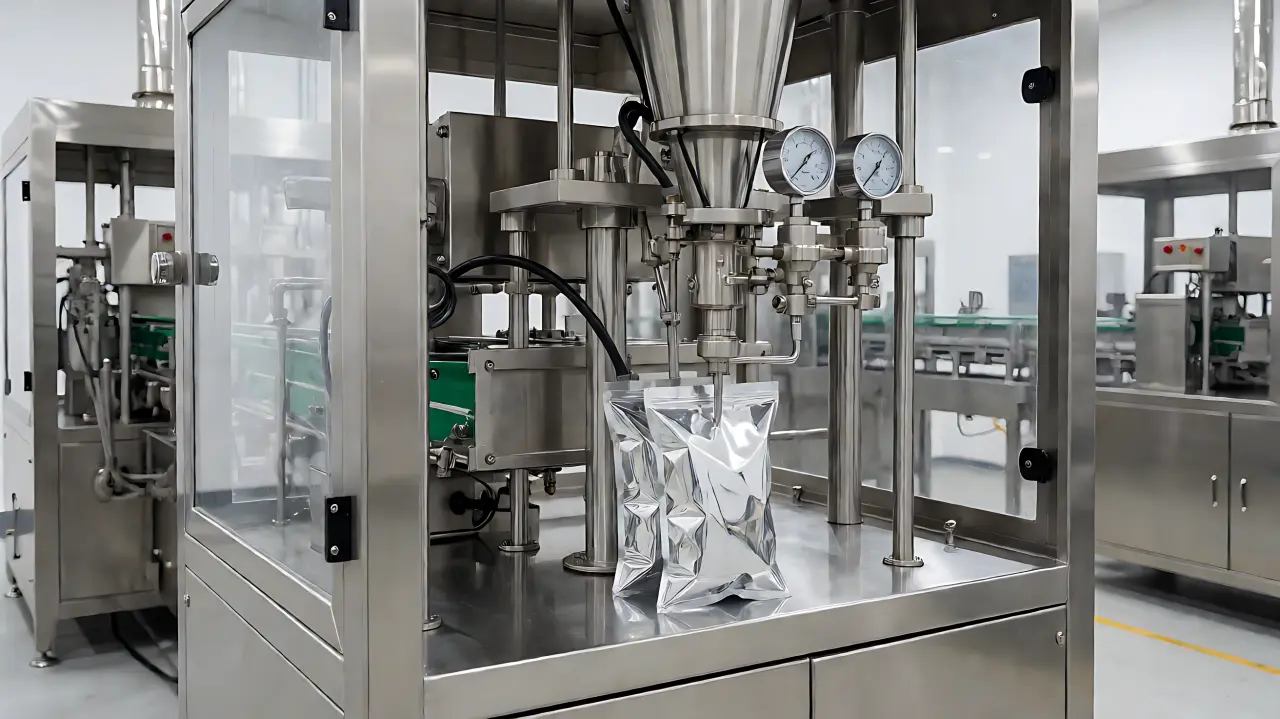
Nitrogen Flushing Purity: 99.5% vs 99.999% Snack Packaging Guide
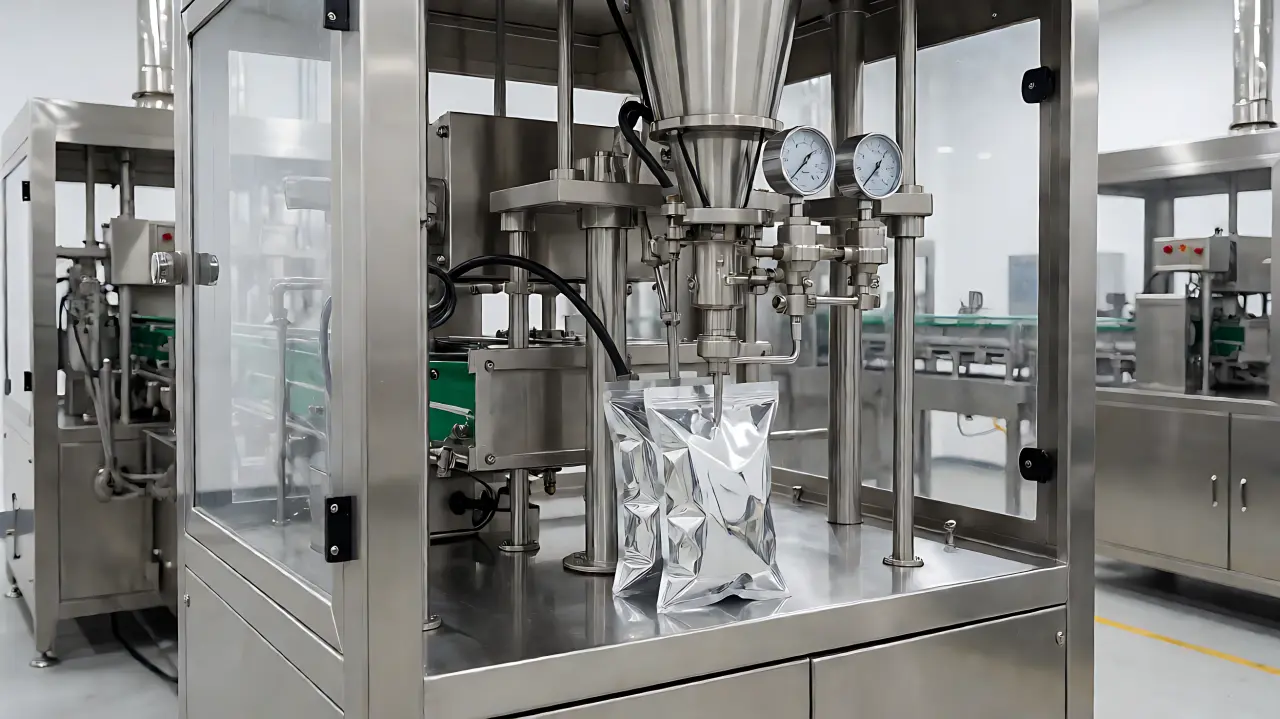
In automated snack and nut packaging—including potato crisps, roasted macadamias, extruded snacks, and specialty coffee—residual oxygen within the package headspace drives lipid autoxidation. Polyunsaturated fatty acids react with oxygen to generate hydroperoxides, which subsequently decompose into volatile aldehydes (such as hexanal) and short-chain ketones, causing sharp rancid odors and stale textures.
To arrest oxidative degradation and provide pillow cushioning against shipping breakage, vertical form-fill-seal (VFFS) lines inject nitrogen ($N_2$). However, food processors often debate whether on-site Membrane / PSA Generated Nitrogen ($99.0% - 99.5%$) is sufficient or whether cryogenic Ultra-High Purity Nitrogen ($99.999%$) / Liquid Nitrogen ($LN_2$) Dosing is required.
Lipid Oxidation Kinetics & Headspace Oxygen Thresholds
The primary driver for nitrogen flushing is extending the Induction Period ($\tau_{\text{ind}}$) before exponential free-radical peroxide generation begins:
Peroxide Value (PV, meq/kg) vs. Storage Time (Weeks at 25°C)
20 ┼                                                Ambient Air (20.9% O2)
   │                                          ╭─────
15 ┼                                   ╭──────╯
   │                            ╭──────╯            Standard Flush (2.0% O2)
10 ┼ ── Critical Rancidity ─────┼───────────────────────────────────────────
   │                            │             ╭─────
 5 ┼                            │      ╭──────╯     Ultra-Purity Flush (<0.5% O2)
   │                            │╭─────╯
 0 ┼─┴──────────────┴───────────┴┴──────────────────┴─────────────────────►
   0                4           8                  16               24 Weeks
The mathematical relationship between residual headspace oxygen concentration ($[O_2]$) and lipid oxidation rate follows pseudo-zero-order kinetics during early shelf life:
$$\frac{d[\text{PV}]}{dt} = k \cdot [O_2]^n$$
Where:
- $[\text{PV}]$: Peroxide value in milliequivalents of active oxygen per kilogram of oil.
- $k$: Reaction rate constant governed by storage temperature (Arrhenius equation).
- $n$: Reaction order ($0.5 \le n \le 1.0$ depending on pro-oxidant transition metal presence).
For high-fat roasted nuts (such as walnuts and macadamias with $> 65%$ unsaturated oil content), reducing headspace $O_2$ from $2.0%$ down to $< 0.5%$ triples the induction period, extending commercial shelf life from 4 months to over 14 months without refrigeration.
Generation Technology: PSA vs. Cryogenic Liquid Dosing
On-Site PSA Generator (Gaseous Flush)       Liquid Nitrogen (LN2) Droplet Injection
┌──────────────────────────────────────┐    ┌──────────────────────────────────────┐
│ Compressed Air ──► Carbon Sieve (CMS)│    │ Cryogenic Vacuum-Insulated Doser     │
├──────────────────────────────────────┤    ├──────────────────────────────────────┤
│ Continuous Gaseous Stream (99.5% N2) │    │ Liquid Droplet (-196°C) Injected     │
├──────────────────────────────────────┤    ├──────────────────────────────────────┤
│ Gas Lance inside VFFS Forming Tube   │    │ 1 Droplet Expands 694x to Gas Volume │
└──────────────────────────────────────┘    └──────────────────────────────────────┘
                 ▼                                             ▼
   Displaces air by turbulent mixing;          Instant phase expansion purges air &
   High gas volume required (4-6x bag vol).    pressurizes container (rigidity!).
1. Pressure Swing Adsorption (PSA) Generators
- Operating Principle: Passing clean compressed air through dual towers packed with Carbon Molecular Sieve (CMS). Oxygen molecules ($3.46\text{ \AA}$ kinetic diameter) adsorb onto the sieve pores faster than larger nitrogen molecules ($3.64\text{ \AA}$), allowing $99.0% - 99.9%$ pure gaseous $N_2$ to exit the column.
- Operating Cost: Low operating expenditure ($\approx $0.02 - $0.05\text{ per m}^3$), eliminating pressurized cylinder deliveries.
- Limitations: In high-speed VFFS baggers ($80 - 140\text{ bags/min}$), turbulent air entrainment through open bag collars dilutes gas purity. Injecting $99.5%,N_2$ gas typically yields an actual package headspace of $1.5% - 3.0%,O_2$ due to ambient air back-drafting.
2. Liquid Nitrogen ($LN_2$) Injection Dosing
- Operating Principle: A precision cryogenic doser deposits a single droplet (micro-liter volume) of liquid nitrogen at $-196^\circ\text{C}$ directly into the open package just milliseconds prior to top jaw sealing.
- Flash Expansion Dynamics: As $LN_2$ boils into gas at room temperature, it expands 694-fold in volume:
$$V_{\text{gas}} = V_{\text{liquid}} \cdot \frac{\rho_{\text{liquid}}}{\rho_{\text{gas}}} = 1.0\text{ L} \cdot \frac{808\text{ kg/m}^3}{1.165\text{ kg/m}^3} \approx 694\text{ L}$$
- Positive Pressure Purge: Rapid gas vaporization creates an aggressive outward pressure wave that purges ambient air out of the pouch opening immediately before the sealing jaws close, reliably achieving residual $O_2$ concentrations below $0.5%$.
- Structural Rigidity: Trapped expansion gas pressurizes the pouch or bottle, providing structural column crush resistance without needing heavier plastic or paperboard outer shippers.
Process Performance Matrix
| Engineering Metric | On-Site PSA Generator ($99.5%$) | Cryogenic Bulk Liquid $LN_2$ ($99.999%$) | Testing Standard | | :— | :— | :— | :— | :— | | Achievable Headspace $O_2$ | $1.2% - 2.5%$ (VFFS Bagging) | $0.2% - 0.6%$ (Precision Dosing) | MOCON Pac Check 325 | | Pouch Internal Pressure | Neutral / Slight Pillow | Controllable ($+5\text{ to }+35\text{ kPa}$) | Internal Pressure Sensor | | Pouch Line Speed | Up to $90\text{ bags/min}$ | Up to $400+\text{ containers/min}$ | VFFS / Flow-Wrap Line | | Capital Investment (CapEx)| Moderate ($$25,000 - $60,000$) | Moderate doser + Bulk dewar rental | CapEx Audit | | Operational Safety | Standard non-toxic gas | Cryogenic burn & asphyxiation sensors | OSHA / ISO 45001 | | Best Food Applications | Potato chips, pretzels, extruded corn | Roasted macadamias, coffee beans, oils | Sensory Panel Stability |
Packaging Film Barrier Synergy
Nitrogen flushing is wasted if the packaging film permits rapid oxygen permeation through its walls. To preserve a $< 1.0%,O_2$ headspace over a 12-month ambient distribution cycle:
- Minimum OTR Specification: Film oxygen transmission rate must remain below $1.0\text{ cc}/(\text{m}^2 \cdot 24\text{h})$ at $23^\circ\text{C} / 0%,\text{RH}$ (ASTM D3985), requiring metallized BOPP (VMBOPP), aluminum foil, or coextruded EVOH cores.
- Hermetic Jaw Seals: Crimping jaws must maintain seal strength $> 20\text{ N}/15\text{mm}$ (ASTM F88) without micro-leaks or channel defects across the side gusset transitions.
For coffee and snack packaging, explore our degassing valve physics guide and premium flat bottom box pouches. Contact CraftPack Global to calibrate barrier laminates for automated nitrogen gas flushing lines.