
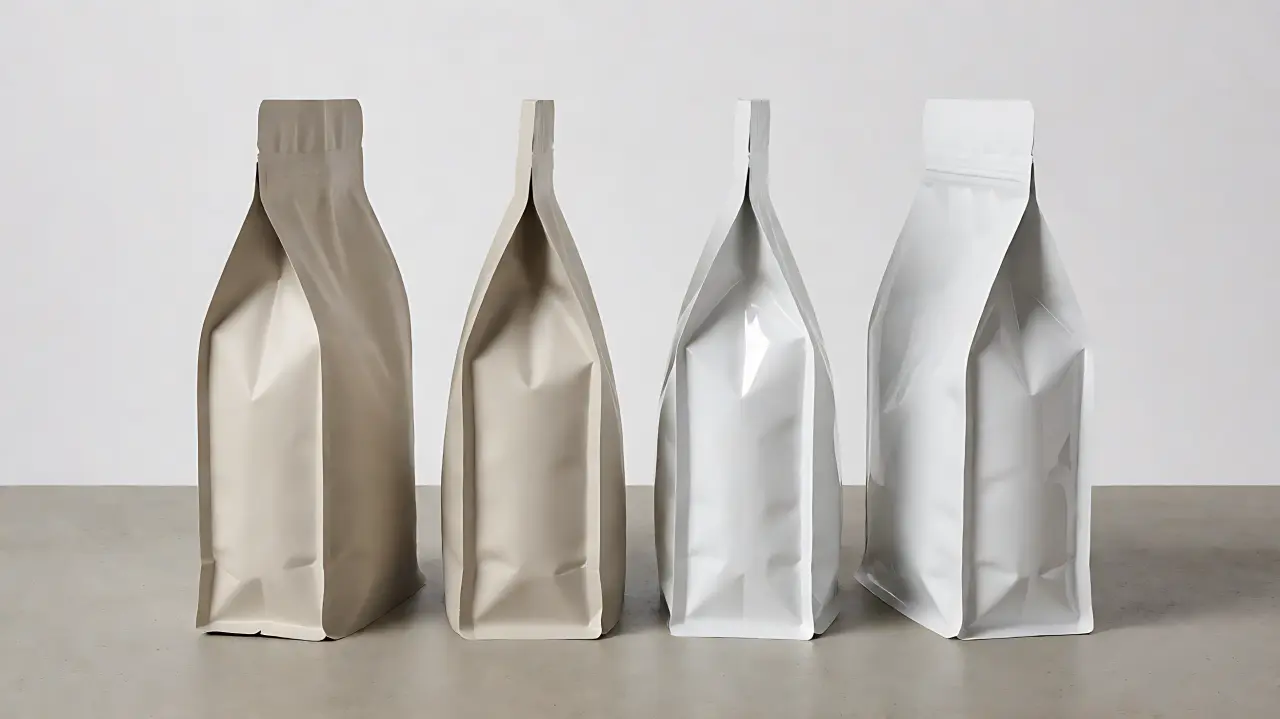
Mono-PP vs Mono-PE: Recyclable Barrier Pouch Comparison Guide
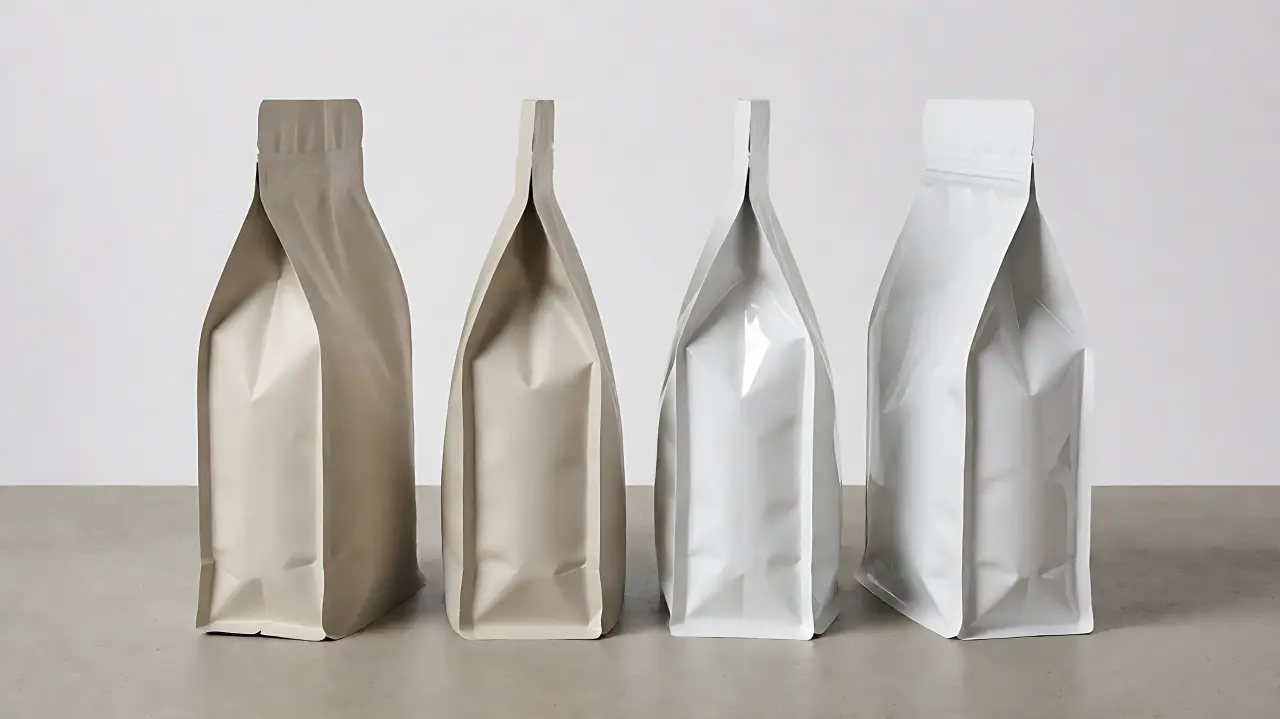
In the global shift away from unrecyclable multi-material barrier packaging (PET / Foil / PE), circular design directives—led by CEFLEX in Europe and the APR in North America—demand mono-material polymer structures containing $\ge 90%$ single-polymer purity by mass. Mixing polyester (PET) or polyamide (Nylon) with polyolefins contaminates mechanical wash-and-regranulation lines, producing brittle, unprocessable recycled resins.
To engineer high-barrier recyclable stand-up pouches, converters must evaluate two competing mono-polymer platforms: Mono-PE (Polyethylene) versus Mono-PP (Polypropylene).
Thermal & Mechanical Polymer Physics
The choice between Mono-PE and Mono-PP is fundamentally governed by polymer melting points ($T_m$), crystalline heat deflection temperatures, and thermal shrinkage windows:
Melting Point Differential & Sealing Thermal Headroom
Temp (°C)
 170° ┼ ─── PP Melting Point (165°C - 168°C) ───
      │                                          ▲ 35°C - 45°C
 130° ┼ ─── PE Melting Point (120°C - 128°C) ─── │ Sealing Processing Window
      │                                          ▼ (Prevents Outer Film Melting!)
 100° ┼ ─── Low-SIT Sealant Initiation (95°C - 105°C) ───
  25° ┼┴────────────────────────────────────────────────►
1. Mono-PE Architecture: MDO-PE / High-Barrier Core / Sealant PE
- Orientation Technology: Standard blown polyethylene possesses high elongation and low tensile modulus ($E \approx 300\text{ MPa}$), which stretches and deforms on high-tension printing presses. Machine Direction Orientation (MDO) stretches PE film under heat by $4:1\text{ to }6:1$ draw ratios, aligning crystalline lamellae along the machine axis.
- Properties: MDO-PE delivers optical clarity, high stiffness ($E \approx 1,200\text{ MPa}$), and excellent print register stability.
- Thermal Limitation: Because outer MDO-PE melts at $125^\circ\text{C} - 130^\circ\text{C}$ while the inner sealant PE melts at $105^\circ\text{C} - 115^\circ\text{C}$, the sealing thermal window is narrow ($\approx 15^\circ\text{C} - 20^\circ\text{C}$). Overheating causes outer web sticking and jaw puckering.
2. Mono-PP Architecture: BOPP / High-Barrier Core / Cast PP (CPP)
- Thermal Headroom: Isotactic polypropylene features a high melting point ($T_m \approx 165^\circ\text{C} - 168^\circ\text{C}$). When paired with low-initiation temperature cast polypropylene sealants ($SIT \approx 120^\circ\text{C} - 130^\circ\text{C}$), the thermal operating window spans $35^\circ\text{C} - 45^\circ\text{C}$.
- Autoclave Retort Survivability: Polypropylene retains structural modulus at elevated temperatures, making Mono-PP the only mono-material platform capable of surviving $121^\circ\text{C}$ autoclave steam sterilization for wet pet foods and RTE meals.
Technical Property Comparison
| Engineering Metric | Mono-PE Pouch (MDO-PE / PE) |
Mono-PP Pouch (BOPP / CPP) |
Standard Test Method |
|---|---|---|---|
| Polymer Density | $0.940 - 0.960\text{ g/cm}^3$ | $0.900 - 0.910\text{ g/cm}^3$ (Higher yield) | ASTM D792 |
| Tensile Modulus (MD) | $1,100 - 1,400\text{ MPa}$ | $1,800 - 2,400\text{ MPa}$ (Superior stiffness) | ASTM D882 |
| Max Service Temperature | $95^\circ\text{C}$ (Hot-fill limit) | $125^\circ\text{C} - 130^\circ\text{C}$ (Retort capable) | Thermal Deflection |
| Cold Impact Toughness ($-20^\circ\text{C}$) | Excellent ($T_g \approx -120^\circ\text{C}$) | Poor / Brittle ($T_g \approx 0^\circ\text{C}$) | ASTM D1709 (Dart Drop) |
| Optical Haze | $3.5% - 5.5%$ | $1.5% - 2.5%$ (High gloss clarity) | ASTM D1003 |
| Barrier Integration | Ultra-thin EVOH ($< 5%$ wt) | AlOx / SiOx or Metallized CPP | ASTM D3985 / F1249 |
| Recycling Stream Sorting | RIC #4 (LDPE / LLDPE stream) | RIC #5 (PP rigid & flexible stream) | NIR Optical Sorting |
Low-Temperature Impact Resistance vs. Retort Heat
A major engineering trade-off centers on the polymer Glass Transition Temperature ($T_g$):
- Frozen Food Logistics (Mono-PE Dominance): Polyethylene has an ultra-low glass transition temperature ($T_g \approx -120^\circ\text{C}$). At deep-freeze storage temperatures ($-18^\circ\text{C} \text{ to } -25^\circ\text{C}$), Mono-PE remains ductile and absorbs handling drop impacts without shattering. In contrast, standard homopolymer polypropylene has a $T_g \approx 0^\circ\text{C}$; at freezing temperatures, it becomes glassy and fractures on impact unless modified with high-cost random ethylene block copolymers.
- Hot-Fill & Retort Logistics (Mono-PP Dominance): For liquids filled at $85^\circ\text{C} - 95^\circ\text{C}$ (sauces, broths) or autoclaved at $121^\circ\text{C}$, Mono-PE softens and collapses. Mono-PP preserves pouch uprightness and dimensional stability.
CEFLEX Recycling Protocol Compliance
To qualify for CEFLEX “Class A” circular recyclability certification:
- $\ge 90%$ Main Polymer Content: The total pouch weight must comprise at least $90%$ of the designated polymer (PE or PP).
- Barrier Layers Under 5%: Non-polyolefin functional barrier layers (such as high-ethylene EVOH) must remain below $5.0%$ of total pouch mass. When EVOH content is kept under $5%$, standard twin-screw recycling extruders disperse the polar EVOH into sub-micron droplets without requiring compatibilizers.
- Zipper & Fitment Matching: Pouches must use mono-material zippers, sliders, or spout fitments molded from the identical polymer (PE zipper for PE pouches, PP spout for PP pouches).
Application Decision Matrix
- Choose Mono-PE: For frozen foods (IQF berries, poultry), dry pet kibble, detergent pods, and ambient snack pouches where low-temperature drop toughness, puncture resistance, and seamless curbside recycling take priority.
- Choose Mono-PP: For ready-to-eat retorted stews, wet pet food, hot-fill beverages, and premium glossy confectionery where high thermal resistance, stiffness, and glass-like clarity are mandatory.
Explore our sustainable monomaterial pouches guide and premium stand-up barrier pouches. Consult CraftPack Global’s materials specialists to transition your brand to certified circular mono-polymer flexible packaging.