
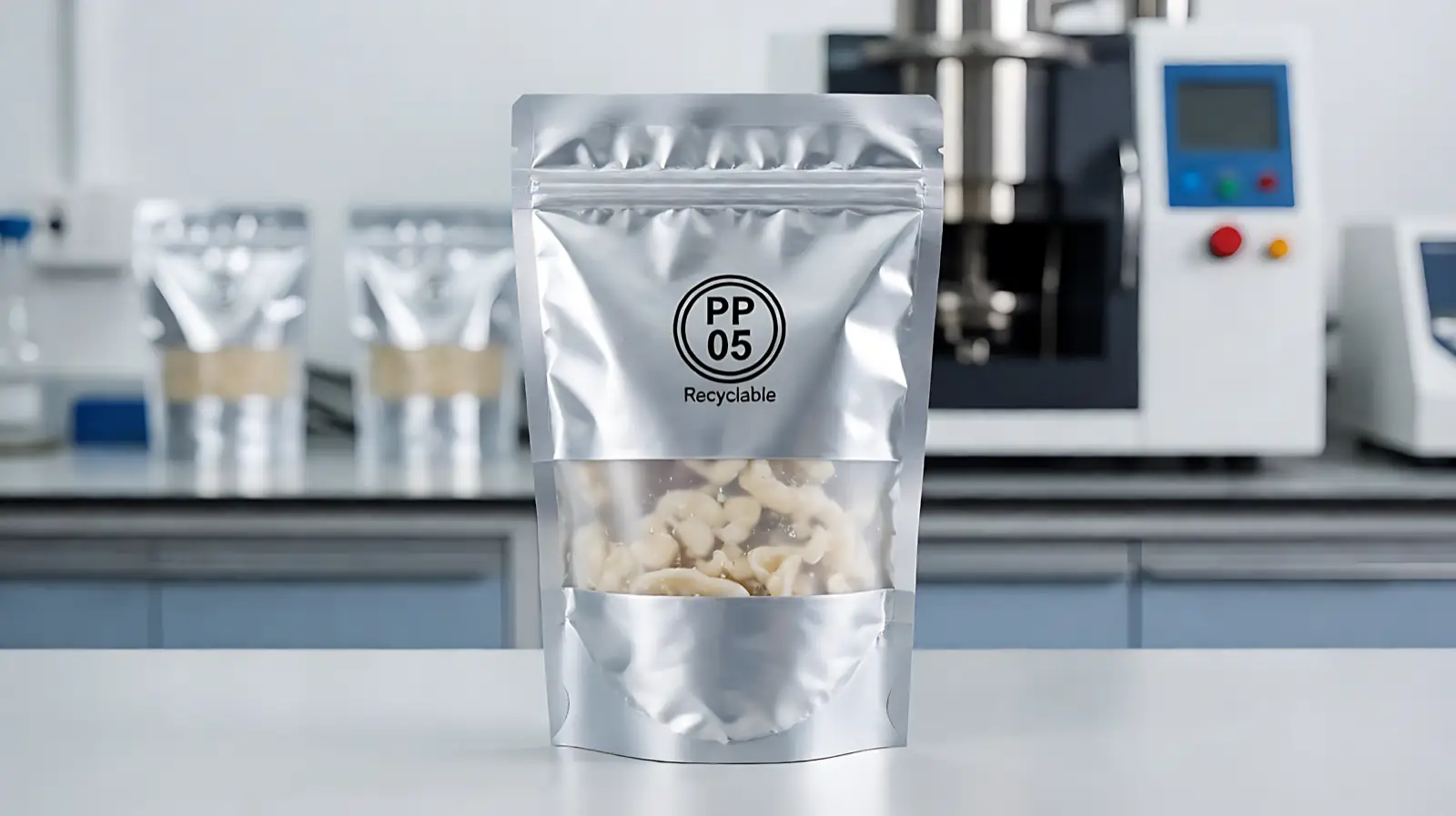
Recyclable Mono-PP High-Barrier Pouches: Circular Retort Guide
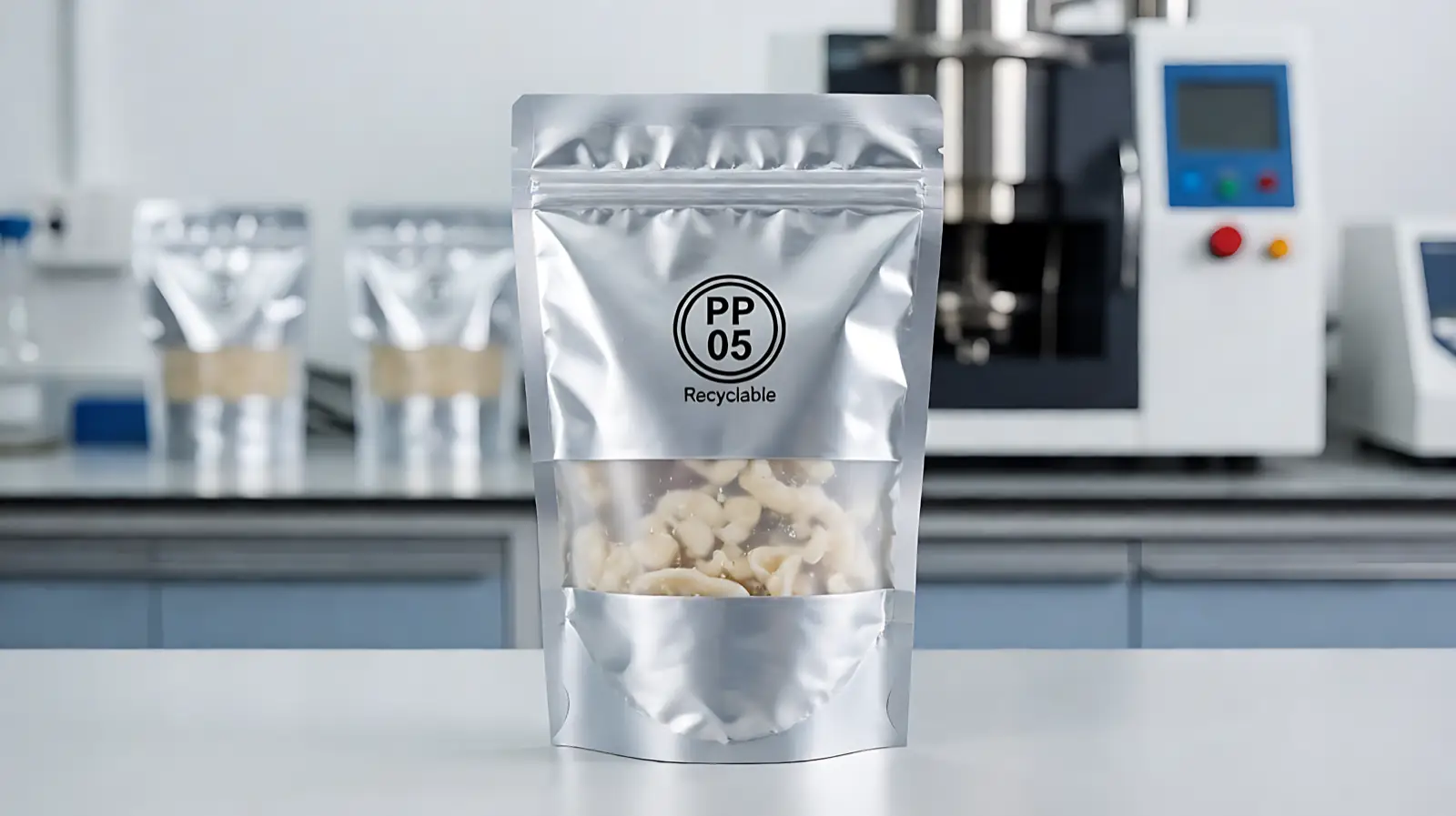
In commercial food preservation, the flexible retort pouch has long provided an energy-efficient alternative to heavy metal cans and glass jars. Capable of enduring 121°C (250°F) autoclave steam sterilization, retort pouches deliver 12 to 24 months of ambient shelf life for wet pet food, ready-to-eat meals, soups, and baby food purees without artificial preservatives.
However, traditional retort packaging is an environmental paradox: to achieve thermal heat resistance and gas impermeability, converters historically laminated four disparate materials together: BOPET / Aluminum Foil / BOPA (Nylon) / Cast Polypropylene (CPP).
Because these polymers cannot be separated economically, conventional multi-material retort pouches are completely unrecyclable—destined for landfills or municipal incinerators.
Driven by the EU Packaging and Packaging Waste Regulation (PPWR) and global extended producer responsibility (EPR) mandates, packaging converters have engineered the Holy Grail of sustainable flexible barrier packaging: Recyclable Mono-Material Polypropylene (Mono-PP) Retort Pouches.
This engineering guide examines polymer orientation mechanics, vacuum-deposited nano-ceramic barrier coatings ($SiO_x / AlO_x$), autoclave counter-pressure controls, and CEFLEX recycling purity.
1. Quick Engineering Benchmark Matrix
| Performance Attribute | Conventional Multi-Material Retort Pouch | Recyclable Mono-Material Polypropylene (Mono-PP) | Recyclable Mono-Material Polyethylene (Mono-PE) |
|---|---|---|---|
| Laminate Architecture | BOPET (12µm) / AL Foil (9µm) / BOPA (15µm) / CPP (70µm) | High-Heat BOPP (20µm) + SiOx/AlOx / Retort-CPP (80µm) | MDO-PE (25µm) + EVOH / Barrier-PE (90µm) |
| Material Recycling Category | Unrecyclable (Code 07 Other Plastic) | 100% Circular Polypropylene (Code 05 PP Stream) | 100% Circular Polyethylene (Code 04 PE Stream) |
| Autoclave Sterilization Temp | 121°C to 135°C (Extreme steam) | 121°C to 125°C (Standard retort sterilization) | Maximum 100°C (Pasteurization only; PE melts) |
| Oxygen Transmission (ASTM F1927) | 0.00 cc/m²/day (Absolute foil shield) | < 0.5 to 1.0 cc/m²/day (Nano-ceramic barrier) | < 1.0 to 2.0 cc/m²/day (EVOH core) |
| Moisture Transmission (ASTM F1249) | 0.00 g/m²/day (Absolute foil shield) | < 0.5 to 1.0 g/m²/day (Hydrophobic PP matrix) | < 1.5 to 3.0 g/m²/day |
| Microwaveability & Metal Detection | Opaque & non-microwaveable (Foil sparks) | 100% Microwave-Safe & Metal-Detector Transparent | 100% Microwave-Safe |
| Product Viewing Window | Impossible (Aluminum is 100% opaque) | Crystal-clear see-through window possible | Clear window possible |
Review autoclave science in our Retort Pouch Science Guide and MDO-PE Recyclable Films Guide.
2. The Polymer Paradox: Why Mono-PP Succeeded Where Mono-PE Failed
Polymer physics dictates that you cannot sterilize standard polyethylene (PE) in a 121°C steam autoclave:
THERMAL RESISTANCE & MELTING POINT (Tm)
Temperature (°C)
  │
165 ────┐ [Polypropylene Melting Point (Tm: 160°C–168°C)]
  │     │ ──► Survives 121°C steam autoclave without losing structural shape
125 ────┼──── [AUTOCLAVE STERILIZATION PEAK: 121°C] ──────────────────────────
  │     │
115 ────┴──── [Polyethylene Melting Point (Tm: 110°C–125°C)]
  │           ──► PE softens, loses tensile strength, and suffers seal blowout
0 ────────────────────────────────────────────────────────────────────────►- Polyethylene’s Thermal Ceiling: Low-density polyethylene (LDPE) and linear low-density polyethylene (LLDPE) melt between 105°C and 122°C. Subjecting a mono-PE pouch to a 121°C autoclave causes immediate molecular relaxation, seam rupture, and catastrophic package collapse. Mono-PE is therefore restricted to pasteurization (< 100°C) or ambient shelf foods.
- The Polypropylene Advantage: Semi-crystalline Polypropylene has a high melting temperature of 160°C to 168°C. By utilizing specialized high-heat biaxially oriented polypropylene (BOPP) for the outer face and high-impact cast polypropylene (CPP) for the inner seal, the pouch maintains complete dimensional rigidity under pressurized 121°C steam.
3. Nano-Ceramic Barrier Deposition: $SiO_x$ & $AlO_x$
Because mono-PP eliminates solid aluminum foil, high gas barrier performance is achieved via physical vapor deposition (PVD):
┌────────────────────────────────────────────────────────────────────────┐
│             NANO-CERAMIC VACUUM COATING ARCHITECTURE                   │
├───────┬────────────────────────────────────────────────────────────────┤
│ LAYER │ COMPONENT & FUNCTION                                           │
├───────┼────────────────────────────────────────────────────────────────┤
│ Outer │ 18µm – 20µm High-Heat Biaxially Oriented Polypropylene (BOPP)  │
│       │ • Thermally stabilized to prevent shrinkage at 121°C           │
├───────┼────────────────────────────────────────────────────────────────┤
│ Nano  │ 10nm – 30nm Silicon Oxide (SiOx) or Aluminum Oxide (AlOx)      │
│       │ • Molecular vapor-deposited ceramic glass network              │
│       │ • Delivers ultra-low OTR (< 0.5 cc) & WVTR (< 0.5 g)           │
├───────┼────────────────────────────────────────────────────────────────┤
│ Tie   │ High-Temperature Retort-Grade Polyurethane Adhesive (Aliphatic)│
├───────┼────────────────────────────────────────────────────────────────┤
│ Inner │ 70µm – 90µm Retort Cast Polypropylene (R-CPP) Sealant          │
│       │ • Engineered ethylene-propylene block copolymer                │
│       │ • High impact resistance to withstand drop shock after retort  │
└───────┴────────────────────────────────────────────────────────────────┘
The Power of Metal-Free Nano-Coatings
- Microwave-Transparent & Metal-Detector Safe: Ceramic nano-coatings consist of inert silicon dioxide ($SiO_x$, chemically identical to glass) or transparent alumina ($AlO_x$). Unlike aluminum foil, food processors can pass finished, sealed pouches through high-sensitivity inline metal detectors, and consumers can heat ready meals directly in the microwave without opening the pouch.
- Flex-Crack Resistance (ASTM F392 Gelbo Flex): While aluminum foil is prone to pinholing when flexed during handling, nano-ceramic coatings paired with oriented polypropylene survive over 1,000 Gelbo flex cycles without barrier degradation.
For lamination safety, review our Solventless vs Solvent-Based Lamination Guide.
4. Autoclave Retort Processing: Overpressure Control
During thermal sterilization, steam temperature reaches 121°C, causing liquids and trapped gases inside the sealed pouch to expand violently:
INTERNAL PRESSURE DYNAMICS DURING 121°C RETORT
Pressure (bar)
  │
3.0 ────┐
  │     │ Internal Pouch Vapor Expansion (2.2 bar)
2.0 ────┴───────────────────────────┐
  │                                 │ Compensating Air Overpressure (2.4 bar)
1.0 ────────────────────────────────┴────► Steam Heat Cycle (45 Minutes)- The Overpressure Balancing Act: To prevent the expanding steam inside the pouch from bursting perimeter heat seals, modern autoclave retorts inject compressed air alongside saturated steam, maintaining a compensating overpressure of 2.2 to 2.5 bar.
- Post-Retort Embrittlement Prevention: Polypropylene can experience secondary crystallization when cooled too rapidly. CraftPack Global utilizes impact-modified ethylene-propylene block copolymers in the inner R-CPP sealant, ensuring the pouch retains extreme ductility and survives 1.5-meter drop tests (ASTM D5276) even when chilled to refrigerator temperatures.
5. Circular Economy Purity: CEFLEX & PPWR Guidelines
Under circular design standards formulated by CEFLEX (Circular Economy for Flexible Packaging) and the EU Packaging and Packaging Waste Regulation (PPWR):
MONO-MATERIAL PURITY VERIFICATION
Total Pouch Weight: 100%
┌──────────────────────────────────────────────────────────────┐
│  BOPP Outer Film:        24% Polypropylene                   │
│  R-CPP Inner Sealant:    71% Polypropylene                   │
│  Nano-Barrier (SiOx):   < 0.1% Ceramic Glass                 │
│  Adhesive / Inks:        4.9% Non-PP Content                 │
└──────────────────────────────────────────────────────────────┘
TOTAL POLYPROPYLENE PURITY: > 95% (CLASS A RECYCLABLE)
Because total polypropylene content exceeds 95% by weight, the entire pouch is categorized as a pure Mono-Material Polypropylene (Code 05) stream. It passes through near-infrared (NIR) automated sorting facilities and melts down into high-grade recycled PP pellets suitable for automotive components, storage bins, and industrial carriers.
Explore mono-PE alternatives in our Sustainable Monomaterial Pouches Guide.
6. Procurement & Qualification Checklist for Retort SKUs
When transitioning food products to recyclable Mono-PP retort pouches:
- Specify Retort-Grade BOPP with High Thermal Heat-Setting: Ensure the print web will not stretch or shrink by more than 1.5% at 125°C.
- Request Gelbo Flex Barrier Test Data (ASTM F392): Verify that OTR remains < 1.0 cc/m²/day after 250 dynamic flex cycles.
- Validate In-Pack Sterilization Cycles: Conduct trial autoclave runs to calibrate heating and cooling ramp overpressure curves for your exact liquid filling weight.
- Verify CEFLEX Class A Recyclability: Mandate third-party certification of > 90% PP polymer purity to ensure exemption from European EPR plastic taxes.
Pioneer Circular Retort Packaging with CraftPack Global
CraftPack Global engineers revolutionary Mono-PP high-barrier retort pouches featuring metal-free nano-ceramic barriers, crystal-clear product viewing windows, and certified circular recyclability.
Contact Our Retort Packaging Specialists to request Mono-PP sample pouches, barrier specification sheets, and custom production dielines.