
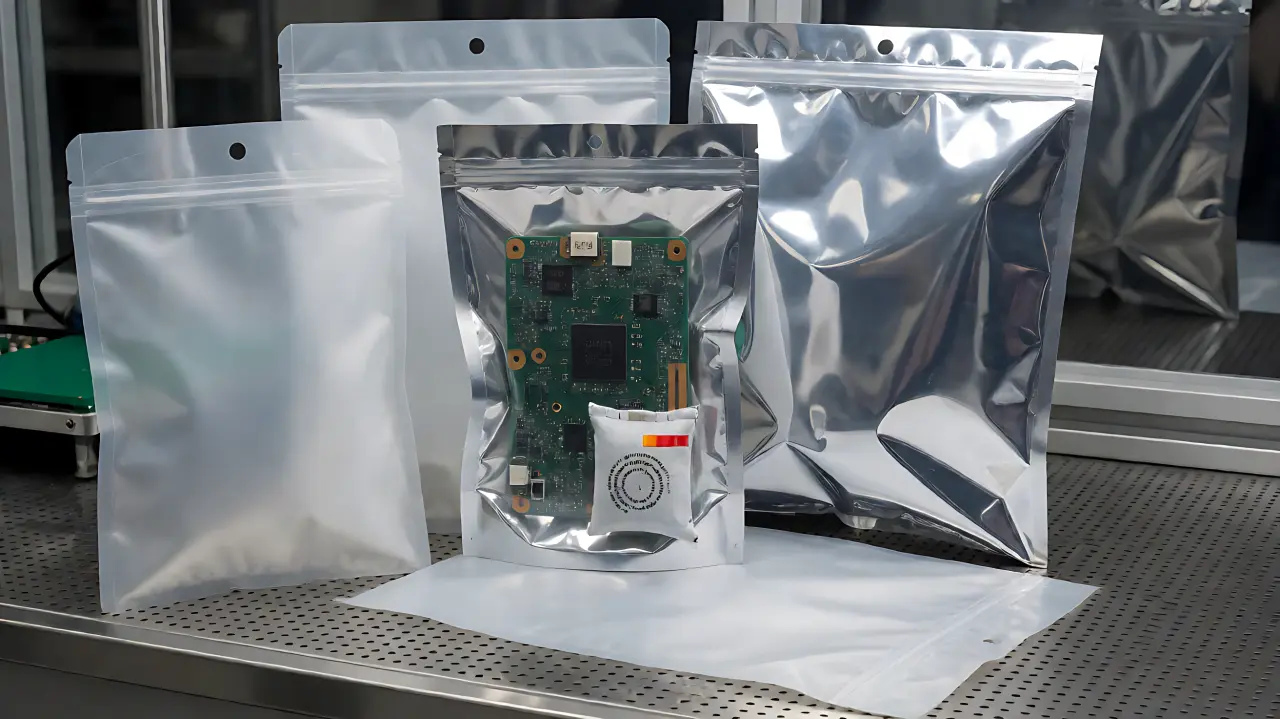
Moisture Barrier Bags vs Static Shielding: IPC/JEDEC J-STD-033 Guide
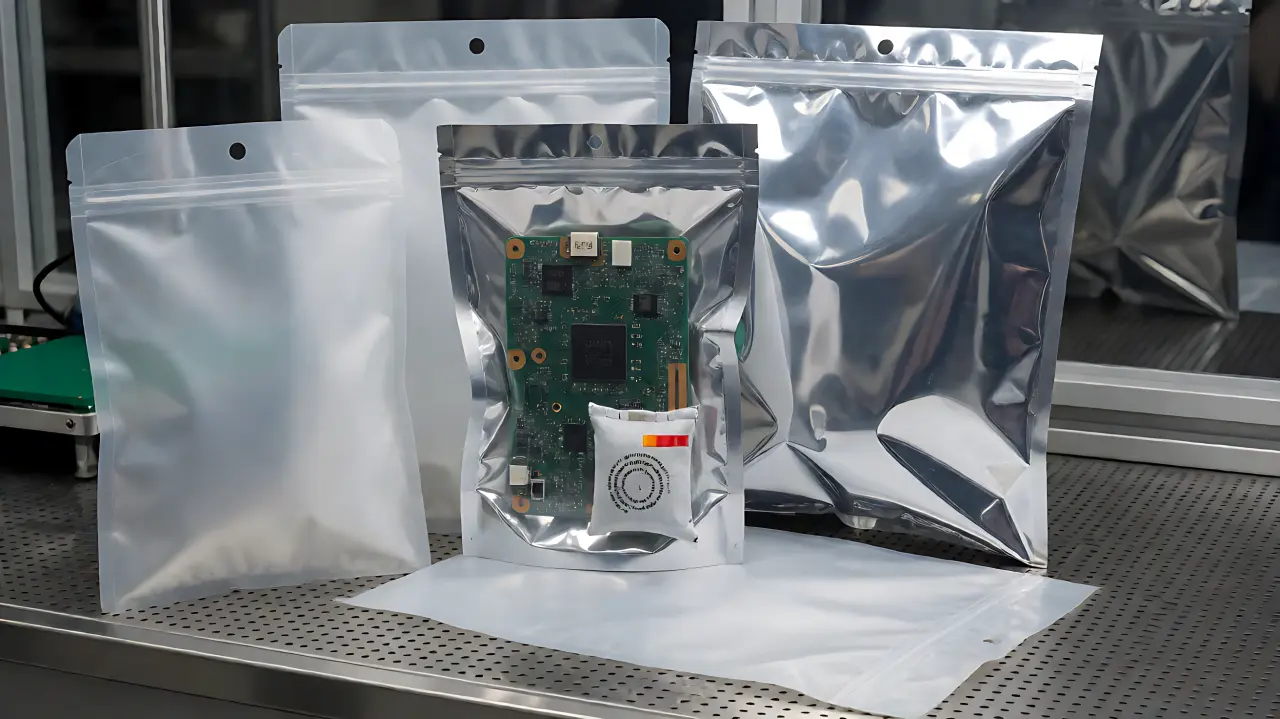
In surface-mount technology (SMT) assembly and semiconductor logistics, electrostatic discharge (ESD) and ambient moisture ingress represent dual failure vectors. Trapped water vapor within non-hermetic semiconductor plastic packages expands violently during lead-free reflow soldering (peak temperatures reaching 245°C to 260°C), resulting in internal delamination, bond wire shearing, or catastrophic package ruptures commonly termed the “popcorn effect.”
Selecting between semi-transparent Static Shielding Bags and opaque multi-layer Moisture Barrier Bags (MBB) requires balancing electrostatic attenuation against water vapor transmission rates (WVTR) governed by IPC/JEDEC J-STD-033 and ANSI/ESD S20.20.
Laminate Architecture & Material Science
The functional divergence between static shielding bags and moisture barrier bags originates in their cross-sectional film lamination:
Static Shielding (Transparent 3-Layer)       Moisture Barrier Bag (Opaque Foil 4-Layer)
┌──────────────────────────────────────┐     ┌──────────────────────────────────────┐
│ Static Dissipative PET (12 µm)       │     │ Static Dissipative Polyamide/PET     │
├──────────────────────────────────────┤     ├──────────────────────────────────────┤
│ Vapor-Deposited Al (~10 nm, 40% T)   │     │ Solid Rolled Aluminum Foil (7-9 µm)  │
├──────────────────────────────────────┤     ├──────────────────────────────────────┤
│ Dissipative Polyethylene (50-65 µm)  │     │ Biaxially Oriented Nylon (BON 15 µm) │
└──────────────────────────────────────┘     ├──────────────────────────────────────┤
                                             │ High-Purity Antistatic PE (75-90 µm) │
                                             └──────────────────────────────────────┘
1. Standard Static Shielding Bags (Metal-In / Metal-Out)
- Primary Function: Electrostatic discharge suppression via Faraday cage effect.
- Physical Structure: A 3-layer laminate featuring a microscopic vacuum-metallized aluminum deposit (~10 nm thick) sandwiched between dissipative polyester and polyethylene.
- Transparency: High optical transmission (typically 40% light transmittance), enabling barcode scanning and optical inspection without unsealing.
- Moisture Barrier Performance: Negligible. A typical static shielding bag exhibits a WVTR of $3.0\text{ to }7.5\text{ g}/(\text{m}^2 \cdot 24\text{h})$ at 37.8°C / 90% RH (ASTM F1249), providing zero defense against solder reflow popcorning for Moisture Sensitivity Level (MSL) 2 through 6 components.
2. Moisture Barrier Bags (MBB / Dry Packaging)
- Primary Function: Comprehensive climate control (moisture exclusion) coupled with ANSI/ESD S20.20 Faraday shielding.
- Physical Structure: A heavy-duty 4- to 5-layer composite incorporating solid rolled aluminum foil ($7\text{ to }9,\mu\text{m}$) or multiple ultra-dense metallized polyester plies reinforced by biaxially oriented nylon (BON/OPA).
- WVTR Performance: Exceeds MIL-PRF-81705 Type I specifications, yielding a WVTR $\le 0.005\text{ g}/(100,\text{in}^2 \cdot 24\text{h})$ ($\le 0.077\text{ g}/(\text{m}^2 \cdot 24\text{h})$).
- Light & Gas Barrier: 100% light block with an oxygen transmission rate (OTR) below $0.05\text{ cc}/(\text{m}^2 \cdot 24\text{h})$, protecting sensitive leads against ambient oxidation.
For broader moisture control strategies across retail flexible formats, review our insights on water-based barrier coatings and stand-up pouch structures.
Mechanical & Electrostatic Performance Matrix
| Engineering Metric | Standard Static Shielding Bag | Multi-Layer Foil MBB (Class 1) | Metallized Film MBB (Class 2) | Test Standard |
|---|---|---|---|---|
| WVTR ($37.8^\circ\text{C}, 90%,\text{RH}$) | $3.5 - 6.5\text{ g}/(\text{m}^2 \cdot 24\text{h})$ | $< 0.005\text{ g}/(100,\text{in}^2 \cdot 24\text{h})$ | $< 0.02\text{ g}/(100,\text{in}^2 \cdot 24\text{h})$ | ASTM F1249 |
| Surface Resistance ($R_s$) | $10^4 - 10^{11},\Omega/\text{sq}$ | $10^4 - 10^{11},\Omega/\text{sq}$ | $10^4 - 10^{11},\Omega/\text{sq}$ | ANSI/ESD STM11.11 |
| ESD Energy Penetration | $< 10\text{ nJ}$ | $< 10\text{ nJ}$ | $< 10\text{ nJ}$ | ANSI/ESD STM11.31 |
| EMI / RFI Attenuation | $> 10\text{ dB}$ ($1 - 10\text{ GHz}$) | $> 45\text{ dB}$ ($100\text{ MHz} - 10\text{ GHz}$) | $> 40\text{ dB}$ ($100\text{ MHz} - 10\text{ GHz}$) | MIL-PRF-81705E |
| Puncture Resistance | $12 - 18\text{ lbs},(53 - 80\text{ N})$ | $> 26 - 35\text{ lbs},(115 - 155\text{ N})$ | $20 - 24\text{ lbs},(89 - 106\text{ N})$ | FTMS 101C / ASTM F1306 |
| Sealing Strength | $12 - 18\text{ N}/15\text{mm}$ | $> 35 - 50\text{ N}/15\text{mm}$ | $> 28 - 35\text{ N}/15\text{mm}$ | ASTM F88 |
| Cleanroom Outgassing | Standard Industrial | Low Amine / Non-Silicone | Low Amine / Non-Silicone | ASTM E595 |
Dry Packaging Calculations: Desiccant Sizing
Under IPC/JEDEC J-STD-033, dry packing involves three essential elements sealed inside an MBB:
- The Semiconductor Devices (trays, reels, or tubes).
- Desiccant Units (TY) compliant with MIL-D-3464.
- A Humidity Indicator Card (HIC) (measuring 5%, 10%, and 60% relative humidity).
To calculate the exact number of desiccant units ($U$) required to maintain internal RH below 10% for a guaranteed 12-month shelf life, engineering standards mandate:
$$U = \frac{0.011 \cdot A \cdot \text{WVTR} \cdot t}{c} + \frac{D_M}{c}$$
Where:
- $A$: Total exposed bag surface area in square inches ($2 \times \text{length} \times \text{width}$).
- $\text{WVTR}$: Rated water vapor transmission rate of the bag in $\text{g}/(100,\text{in}^2 \cdot 24\text{h})$.
- $t$: Target storage duration in months (standard baseline = 12 months).
- $c$: Desiccant capacity (grams of water absorbed per unit desiccant at 20% RH, $c \approx 2.85\text{ g/unit}$ for activated clay or silica gel).
- $D_M$: Mass of dunnage material (such as plastic tape & reel or trays) in grams, scaled by its intrinsic moisture coefficient.
When using high-barrier foil MBBs ($\text{WVTR} \le 0.005$), the first term reduces dramatically, meaning the desiccant sizing is primarily driven by absorbing the latent moisture trapped inside carrier reels and dunnage trays rather than atmospheric permeation.
Sealing Process Window & Verification
Moisture Barrier Bags require higher thermal energy inputs than conventional polyethylene mailers due to the heat-dissipating properties of the laminated aluminum foil layer:
- Platen Temperature: $175^\circ\text{C} - 195^\circ\text{C}$ ($347^\circ\text{F} - 383^\circ\text{F}$)
- Sealing Pressure: $0.35 - 0.55\text{ MPa}$ ($50 - 80\text{ psi}$)
- Dwell Time: $1.2 - 2.0\text{ seconds}$
- Cooling Cycle: Controlled release below $80^\circ\text{C}$ to avoid seal micro-channeling.
Vacuum extraction prior to impulse sealing must be calibrated to a mild $-0.04\text{ to }-0.06\text{ MPa}$. Excessive vacuum pull collapses the foil laminate tightly over sharp surface-mount component pin corners, inducing flex-cracks and puncturing the moisture barrier (ASTM F392 Gelbo flex fatigue).
For shipping finished assemblies and sensitive logistics, explore our heavy-duty ecommerce mailers and custom barrier pouch formats. Contact CraftPack Global’s engineering specialists to audit your component storage chain and specify custom-printed MBBs compliant with J-STD-033.