
Nitrogen Flushing & MAP Packaging for Snacks & Dry Foods
For commercial snack brands, nut roasters, confectionery producers, and dry food manufacturers, extending shelf life without saturating products with artificial chemical preservatives is the golden standard of modern food science.
Yet, dry fried foods, roasted nuts, extruded snacks, and potato crisps face two persistent enemies the moment they leave the fryer or oven:
- Atmospheric Oxygen ($O_2$): Triggers rapid lipid auto-oxidation in cooking oils, generating rancid volatile aldehydes and stale off-flavors.
- Moisture Vapor ($H_2O$): Causes crisp starches to lose their signature crunch, becoming soggy and unpalatable.
To achieve an 8-to-18-month retail shelf life while preserving authentic taste and structural crispness, food processors rely on Modified Atmosphere Packaging (MAP)—specifically nitrogen gas flushing ($N_2$) paired with ultra-high-barrier flexible pouches.
This technical guide explores the gas dynamics of nitrogen flushing, target residual oxygen levels, barrier film selection, and seal integrity testing for export food brands.
The Science of Nitrogen Gas Flushing in Food Packaging
Ambient air consists of approximately 78% Nitrogen, 21% Oxygen, and 1% trace gases. In food packaging, nitrogen is the ideal flushing medium because it is:
- Chemically Inert & Colorless: It does not react chemically with food ingredients, oils, or pigments.
- Sparingly Soluble: Unlike carbon dioxide ($CO_2$), which dissolves readily into fats and water (often causing pouch collapse or imparting an acidic bite), nitrogen does not dissolve into dry foods.
- A Structural Cushion (Gas Pillowing): Nitrogen acts as an internal protective cushion inside the sealed pouch. This internal gas volume absorbs transit compression and drop impacts, preventing delicate chips, crackers, and freeze-dried fruits from crushing into crumbs.
Critical Target: Residual Oxygen Level ($< 1.0% - 2.0%$)
In food packaging, the performance benchmark of an effective nitrogen flushing system is the Residual Oxygen Content measured in the pouch headspace immediately after sealing:
- Standard Ambient Bagging (No Flush): Headspace oxygen remains at 20.9%, causing nuts and potato chips to develop detectable rancidity within 3 to 6 weeks.
- Commercial Nitrogen Flush Standard: Headspace oxygen must be driven down to $< 2.0%$ (with premium roasted nuts and infant nutrition requiring $< 0.5% - 1.0%$).
- Oxygen Scavengers vs Active Flushing: While iron-based oxygen absorber packets work well in manual small-batch packaging, high-speed automated vertical form-fill-seal (VFFS) lines utilize active gas lances to inject continuous food-grade nitrogen ($99.9%$ purity) right before heat-sealing.
Multi-Layer Barrier Structures Required for MAP Packaging
Nitrogen flushing is only as effective as the barrier pouch enclosing it. If the laminate has a high gas transmission rate, nitrogen gradually leaks out while ambient oxygen diffuses inward.
Snack packaging for MAP applications requires specific multi-layer film combinations:
1. Biaxially Oriented Polypropylene Metallized Laminates (BOPP / VMBOPP / PE)
- Layer Breakdown: Matte or Gloss BOPP (Outer print layer) + Vacuum Metallized BOPP (High moisture and oxygen barrier) + Low-Temperature Heat Sealable PE or Cast Polypropylene (CPP).
- Key Performance: Exceptionally low Water Vapor Transmission Rate (WVTR < 0.5 g/m²/24hr) combined with high crispness and puncture resistance.
- Best Suited For: Potato chips, extruded corn snacks, crackers, and pretzels.
2. High-Barrier Metallized Polyester Triplex (PET / VMPET / PE)
- Layer Breakdown: 12µm PET + 12µm VMPET + 60–90µm Linear Low-Density Polyethylene (LLDPE).
- Key Performance: Lower Oxygen Transmission Rate (OTR < 0.5 cc/m²/24hr) and higher mechanical puncture strength against sharp nut shells.
- Best Suited For: Roasted cashews, almonds, macadamia nuts, seeds, and trail mixes.
3. Clear High-Barrier EVOH Laminates (BOPP / EVOH-PE)
- Key Performance: Provides glass-like optical clarity allowing consumers to inspect the product through a transparent window, while EVOH polymer blocks oxygen diffusion.
- Best Suited For: Premium organic snacks, dehydrated fruits, and artisan confectionery.
Explore flexible packaging formats in our stand-up pouches and flat bottom bags collections.
Quality Control & Verification on Nitrogen Flush Lines
To prevent field failures and premature product spoilage, manufacturing plants must maintain three essential testing protocols:
- Headspace Gas Analyzers: Utilizing needle-probe optical or electrochemical oxygen analyzers (such as Dansensor) to pierce sealed pouches through an adhesive septum, verifying that internal $O_2$ remains below $1.5%$.
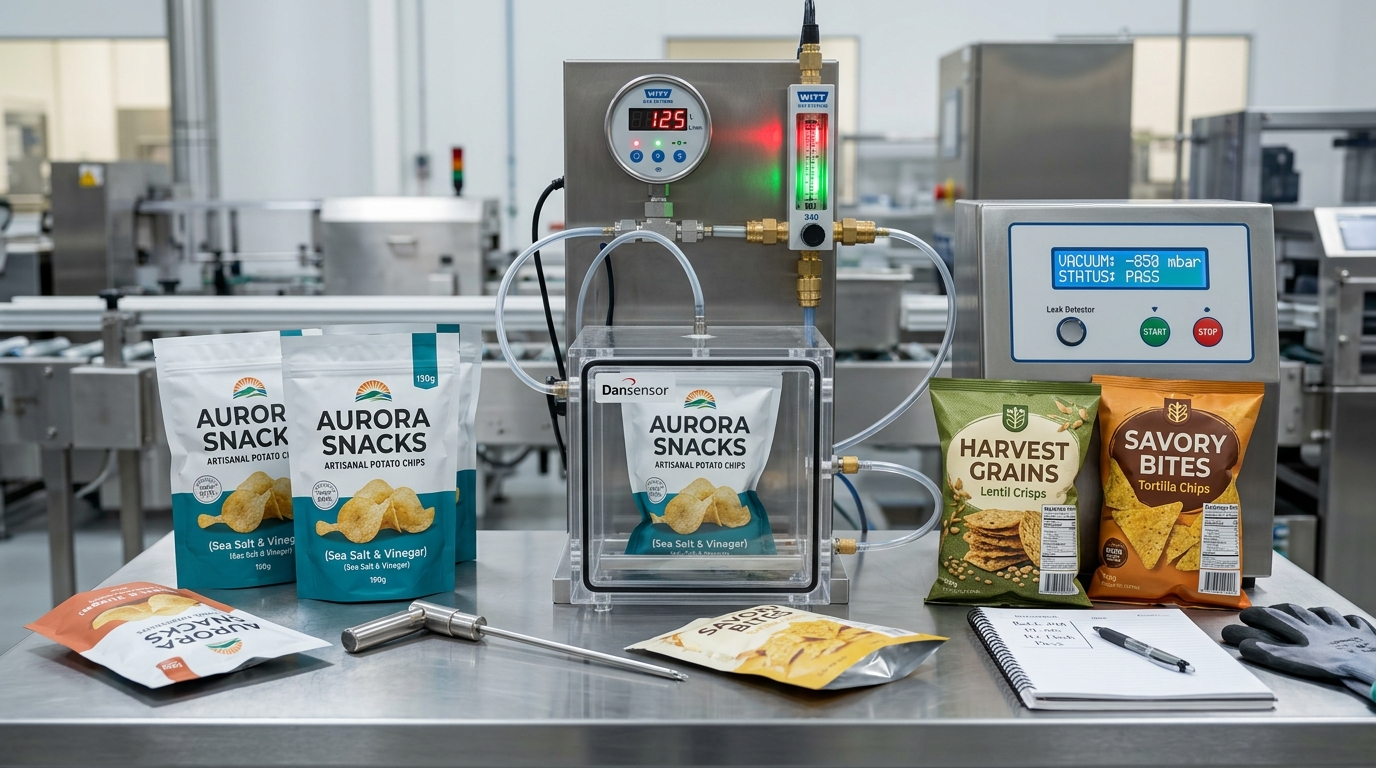
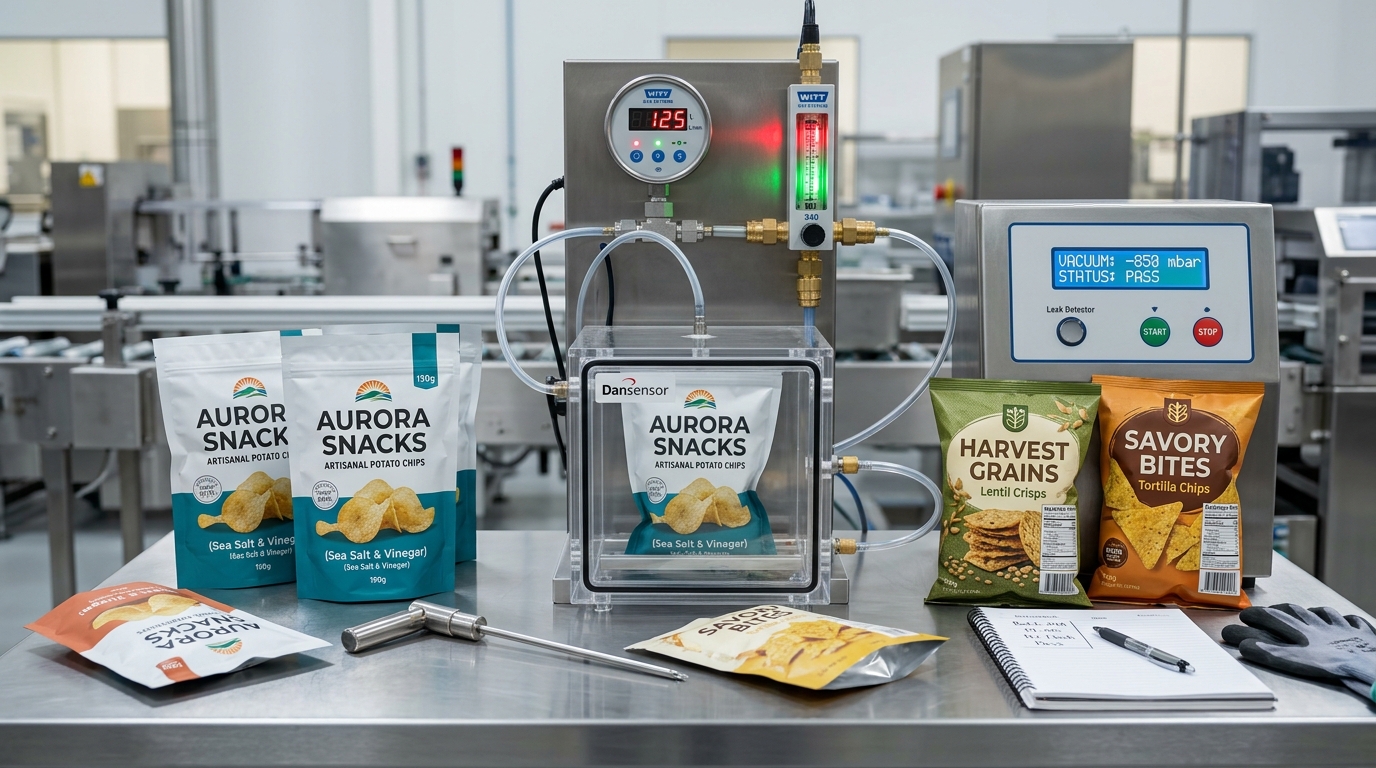
- Underwater Vacuum Chamber Bubble Testing: Placing sealed pouches inside an acrylic water vacuum chamber pulled to $-800\text{ mbar}$. Continuous micro-bubbles reveal pinhole breaches in fin seals, lap seals, or corner welds.
- Seal Jaw Temperature Calibration: High-speed VFFS machines cycle in fractions of a second. Ultrasonic or servo-driven heat-sealing bars must deliver consistent seal pressure and dwell times to avoid localized micro-leaks along the pouch zipper and gusset intersections.
Review quality verification procedures in our packaging pre-shipment inspection checklist.
Packaging Format Comparison for Snack Foods
| Packaging Geometry | Nitrogen Cushioning | Shelf Impact | Typical Fill Weight |
|---|---|---|---|
| Standard Pillow Pouches | Excellent (natural pillow profile) | Lay-down or clip-strip display | 30g to 150g (Single serve) |
| Stand-Up Pouches | Very Good (bottom gusset + gas cushion) | Upright retail shelf presence | 100g to 500g (Retail standard) |
| Flat Bottom Bags | Good (rigid brick shape with gas headspace) | Premium box-like facade | 250g to 1 kg (Family / Bulk) |
Upgrade Your Food Packaging with CraftPack Global
Extending food shelf life requires precision film lamination, hermetic seal integrity, and compliance with international food contact standards (FDA & EU 10/2011). The CraftPack Global Team provides custom barrier pouches, metallized film rolls, certified food-grade laminates, and dieline engineering tailored to high-speed nitrogen flushing packaging operations.