
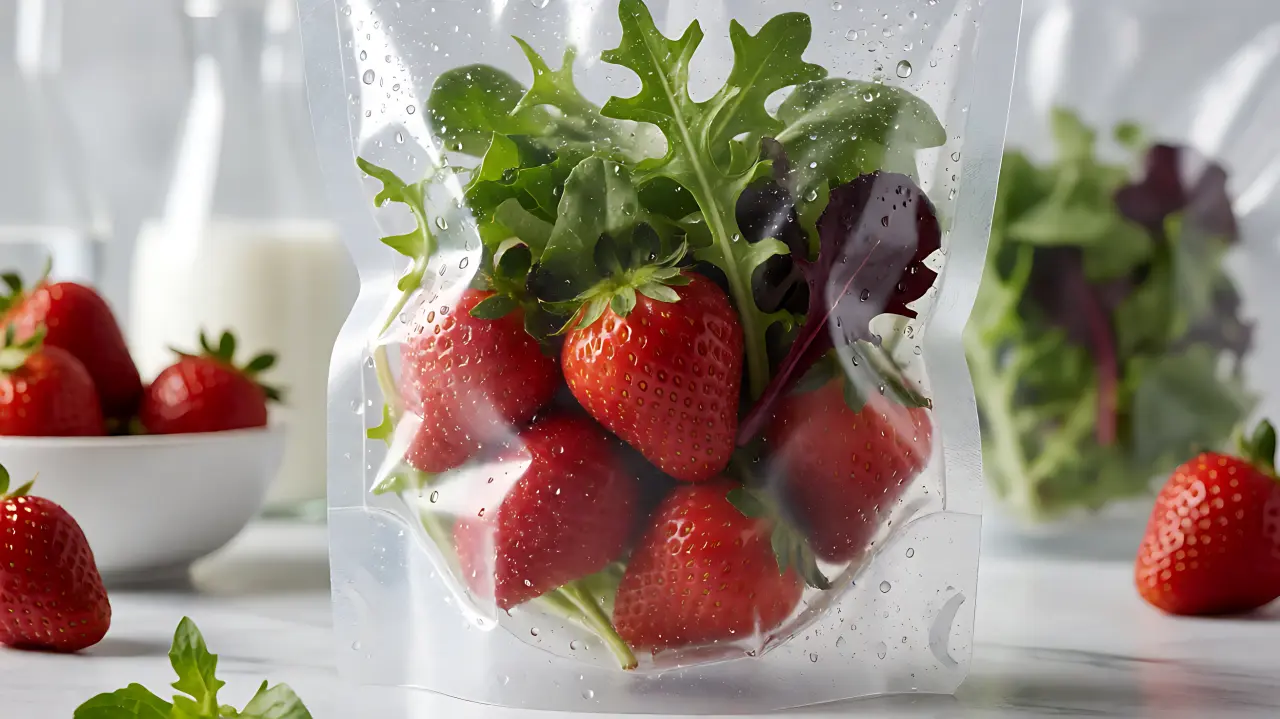
Micro-Perforated MAP Films: Fresh Produce Respiration Guide
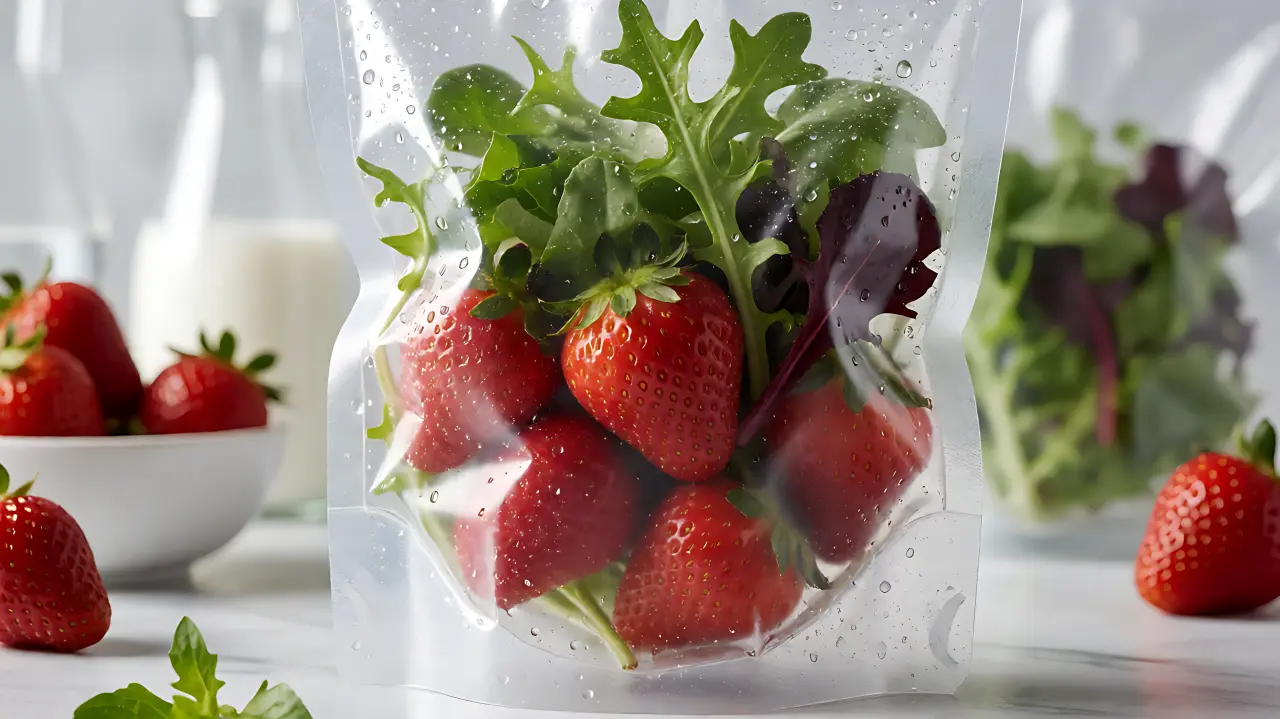
Unlike processed dry foods or cooked meats, freshly harvested fruits and vegetables remain living biological tissues after harvest. They consume oxygen ($O_2$) and glucose to maintain cellular vitality while generating carbon dioxide ($CO_2$), water vapor, and metabolic heat through aerobic respiration.
Sealing fresh produce inside an impermeable barrier film rapidly suffocates the plant tissue ($O_2 < 1%$), triggering an anaerobic metabolic shift where glycolysis converts pyruvate into ethanol, acetaldehyde, and ethyl acetate. This causes bitter off-flavors, tissue softening, and microbial decay.
To achieve an optimal Equilibrium Modified Atmosphere (EMA), packaging engineers deploy Laser Micro-Perforated Flexible Films calibrated to biological respiration rates.
Respiration Kinetics & Target Atmospheric Equilibrium
The primary objective of produce MAP is suppressing metabolic rates without inducing anaerobic fermentation:
Headspace Gas Composition Dynamics in Micro-Perforated Pouch
21% ┼ ── Ambient O2 ──
    │                 ╲
15% ┼                  ╲
    │                   ╲
 8% ┼                    ╲                         Target CO2 (5% - 8%)
    │                     ╰─────────────────────── ╭───────────────
 3% ┼ ──────────────────────────────────────────── ╰───────────────
    │                                              Target O2 (2% - 5%)
 0% ┼┴─────────────────────┴───────────────────────┴───────────────►
    0                     12                      24            Hours
The biological consumption of oxygen follows enzyme-kinetics modeled by the Michaelis-Menten Equation with Uncompetitive $CO_2$ Inhibition:
$$R_{O2} = \frac{R_{\text{max}} \cdot [O_2]}{K_m + [O_2] \cdot \left(1 + \frac{[CO_2]}{K_i}\right)}$$
Where:
- $R_{O2}$: Respiration rate ($\text{mL } O_2 / (\text{kg} \cdot \text{h})$).
- $R_{\text{max}}$: Maximum respiration velocity at a given storage temperature.
- $K_m$: Michaelis constant (the oxygen concentration at half-maximum respiration rate).
- $K_i$: Inhibition constant representing the suppressive effect of carbon dioxide.
- $[O_2], [CO_2]$: Headspace partial pressures of oxygen and carbon dioxide.
Perforation Gas Permeation: Knudsen Diffusion vs. Poiseuille Flow
Standard polymeric films (BOPP, LDPE, PET) possess intrinsic gas permselectivity ($CO_2 / O_2 \approx 3 - 5$), which cannot equilibrate with produce respiration ratios where $CO_2$ generation roughly equals $O_2$ consumption (Respiratory Quotient $RQ \approx 0.8 - 1.2$).
Micro-perforations bypass polymeric barrier limitations. When hole diameters ($d$) range between $50\text{ and }150,\mu\text{m}$, gas transfer shifts to hydrodynamic Fickian gas diffusion through open orifices:
Laser Micro-Perforation Hole Geometry
┌────────────────────────────────────────────────────────┐
│ Film Surface (BOPP / PLA / PE)                         │
│           ╭─────────╮                                  │
│           │ Hole (d)│   d = 50 µm to 120 µm            │
│           │         │   10.6 µm CO2 Pulsed Laser Beam  │
│           ╰─────────╯                                  │
└────────────────────────────────────────────────────────┘
Flux (J): Diffusion through micro-pore independent of film thickness!
The molar gas flux ($Q$) through an array of $N$ micro-perforations is calculated as:
$$Q_{O2} = N \cdot D_{O2} \cdot \frac{\pi \cdot d^2}{4 \cdot (L + \alpha \cdot d)} \cdot \Delta P$$
Where:
- $D_{O2}$: Binary diffusion coefficient of oxygen in nitrogen gas.
- $d$: Perforation diameter (m).
- $L$: Substrate film thickness (m).
- $\alpha \cdot d$: End-correction factor accounting for edge-effect resistance at aperture boundaries.
- $\Delta P$: Trans-membrane partial pressure differential.
By adjusting the hole diameter ($50 - 120,\mu\text{m}$) and number of holes ($N = 2\text{ to }40\text{ per pouch}$), packaging converters precisely balance gas flux against produce mass, holding internal oxygen steady at $2% - 5%$ and carbon dioxide at $5% - 10%$.
Produce Respiration Categorization & Packaging Matrix
| Commodity Group | Commodity Examples | Respiration Rate ($R_{O2}$ at $5^\circ\text{C}$) | Target EMA ($O_2 / CO_2$) | Micro-Perforation Array |
|---|---|---|---|---|
| Very High Respiration | Asparagus, sweet corn, mushrooms | $40 - 80\text{ mL}/(\text{kg}\cdot\text{h})$ | $3 - 5%,O_2 ,/, 8 - 12%,CO_2$ | $16 - 32\text{ holes}$ ($\varnothing 80\mu\text{m}$) |
| High Respiration | Broccoli florets, baby spinach, berries | $20 - 40\text{ mL}/(\text{kg}\cdot\text{h})$ | $2 - 5%,O_2 ,/, 5 - 10%,CO_2$ | $8 - 16\text{ holes}$ ($\varnothing 70\mu\text{m}$) |
| Moderate Respiration | Shredded lettuce, carrots, bell peppers | $10 - 20\text{ mL}/(\text{kg}\cdot\text{h})$ | $2 - 4%,O_2 ,/, 4 - 8%,CO_2$ | $4 - 8\text{ holes}$ ($\varnothing 60\mu\text{m}$) |
| Low Respiration | Whole apples, citrus fruits, onions | $< 10\text{ mL}/(\text{kg}\cdot\text{h})$ | $3 - 5%,O_2 ,/, 3 - 5%,CO_2$ | Macro-vented or unperforated |
Critical Synergy: Anti-Fog (AF) Coatings
Fresh produce transpires water vapor continuously, creating $100%$ relative humidity inside the package. In cold display cases, minor temperature drops cause water droplets to condense onto the inner film face.
- Without Anti-Fog: High surface tension produces fine, light-scattering water droplets (fogging), obscuring product visibility and fostering mold growth where liquid water pools on fruit skins.
- With Surfactant Anti-Fog: Coextruded or coated non-ionic surfactants (glycerol monooleate or polyglycerol esters) reduce the water contact angle from $> 65^\circ$ down to $< 15^\circ$. Condensed water spreads into an invisible, continuous ultra-thin water sheet, preserving crystal-clear shelf visibility.
For fresh food foodservice solutions, discover our foodservice packaging bags and sustainable stand-up barrier pouches. Consult CraftPack Global’s produce packaging specialists to calculate perforation densities tailored to your cold-chain shelf-life targets.