
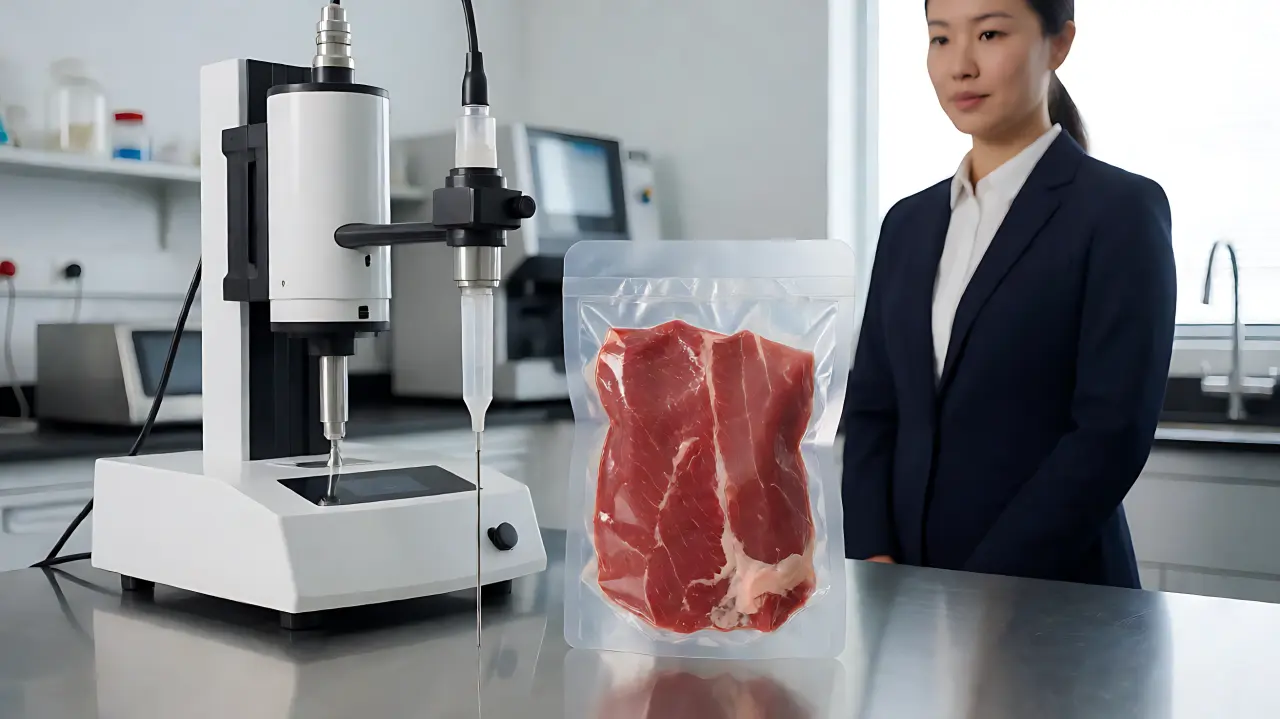
MAP Gas Flushing Ratios: Shelf-Life Packaging Guide
In commercial food processing, shelf-life extension without synthetic chemical preservatives depends directly on Modified Atmosphere Packaging (MAP). By altering the gaseous headspace composition surrounding perishable foods inside hermetically sealed barrier pouches or lidding trays, food manufacturers suppress aerobic microbial spoilage, delay enzymatic oxidation, and arrest sensory decay.
However, MAP engineering is not a one-size-fits-all process. The optimal gas formulation is governed by biochemical respiration rates, lipid rancidity susceptibility, and microbial flora specific to each food matrix. Flushing an incorrect gas mixture can trigger package collapse, promote lethal anaerobic pathogen growth, or accelerate color discoloration.
This technical guide provides an engineering evaluation of MAP Gas Flushing Ratios, detailing the biochemical roles of Carbon Dioxide ($CO_2$), Nitrogen ($N_2$), and Oxygen ($O_2$), gas-to-product volume ratios, package collapse physics, and barrier film transmission pairing.
1. Technical Matrix: MAP Gas Formulations by Food Category
| Food Matrix Category | Target Gas Mixture ($O_2 / CO_2 / N_2$) | Primary Biochemical Mechanism | Shelf Life Extension vs. Air | Critical Barrier Requirement |
|---|---|---|---|---|
| Fresh Red Meat (Beef / Lamb) | $70%\text{ to }80% \ O_2 \ / \ 20%\text{ to }30% \ CO_2$ | High $O_2$ promotes bright red oxymyoglobin; $CO_2$ stops bacteria | 3–4 Days ➔ 14–18 Days (300%) | High Barrier (EVOH OTR < 2.0 cc) |
| Poultry & Fresh Pork | $0% \ O_2 \ / \ 30%\text{ to }40% \ CO_2 \ / \ 60%\text{ to }70% \ N_2$ | Zero $O_2$ suppresses lipid oxidation; $CO_2$ inhibits Pseudomonas | 4–6 Days ➔ 18–22 Days (350%) | Ultra-High Barrier (OTR < 1.0 cc) |
| Cooked & Cured Meats / Deli | $0% \ O_2 \ / \ 25%\text{ to }35% \ CO_2 \ / \ 65%\text{ to }75% \ N_2$ | Prevents nitrosylmyoglobin fading; suppresses lactic acid bacteria | 7–10 Days ➔ 45–60 Days (500%) | High-Barrier (OTR < 1.0 cc) |
| Bakery & Bread (Dry / Crusty) | $0% \ O_2 \ / \ 50%\text{ to }70% \ CO_2 \ / \ 30%\text{ to }50% \ N_2$ | Extreme $CO_2$ arrests mold growth; prevents staling | 5–7 Days ➔ 28–45 Days (500%) | Moderate Barrier + Controlled WVTR |
| Fresh Pasta & Ready Meals | $0% \ O_2 \ / \ 40%\text{ to }60% \ CO_2 \ / \ 40%\text{ to }60% \ N_2$ | Suppresses yeast and mold; inert $N_2$ prevents pouch crush | 3–5 Days ➔ 30–45 Days (800%) | High-Barrier (EVOH / PVDC) |
| Hard Cheeses | $0% \ O_2 \ / \ 30%\text{ to }50% \ CO_2 \ / \ 50%\text{ to }70% \ N_2$ | $CO_2$ arrests mold; inert $N_2$ prevents fat weeping | 14–21 Days ➔ 90–120 Days (500%) | High-Barrier (OTR < 5.0 cc) |
To inspect our food-grade MAP barrier pouches and vacuum bags, visit our Stand-up Pouches Category and Flat Bottom Bags Category.
2. The Tri-Gas Dynamic: Biochemical Functions of $CO_2$, $N_2$, and $O_2$
Understanding MAP requires analyzing how individual gas molecules interact with food biochemistry:
Biochemical Functions in MAP Headspace:
┌────────────────────────────────────────────────────────┐
│  Headspace Atmosphere inside High-Barrier Pouch        │
│                                                        │
│   Carbon Dioxide (CO2):        Nitrogen (N2):          │
│   - Dissolves into moisture    - Inert, non-reactive   │
│   - Forms carbonic acid        - Zero taste / aroma    │
│   - Lowers surface pH          - Fills cushion volume  │
│   - Arrests aerobic bacteria   - Prevents pouch crush  │
│                                                        │
│   Oxygen (O2):                                         │
│   - Kept <0.5% (Non-red meats) to stop oxidation       │
│   - Kept 70-80% (Red beef) to bloom oxymyoglobin      │
└────────────────────────────────────────────────────────┘- Carbon Dioxide ($CO_2$) — The Active Antimicrobial Agent:
- $CO_2$ is a bacteriostatic and fungistatic gas. When introduced into the package, $CO_2$ dissolves into the aqueous phase of the food matrix, establishing an equilibrium with carbonic acid ($H_2CO_3$):
$$CO_2 + H_2O \rightleftharpoons H_2CO_3 \rightleftharpoons H^+ + HCO_3^-$$
- This reaction slightly lowers surface pH and penetrates bacterial cell membranes, altering intracellular permeability and inhibiting essential metabolic decarboxylating enzymes. It specifically suppresses Gram-negative aerobic spoilage bacteria (Pseudomonas species).
- Threshold Rule: A minimum concentration of $20%\text{ to }30% \ CO_2$ is required in the package headspace to achieve significant antimicrobial inhibition.
-
Nitrogen ($N_2$) — The Inert Filler & Anti-Collapse Shield:
- Nitrogen is chemically inert, odorless, and has ultra-low solubility in water and lipids.
- Its primary function is volumetric displacement: replacing atmospheric oxygen to prevent rancidity while serving as a structural “filler gas.” Because $CO_2$ dissolves into moist foods, packages flushed exclusively with $CO_2$ develop internal vacuum pressure, causing package deformation (“snorkelling” or “pouch collapse”). Nitrogen provides the necessary internal cushion to maintain pouch structural integrity.
-
Oxygen ($O_2$) — The Strategic Variable:
- In 90% of food applications, oxygen is an undesirable contaminant (target residual $O_2 < 0.5%$) because it drives lipid oxidation, vitamin degradation, and mold proliferation.
- The Red Meat Exception: For fresh retail cuts of beef, high concentrations of oxygen ($70%\text{ to }80% \ O_2$) are deliberately introduced. High oxygen pressures bind with deoxymyoglobin in muscle tissue to form oxymyoglobin, producing the bright, cherry-red bloom demanded by supermarket consumers, while $20%\text{ to }30% \ CO_2$ controls bacterial growth.
3. Gas-to-Product Ratio & Package Collapse Physics
A frequent engineering error in MAP packaging is underestimating the Gas-to-Product Volume Ratio (G:P Ratio):
$$\text{Gas-to-Product Ratio } (G:P) = \frac{\text{Headspace Gas Volume (ml)}}{\text{Solid Product Volume (ml)}}$$
The Mechanism of Package Snorkelling / Collapse:
Excess CO2 Flushed (100% CO2):               Balanced CO2/N2 Mixture:
┌──────────────────────────────────────┐     ┌──────────────────────────────────────┐
│  Pouch Walls Drawn Inward (Collapse) │     │  Cushioned, Stable Rectangular Pouch │
│         ───►            ◄───         │     │  ┌────────────────────────────────┐  │
│  High vacuum from dissolved CO2      │     │  │ Insoluble N2 holds headspace  │  │
│  Food crushed; liquid purge leaches  │     │  │ Dissolved CO2 preserves food   │  │
└──────────────────────────────────────┘ └──────────────────────────────────────┘- When 1 kg of fresh ground meat or wet fish is packaged under high $CO_2$, the product absorbs between 100 ml to 250 ml of gaseous $CO_2$ until chemical equilibrium is reached.
- If the initial headspace volume is too small (e.g., $G:P < 1:1$), the loss of gas volume creates strong internal vacuum, causing flexible pouch walls to collapse inward, crushing delicate foods and forcing liquid purge to seep from the meat matrix.
- Engineering Standard: Maintain a minimum Gas-to-Product Ratio of $1.5:1$ to $2:1$ (ideal $2:1$ for wet proteins), pairing $CO_2$ with at least $30%\text{ to }50% \ N_2$ to maintain package geometry.
4. Barrier Film Selection & Permeability Matching
The modified atmosphere inside a package will degrade if the barrier film permits atmospheric gas exchange:
- ASTM D3985 Oxygen Transmission Rate (OTR): For MAP red meats, cured meats, and cheese, the packaging film must achieve an OTR $< 1.5\text{ cc/m}^2/24\text{h}$ at 23°C, 0% RH. Structures utilizing an EVOH core (Ethylene Vinyl Alcohol) or PVDC coating are mandatory.
- Seal Integrity & ASTM F1140 Burst Resistance: Because MAP packages contain positive internal gas pressure during distribution, thermal seals must withstand altitude expansion during truck mountain passes and air transit. Seal layers must be formulated with high hot-tack metallocene PE or Cast PP delivering peel strengths $> 35\text{ N/15mm}$.
5. Industrial Packaging Quality Control SOP
Inline MAP Quality Verification Protocol:
1. Gas Concentration Headspace Sampling:
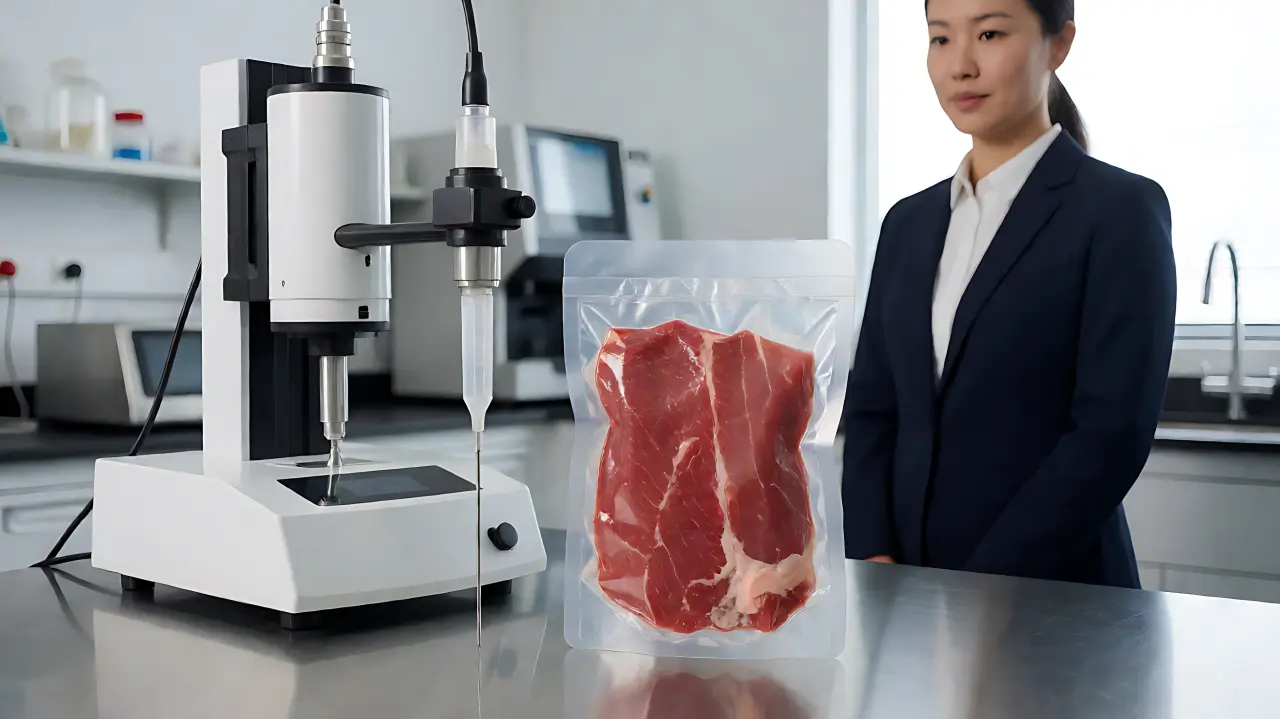
   - Use a calibrated zirconia sensor headspace analyzer with a septa needle.
   - Verify residual O2 is strictly within target (e.g., < 0.2% for bakery; 75% ± 3% for beef).
   - Frequency: Minimum 1 package tested per sealing head every 30 minutes.

2. Water Submersion Bubble Leak Testing (ASTM D3078):
   - Immerse sealed MAP pouches into a vacuum chamber filled with water.
   - Pull vacuum to -50 kPa; observe for continuous gas bubble streams from seals or corners.
   - Pinhole leaks cause MAP gas to escape, resulting in microbial spoilage within 72 hours.
To configure custom high-barrier MAP rollstock, gas-flush pouches, and lidding films engineered for your packaging lines, connect with our materials team via our Custom Stand-up Pouches Division.