
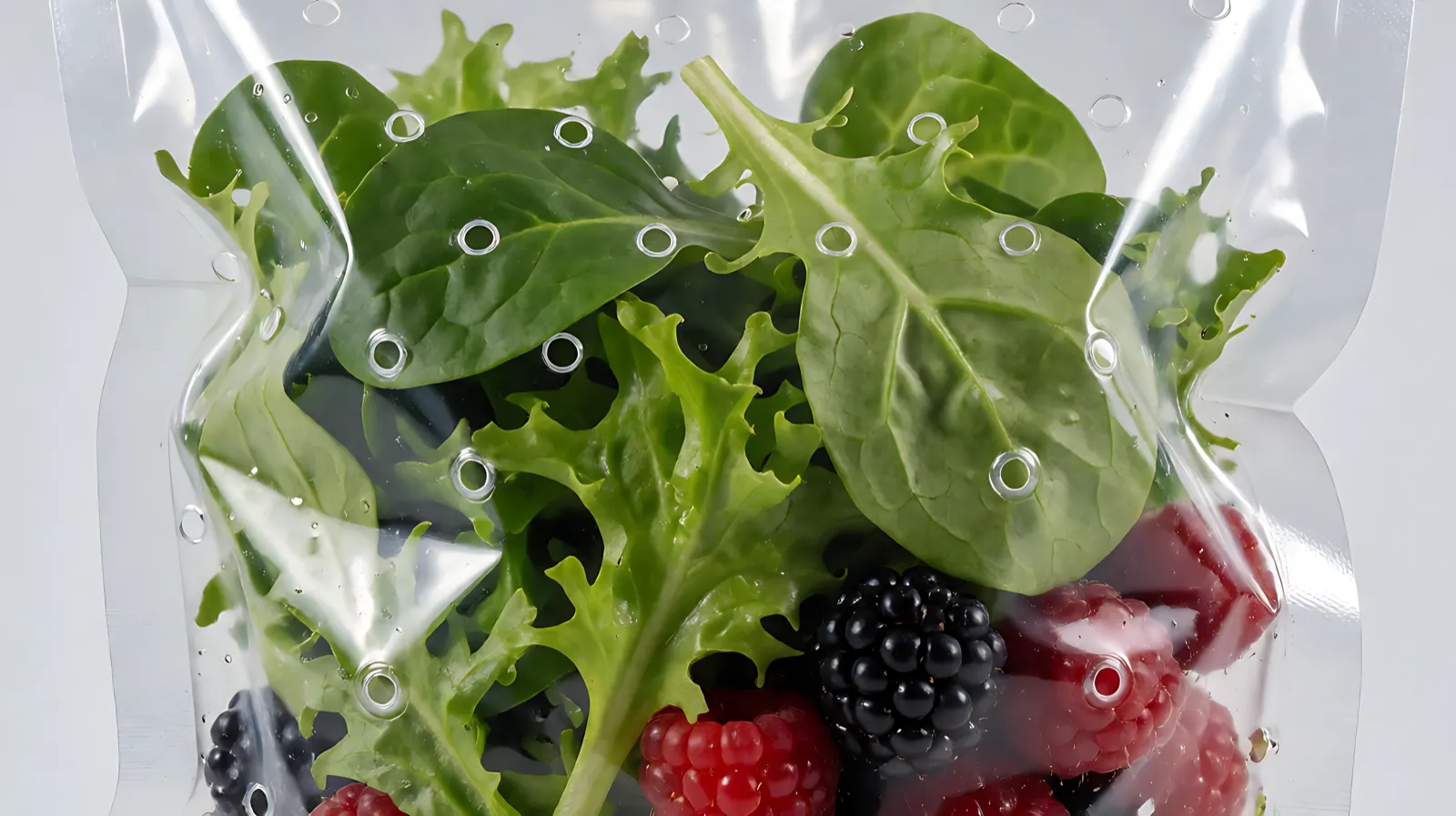
Laser Micro-Perforation for Fresh Produce Packaging: OTR Guide
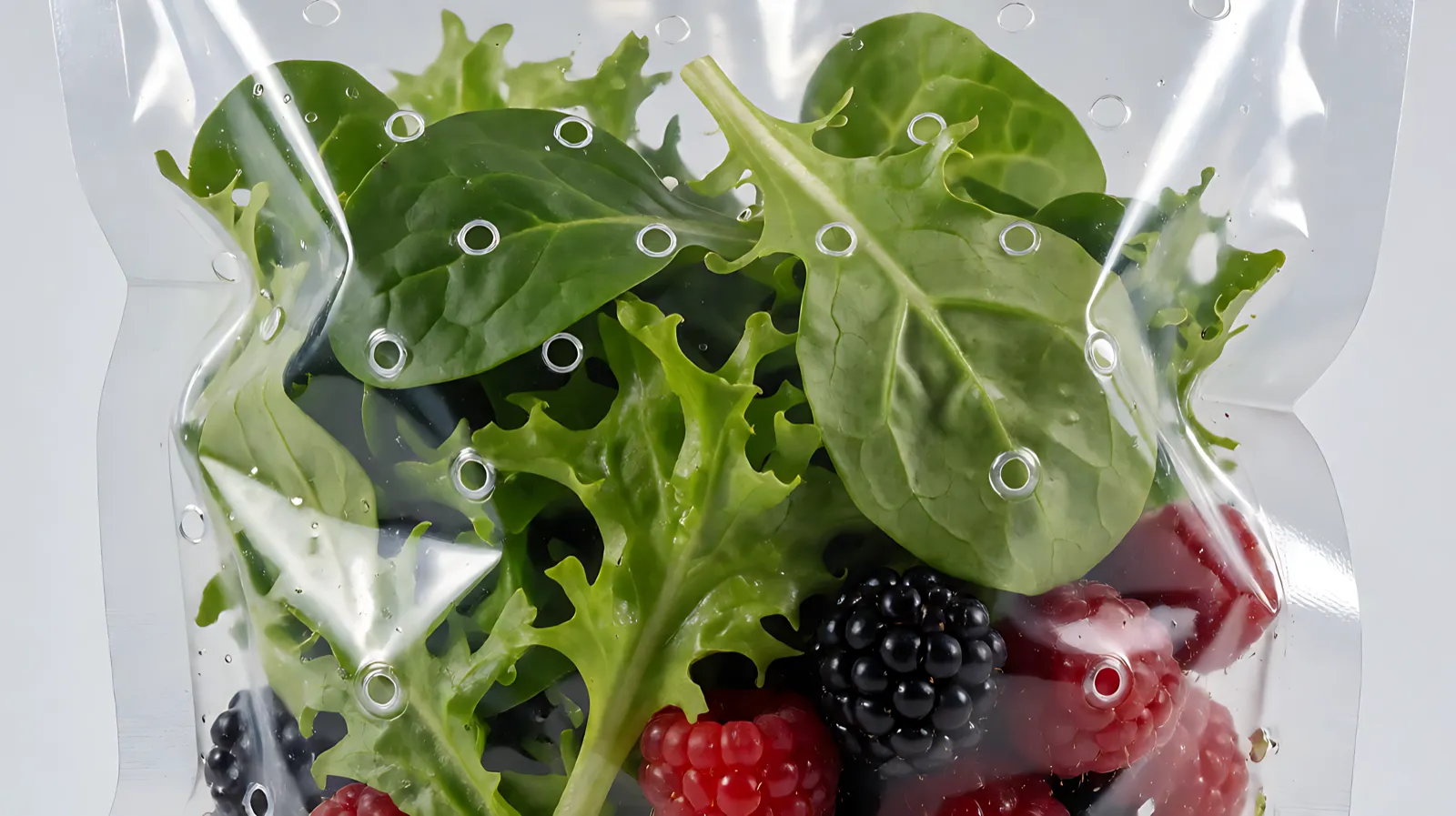
Fresh fruits and vegetables are living biological organisms that continue to respire after harvest—consuming atmospheric oxygen (O₂), metabolizing internal sugars, and releasing carbon dioxide (CO₂), water vapor, and heat.
If packaged in an unvented hermetic barrier film, the produce rapidly consumes all residual oxygen. Once internal O₂ levels fall below 1% to 2%, the produce switches to anaerobic fermentation, producing acetaldehyde, ethanol, and off-odors that destroy consumer acceptance. Conversely, if packaged in standard perforated film with large mechanical needle holes (macro-perforations of 1mm to 6mm), excessive moisture loss causes severe desiccation, wilting, and moisture loss.
The technical solution for modern retail produce logistics is Equilibrium Modified Atmosphere Packaging (EMAP) achieved through Laser Micro-Perforation. By engineering microscopic apertures between 50µm and 120µm, packaging converters dial in the precise gas transmission rate required to balance the specific respiration rate of each fresh crop.
1. Quick Technical Comparison: Laser vs Mechanical Punching
| Feature / Metric | Laser Micro-Perforation (CO₂ Laser) | Hot-Needle Mechanical Punching | Cold-Punch Die Perforation |
|---|---|---|---|
| Hole Diameter Range | 50µm to 120µm (Precision controlled) | 300µm to 800µm (Irregular shape) | 1,000µm to 6,000µm (1mm – 6mm macro) |
| Hole Edge Quality | Hermetically fused molten ring (No tearing) | Torn jagged edges, prone to tears | Mechanical sheared edge, web flap debris |
| Target Gas Control | Equilibrium MAP (O₂ target 3%–5%, CO₂ 5%–8%) | High gas flushing loss | Free atmospheric exchange (Zero barrier) |
| Moisture / Weight Loss | Minimal (< 1.5% over 14 days) | High (4% to 8% dehydration) | Severe (> 12% weight loss, wilting) |
| Insect & Pathogen Ingress | Zero ingress (Holes smaller than insect eyes) | Moderate risk (Fruit flies, aphids) | High infestation risk |
| Inline Process Speed | Up to 400 meters/minute on slitter-rewinders | Up to 150 meters/minute | Up to 200 meters/minute |
| Anti-Fog Synergy | Optimized for Antifog (AF) BOPP / PE | Incompatible with fine droplet spread | Ineffective moisture management |
Explore complementary polymer films in our Commercial Plastic Bags Category and learn about inline web processing in our Stand-Up Pouch Tear Notches and Laser Scoring Guide.
2. Respiration Quotient & Equilibrium Modified Atmosphere (EMAP)
The core principle of EMAP is matching the Oxygen Transmission Rate (OTR) of the perforated package directly to the Respiration Rate ($R_{O2}$) of the target fresh produce at specific storage temperatures:
┌────────────────────────────────────────────────────────────────────────┐
│                   EMAP EQUILIBRIUM EQUATION & GAS DYNAMICS             │
├────────────────────────────────────────────────────────────────────────┤
│                                                                        │
│        Target Equilibrium Zone:  O₂ = 3% - 5%  |  CO₂ = 5% - 8%        │
│                                                                        │
│            Atmospheric Air                                             │
│            O₂: 21%  |  CO₂: 0.04%                                      │
│                  │                                                     │
│                  ▼ (Inward Diffusion through 70µm Laser Hole)          │
│       ┌────────────────────────────────────────────────────────┐       │
│       │                 Package Micro-Environment              │       │
│       │                                                        │       │
│       │   [ Fresh Produce ] ──► Consumes O₂ & Releases CO₂    │       │
│       │                                                        │       │
│       │   • High Respiration (Asparagus, Spinach, Berries)     │       │
│       │   • Low Respiration  (Apples, Citrus, Carrots)         │       │
│       └────────────────────────────────────────────────────────┘       │
│                  ▲                                                     │
│                  │ (Outward Diffusion of excess CO₂ & H₂O)             │
│                                                                        │
└────────────────────────────────────────────────────────────────────────┘
When equilibrium is reached inside the bag:
- Produce metabolic rate slows down by 60% to 75%, dramatically delaying senescence and yellowing.
- Natural ethylene production ($C_2H_4$) is suppressed.
- Aerobic spoilage bacteria are suppressed by elevated CO₂ without triggering anaerobic fermentation.
3. Respiration Classes and Perforation Density Specifications
Different produce commodities exhibit wildly disparate respiration dynamics. The table below outlines technical perforation profiles per 500g retail package:
Produce Commodity Matrix at 4°C Storage:
──────────────────────────────────────────────────────────────────────────
Produce Item        Respiration Class     Hole Diameter    Hole Count / Bag
──────────────────────────────────────────────────────────────────────────
Baby Spinach        Very High (>40 mg/kg·h) 80µm – 100µm     12 to 18 Holes
Broccoli Florets    Extremely High (>60)   90µm – 110µm     16 to 24 Holes
Raspberries/Blackb. High (20–40 mg/kg·h)   70µm – 90µm      8 to 12 Holes
Fresh Sugar Snaps   High (20–30 mg/kg·h)   70µm – 85µm      8 to 10 Holes
Shredded Lettuce    Moderate (10–20 mg/h)  60µm – 75µm      6 to 8 Holes
Whole Carrots       Low (<10 mg/kg·h)      50µm – 65µm      2 to 4 Holes
──────────────────────────────────────────────────────────────────────────
4. Optical Camera Inspection & Process Quality Control
In laser perforation lines, a pulsating CO₂ laser (10.6µm wavelength) fires nanosecond pulses at the moving web. If web speed fluctuations or laser power degradation occur, hole size can drift:
- An undersized hole (30µm instead of 70µm) causes package oxygen starvation and sour anaerobic decay.
- An oversized hole (150µm) allows excessive moisture evaporation, resulting in dried, wilted produce.
Industrial converters employ Inline Optical Vision Systems featuring high-magnification CCD cameras and infrared backlighting. Every individual perforation hole is measured in real-time at 300+ meters per minute. Systems automatically adjust laser pulse duration or trigger automatic splice rejections if hole diameters deviate by more than $\pm 5\mu m$ from specification.
5. Anti-Fog (AF) Surfactant Chemistry Synergy
Laser micro-perforation must always be paired with Anti-Fog (AF) Film Formulations. When warm produce cools in refrigerated supermarket display cases, water vapor condenses onto the inner film surface.
- Non-AF Film: Condensed water forms hundreds of tiny opaque droplets (high surface tension contact angle >70°). This produces a cloudy, milky haze that obscures product visibility and creates water dripping that accelerates fungal growth (Botrytis cinerea).
- Anti-Fog Coated / Coextruded Film: Non-ionic fatty acid ester surfactants migrate to the polymer surface, lowering the water contact angle to below 15°. Droplets spread into an ultra-thin, invisible, transparent continuous water sheet, maintaining 100% optical clarity and preventing localized water drops from rotting produce.
6. Sourcing Specifications for Fresh Produce Converters
When specifying flexible packaging for fresh cut salads, herbs, or berries, confirm the following technical data:
- Target Respiration Curve: Document $R_{O2}$ across storage temperatures (4°C shipping, 10°C retail display break).
- Polymer Substrate: High-clarity BOPP, Cast PP, or recyclable mono-PE with approved food-contact anti-fog additive packages (FDA 21 CFR 178.3400 compliant).
- Pouch Style: Zipper stand-up pouches, pillow pouches, or flow-wrap rollstock for vertical and horizontal form-fill-seal lines.
To develop customized laser-perforated produce packaging solutions, contact our packaging engineering specialists at CraftPack Global Contact.