
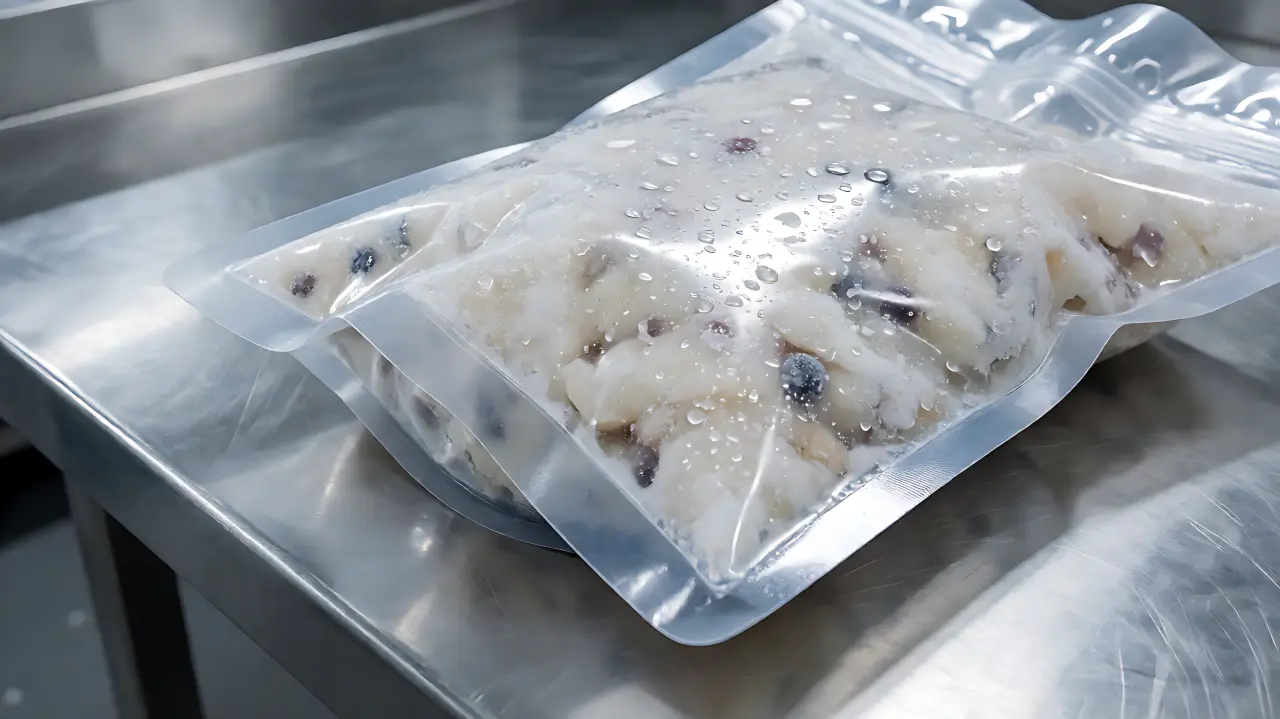
IQF Frozen Food Packaging: Metallocene PE vs EVA Cold-Crack Barrier
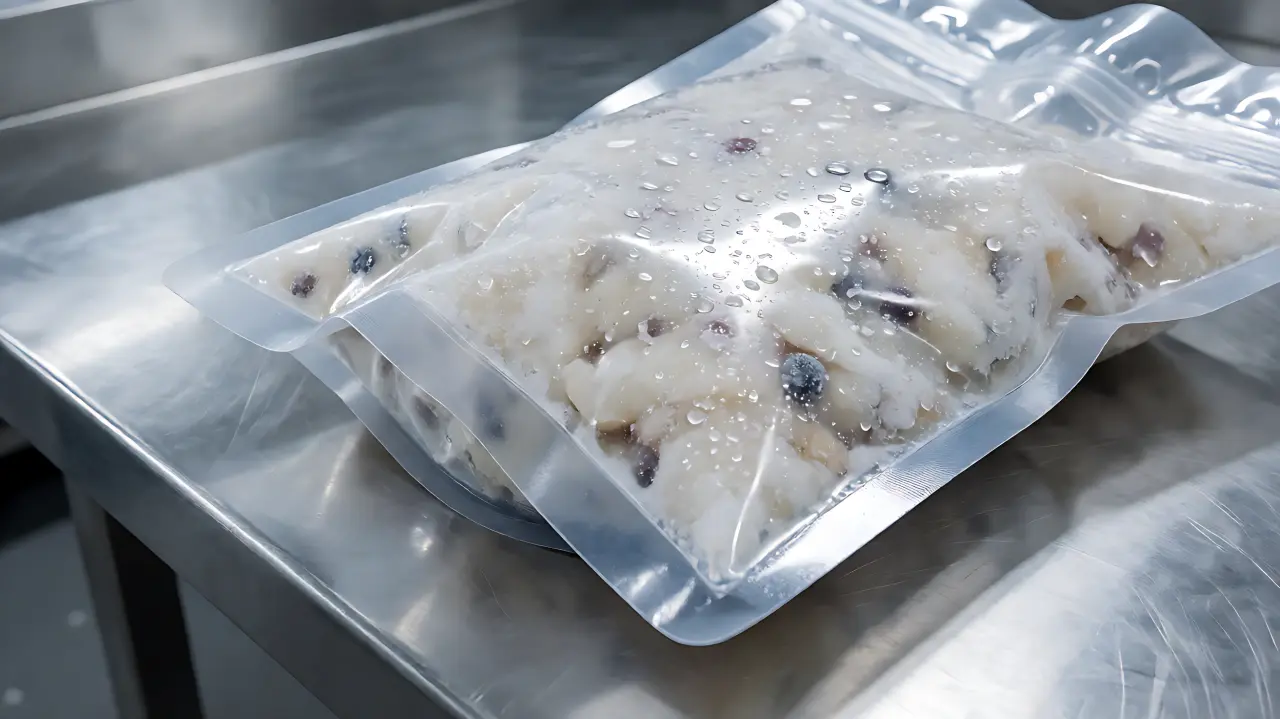
In Individually Quick Frozen (IQF) food distribution—encompassing wild seafood, diced poultry, IQF fruits and berries, frozen vegetables, and gourmet pre-made meals—packaging films operate under severe thermo-mechanical stress. Sub-zero distribution chains (typically $-18^\circ\text{C}$ to $-40^\circ\text{C}$) induce polymer embrittlement, where standard flexible films cross their glass transition thresholds and fracture upon rough transit impacts.
Simultaneously, rigid frozen food edges (such as frozen shrimp tails, poultry bones, or sharp ice crystals) act as localized stress concentrators, puncturing low-ductility polymers. Packaging converters resolve these cold-chain hazards through two primary sealant chemistries: Metallocene Linear Low-Density Polyethylene (mLLDPE / Plastomers) and Ethylene-Vinyl Acetate (EVA) Copolymers.
Low-Temperature Ductility & Polymer Physics
Single-Site Metallocene LLDPE (mPE)          Ethylene Vinyl Acetate (EVA Copolymer)
┌───────────────────────────────────────┐   ┌───────────────────────────────────────┐
│ Narrow Molecular Weight Dist. (MWD)   │   │ Bulky Acetate Side Groups (-OCOCH3)   │
├───────────────────────────────────────┤   ├───────────────────────────────────────┤
│ Uniform Short-Chain Branching (SCB)   │   │ Disrupts Polyethylene Crystallinity   │
├───────────────────────────────────────┤   ├───────────────────────────────────────┤
│ Low Glass Transition: Tg ~ -125°C      │   │ Tg Shifts Depending on VA% (-25°C to  │
│ Outstanding Cryogenic Ductility       │   │ -35°C); Risk of Cold-Creep Embrittle  │
├───────────────────────────────────────┤   ├───────────────────────────────────────┤
│ Low Extractables / Odor Neutral       │   │ Acetic Acid Odor & High Extractables  │
└───────────────────────────────────────┘   └───────────────────────────────────────┘
                 ▼                                              ▼
   Supreme puncture resistance at -40°C;       Ultra-low sealing initiation temp (SIT);
   100% Recyclable mono-PE stream compatible.  Soft flexibility, but lower pinhole barrier.
1. Metallocene Linear Low-Density Polyethylene (mLLDPE / POP)
- Catalyst Precision: Synthesized using single-site metallocene catalysts (producing polyolefin plastomers, POP), generating an exceptionally narrow molecular weight distribution (MWD) and uniform incorporation of comonomers (typically 1-octene or 1-hexene).
- Cryogenic Ductility: Retains a deeply negative glass transition temperature ($T_g \approx -120^\circ\text{C} \text{ to } -128^\circ\text{C}$). At commercial blast-freezer temperatures ($-30^\circ\text{C} \text{ to } -40^\circ\text{C}$), the polymer chains maintain high amorphous chain mobility, avoiding the ductile-to-brittle transition that shatters conventional Ziegler-Natta LLDPE.
- Puncture & Dart Impact: Uniform crystal lamellae distribute localized point-load stresses across a wide plastic deformation zone, delivering extraordinary Spencer impact energy ($> 55,\text{J/mm}$) and Spencer puncture resistance.
2. Ethylene-Vinyl Acetate (EVA) Copolymer Dynamics
- Chain Chemistry: Produced via high-pressure autoclave or tubular free-radical copolymerization of ethylene and vinyl acetate monomer ($9% - 18%,\text{VA}$ content for packaging grades).
- Crystallinity Disruption: The bulky polar acetate side groups disrupt the polyethylene crystal lattice, lowering the melting point ($85^\circ\text{C} - 98^\circ\text{C}$) and imparting high optical clarity, elastomeric softness, and an ultra-low Seal Initiation Temperature ($\text{SIT} \approx 80^\circ\text{C} - 95^\circ\text{C}$).
- Limitations at Deep Freeze: While EVA performs well down to $-15^\circ\text{C}$, as temperatures plunge toward $-35^\circ\text{C}$, its secondary glass relaxations cause rigidity and micro-creasing, increasing the rate of Gelbo flex pinholing during vibratory trucking.
Mechanical Performance Under Sub-Zero Conditions
Impact energy dissipation during freezer dropping follows the kinetic energy absorption formula:
$$E_{\text{impact}} = m \cdot g \cdot h \le \int_{0}^{\delta_{\text{max}}} F(x) , dx$$
Where the film must absorb the kinetic energy through plastic deformation before reaching its ultimate tensile fracture limit:
| Engineering Metric | Co-Ex mLLDPE Film ($60,\mu\text{m}$) | Co-Ex EVA Film ($60,\mu\text{m}, 14%\text{VA}$) | Testing Protocol |
|---|---|---|---|
| Dart Drop Impact @ +23°C | $> 850,\text{g}$ | $520 - 680,\text{g}$ | ASTM D1709 (Method A) |
| Dart Drop Impact @ -30°C | $> 650,\text{g}$ (Minimal loss) | $240 - 380,\text{g}$ ($> 50%$ drop) | Cold-Chamber Dart Drop |
| Seal Initiation Temp (SIT) | $95^\circ\text{C} - 108^\circ\text{C}$ | $82^\circ\text{C} - 92^\circ\text{C}$ | ASTM F1921 |
| Hot Tack Strength Peak | $> 12.0,\text{N}/15\text{mm}$ | $6.5 - 9.0,\text{N}/15\text{mm}$ | ASTM F1921 ($250,\text{ms}$) |
| Slow Puncture Resistance | $32 - 45,\text{N}$ (High ice-crystal stop) | $18 - 26,\text{N}$ | ASTM F1306 ($3.2,\text{mm}$ probe) |
| Gelbo Flex Pinholes (-20°C) | $< 2\text{ pinholes/m}^2$ ($900\text{ cycles}$) | $12 - 28\text{ pinholes/m}^2$ | ASTM F392 (Sub-Zero Chamber) |
| Volatile Off-Odor / Taste | Completely odorless (Organoleptic) | Slight acetic acid off-taste | Sensory Taste Panel |
| Recycling Stream Status | $100%$ Polyethylene Loop (Code 4) | Disqualifies clean PE streams | RecyClass / APR Design Guide |
Hot Tack & High-Speed Vertical Form-Fill-Seal (VFFS)
In IQF packaging facilities, multi-head weighers drop dense, heavy batches of frozen goods ($500,\text{g} - 2.5,\text{kg}$) into newly formed film tubes within milliseconds of the cross-seal jaws opening.
- The Hot Tack Challenge: The molten heat seal must resist the dynamic gravitational impact of falling sharp-edged frozen blocks without blowing open at the bottom seam.
- Metallocene POP Advantage: Plastomers provide exceptional molten melt strength and hot tack plateau ranges spanning $> 25^\circ\text{C}$. This allows packaging engineers to accelerate VFFS cycle speeds by up to $20% - 35%$ compared to standard EVA formulations.
Freezer Grade Converter Decision Architecture
Does the product feature sharp skeletal edges, ice spikes, or drop into deep-freeze (-30°C)?
   ├── YES ──> Co-Extruded Metallocene mLLDPE (Maintains toughness; prevents brittle shatter)
   └── NO  ──> Are packaging line seal bars constrained by extremely low heat budgets?
                 ├── YES ──> EVA Copolymers (Ultra-low SIT, rapid thermal bond)
└── NO ──> Mono-PE metallocene structures for circular packaging compliance- Specify Metallocene PE Blends: For frozen shrimp, bone-in chicken cuts, IQF berries, and retail stand-up freezer bags requiring puncture-proof drop security, pristine organoleptic neutrality, and closed-loop PE recyclability.
- Specify EVA Copolymers: For light confectionery freezer wraps, ice bags with loose smooth cubes, or secondary bundling wraps where low-cost low-temperature heat sealing takes precedence.
Explore our durable stand-up barrier pouches and heavy-duty plastic carrier bags. Contact CraftPack Global to engineer cold-chain film structures engineered to survive the most rigorous freezing environments.