
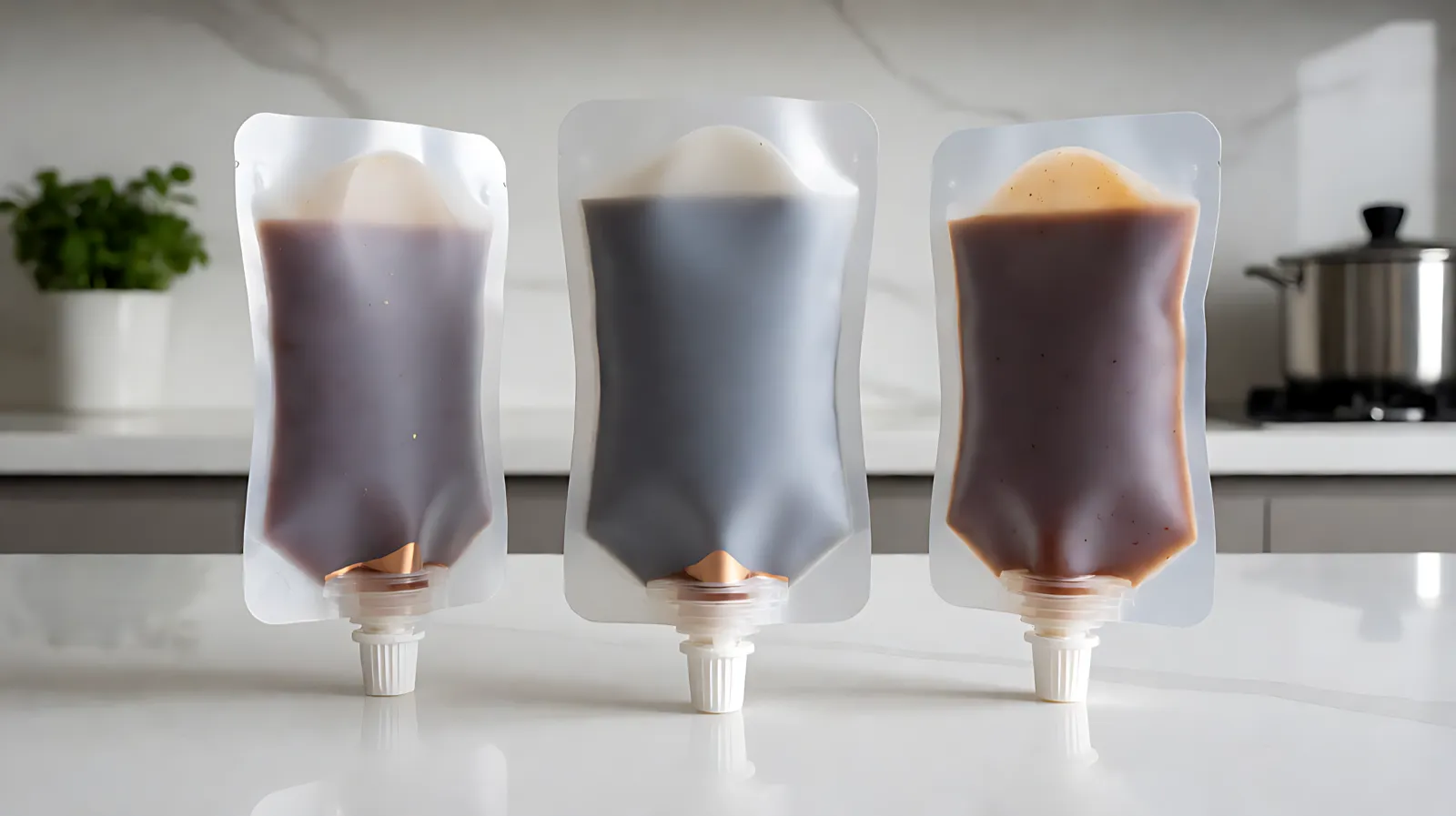
Inverted Squeeze Pouches: Dual-Cut Dispensing Valves & Pouch Guide
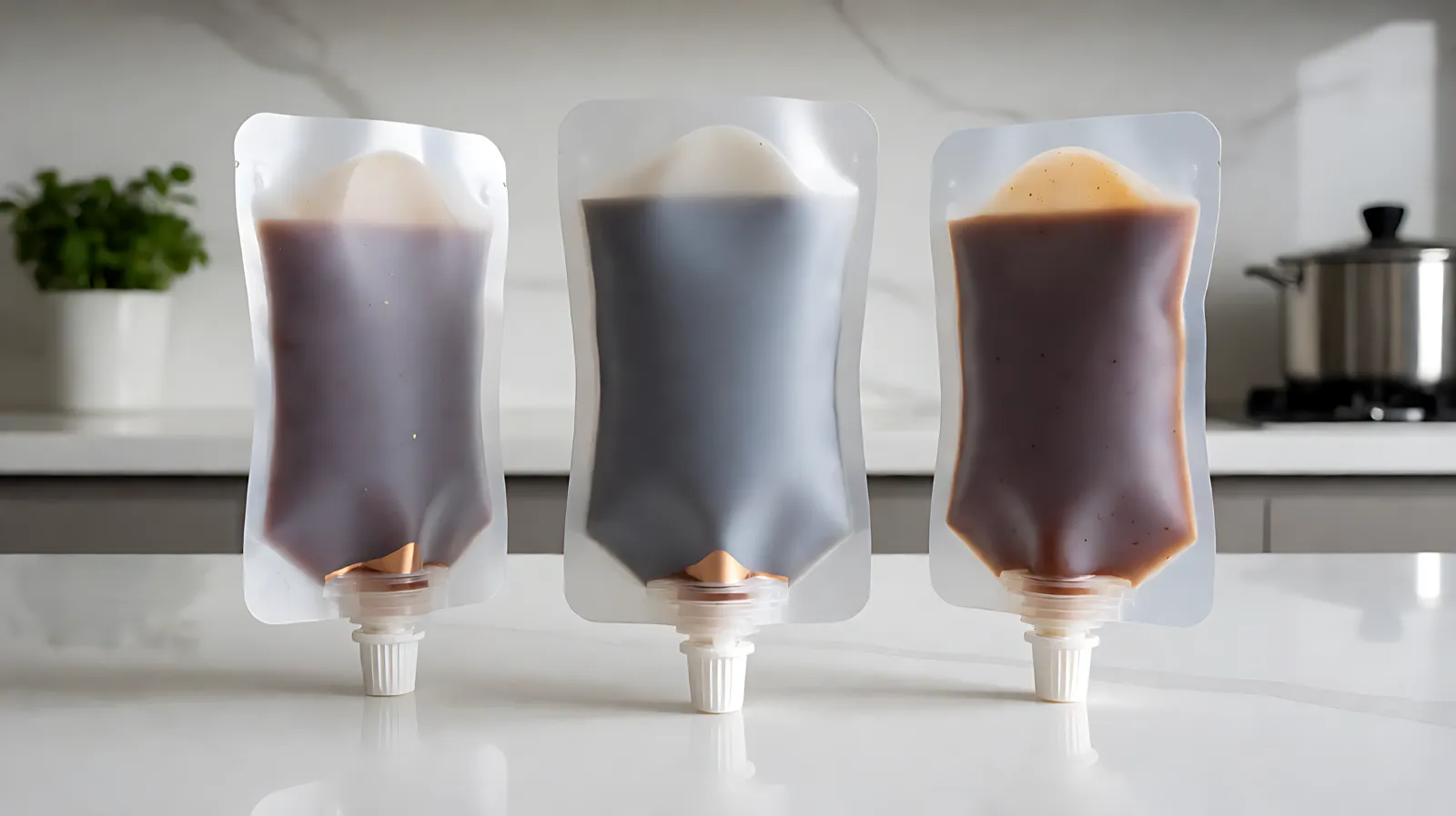
In liquid and viscous food, condiment, and personal care packaging, traditional rigid plastic squeeze bottles suffer from two major consumer frustrations: product hang-up and messy cap dispensing. Standard rigid bottles trap 10% to 15% of product inside the container when discarded, and inverted gravity storage often results in crusty liquid buildup around the orifice.
Inverted Stand-Up Squeeze Pouches solve both issues simultaneously. By combining a flexible barrier pouch body with a wide, self-standing flip-top cap and an engineered silicone slit dispensing valve, this packaging format delivers gravity-assisted, instant dispensing, a clean cut-off with zero drip, and greater than 98% product evacuation.
However, designing an inverted flexible pouch requires careful structural engineering: the wide closure must support the pouch’s center of gravity when full, the spout weld must survive hydraulic shock when dropped upside-down, and the valve elastomer must maintain slit memory across hundreds of actuations.
1. Engineering Benchmark Matrix: Inverted Pouch vs. Rigid Bottle & Spouted Pouch
| Performance Metric | Inverted Pouch with Silicone Valve | Standard Top-Spout Pouch | Rigid HDPE / PET Inverted Bottle |
|---|---|---|---|
| Dispensing Orientation | Resting inverted (Cap-down) | Upright (Requires flipping over) | Resting inverted (Cap-down) |
| Product Evacuation Rate | > 98.5% (Flexible body collapses) | 92% to 95% | 85% to 88% (Rigid walls resist squeeze) |
| Cut-Off Precision | Zero drip / Instant suck-back | Residual drop hangs on spout | Prone to crusting without silicone valve |
| Packaging-to-Product Weight Ratio | 1:12 (Ultra-lightweight) | 1:14 | 1:5 (Heavy plastic bottle shell) |
| Greenhouse Gas Emissions (LCA) | -60% vs. Rigid Bottles | -65% vs. Rigid Bottles | Baseline benchmark |
| Drop Impact Failure Mode | Spout shoulder peel failure | Bottom gusset burst | Cap hinge crack / side wall dent |
| Primary Target Viscosity | 800 to 25,000 cP (Ketchup, Honey, Lotion) | 10 to 5,000 cP (Juice, puree) | 1,000 to 30,000 cP |
| Cap Base Diameter | 38mm to 55mm (Wide standing footprint) | 8.6mm to 22mm fitment | 38mm to 50mm flat base |
Explore complementary liquid pouch closures in our Spout Fitment Engineering Guide and our Stand-Up Pouches Category.
2. Anatomy of the Silicone Cross-Slit Valve
The core innovation that makes inverted pouches practical is the elastomeric dispensing valve housed inside the dispensing orifice:
┌────────────────────────────────────────────────────────────────────────┐
│             SILICONE SLIT DISPENSING VALVE DYNAMICS                    │
├───────────────────────────────────┬────────────────────────────────────┤
│      1. AT REST (INVERTED)        │     2. UNDER SQUEEZE PRESSURE      │
├───────────────────────────────────┼────────────────────────────────────┤
│           Pouch Fluid             │           Pouch Fluid              │
│               ↓↓↓                 │               ↓↓↓                  │
│       Hydrostatic Head Pressure   │          Hydraulic Squeeze         │
│     ╭───────────────────────╮     │     ╭───────────────────────╮      │
│     │   Silicone Diaphragm  │     │     │   Silicone Diaphragm  │      │
│     │   [ Closed X-Slits ]  │     │     │   [ Petals Open Out ] │      │
│     ╰───────────┬───────────╯     │     ╰───────────┬───────────╯      │
│                 │                 │                 │                  │
│                 ▼                 │                 ▼                  │
│          Zero Leak / Drip         │       Controlled Fluid Stream      │
│                                   │                                    │
│  • Surface tension + elastomeric  │  • Squeeze pressure flexes 4 petals│
│    preload withstands head weight │  • Linear flow rate proportional   │
│  • Air cannot ingress into pouch  │  • Instant snapping shut on release│
└───────────────────────────────────┴────────────────────────────────────┘
Fluid Mechanics: How the Valve Operates
- Hydrostatic Preload: When resting upside down in a refrigerator or pantry, the column of sauce exerts downward hydrostatic pressure. The convex geometry of the silicone dome utilizes this pressure to push the four quadrant petals against each other, reinforcing the seal and preventing leaks.
- Dynamic Actuation: When the consumer squeezes the flexible pouch body, internal pressure spikes to 15–35 kPa. This overcomes the elastomeric yield threshold of the silicone, causing the petals to flex outward and open a clean circular orifice.
- Suck-Back & Cut-Off: As soon as the squeeze pressure is released, the natural elastic memory of the medical-grade liquid silicone rubber (LSR) snaps the petals back to their convex resting position. This rapid recoil creates a momentary vacuum at the tip, pulling excess sauce back into the closure and leaving the exterior surface clean.
For drop impact benchmarks on liquid pouches, consult our ASTM D5276 Spout Pouch Drop Testing Guide.
3. Structural Center of Gravity & Cap Stability
Unlike traditional stand-up pouches that balance on an oval Doyen or K-seal bottom gusset, an inverted pouch stands entirely on its dispensing cap.
┌─────────────────────────────────────────────────────────────────────────┐
│               INVERTED POUCH STABILITY ARCHITECTURE                     │
│                                                                         │
│         ╭───────────────────────────────╮                               │
│         │   Heat-Sealed Top Fin (15mm)  │ ◄── Hang hole optional        │
│         │                               │                               │
│         │     Flexible Barrier Body     │                               │
│         │    (PET / OPA / EVOH / PE)    │ ◄── Tapered triangular taper  │
│         │                               │     lowers center of mass     │
│         │                               │                               │
│         ╰──────────────┬────────────────╯                               │
│                        │                                                │
│         ╭──────────────┴────────────────╮                               │
│         │    Ultrasonic Canoe Spout     │ ◄── Feathered weld wings      │
│         │                               │                               │
│         │  Wide Flip-Top Base (Ø 48mm)  │ ◄── Minimum 42mm footprint    │
│         ╰───────────────────────────────╯     prevents tilt tipping     │
│         ═════════════════════════════════                               │
│                  Shelf Surface                                          │
└─────────────────────────────────────────────────────────────────────────┘
Key Engineering Rules for Inverted Standing:
- Footprint-to-Height Aspect Ratio ($R_{aspect}$): The ratio between total pouch height ($H$) and cap base diameter ($D$) must not exceed $3.8:1$. For a 250ml condiment pouch with a height of 160mm, the flip-top base must have an outer diameter of at least 42mm to 48mm to prevent tipping on conveyor lines or grocery shelves.
- Tapered Silhouette Design: The pouch pouch geometry should feature a broader top and a tapered lower neck. This geometry shifts product weight downwards when inverted, lowering the center of gravity ($CG$) below the pouch mid-point.
- Air Headspace Minimization: Trapped air creates fluid sloshing, which destabilizes the pouch. Vacuum fill-and-seal nozzles must eliminate excess headspace air during automated filling.
4. Spout Fitment Welding & Seal Fatigue
Because the inverted pouch rests on its spout, any drop impact transfers peak hydraulic energy directly to the junction between the rigid HDPE/PP spout fitment and the flexible film.
Canoe Wing Fitment Geometry
Standard round spouts concentrate mechanical stress at two sharp tangential pinch points. For inverted pouches, processors must utilize canoe-shaped (winged) spout fitments featuring feathered transition edges (tapering down to 0.4mm). The feathered edge allows the flexible film to transition smoothly from two separate webs into a welded tube, eliminating micro-pinholes.
Ultrasonic vs. Thermal Conduction Welding
- Ultrasonic Sealing: Delivers localized high-frequency mechanical friction (20 kHz) that melts only the inner sealant layer without overheating the outer PET barrier layer. Recommended for inverted liquid pouches containing fats and oils.
- Thermal Heat Sealing: Uses dual-contoured heated brass jaws ($180^\circ\text{C}$ to $210^\circ\text{C}$) clamped under 0.4 to 0.6 MPa. Requires stepped heating profiles to prevent polymer thinning at the wing tip. For process comparisons, see our guide on Thermal vs Ultrasonic Valve Insertion.
5. Application Matrix & Filling Line Integration
| Product Application | Recommended Film Laminate | Valve Orifice Type | Cap Base Size |
|---|---|---|---|
| Ketchup, Mustard & BBQ Sauce | 12µm PET / 15µm OPA / 80µm LLDPE | Medium 4-slit silicone valve | 45mm flat flip-top |
| Artisanal Honey & Maple Syrup | 12µm AlOx-PET / 90µm mPE | High-viscosity cross-slit valve | 48mm anti-slip cap |
| Mayonnaise & Salad Dressings | 12µm PET / 15µm EVOH-PE / 75µm PE | Wide star-burst valve | 50mm dual-lock cap |
| Hair Conditioner & Body Wash | 12µm Soft-Touch BOPP / 100µm PE | Precision dosing slit valve | 40mm matte cap |
| Industrial Greases & Lubricants | 15µm OPA / 9µm Alufoil / 100µm CPP | High-pressure shut-off valve | 55mm screw closure |
Review related high-barrier pouch options across our Custom Product Catalog or configure your specifications in our Standup Pouches Standard Line.
6. Frequently Asked Questions (FAQ)
Can consumers open the pouch if the silicone valve clogs?
The silicone valve is self-cleaning due to its elastic recoil. However, for products with high particulate matter (such as relish or chunky tomato salsa), a specialized mesh-free star slit must be specified to prevent fiber bridging.
Are inverted pouches compatible with existing horizontal form-fill-seal (HFFS) machines?
Yes. Pre-made inverted spouted pouches are fed into rotary filling carousels, filled directly through the spout fitment, and capped with high-speed automated chucks. Alternatively, pouches can be bottom-filled through an open bottom gusset on HFFS lines before final heat sealing.
Is the silicone valve recyclable with the cap?
Under current mechanical sorting standards, the silicone valve represents less than 2% of the closure weight. During the sink-float recycling step, polyolefin cap flake floats in water while the silicone valve sinks, enabling clean material separation.
Ready to transition your liquid or condiment line from rigid bottles to high-efficiency inverted squeeze pouches? Contact our engineering team for technical drawings, CAD samples, and barrier testing.