
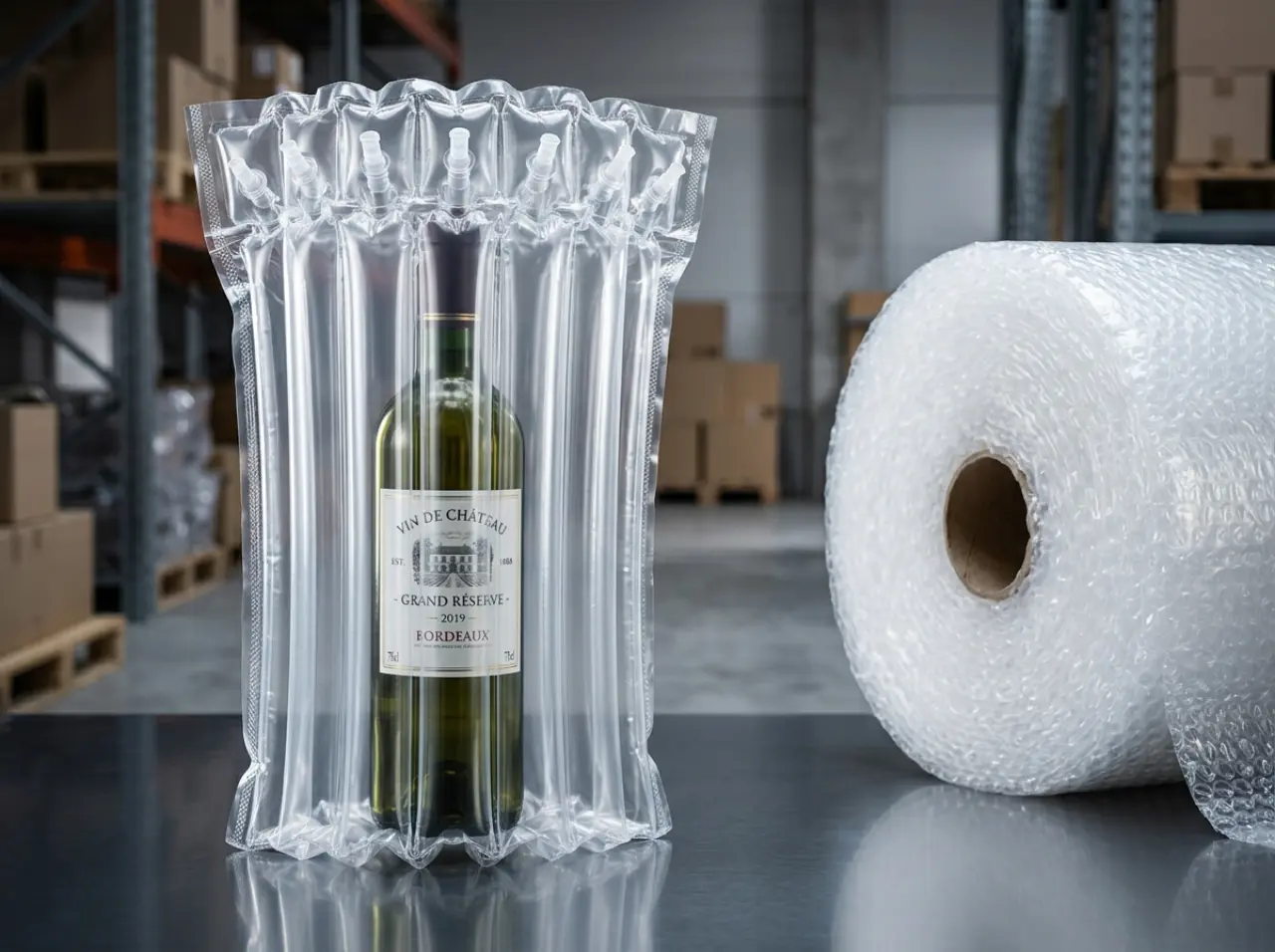
Inflatable Air Column Bags vs Bubble Wrap: Cushioning Guide
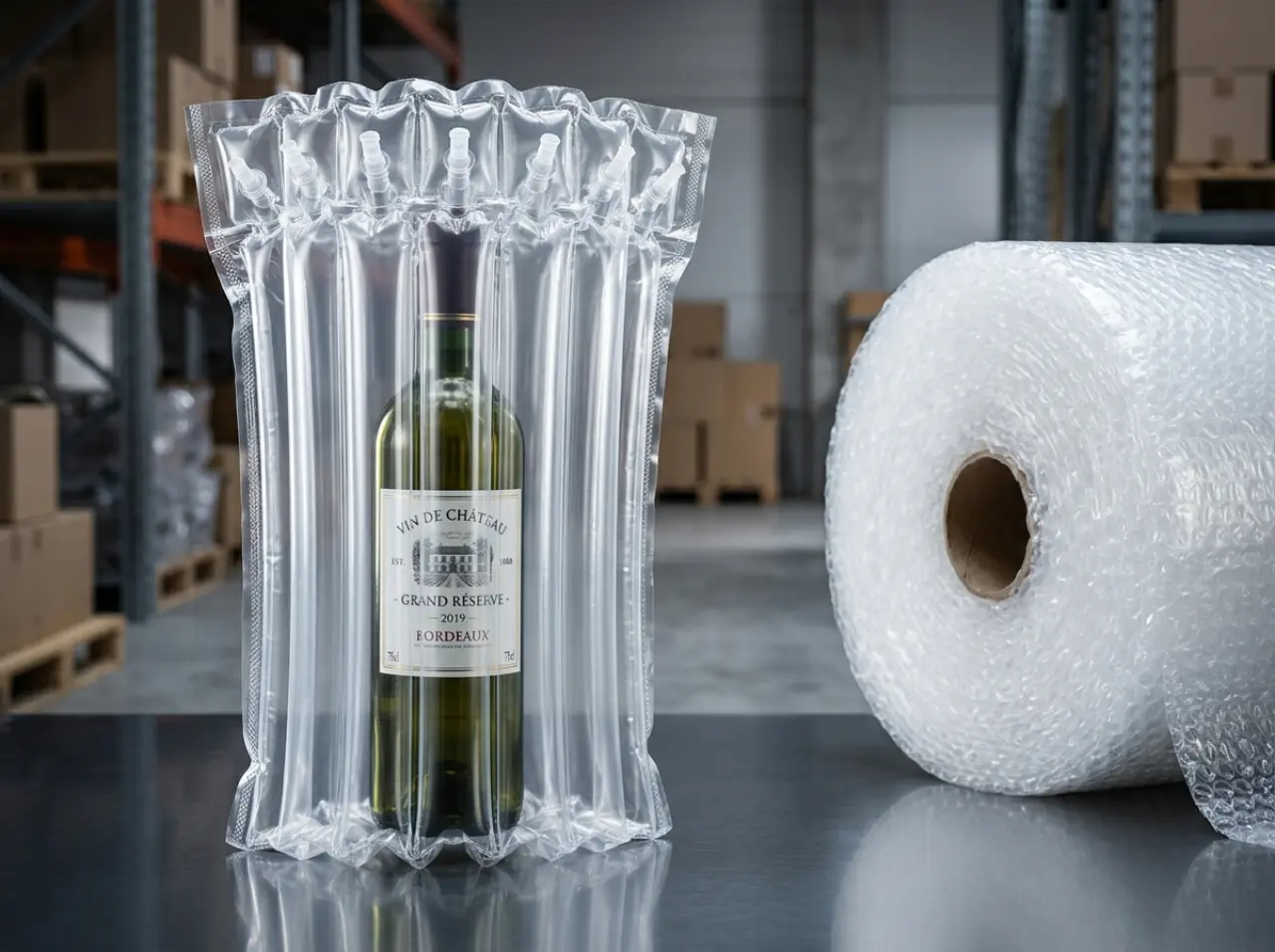
In e-commerce fulfillment and protective logistics, shipping fragile high-value merchandise—such as bottled wine, laptops, smartphones, optical instruments, and cosmetic glass jars—represents an ongoing struggle between transit damage claims and packing material overhead.
Historically, warehouse packing stations relied on traditional polyethylene (PE) bubble wrap. Shippers wrapped fragile items in three to five manual layers, taping them heavily before placing them inside oversized corrugated boxes filled with loose peanuts or paper dunnage.
However, the rapid adoption of Inflatable Air Column Bags (also known as air cushion bags or air tube packaging) has fundamentally revolutionized protective packaging. Manufactured from co-extruded polyethylene and polyamide (PE/PA) film featuring independent multi-chamber reverse air valves, air column bags provide engineered 360-degree shock suspension while slashing warehouse storage footprint.
This technical guide evaluates the engineering performance of air column bags against conventional bubble wrap across impact deceleration, puncture resistance, storage economics, and operational packing speeds.
1. Engineering Comparison: Air Column Bags vs. Polyethylene Bubble Wrap
| Performance Metric | Multi-Chamber Inflatable Air Column Bag | Standard Small Bubble Wrap (Ø10mm) | Heavy-Duty Large Bubble Wrap (Ø25mm) |
|---|---|---|---|
| Film Substrate | 9-Layer Co-Extruded PE/PA (Nylon) | Monolayer LDPE / LLDPE | Monolayer LDPE with Barrier Blend |
| Film Thickness | 50µm to 75µm (Heavy-duty puncture proof) | 25µm to 35µm | 40µm to 55µm |
| Static Compressive Load Limit | 60 kg to 120 kg per unit | 5 kg to 15 kg (Bubbles pop under load) | 15 kg to 30 kg |
| Drop Impact Shock Cushioning (1.2m) | Peak Deceleration: 25G to 35G | Peak Deceleration: 60G to 95G | Peak Deceleration: 45G to 65G |
| Chamber Failure Independence | 100% Independent (One popped tube retains 95% protection) | Interconnected or pops cascades across web | Air leaks across crushed bubble cells |
| Pre-Inflation Storage Volume (1,000 units) | ~0.15 m³ (Flat sheets on a single small shelf) | ~3.8 m³ (Multiple massive rolls) | ~6.5 m³ (Consumes huge warehouse space) |
| Warehouse Space Reduction | Up to 90% space savings | Baseline | Consumes +70% more volume |
| Packing Cycle Time (Per Bottle/Laptop) | 5 to 8 seconds (Slide in & inflate) | 35 to 60 seconds (Wrap, cut, tape) | 30 to 50 seconds (Wrap, cut, tape) |
| Outer Shipping Carton Sizing | Snug-fit cartons; minimal dead volume | Requires large boxes to accommodate wrap bulk | Requires large boxes to accommodate wrap bulk |
For other high-performance shipping and logistics solutions, browse our E-commerce Mailers Category and protective transit envelopes.
2. Impact Deceleration Physics: Peak G-Force & Cushioning Curves
When a package is dropped from a tailgate or conveyor belt (standard ASTM D5276 drop test from 1.0m to 1.2m), the fragility of the packaged item is determined by its Fragility Index ($G_{\text{crit}}$)—the maximum deceleration shock it can survive without internal component failure:
Drop Impact Deceleration Curve (ASTM D3332):
Shock Force (G)
  ▲
  │       Bubble Wrap (Bottoms out under shock)
90├─ ─ ─ ─ ─ ─ ╭─╮
  │           ╭╯ │╰╮
  │          ╭╯  │ ╰╮
  │         ╭╯   │  ╰╮   Air Column Bag (Controlled progressive air compression)
30├─ ─ ─ ─ ╭╯─ ─ ┼ ─ ╰╮─ ─ ─ ─ ─ ─ ─ ─ ─ ─ ─ ─ ─ ─ ─ ─ ─
  │       ╭╯     │    ╰╮
  │      ╭╯      │     ╰╮
0└───┬──┴───────┴──────┴────────────────► Time (ms)- Why Bubble Wrap “Bottoms Out”: Traditional LDPE bubble wrap contains low air volume per cell (bubble height: 4mm to 10mm). Under dynamic impact from a 1.5 kg glass bottle or laptop, the air pressure inside the bubble spikes instantly, rupturing the thin poly film or compressing flat against the outer box. The deceleration shock spikes above 80G to 100G, exceeding the fragility threshold of glass and delicate PCB electronics.
- Air Column Progressive Cushioning: An air column provides a pressurized pneumatic air chamber with a diameter of 20mm to 40mm. As the dropping object impacts the column, the internal air compresses progressively, acting as a pneumatic shock absorber that extends the impact duration ($\Delta t$). By extending deceleration time, the peak shock experienced by the item is capped between 25G and 35G, well below the fracture limit of fine wine bottles or sensitive computer hard drives.
3. Reverse Check Valve Technology: Multi-Chamber Redundancy
The defining engineering breakthrough of air column packaging is the patented one-way micro-slit reverse check valve:
One-Way Reverse Air Valve Mechanics:
      Inflation Air Nozzle (0.06 - 0.08 MPa)
                 ▼
══════[ Air Entry Channel ]════════════════════════════════════
    ┌───┐       ┌───┐       ┌───┐       ┌───┐
    │ ▲ │       │ ▲ │       │ ▲ │       │ ▲ │  <-- Micro-flap opens during inflation
────┴───┴───────┴───┴───────┴───┴───────┴───┴──────────────────
   Tube 1      Tube 2      Tube 3      Tube 4
  [ 60 kPa ]  [ 60 kPa ]  [POPPED]    [ 60 kPa ]
(Punctured) (Retains full pressure!)- Single Point Inflation: The entire bag is inflated through a single air entry port in just 2 to 4 seconds using compressed air regulated to 0.06–0.08 MPa (0.6–0.8 bar).
- Independent Valve Sealing: Each individual tube connects to the common inflation header via two micro-thin poly flaps. Once inflation pressure equalizes, internal chamber pressure pushes the flaps flat against the outer wall, permanently sealing the chamber.
- Fail-Safe Redundancy: If a sharp object (such as a staple or jagged box edge) punctures Tube 3 during transit, only Tube 3 deflates. Tubes 1, 2, 4, 5, and 6 remain fully pressurized at 60 kPa, maintaining over 90% of total cushioning geometry and preventing product breakage.
4. Inbound Warehouse Freight & Storage Economics
Warehousing space represents a major fixed cost for e-commerce fulfillment centers. The volumetric comparison between inflated bubble wrap rolls and flat air column sheets is dramatic:
Storage Footprint for Packaging 5,000 Wine Bottles:
Bubble Wrap (25 Huge Commercial Rolls):
[████████████████████████████████████████] ~18.5 Cubic Meters
Air Column Bags (Uninflated Flat Bundles in 5 Cartons):
[██] ~0.75 Cubic Meters (96% Warehouse Space Savings!)- Inbound Transport: Shipping bulk rolls of bubble wrap is effectively “shipping air.” A full 53-foot dry van carries only a few thousand units of bubble wrap. In contrast, uninflated air column bags pack flat in compact corrugated master cartons. Shippers can fit 50,000+ uninflated air bags in a single container.
- Fulfillment Packing Efficiency: Operators simply slide the product into the flat sleeve, hold the nozzle against an automatic tabletop air inflator for 3 seconds, and place the snug package into the shipping box. This eliminates messy taping, scissors, and uneven hand-wrapping, doubling packing throughput per station.
5. Environmental Footprint & Material Efficiency
Evaluating the environmental profile of protective packaging under modern circular economy directives:
- Source Reduction: Because air columns achieve superior cushioning using air pressure rather than plastic mass, a single air column sleeve uses 45% to 60% less plastic by weight than the four to six layers of bubble wrap required to provide equivalent protection.
- Volumetric Freight Weight (DIM Weight): Bulky bubble wrap forces shippers to use oversized boxes, triggering punitive dimensional weight surcharges from parcel carriers (UPS, FedEx, DHL). Air column packaging conforms tightly to the product profile, allowing shippers to downsize carton dimensions and lower carbon emissions per parcel.
- Recyclability: Modern air column bags are manufactured from co-extruded PE/PA blends. Once deflated via a simple utility knife slit, the packaging collapses into a thin plastic film that occupies less than 1% of its inflated volume, reducing waste bin clutter for end consumers.
6. Specification & Procurement Checklist for E-Commerce Shippers
When specifying air column packaging for your logistics operations, review these parameters:
- Bag Architecture: Select between Q-Shape (Full clamshell 360° bottle wrap), L-Shape (Laptop base and screen wrap), or U-Shape (Cap and base end-caps).
- Film Thickness: Specify 50µm (0.05 mm) for light electronics (<1.0 kg), 60µm for standard wine bottles, and 75µm for heavy industrial machinery parts (>3.0 kg).
- Air Tube Width: Choose 30mm uninflated width (inflates to ~20mm tubes) for compact products, or 40mm uninflated width (inflates to ~30mm tubes) for maximum drop cushioning.
- Inflation Air Line Pressure: Ensure packing stations are equipped with regulated compressed air supplies calibrated between 0.06 MPa and 0.08 MPa to prevent valve blowout.
To request custom-engineered inflatable air column prototypes tailored to your product dimensions, contact the CraftPack Global logistics packaging team.