
Induction Sealing Liners: One-Piece vs Two-Piece Cap Seal Guide
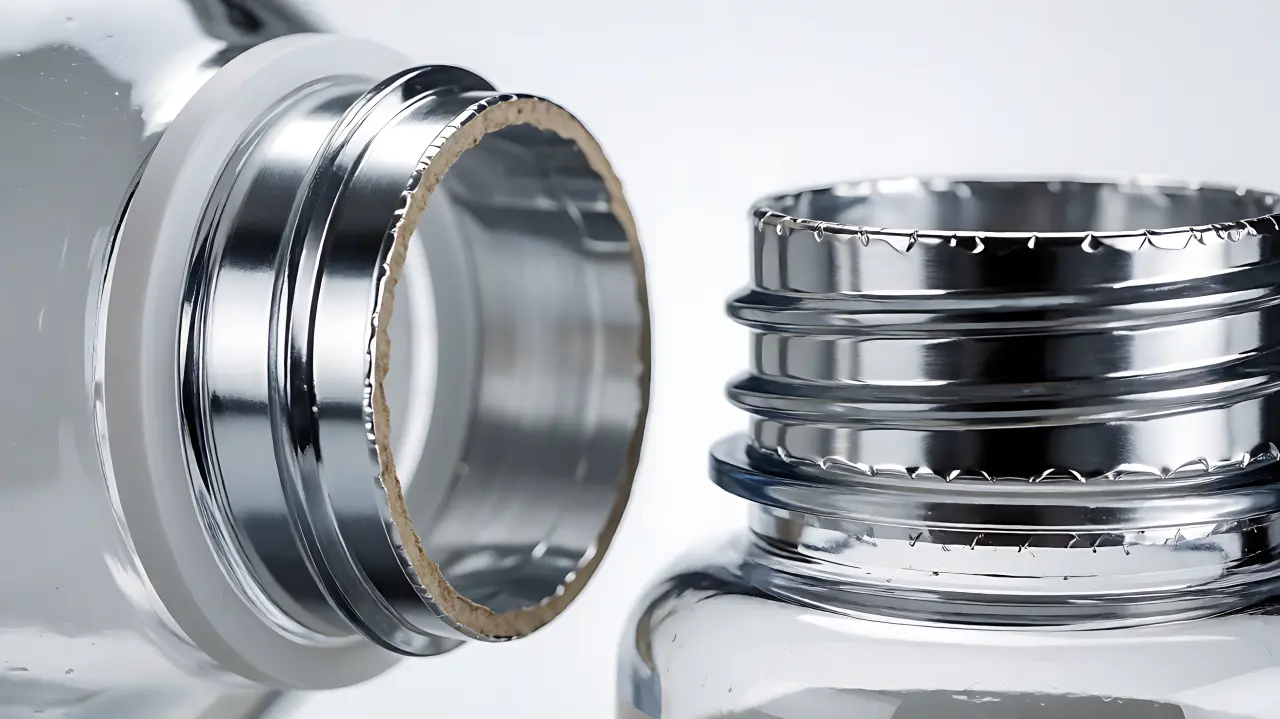
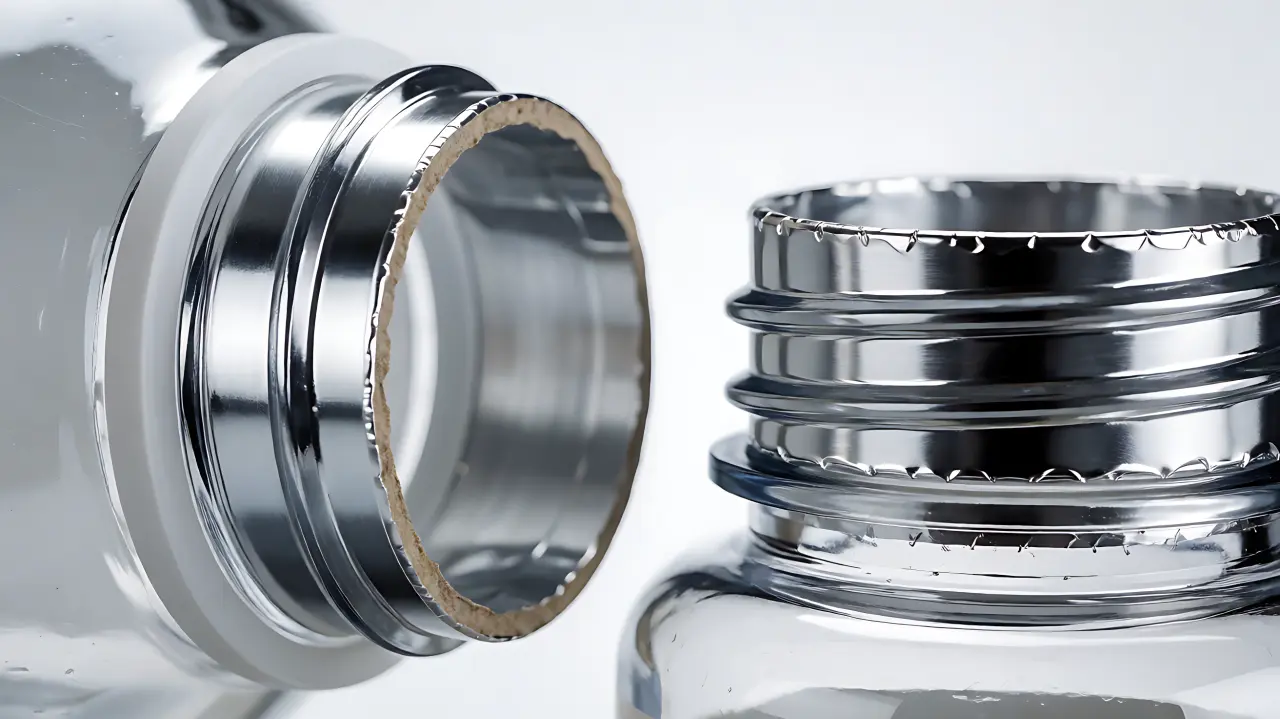
In rigid container packaging for pharmaceuticals, agrochemicals, engine lubricants, and food sauces, cap closure torque alone is insufficient to guarantee long-term hermetic integrity during maritime transport or air freight altitude shifts. High-frequency electromagnetic induction sealing bonds an aluminum foil membrane directly to the container land (neck lip), creating an airtight, tamper-evident barrier.
Selecting between One-Piece Liners and Two-Piece Wax-Bonded Liners governs container resealability, cap torque retention, and packaging line automation.
Induction Sealing Physics: Electromagnetic Eddy Currents
Cap induction sealing functions without direct conductive heating. A filled and capped bottle passes under an induction sealing coil radiating an alternating high-frequency electromagnetic field ($300\text{ to }500\text{ kHz}$):
$$P_{\text{heat}} = I_{\text{eddy}}^2 \cdot R_{\text{foil}} = \frac{(\pi \cdot f \cdot B \cdot r^2)^2}{2 \cdot \rho_{\text{Al}}}$$
Where:
- $P_{\text{heat}}$: Dissipated thermal power in the aluminum foil disc.
- $f$: Induction frequency (Hz).
- $B$: Magnetic flux density generated by the induction coil.
- $r$: Radius of the sealing liner.
- $\rho_{\text{Al}}$: Electrical resistivity of aluminum.
The induced electrical eddy currents rapidly heat the aluminum foil ($160^\circ\text{C} - 220^\circ\text{C}$) in fractions of a second ($0.1 - 0.5\text{ s}$). This heat conducts directly downward into a polymer heat-seal film, melting it onto the lip of the bottle (HDPE, PET, PP, or glass).
One-Piece Liner (Clean Peel / Weld)        Two-Piece Liner (Wax-Separated Reseal)
┌───────────────────────────────────┐     ┌───────────────────────────────────┐
│ Backing: Expanded EPE Foam / Paper│     │ Pulpboard / Foam Reseal Liner     │
├───────────────────────────────────┤     ├───────────────────────────────────┤
│ Aluminum Foil Barrier (20-25 µm)  │     │ Temporary Wax Layer (Microwax)    │
├───────────────────────────────────┤     ├───────────────────────────────────┤
│ Heat Seal Polymer (HDPE/PET/PP)   │     │ Aluminum Foil Barrier (20-25 µm)  │
└───────────────────────────────────┘     ├───────────────────────────────────┤
                 ▼                        │ Heat Seal Polymer (Container Match│
   Seals entirely onto container;         └───────────────────────────────────┘
   Cap interior left bare upon opening.                    ▼
                                           Wax melts & absorbs into pulpboard;
                                           Foil seals to rim, pulp stays in cap!
Structural Comparison: One-Piece vs. Two-Piece Liners
| Engineering Feature | One-Piece Induction Liner | Two-Piece Induction Liner | Testing Standard |
|---|---|---|---|
| Cross-Sectional Structure | Foam/Board + PET + Foil + Sealant | Pulpboard + Wax + Foil + Sealant | ASTM D3078 |
| Reseal Capability | None (Cap liner is empty after unsealing) | High (Pulpboard remains inside cap) | Reseal Torque Test |
| Separation Mechanism | Pre-laminated permanent bond | Thermally activated wax absorption | ASTM F88 |
| Cost Profile | Lower material & manufacturing cost | Moderate (Multi-ply wax lamination) | Bill of Materials |
| Typical Container Uses | Single-use motor oils, OTC blister tubs | Multi-use sauces, vitamins, agrochem | Industry Standard |
| Hermetic Vacuum Retention | $> 65\text{ kPa}$ (Zero bubble leakage) | $> 65\text{ kPa}$ (Zero bubble leakage) | ASTM D3078 / ASTM F1140 |
| Peel Characteristic | Easy-peel or destructive weld-seal | Easy-peel or tamper-evident weld | ASTM F88 / ISO 11607 |
Failure Modes & Sealing Window Optimization
Improper calibration of the induction power vs. line conveyor speed produces distinct packaging failures:
1. Under-Sealing (Insufficient Thermal Energy)
- Symptom: Cold peel where the heat-seal polymer fails to wet the bottle neck lip, resulting in weeping leaks under altitude pressure differentials (ASTM D4991).
- Corrective Action: Increase induction power output, lower conveyor speed, or calibrate capping torque to ensure uniform 360-degree contact pressure.
2. Over-Sealing (Excessive Energy / Hot Spot)
- Symptom: Overheated aluminum foil vaporizes the polymer sealant layer, generating pinholes, scorched paper backing, and localized embrittlement.
- Wax Migration in Two-Piece Liners: In two-piece assemblies, excessive heat drives micro-crystalline wax beyond the pulpboard into the cap threads, causing cap back-off (torque loss) during vibrating ground transport (ASTM D4169).
3. Application Torque Dependency
Induction liners rely heavily on mechanical capping torque prior to entering the induction tunnel. Insufficient torque ($< 1.5\text{ N}\cdot\text{m}$ for a 38mm closure) creates uneven air gaps between the foil and bottle lip. Because air is an effective thermal insulator, the foil overheats without transferring heat to the container land, yielding a non-uniform, partial seal.
Industry Application Guidelines
- Specify One-Piece Liners: In high-volume consumer goods and motor lubricants where the product is consumed in a single use or where secondary re-torquing does not require a resilient gasket liner.
- Specify Two-Piece Liners: In pharmaceutical tables, nutraceutical powders, peanut butter, and bulk condiments where consumers repeatedly open and close the container over weeks, requiring the retained pulpboard disc to maintain moisture exclusion between uses.
For flexible alternatives that replace rigid bottles with sustainable alternatives, explore our spouted pouches vs rigid bottles guide and stand-up barrier pouches. Contact CraftPack Global to match cap liners with induction-ready container mouths.