
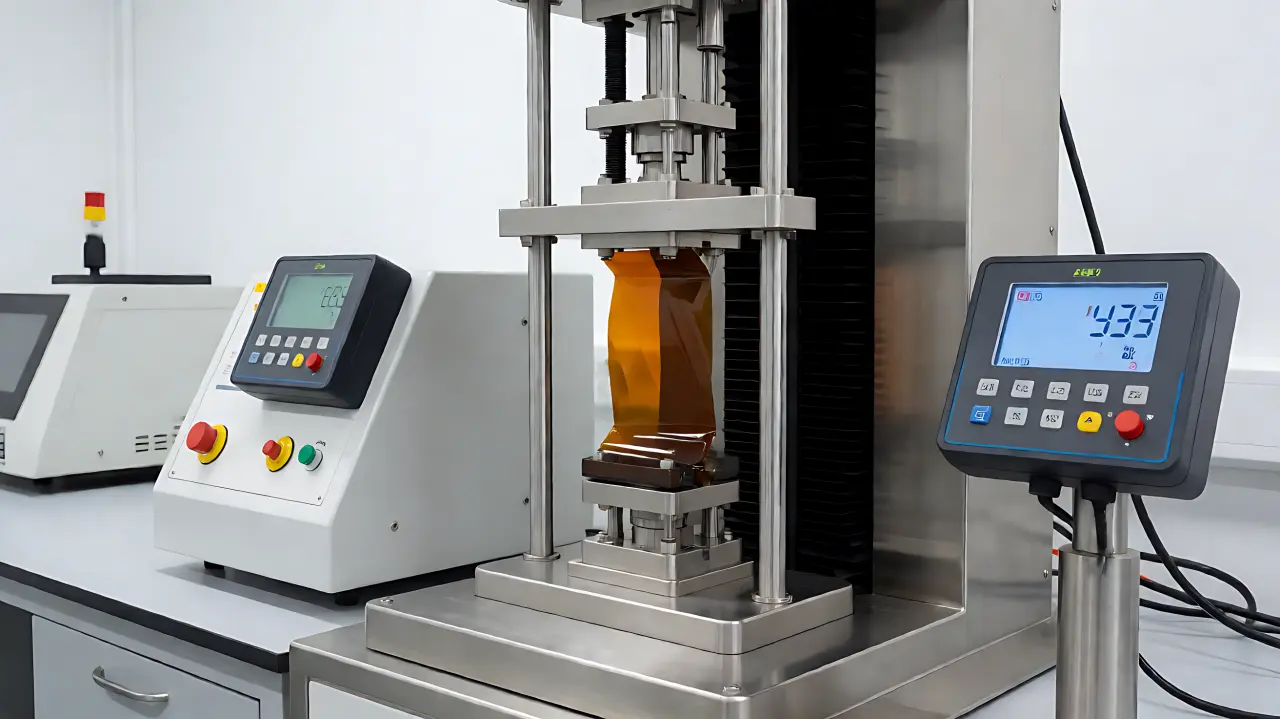
Hot Tack vs Ultimate Seal Strength: ASTM F1921 Packaging Guide
In high-speed Vertical Form-Fill-Seal (VFFS) bagging lines—packing frozen poultry, IQF vegetables, pet kibble, or confectionery—packaging film is formed into a tube, bottom-sealed by heated jaws, and immediately loaded with product dropped from a multi-head weigher mounted overhead.
The product mass (often $500\text{ g to } 2.5\text{ kg}$) impacts the newly created bottom seal mere milliseconds after the sealing jaws open. If the still-molten polymer interface cannot resist this dynamic impact, the bottom seal ruptures or stretches, causing catastrophic line jams, product spillage, and burnt sugar contamination on subsequent seal cycles.
To maximize packaging machine speeds, engineers must differentiate between Hot Tack Strength (ASTM F1921) and Ultimate Ambient Seal Strength (ASTM F88).
Sealing Timeline & Testing Standards
The mechanical strength of a heat seal changes dramatically over a 2-second timeline:
Seal Strength (N / 15mm) vs. Cooling Time Post-Jaw Opening
25 ┼                                              Ultimate Strength (ASTM F88)
   │                                              Fully Crystallized / Room Temp
20 ┼                                      ╭─────────────────────────────────────
   │                               ╭──────╯
15 ┼                        ╭──────╯
   │                 ╭──────╯
 8 ┼ ── Hot Tack ────╯ (ASTM F1921: Measured at 100 ms to 500 ms)
   │    Molten / Semi-Crystalline Interdiffusion
 0 ┼─┴───────────────┴───────────────┴───────────────┴───────────────►
   0 ms            250 ms          500 ms          1000 ms         Time
   ▲
Jaws Open; Product Drop Impact Occurs Here!
1. Hot Tack Strength (ASTM F1921)
- Definition: The capability of a heat-sealed polymer interface to resist mechanical separation while the sealant polymer remains in a semi-molten state, immediately following the release of the sealing jaws ($100 - 500\text{ ms}$ delay time).
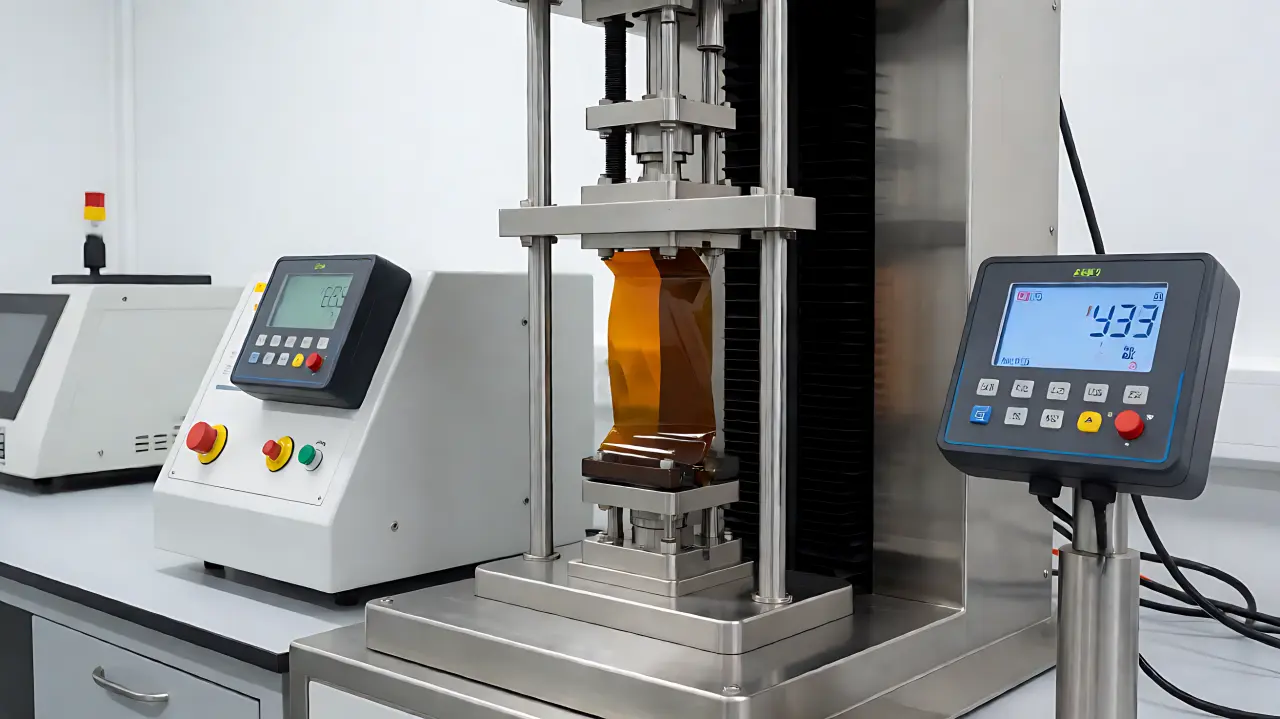
- Measurement Standard: Governed by ASTM F1921 (Method B) using high-precision automated instruments (e.g., J&B Hot Tack Tester). The machine clamps two film strips with heated platens, releases pressure, and pneumatically pulls the warm seal apart at high speed ($200\text{ mm/s}$) after a programmable cooling delay ($50 - 1,000\text{ ms}$).
- Failure Mode: Cohesive failure within the molten polymer melt pool.
2. Ultimate Ambient Seal Strength (ASTM F88)
- Definition: The maximum tensile force required to separate or rupture the heat seal after the polymer has cooled to ambient room temperature ($23^\circ\text{C}$) and reached equilibrium crystalline structure.
- Measurement Standard: Governed by ASTM F88 / F88M on a standard universal tensile tester pulling at $200 - 300\text{ mm/min}$.
- Failure Mode: Typically adhesive peeling, substrate delamination, or film tear adjacent to the seal edge.
Sealant Polymer Science: Metallocene vs. Conventional Resins
The hot tack performance of a flexible packaging laminate is dictated almost entirely by the molecular architecture of the innermost sealant resin:
| Sealant Polymer Type | Density ($\text{g/cm}^3$) | Peak Melting Point ($T_m$) | Seal Initiation Temp (SIT) | Peak Hot Tack Force (ASTM F1921) | Hot Tack Operating Window |
|---|---|---|---|---|---|
| Traditional LDPE (Autoclave) | $0.920 - 0.924$ | $108^\circ\text{C} - 112^\circ\text{C}$ | $110^\circ\text{C} - 118^\circ\text{C}$ | $2.5 - 4.0\text{ N}/15\text{mm}$ | Narrow ($10^\circ\text{C} - 15^\circ\text{C}$) |
| Ziegler-Natta LLDPE (C4/C6) | $0.918 - 0.922$ | $120^\circ\text{C} - 124^\circ\text{C}$ | $115^\circ\text{C} - 122^\circ\text{C}$ | $3.5 - 5.5\text{ N}/15\text{mm}$ | Moderate ($15^\circ\text{C} - 20^\circ\text{C}$) |
| Metallocene mLLDPE (C8) | $0.916 - 0.920$ | $116^\circ\text{C} - 120^\circ\text{C}$ | $95^\circ\text{C} - 105^\circ\text{C}$ | $7.0 - 11.0\text{ N}/15\text{mm}$ | Broad ($30^\circ\text{C} - 45^\circ\text{C}$) |
| Polyolefin Plastomer (POP) | $0.885 - 0.905$ | $85^\circ\text{C} - 100^\circ\text{C}$ | $75^\circ\text{C} - 88^\circ\text{C}$ | $> 12.0 - 16.0\text{ N}/15\text{mm}$ | Ultra-Broad ($50^\circ\text{C}+$) |
| Cast Polypropylene (CPP) | $0.900 - 0.905$ | $135^\circ\text{C} - 160^\circ\text{C}$ | $125^\circ\text{C} - 138^\circ\text{C}$ | $3.0 - 5.0\text{ N}/15\text{mm}$ | Narrow ($12^\circ\text{C} - 18^\circ\text{C}$) |
Why Metallocene Plastomers Excel
Single-site metallocene catalysts produce narrow molecular weight distributions (MWD) with uniform short-chain branching along the polyethylene backbone. This eliminates low-molecular-weight waxes that migrate to the surface and weaken molten weld pools. Metallocene plastomers (POP) exhibit rapid recrystallization kinetics, achieving load-bearing cohesive strength within $50\text{ milliseconds}$ of jaw release.
Dynamic Impact Energy Balance on VFFS Baggers
Calculating whether a bottom seal will survive product loading is governed by kinetic impact energy:
$$E_{\text{impact}} = m \cdot g \cdot h_{\text{drop}}$$
Where:
- $m$: Mass of product dropped per cycle (kg).
- $g$: Gravitational acceleration ($9.81\text{ m/s}^2$).
- $h_{\text{drop}}$: Vertical distance from weigher discharge funnel to the bottom seal (m).
For a $1.0\text{ kg}$ bulk frozen fry bag dropped from a height of $0.8\text{ meters}$, the impact energy equals:
$$E_{\text{impact}} = 1.0\text{ kg} \cdot 9.81\text{ m/s}^2 \cdot 0.8\text{ m} \approx 7.85\text{ Joules}$$
If the molten hot tack peel energy ($W_{\text{tack}} = \int F_{\text{tack}} , dx$) is lower than $E_{\text{impact}}$, the seal unzips. Increasing machine speed from $60\text{ to }100\text{ bags/min}$ reduces available seal cooling time by $40%$, demanding films with hot tack values $\ge 8.0\text{ N}/15\text{mm}$.
Packaging Machine Optimization Checklist
- Verify Seal Initiation Temperature (SIT): Lower SIT allows operators to run jaw platens at cooler temperatures ($120^\circ\text{C}$ vs. $160^\circ\text{C}$), shortening cooling times.
- Prevent Seal Contamination: Formulations blended with 20% to 30% metallocene plastomer seal through grease, oil splashes, and dry dust particulates without delamination.
- Calibrate Jaw Pressure Uniformity: Inconsistent pressure across wide pouch widths ($> 300\text{mm}$) causes localized hot-spot thinning, dropping hot tack by more than $50%$.
For high-speed bagging operations, examine our VFFS rollstock film engineering guide and heavy-duty stand-up barrier pouches. Consult CraftPack Global’s polymer engineers to optimize hot tack curves for your high-speed packaging lines.