
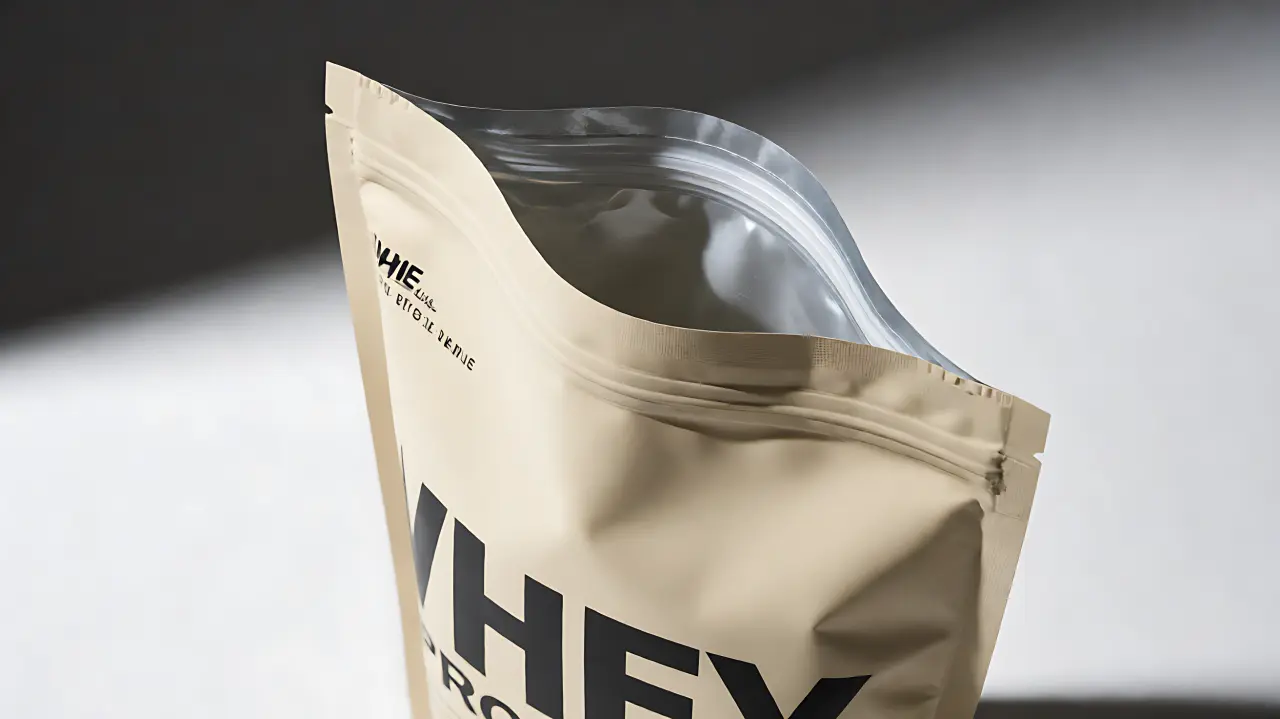
Hook-and-Loop vs. Press-to-Close Zippers: Powder Packaging Guide
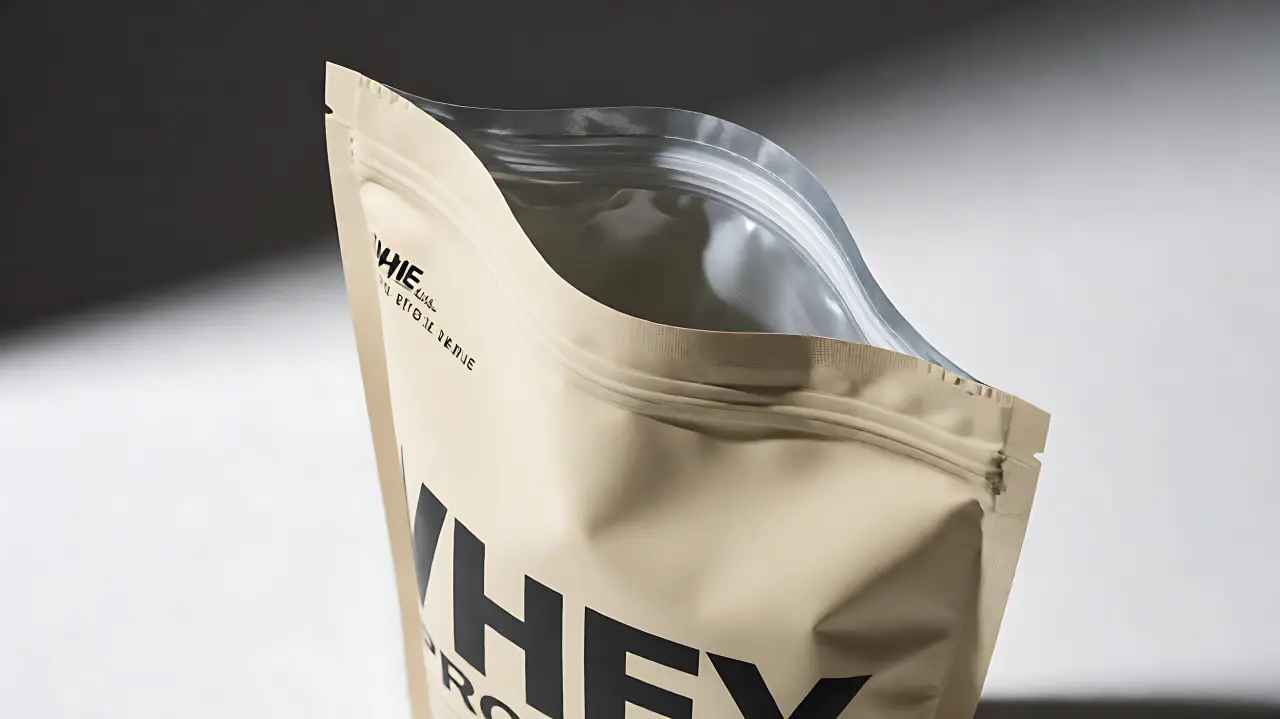
In powder, granular, and particulate packaging—ranging from whey protein isolates and collagen peptides to specialty bakery flours, matcha powders, and freeze-dried pet treats—reclosability is the primary determinant of consumer satisfaction and product freshness. However, standard reclosable features encounter a chronic mechanical failure mode: powder particulate fouling.
When fine powders (particle diameter $< 150 \mu\text{m}$) settle within the female channel of a traditional Press-to-Close (PTC) interlocking zipper, the mechanical interference prevents the male hook from seating. Consumers struggle to achieve closure, leading to pouch blowouts, spilled contents, and accelerated moisture-induced powder caking.
To solve this, flexible packaging engineers increasingly deploy Hook-and-Loop (Aplix / Velcro-style micro-hook) closure systems.
This technical guide analyzes the mechanical engagement physics, particulate contamination resistance, internal burst resistance, ultrasonic sealing conversion, and commercial cost factors separating Hook-and-Loop from traditional Press-to-Close zipper profiles.
1. Technical Matrix: Hook-and-Loop vs. Press-to-Close Zippers
| Engineering Feature | Hook-and-Loop Closure (Micro-Hook / Loop) | Standard Single-Track PTC Zipper | Twin-Track Flanged PTC Zipper | De-Flaker Powder-Proof PTC Zipper |
|---|---|---|---|---|
| Mechanical Engagement | Multi-point micro-hook matrix (Self-aligning) | Male arrow into female groove | Dual parallel male/female tracks | Offset female channel with relief ports |
| Powder Particle Clogging Sensitivity | Zero Clogging (Displaces powder freely) | Severe Clogging (Fails when fouled) | High Clogging (Both tracks jam) | Moderate (Relief ports clear granules) |
| Alignment Tolerance | Omnidirectional (Engages offset by ±5mm) | Strict (Must align perfectly within ±0.5mm) | Strict (Zero misalignment tolerance) | Moderate tolerance (±1.0mm) |
| Acoustic & Haptic Feedback | Loud tactile “crunch” / rip feedback | Subtle click (Muffled by fine powder) | Audible double-click | Moderate audible click |
| Internal Burst Resistance (Holding Force) | Moderate (15 to 25 N/25mm) | High (25 to 40 N/25mm) | Very High (35 to 55 N/25mm) | High (30 to 45 N/25mm) |
| Airtight / Liquid-Tight Seal | Non-Hermetic (Requires barrier top seal) | Semi-hermetic (Resists air diffusion) | High air resistance | Semi-hermetic |
| Ultrasonic Side-Seal Crush Ease | High energy required (Thicker PE flange) | Standard low energy | Moderate energy | Moderate energy |
| Unit Hardware Cost Multiplier | 2.5× to 3.5× Standard PTC | Baseline (1.0×) | 1.3× to 1.6× Baseline | 1.5× to 1.8× Baseline |
To view our complete selection of reclosable powder and food packaging, explore our Stand-up Pouches Category and Flat Bottom Bags Category.
2. Particulate Fouling Physics: Why Traditional Zippers Jam
The root mechanism of closure failure lies in the dimensional mechanics of polymer interlocking channels:
Particulate Interference in Reclosable Flanges:
Standard Press-to-Close Zipper (Fouling):     Hook-and-Loop Micro-Hook (Self-Clearing):
┌──────────────────────────────────────┐     ┌──────────────────────────────────────┐
│        [Male Arrow Profile]          │     │    ▼  ▼  ▼  ▼  ▼  ▼  ▼ [Micro-Hooks] │
│                 │                    │     │   ░░░░░░░░░░░░░░░░░░░░░░░░░░░░░░░░░   │
│   ● ● ● ● Powder Trapped ● ● ● ●     │     │   Powder particles migrate into wide  │
│  ┌─┐                               ┌─┐│    │   interstitial voids between hooks    │
│  │ └───┐                       ┌───┘ ││    │   ▲  ▲  ▲  ▲  ▲  ▲  ▲ [Micro-Loops] │
│  └─────┘  [Female Cavity]      └─────┘│    │   Contact intact across 80% surface   │
└──────────────────────────────────────┘     └──────────────────────────────────────┘
Result: Male arrow cannot bottom out;        Result: Thousands of micro-hooks engage
flange pops open under minor pouch flex. regardless of fine powder presence.-
Press-to-Close Groove Jamming:
- A standard LDPE male profile relies on a 0.30 mm to 0.45 mm interference fit within the female retention cavity.
- When a consumer pours or scoops whey protein isolate ($D_{50} \approx 45 \mu\text{m}$) or bakery flour, electrostatic charges attract fine starch and protein particles into the cavity.
- Once compact powder fills the bottom clearance, the male profile cannot penetrate past the detent barb. Forcing the closure induces elastic shear on the side flanges, resulting in spontaneous popping open.
-
Hook-and-Loop Particulate Bypass:
- Micro-hook fasteners utilize hundreds of miniature self-molded polyethylene hooks ($0.4\text{ mm}$ height) interlocking with a soft non-woven loop pile or a reciprocal hook-to-hook web.
- When powder enters the closure zone, individual particles fall into open interstitial valleys between hook stems. Because the active mechanical contact area spans hundreds of distributed nodes across a 12 mm to 15 mm wide strip, the closure functions reliably even when 60% of the surface is coated in powder.
3. Hermeticity vs. Mechanical Reclosure: The Barrier Distinction
A common misconception among brand procurement teams is expecting hook-and-loop fasteners to maintain an airtight seal:
Pouch Barrier Profile Architecture:
┌────────────────────────────────────────────────────────┐
│  Hermetic Tear-Notch Factory Heat Seal (Outer Barrier) │ <── Keeps OTR/WVTR intact
├────────────────────────────────────────────────────────┤
│  Top Cavity / Tear Line                                │
├────────────────────────────────────────────────────────┤
│  Hook-and-Loop Strip (Secondary Mechanical Closure)    │ <── Consumer Reclosure
├────────────────────────────────────────────────────────┤
│  Pouch Interior (Powder / Food Reservoir)              │
└────────────────────────────────────────────────────────┘- Factory Integrity: All flexible pouches utilizing hook-and-loop fasteners are sealed with a hermetic continuous thermal top weld above the tear notches during form-fill-seal packaging. Until the consumer tears off the header, the oxygen transmission rate (OTR) and water vapor transmission rate (WVTR) are determined entirely by the pouch film laminate (e.g.,
PET / VMPET / PE), not the closure strip. - Post-Opening Storage: Hook-and-loop systems do not form a gas-tight seal after initial tearing. For products with extreme hygroscopic sensitivity (e.g., effervescent drink tablets), a modified powder-proof PTC zipper with elastomer gasket seals is preferred. However, for bulk protein powders, pet kibble, and pancake mixes, hook-and-loop prevents air currents, insect intrusion, and spilling while maintaining practical sensory freshness over a 30-day consumption cycle.
4. Converting & Sealing Line Considerations
Integrating hook-and-loop closures into horizontal form-fill-seal (HFFS) and pre-made pouch converting lines introduces specific engineering requirements:
-
Ultrasonic End-Crushing:
- At the pouch side seams, the closure strip must be flattened to zero caliper to allow the perimeter seal bars to create a leak-proof weld.
- Because hook-and-loop strips feature a total combined thickness of 1.4 mm to 1.8 mm (compared to 0.8 mm for standard PTC zippers), conventional heated seal bars can cause outer film blistering and pinholes.
- Converting lines must integrate 20 kHz to 35 kHz ultrasonic plunge horns to liquefy the polyethylene backing and collapse the hook structure instantaneously without overheating the outer PET print web.
-
Pouch Opening Tension:
- Hook-and-loop fasteners provide a uniform opening peel force of 3.5 to 5.5 N/25mm, delivering a satisfying, low-effort unzipping experience accessible to elderly consumers and children alike, whereas clogged traditional zippers require erratic finger forces that risk tearing the side pouch film.
5. Strategic Procurement Selection Matrix
                      What is the physical nature of your product?
                                     │
                     ┌───────────────┴───────────────┐
             Fine Powders or Crumbs           Clean Pellets / Solids
          (Protein, Flour, Pet Treats)          (Coffee, Snacks, Candy)
                     │                               │
       Does the consumer re-open the bag      Do you require gas-tight
           more than 10–15 times?              hermetic resealing?
                     │                               │
        ┌────────────┴────────────┐             ┌────┴──────────────────────────┐
       YES                        NO            │ Deploy Standard PTC Zipper:   │
        │                          │            │ - Whole bean coffee           │
  Deploy Hook-and-Loop:            │            │ - Dried fruit & nut snacks    │
  - 2lb / 5lb Whey protein         │            │ - Confectionery candies       │
  - Artisanal milling flour        │            │ - Single-serve jerky packs    │
  - Freeze-dried pet treats        │            └───────────────────────────────┘
  - Lawn fertilizer / seed         │
  - Fine cosmetic bath salts       └──────────> Deploy De-Flaker Offset Zipper
                                                or Pocket Slider Zipper
By engineering the closure profile to match your product’s rheology and particle diameter, you eliminate top-of-funnel customer complaints while elevating the premium tactile experience of your brand.
Consult with CraftPack Global’s packaging engineering team to receive complimentary closure sample swatches via our Custom Stand-up Pouches Engineering Center.