
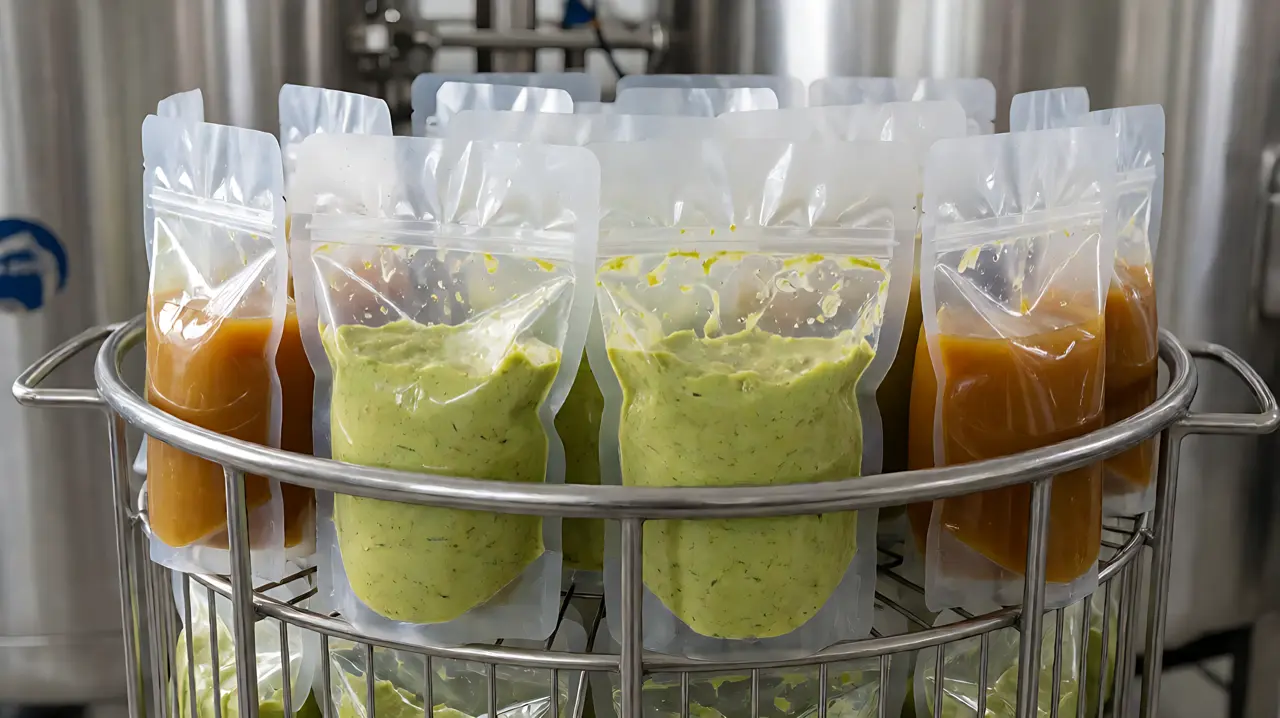
HPP Packaging: Flexible Pouch Barrier & Engineering Guide
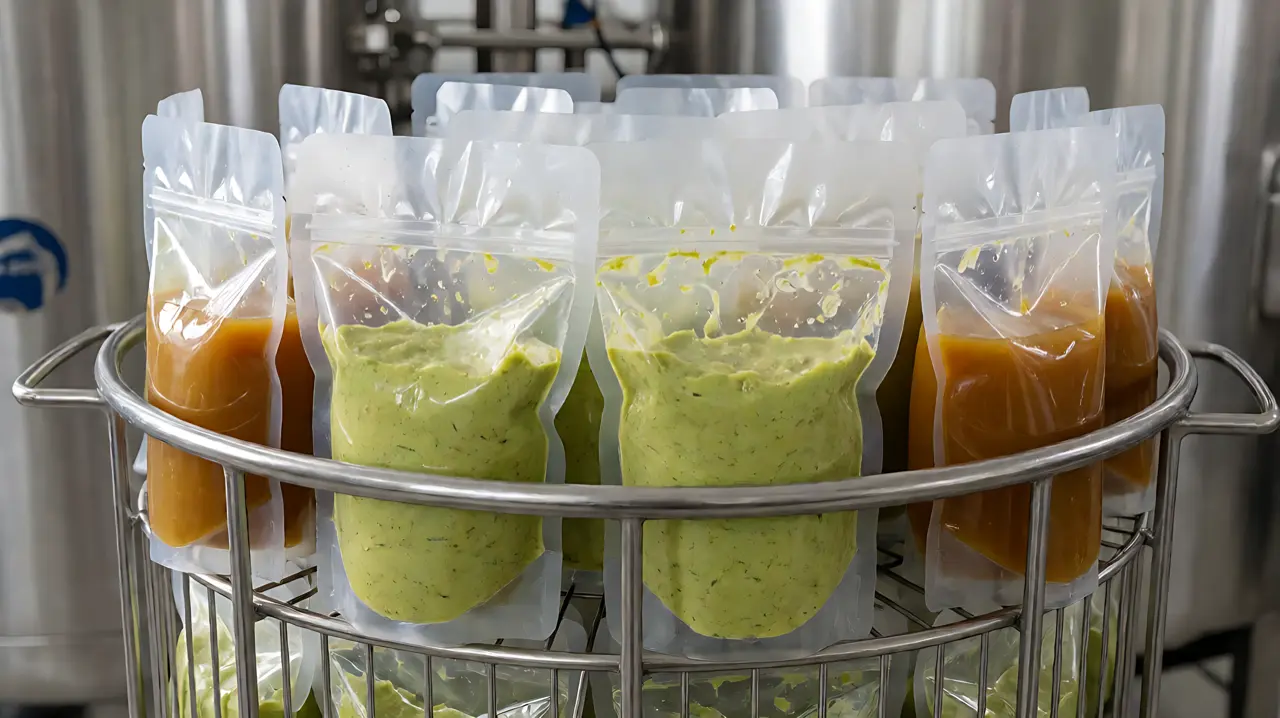
In premium refrigerated food processing, consumer demand has decisively shifted toward clean-label products: fresh cold-pressed juices, refrigerated guacamole, ready-to-eat deli meats, wet pet food, and raw soups formulated without chemical preservatives.
To achieve a 45-to-90-day refrigerated shelf life without thermal degradation, processors utilize High-Pressure Processing (HPP)—a non-thermal “cold pasteurization” method. Packaged foods are loaded into an intense hydrostatic pressure vessel where water pressure is ramped up to 600 megapascals (MPa / 87,000 psi)—equal to six times the pressure at the bottom of the Mariana Trench—and held for 1 to 5 minutes. This extreme isostatic pressure inactivates vegetative foodborne pathogens (Listeria monocytogenes, Salmonella, E. coli) by disrupting cellular membranes while leaving delicate vitamins, pigments, and fresh flavor notes completely intact.
However, subjecting a flexible pouch to 600 MPa introduces extreme physical stresses. Under hydrostatic compression, internal headspace gas compresses by up to 15%, water molecules force their way into polymer boundaries, and rapid depressurization can trigger catastrophic interlaminar delamination blistering and barrier micro-fractures.
This technical guide evaluates pouch barrier selections, headspace void control, EVOH plasticization, and specialized polyurethane adhesives engineered for commercial HPP cycles.
1. Material Performance Matrix: HPP Flexible Packaging
| Engineering Metric | Co-Extruded EVOH Coex (9-Layer) | PET / EVOH / PE Adhesive Laminate | Standard Met-PET Foil Laminate | Rigid HDPE Bottle (HPP Grade) |
|---|---|---|---|---|
| Pouch Geometry | Stand-Up Pouches & Vacuum Skin Packs | Stand-Up Pouches & Flat Pouches | Retort & High-Barrier Pouches | Squeeze Bottles (Beverages) |
| Hydrostatic Pressure Limit | Survives 600 MPa / 87,000 psi | Survives 600 MPa (With HPP PU adhesive) | FAILS (Metallized layer fractures / crazes) | Survives 600 MPa (Requires flex base) |
| Depressurization Delamination | Zero risk (Polymer layers are co-extruded) | Low risk with aliphatic adhesive | Extreme risk (Gas expansion shears foil) | N/A (Monolayer) |
| Oxygen Transmission (OTR) (cc/m²/day @ 23°C, 65% RH) |
0.8 to 1.8 | 0.6 to 1.5 | < 0.1 (Pre-HPP) -> > 10.0 (Post-HPP) | 15.0 to 25.0 (High oxygen ingress) |
| Water Induced Plasticization | Reversible after drying | Reversible after drying | Permanent delamination | Negligible |
| Headspace Gas Tolerance | Requires < 5% Headspace Volume | Requires < 5% Headspace Volume | Requires < 3% Headspace Volume | Requires 10% expandable geometry |
| Optical Clarity After Cycle | Crystal clear (Zero whitening) | High clarity | Opaque metallic (develops crease lines) | Translucent / Opaque |
For high-integrity vacuum and barrier pouches, explore our Stand-Up Pouches Category and specialized barrier packaging lines.
2. Pascal’s Principle & Headspace Management Mechanics
HPP relies on Pascal’s Principle: pressure applied to a confined liquid is transmitted instantly and uniformly in all directions throughout the vessel:
Headspace Compression & Expansion During 600 MPa Cycle:
Phase 1: Loading (1 atm)        Phase 2: Pressurization (600 MPa)     Phase 3: Depressurization (1 atm)
┌──────────────────────┐        ┌──────────────────────┐             ┌──────────────────────┐
│ [Air Headspace 15%]  │        │ [Air Crushed to ~1%] │             │ [Air Snaps Back]     │
│                      │ ───►   │ Film flexes tightly  │     ───►    │ If adhesive is weak: │
│ [Guacamole / Juice]  │        │ around dense food    │             │ Instant Delamination!│
└──────────────────────┘ └──────────────────────┘ └──────────────────────┘- The Incompressibility of Water vs. Gas:
While water and liquid foods compress by only ~15% at 600 MPa, gases obey the ideal gas law: any ambient air pocket trapped inside the pouch compresses to less than 1/100th of its original volume.
- If a flexible pouch contains excessive air headspace (>8% to 10%), the flexible film is forced to bend at acute angles around the shrinking air bubble. This concentrated localized shear stress creases brittle barrier layers and tears seal corners.
- Vacuum Sealing Protocol: Products destined for HPP must be packaged on vacuum chamber sealers or gas-flush lines that pull residual headspace down to strictly $< 3% \text{ to } 5%$ void volume. Eliminating excess headspace ensures the film conforms smoothly around the food matrix without forming sharp stress wrinkles.
3. Delamination Physics During Rapid Depressurization
The most common failure mode in HPP packaging occurs not during the pressure ramp, but during decompression:
- Moisture & Micro-Gas Dissolution: At 600 MPa, water molecules and microscopic gas molecules are forced into the microscopic interstitial spaces of the polyurethane lamination adhesive and polyethylene sealant film.
- The Explosive Decompression Effect: When the HPP machine releases vessel pressure—dropping from 600 MPa back to atmospheric pressure in just 2 to 5 seconds—the trapped gas and moisture molecules expand instantaneously.
- Countermeasure (Cross-Linked Aliphatic Adhesives): Standard packaging adhesives lack the cohesive bond strength to resist this expansion, resulting in visible “tunneling” bubbles and delamination blisters between the PET print layer and the PE sealant. HPP packaging mandates specialized highly cross-linked, two-component solventless or solvent-based polyurethane adhesives with interlaminar peel strength exceeding $\ge 4.5\text{ N/15mm}$ (ASTM D1876).
4. Barrier Retention: Why Metallized Films Fail and EVOH Succeeds
The choice of barrier substrate dictates whether packaged food retains its shelf life post-treatment:
1. Metallized Films (VMPET) & Aluminum Foil Failure
Vacuum-metallized aluminum coatings consist of nanometer-thin crystalline metallic layers deposited onto polyester. Under the combined hydrostatic crushing and localized shear strains of HPP, the brittle metal lattice develops catastrophic craze cracking. Laboratory testing reveals that the Oxygen Transmission Rate (OTR) of a metallized pouch degrades from 1.0 cc/m²/day before HPP to over 15.0 cc/m²/day after HPP, accelerating discoloration in guacamole and fruit purees.
2. The Ductile EVOH Advantage
Ethylene-Vinyl Alcohol (EVOH) is a ductile thermoplastic copolymer. When subjected to isostatic pressure, EVOH deforms elastically without micro-fracturing.
- While high-pressure water temporarily increases EVOH moisture content (causing a temporary dip in gas barrier performance immediately post-vessel), the polymer desorbs excess moisture within 24 to 48 hours in cold storage, restoring its original pristine OTR barrier ($< 1.0\text{ cc/m}^2/\text{day}$).
5. Heat Seal Integrity: Contamination-Resistant mLLDPE
Hermetic seal integrity is non-negotiable in HPP processing because any seal failure allows non-sterile vessel water to contaminate the food:
- Sealant Chemistry: The inner food contact layer must utilize metallocene linear low-density polyethylene (mLLDPE) or plastomers featuring a broad hot-tack sealing window and high melt elasticity.
- Seal-Through Contamination: During high-speed filling of viscous purees, salsa, or wet pet food, splashes of fat or acid frequently contaminate the heat-seal flange. Standard LDPE sealants fail to bond through fat films. Metallocene sealants displace oil droplets during thermal bar sealing, delivering hermetic, contamination-free seals that withstand ASTM F1140 burst pressures exceeding 0.50 bar (50 kPa).
6. HPP Processor Sourcing & Quality Verification Checklist
When specifying flexible pouches for toll HPP processing, require converters to guarantee:
- Proof of Pressure Qualification: Verify that test pouches survived 600 MPa / 87,000 psi holding dwell for at least 300 seconds without delamination or seal rupture.
- Interlaminar Peel Strength (ASTM D1876): Mandate minimum peel strength $\ge 4.5\text{ N/15mm}$ post-HPP cycle.
- Substrate Formulation: Exclude metallized polyester (Met-PET) and aluminum foil in favor of 9-layer co-extruded EVOH or AlOx-coated PET.
- Headspace Specification: Calibrate pouch fill volume and vacuum chamber draw to maintain headspace volume strictly $< 5%$.
To engineer custom HPP-compatible flexible pouches that guarantee hermetic freshness and zero delamination, consult CraftPack Global’s barrier packaging laboratory.