
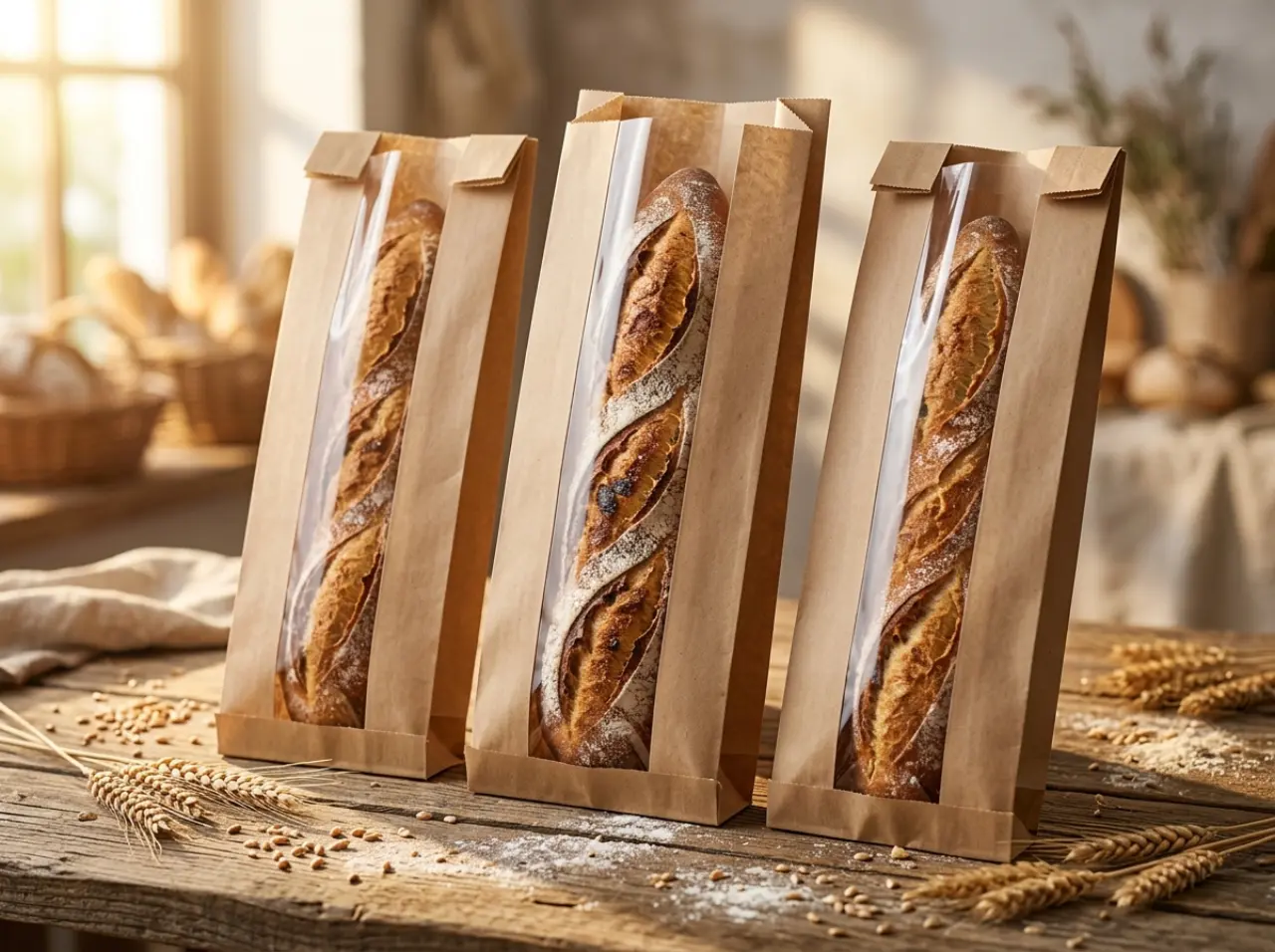
Bakery Window Bags: Glassine Paper vs Clear PLA Guide
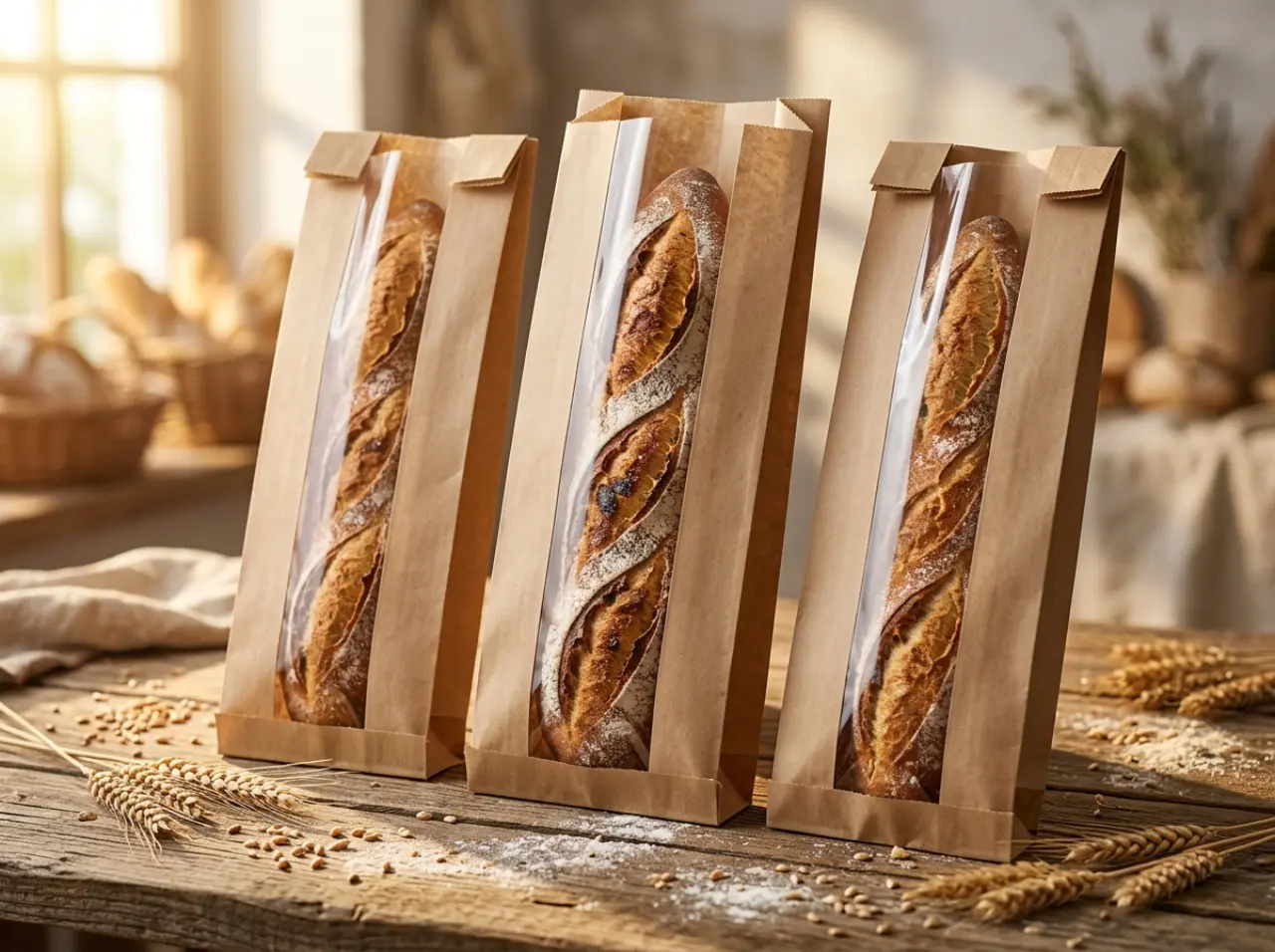
In commercial bakery retailing, artisanal bread merchandising, and supermarket pastry aisles, product visibility drives impulse purchasing. Consumers demand to inspect the golden-brown crust, crumb structure, and freshness of baguettes, croissants, and sourdough loaves before buying.
Traditionally, bakeries met this merchandising requirement by adding a clear plastic strip—most commonly petroleum-derived polypropylene (PP) or perforated polyethylene (PE)—down the center of unbleached kraft paper bags. However, multi-material bags featuring plastic bonded to paper create a recycling nightmare. Most municipal recycling facilities (MRFs) reject plastic-windowed paper bags because the plastic film contaminates paper repulping hydro-pulpers, relegating millions of bakery bags directly to landfills.
Under intensifying regulatory scrutiny from the EU Packaging and Packaging Waste Regulation (PPWR) and US state-level single-use plastic bans, commercial bakeries face an urgent packaging redesign challenge: Glassine Paper Windows vs. Clear Polylactic Acid (PLA) Bioplastic Windows.
This technical guide evaluates the material physics, grease resistance, moisture vapor breathability (crust crispness preservation), and recycling compliance of glassine and PLA window bakery bags.
1. Material Benchmark: Glassine Paper vs. Clear PLA vs. Conventional Polypropylene
| Technical Property | Supercalendered Glassine Paper (35–45 GSM) | Clear PLA Bioplastic Film (20–30µm) | Conventional Biaxially Oriented PP (BOPP 20µm) |
|---|---|---|---|
| Material Origin | 100% Virgin Wood Pulp (Cellulose Fibers) | Cornstarch / Sugarcane Derived (Bio-based) | Fossil-Fuel Petrochemical Polypropylene |
| Optical Transparency | Translucent (Semi-transparent / Frosted) | Crystal Clear (High Gloss, >90% Clarity) | Crystal Clear (>92% Clarity) |
| Recycling Stream | 100% Curbside Paper Recyclable (Mono-material) | Industrial Composting Only (EN 13432) | Contaminates paper recycling; landfill bound |
| TAPPI T559 Grease Resistance | Kit 7 to Kit 9 (Natural fiber hydration) | Kit 12 (Complete synthetic barrier) | Kit 12 (Complete synthetic barrier) |
| Moisture Vapor Transmission (WVTR) | High (~150 to 300 g/m²/day — Breathable) | Low to Moderate (~40 to 60 g/m²/day) | Extremely Low (~4 to 6 g/m²/day — Non-breathable) |
| Crust Crispness Retention (Baguette) | Superior (Vapor escapes; crust stays crisp) | Moderate (Prone to condensation softening) | Poor (Traps moisture; turns crust rubbery) |
| Thermal Heat Deflection Limit | Stable up to 180°C (Oven & warm rack safe) | Softens above 55°C (Heat sensitive) | Stable up to 125°C |
| PFAS Chemical Status | 100% PFAS-Free (Mechanical calendering) | 100% PFAS-Free | 100% PFAS-Free |
To explore our full collection of food-grade kraft bags and takeaway packaging, visit our Food Service Bags Category and Paper Shopping Bags.
2. Crust Preservation Physics: Moisture Vapor Breathability
Freshly baked artisan bread continuously releases warm moisture vapor as its crumb cools. How the packaging handles this water vapor dictates whether the bread maintains a crispy, crackling crust or turns soggy:
Moisture Dynamics in Window Bakery Packaging:
Non-Breathable Film (BOPP/Thick PLA):      Breathable Glassine Window:
┌─────────────────────────────────┐      ┌─────────────────────────────────┐
│ Moisture Trapped Inside         │      │ Moisture Vapor Diffuses Outward │
│ ░░░░░░░░░░░░░░░░░░░░░░░░░░░░░░░ │      │ ░░░░░░ ⇡ ⇡ ⇡ ⇡ ⇡ ⇡ ░░░░░░░░░░░ │
│ Condensation Droplets on Window │      │ Micro-calendered cellulose pores│
│ -> Rubbery, Tough Crust         │      │ -> Crisp, Crackling Crust Kept  │
└─────────────────────────────────┘ └─────────────────────────────────┘- The Condensation Trap: Impermeable films like BOPP (WVTR < 6 g/m²/day) trap evaporating steam within the bag. Within 30 to 60 minutes, internal relative humidity reaches 100%, causing water droplets to condense on the inside of the clear window. This moisture is reabsorbed by the outer starch layer of the loaf, transforming a crispy crust into a rubbery, chewy texture.
- The Glassine Solution: Glassine is manufactured through intensive mechanical fiber beating (hydration) followed by high-pressure, heated steel-roll calendering. This closes large air voids while leaving a microscopic network of hydrophilic cellulose pores. With a WVTR of 150 to 300 g/m²/day, glassine allows excess moisture vapor to dissipate steadily into ambient air while preventing rapid drying out, keeping artisanal sourdough and baguettes crusty for up to 36 hours.
3. Grease Barrier Science: Mechanical Hydration vs. Synthetic Barrier
Bakery products like croissants, brioche, and butter pastries contain high fat and butter fractions that will quickly leach through standard paper, creating unsightly greasy stains:
Mechanical Calendering vs. PFAS Coatings
Historically, mills added per- and polyfluoroalkyl substances (PFAS) to paper to achieve grease resistance. With global bans on fluorinated grease-proofing agents under FDA directives and EU REACH:
- Glassine’s Pure Mechanical Barrier: Glassine achieves grease resistance without a single drop of fluorochemicals or synthetic coatings. During manufacturing, refined wood fibers are beaten until the outer cell walls collapse into a gelatinous slurry. When passed through supercalender stacks under thousands of pounds of nip pressure, the fibers fuse into an ultra-dense sheet ($0.95\text{ to }1.15\text{ g/cm}^3$) that physically blocks non-polar butter and vegetable oils up to TAPPI T559 Kit Rating 8.
- PLA Bioplastic Barrier: PLA offers an impenetrable synthetic barrier (Kit 12). However, when hot butter or oils contact PLA above 50°C, the bioplastic can experience localized plasticization and thermal distortion.
4. End-of-Life & Repulpability Compliance (CEPI & EN 13432)
Packaging end-of-life certifications represent a major brand liability for commercial bakery chains:
Recycling Stream Sorting Efficiency:
Kraft Paper + Glassine Window:
[100% Wood Cellulose] ──> Standard Curbside Blue Bin ──> 95%+ Fiber Yield (CEPI)
Kraft Paper + PLA Window:
[Paper + Bio-Plastic] ──> Screen Reject at Paper Mill ──> Landfill / Incinerator
1. The Mono-Material Paper Standard (CEPI Guidelines)
The Confederation of European Paper Industries (CEPI) mandates that composite packaging contain at least 85% to 95% repulpable paper fiber to qualify for standard paper recycling streams.
- A bakery bag combining unbleached kraft paper with a glassine window is 100% cellulose fiber. In a paper recycling hydropulper, the water-soluble dispersion adhesives dissolve, and the glassine fibers disintegrate alongside the kraft body, yielding over 96% usable recycled pulp with zero plastic flake residue.
2. The PLA Composting Conundrum
While PLA is certified industrially compostable under EN 13432 and ASTM D6400, it requires industrial composting facilities maintaining 58°C and 90% humidity for 180 days. In municipal paper recycling streams, PLA behaves identically to petroleum plastic: it is caught by coarse sorting screens and diverted to landfills, or worse, melts into recycled paper slurries, creating defective resin spots.
5. Visual Merchandising: Transparency vs. Eco-Aesthetic
Procurement teams must balance optical merchandising against consumer sustainability perceptions:
- Crystal-Clear PLA: Delivers high gloss and 90%+ light transmission. Ideal for iced pastries, glazed donuts, and colorful berry danishes where intricate visual detail drives the purchase decision.
- Translucent Glassine (The “Artisan Aesthetic”): Provides frosted, semi-translucent visibility (60% to 75% light transmission). While slightly obscuring microscopic surface details, the frosted translucent window has become an instant consumer visual cue for organic, non-industrial, European-style artisanal baking.
6. Commercial Bakery Sourcing & Specification Checklist
When ordering custom window bakery bags, verify these technical parameters:
- Window Placement: Choose between Center Vertical Strip (ideal for long baguettes) or Offset Side Window (ideal for round sourdough boules and pastries).
- Window Adhesive: Require food-grade water-based acrylic dispersion glue tested to withstand proofing humidity and warm packing conditions without window delamination.
- Kraft Paper Weight: Specify 40 to 50 GSM unbleached virgin kraft paper for standard baguettes; specify 60 to 70 GSM for heavy artisan loaves up to 1.5 kg.
- Bag Base Geometry: Select Pinch Bottom (flat envelope style) for rapid counter packing or SOS Flat Bottom (Self-Opening Sack) for freestanding bakery counter display.
To engineer recyclable glassine or high-clarity PLA window bakery bags tailored to your product line, request samples from CraftPack Global’s food packaging team.