
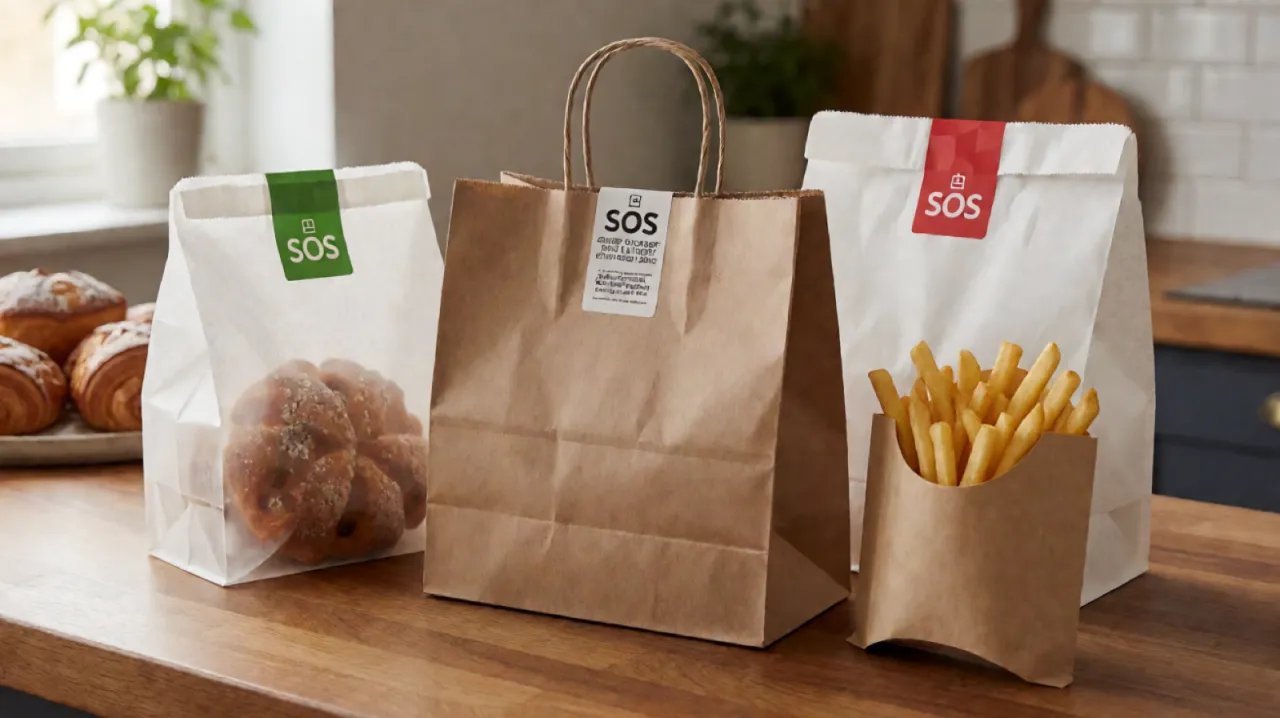
Food Service Bags: The PFAS-Free Greaseproof & Kraft Guide
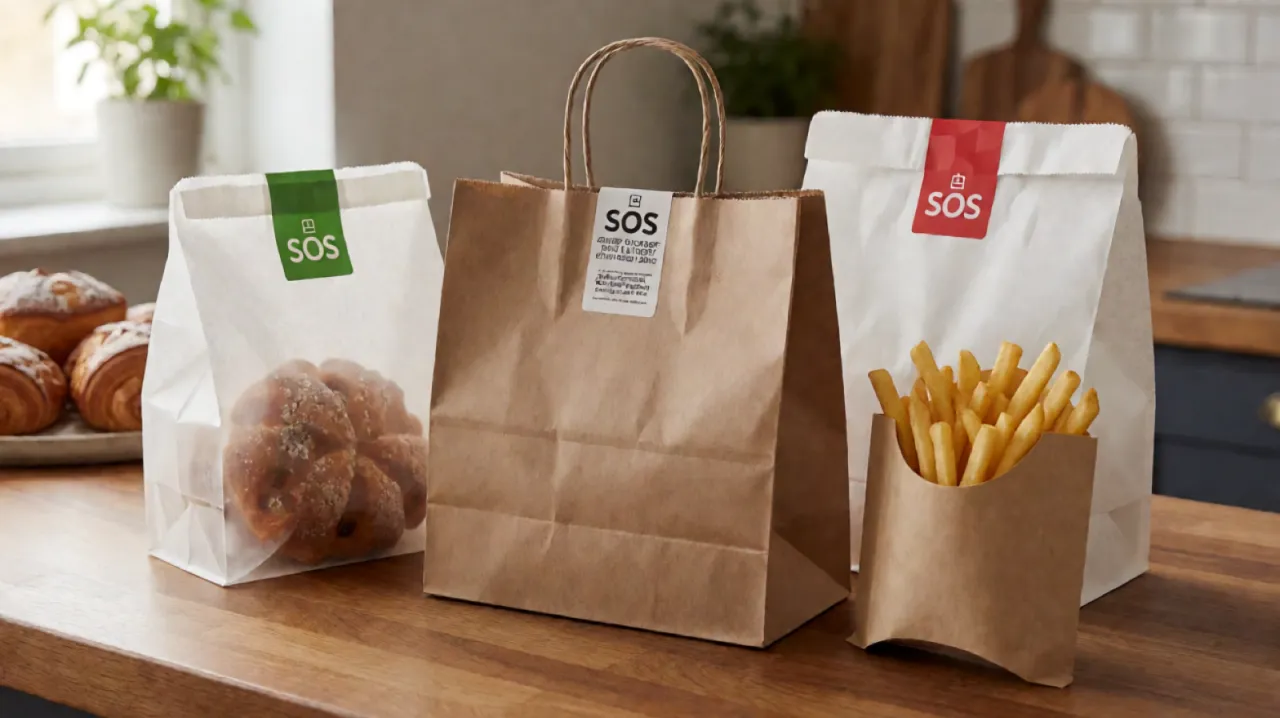
In commercial food service, packaging functions as the final thermal and mechanical envelope between kitchen production and table consumption. A structural failure during transport—such as grease saturation weeping onto delivery vehicle seats, trapped steam turning crispy fried foods limp, or a bag bottom bursting under the weight of stacked clamshells—damages restaurant brand perception immediately.
Simultaneously, global regulatory mandates have overhauled food-contact substrate chemistry. Sweeping bans on Per- and Polyfluoroalkyl Substances (PFAS) across the United States (including California AB 1200, New York, and Washington state) and the European Union (under REACH and PPWR) have made legacy fluorochemical grease-sizing obsolete.
This technical guide outlines operational criteria for selecting and specifying commercial food service bags: TAPPI Kit grease resistance ratings, paper substance (GSM), structural geometries (SOS vs. pinch bottom), thermal venting dynamics, and high-volume procurement parameters.
Grease Resistance Standards: Deconstructing the TAPPI T559 Kit Test
Food service papers must resist hot animal fats, vegetable cooking oils, and liquid sauces without structural delamination or surface staining. The recognized global benchmark for assessing surface oil repellency is the TAPPI T559 standard (commonly referred to as the Kit Test).
The test uses 12 distinct chemical formulations consisting of varying volumetric ratios of Castor Oil, Toluene, and n-Heptane. Solutions range from Kit 1 (mildest, highest castor oil fraction) to Kit 12 (most aggressive, pure hydrocarbon solvents):
| TAPPI Kit Level | Chemical Penetration Aggressiveness | Primary Food Application | Typical Barrier Failure Risk |
|---|---|---|---|
| Kit 1 – 3 | Low (Heavy oil viscosity) | Dry baked goods (artisan sourdough, baguettes, dry pretzels) | Low; minimal free lipid migration |
| Kit 4 – 6 | Moderate (Balanced blend) | Butter-rich pastries (croissants, cookies, warm donuts) | Wicking at folded edges if unsealed |
| Kit 7 – 9 | High (Solvent-rich penetration) | Hot fried items (french fries, churros, fried chicken fillets) | Rapid oil bleed-through under heat |
| Kit 10 – 12 | Severe (Aggressive hydrocarbon) | High-temperature smash burgers, carnitas, heavy chili sauces | Delamination of aqueous dispersion coats |
Procurement teams must specify paper based on thermal exposure. A paper rated Kit 7 at room temperature (23°C / 73°F) may drop to an effective Kit 4 under the thermal convection of freshly fried chicken packed at 75°C (167°F), because heat decreases oil viscosity and accelerates capillary wicking through paper cellulose pores.
The Shift to PFAS-Free Barrier Technologies
Historically, paper mills achieved Kit 8 to Kit 12 performance by surface-sizing paper webs with fluorochemical polymers. These additives lowered the surface energy of cellulose fibers below the surface tension of oils. With fluorochemicals banned across major jurisdictions, paper converters utilize three compliant alternatives:
Substrate Chemistry Comparison:
┌───────────────────────────┬───────────────────────────┬───────────────────────────┐
│ Aqueous Dispersion (WBBC) │ Mechanical Hydration      │ Bio-Wax / PLA Extrusions  │
├───────────────────────────┼───────────────────────────┼───────────────────────────┤
│ Water-based polymer coat  │ Dense refined pulp matrix │ Biopolymer resin barrier  │
│ Repulpable / Recyclable   │ 100% natural fiber        │ Industrial compostable    │
│ Best for: Fast casual QSR │ Best for: Artisan bakery  │ Best for: Wet gravies     │
└───────────────────────────┴───────────────────────────┴───────────────────────────┘- Aqueous Water-Based Barrier Coatings (WBBC):
- Polymeric water-based dispersions applied inline via blade or rod coaters.
- Polymer particles coalesce into a continuous, flexible micro-film that repels lipids while preserving mill repulpability and municipal curbside recycling compatibility.
- Super-Calendered High-Density Parchment & Glassine:
- Manufactured by subjecting chemical wood pulp to intensive mechanical beating (refining) followed by high-pressure steam calenders.
- The cellulose fibers hydrate and collapse into an ultra-dense sheet with minimal microscopic void space, preventing oil migration through physical fiber density rather than chemical additives.
- Bio-Polymer Extrusion Coatings (PLA / PHA):
- Polylactic acid (PLA) derived from plant starches extruded directly onto virgin kraft paper.
- Delivers both an oil barrier (Kit 12) and a complete liquid moisture barrier, making it suitable for wet takeaway containers and sauces.
For brands planning custom food packaging lines, review our certified food service bags catalog for confirmed compliant barrier grades.
Bag Geometries: Operational Efficiency & Table-Ready Delivery
Bag architecture dictates both kitchen pack-out speed and food stability during courier transit.
Bag Architectures:
Self-Opening Square (SOS)             Pinch Bottom / Flat Satchel
┌───────────────────────────┐         ┌───────────────────────────┐
│     Twisted / Flat Top    │         │      Straight Cut Lip     │
├───────────────────────────┤         ├───────────────────────────┤
│                           │         │                           │
│     Gusseted Sidewalls    │         │     Flat Expanding Tube   │
│                           │         │                           │
├───────────────────────────┤         ├───────────────────────────┤
│    Rigid Rectangular Base │         │    Tapered Glued Seam     │
└───────────────────────────┘         └───────────────────────────┘
1. Self-Opening Square (SOS) Flat Bottom Bags
Self-Opening Square bags are the industry standard for fast-casual meal delivery.
- Base Geometry: Engineered with a pre-glued, multi-fold rectangular bottom. Kitchen assembly staff can snap open the bag with a single wrist motion, placing it flat on prep counters.
- Loading Stability: Accommodates rectangular paperboard burger boxes, salad bowls, and molded fiber clamshells side-by-side without tilting or crushing delicate items.
- Handle Configurations:
- Twisted Paper Cord Handles: Higher tensile strength, preferred for upscale retail and heavier meal bundles.
- Internal Flat Fold-Out Handles: Economical paper strip handles that fold flush against the inside rim for compact carton packing.
- Handleless Roll-Down Tops: Standard for fast-food drive-thrus, folded down and secured with a tamper-evident sticker.
2. Pinch Bottom & Gusseted Bakery Bags
Pinch bottom bags utilize an envelope-style bottom fold sealed with food-grade hot melt adhesive.
- Efficiency: Delivered flat in high-density bundles (typically 1,000 to 2,000 units per master shipper), conserving limited back-of-house storage space in tight urban kitchens.
- Application: Single-portion pastries, baguettes, warm cookies, and street food.
- Venting Windows: Frequently manufactured with clear micro-perforated cellulose or PLA window panels to present artisan crust coloration while allowing moisture vapor to escape.
To compare carrier formats for retail integration, explore our paper shopping bags and custom kraft paper bags.
Thermal Steam Dynamics: Preventing the “Soggy Fry” Phenomenon
The primary failure mode of hot, moisture-rich fried foods during courier delivery is internal steam condensation.
When hot food above 65°C (150°F) is sealed in an unvented bag, water vapor rapidly evaporates from the food surface. As the vapor contacts the cooler outer paper wall, it condenses back into liquid water droplets. These droplets drip back onto crisp starches, transforming crispy coatings into unappealing mush within 10 to 15 minutes.
To engineer optimal moisture equilibrium:
- Upper Gusset Die-Cut Vents: Incorporating two to four circular venting holes (4 mm to 6 mm diameter) punched into the side gussets above the grease line. This allows convective steam release while preserving core food temperature.
- Selective Air Permeability: Utilizing unlaminated, porous outer kraft paper (Gurley air resistance below 20 seconds/100ml) paired with greaseproof internal wrapping wraps.
Delivery Security: Tamper-Evident Closures
With third-party delivery platforms handling a large portion of QSR revenue, chain operators require verifiable chain-of-custody packaging.
- Tamper-Evident Seal Labels: Pressure-sensitive paper stickers applied across the folded top rim. Engineered with aggressive hot-melt adhesives and security chevron die-cuts that destructively tear the paper fiber if an attempt is made to peel the sticker.
- Integrated Peel-and-Seal Strips: Pre-applied silicone release liners covering permanent adhesive tapes along the top fold. Once closed by the packer, the bag cannot be opened without completely destroying the top margin.
For technical specifications on adhesive shear strength and substrate tear requirements, consult our tamper-evident packaging solutions guide.
Commercial Procurement Specification Matrix
| Metric | Single-Serve Bakery Satchel | Vented Fried Food Bag | Heavy-Duty SOS Delivery Bag | Gourmet Takeaway Carrier |
|---|---|---|---|---|
| Bag Structure | Pinch Bottom / Gusset | SOS Flat Bottom | SOS Flat Bottom | SOS Flat Bottom |
| Base Paper Grammage | 35 – 45 GSM Bleached Kraft | 50 – 70 GSM Unbleached Kraft | 70 – 90 GSM Virgin Kraft | 100 – 120 GSM Heavy Kraft |
| Grease Barrier Rating | TAPPI Kit 5 – 7 | TAPPI Kit 8 – 10 (PFAS-Free) | Kit 3 – 5 (Dry outer) | Standard unwaxed |
| Handle Style | Handleless | Handleless / Roll-down | Internal Flat Tape Handle | Twisted Paper Cord |
| Safe Working Load | Up to 0.75 kg (1.6 lbs) | Up to 2.0 kg (4.4 lbs) | Up to 5.0 kg (11.0 lbs) | Up to 8.0 kg (17.6 lbs) |
| Printing Process | 1–2 Color Water Flexo | 1–4 Color Flexo (Low-VOC) | 1–6 Color Central Impression | Multi-color + Spot UV |
| Master Case Packaging | 1,000 – 2,000 pcs/bundle | 500 – 1,000 pcs/carton | 250 – 500 pcs/carton | 200 – 300 pcs/carton |
Sourcing & Compliance Protocols
When auditing paper bag manufacturers for international restaurant rollouts, procurement directors should verify these baseline quality protocols:
- Food Contact Safety Compliance: Written declarations confirming compliance with US FDA 21 CFR § 176.170 (components of paper and paperboard in contact with aqueous and fatty foods) and European Framework Regulation (EC) No 1935/2004.
- Inks and Adhesives: Formulated with heavy-metal-free water-based flexographic inks and starch- or PVA-based adhesives verified odorless to prevent volatile flavor transfer into warm food.
- Tensile and Seam Integrity (ASTM D828): Ensuring dry and wet tensile strength prevents bottom blowout under humid condensation during peak delivery hours.
To evaluate custom dimensions, test water-based barrier coatings, or request pre-production samples for kitchen operational testing, contact the packaging engineers at the CraftPack Global Contact Team.