
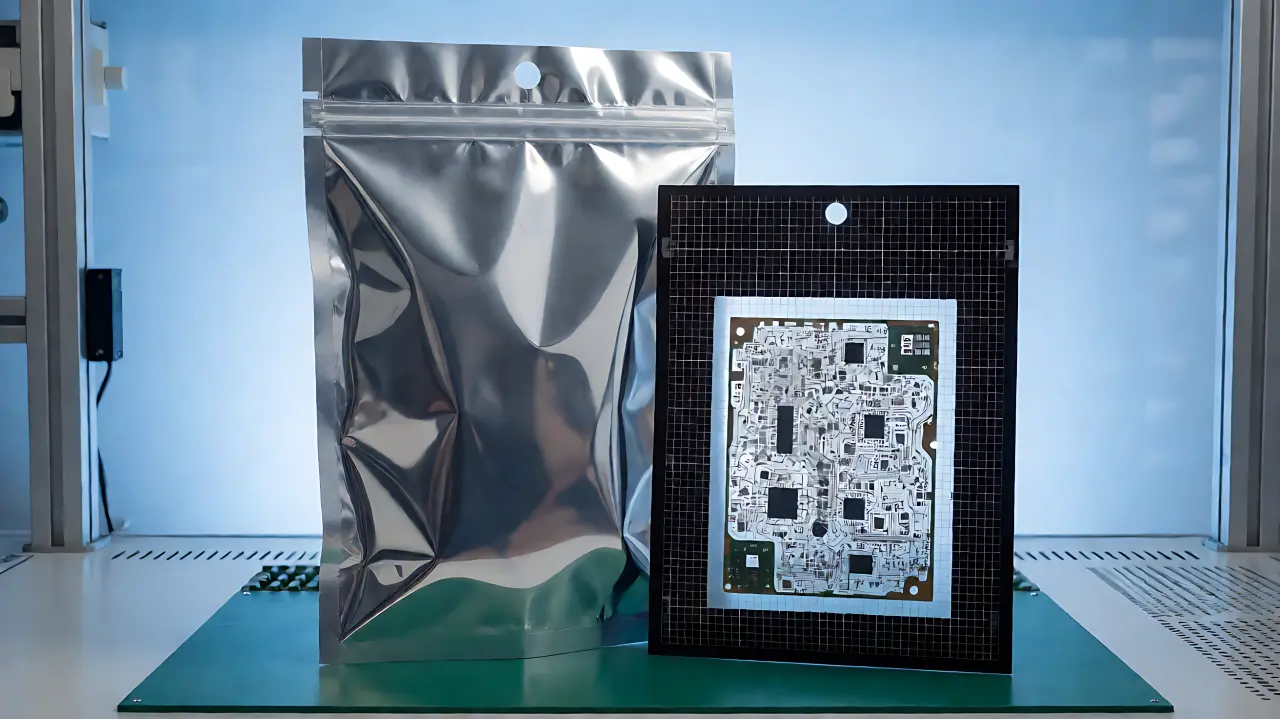
ESD Shielding vs. Conductive Grid Bags: Electronics Guide
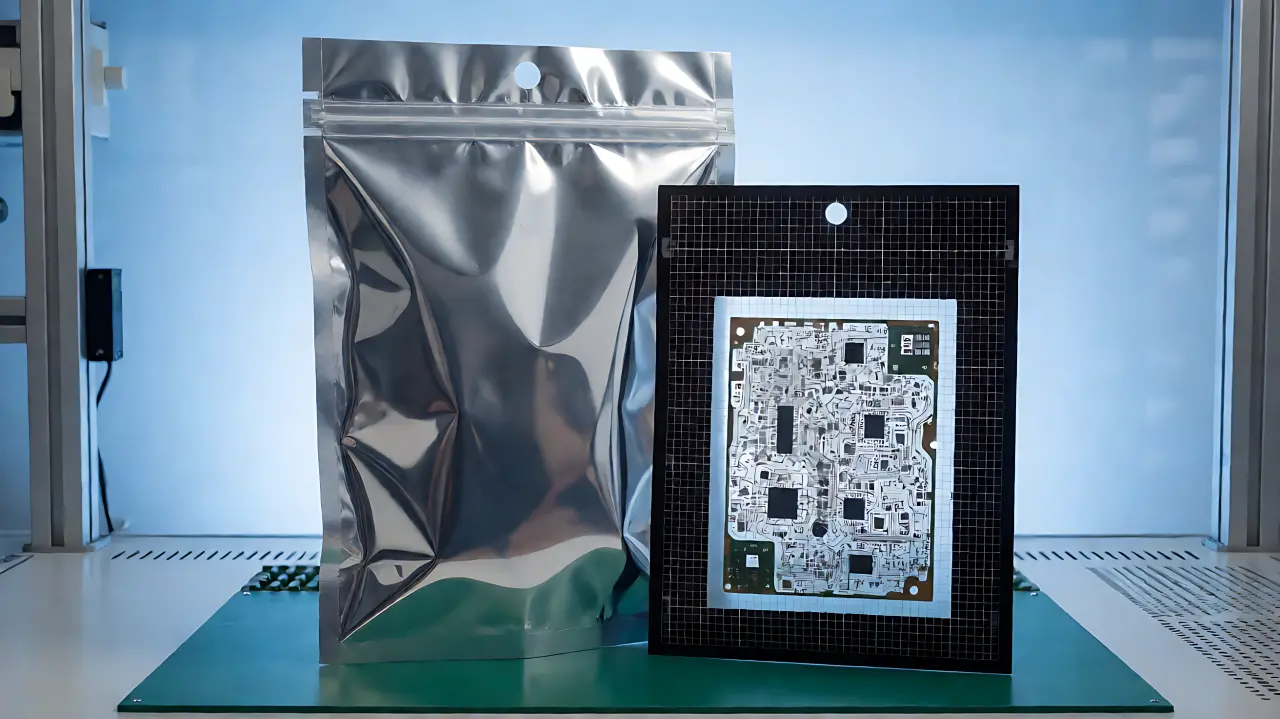
In the packaging, storage, and global shipping of sensitive semiconductor microchips, printed circuit board assemblies (PCBAs), and electro-optical components, uncontrolled Electrostatic Discharge (ESD) is a catastrophic defect vector. Static potentials as low as 50 to 100 volts—imperceptible to human touch—can puncture sub-micron gate oxides and fuse silicon pathways, resulting in immediate device death or insidious latent field failures.
To protect electrostatic discharge sensitive (ESDS) items outside an Electrostatic Protected Area (EPA), packaging engineers specify specialized flexible enclosures. However, procurement teams frequently confuse Static Shielding Bags (Metal-In / Metal-Out) with Black Conductive Grid Bags (Conductive Carbon Mesh).
While both dissipate surface charges, their physical shielding mechanisms, electric field attenuation, transparency, and compliance with ANSI/ESD S20.20 and MIL-PRF-81705E diverge significantly.
This technical guide provides an engineering evaluation of ESD Shielding Bags vs. Conductive Grid Bags, analyzing dielectric breakdown, Faraday cage physics, surface resistivity decades, charge decay kinetics, and cleanroom outgassing.
1. Technical Matrix: ESD Shielding vs. Conductive Grid Bags
| Performance Parameter | Metal-In Static Shielding Bag | Metal-Out Static Shielding Bag | Black Conductive Grid Bag | Pink Poly Anti-Static Bag (Legacy) |
|---|---|---|---|---|
| Primary Protection Class | Electrostatic Shielding (Faraday Cage) | Electrostatic Shielding (Fast Discharge) | Electrostatic Shielding + Carbon Path | Anti-static (Charge generation inhibitor) |
| ANSI/ESD S541 Compliance | Full Shielding Inside & Outside EPA | Full Shielding Inside & Outside EPA | Shielding (Non-critical ESD zones) | Non-shielding (EPA-only use) |
| Metallic Barrier Layer | Vapor-deposited Aluminum (~10 nm Al) | Sputtered Metal Alloy on exterior web | Printed conductive carbon yarn grid | None (Topical chemical surfactant) |
| Surface Resistivity (Inner Layer) | $10^9\text{ to }10^{11} \ \Omega/\text{sq}$ (Dissipative) | $10^9\text{ to }10^{11} \ \Omega/\text{sq}$ (Dissipative) | $10^9\text{ to }10^{11} \ \Omega/\text{sq}$ (Dissipative) | $10^9\text{ to }10^{11} \ \Omega/\text{sq}$ (Humidity sensitive) |
| Surface Resistivity (Shield Layer) | $< 10^2 \ \Omega/\text{sq}$ (Continuous metal) | $< 10^2 \ \Omega/\text{sq}$ (Exterior metal) | $< 10^5 \ \Omega/\text{sq}$ (Carbon grid paths) | $> 10^{12} \ \Omega/\text{sq}$ (Insulative) |
| Energy Penetration (ANSI/ESD STM11.31) | $< 10\text{ nanojoules (nJ)}$ | $< 10\text{ nanojoules (nJ)}$ | 20 to 50 nanojoules (nJ) | $> 10,000\text{ nJ (Zero protection)}$ |
| Visual Component Transparency | Semi-Transparent (~40% Light Transmittance) | Semi-Transparent (~40% Transmittance) | High Transparency between grid lines | Transparent / Tinted pink |
| Cleanroom Outgassing & Sloughing | Ultra-Low (Non-sloughing buried metal) | Low (Requires protective hard coat) | Risk of conductive carbon ink flaking | High surfactant amine outgassing |
| Relative Packaging Cost Index | Baseline (1.0× — Global Standard) | 1.15× to 1.30× Baseline | 0.90× to 1.05× Baseline | 0.45× to 0.60× Baseline |
To explore our high-barrier flexible packaging formats, visit our Stand-up Pouches Category and E-commerce Mailers Category.
2. Electrostatic Shielding Physics: The Faraday Cage Effect
The fundamental difference between these two technologies is how they manage external electrostatic fields:
Electrostatic Discharge & Field Attenuation:
Static Shielding Bag (Continuous Faraday Cage):  Conductive Grid Bag (Lattice Attenuation):
┌──────────────────────────────────────┐        ┌──────────────────────────────────────┐
│  ⚡ Static Spark Event (10,000V)     │        │  ⚡ Static Spark Event (10,000V)     │
│                 │                    │        │                 │                    │
│  ┌──────────────▼─────────────────┐  │        │  ┌──────────────▼─────────────────┐  │
│  │ Continuous Metallic Shield Layer│  │        │  │ Carbon Grid Ink Network        │  │
│  │ ══════════════════════════════ │  │        │  │ ───┼───┼───┼───┼───┼───        │  │
│  │ Surface electrons redistribute │  │        │  │ Open transparent window gaps   │  │
│  │ rapidly around exterior shell  │  │        │  │ allow capacitive field coupling│  │
│  └────────────────────────────────┘  │        │  └────────────────────────────────┘  │
│  Internal Energy: < 10 nJ (Safe)     │        │  Internal Energy: 20–50 nJ (Moderate)│
└──────────────────────────────────────┘ └──────────────────────────────────────┘-
Continuous Metal Faraday Cage (Static Shielding Bags):
- A static shielding bag incorporates a continuous vacuum-metallized aluminum deposition layer (~100 Ångströms / 10 nm thick) laminated between an exterior polyester (PET) dielectric substrate and an interior static-dissipative polyethylene (PE) sealant web.
- When a direct electrostatic discharge (ESD event) strikes the bag, or when the bag passes near an electrostatic field (e.g., an ungrounded operator or synthetic clothing), electrons instantaneously redistribute across the continuous metallic plane.
- Under Gauss’s Law, the electrical field inside a continuous conductor is zero. The energy penetrating into the bag cavity is restricted to $< 10\text{ nanojoules}$ (tested per ANSI/ESD STM11.31), preventing gate oxide puncture on sensitive MOSFETs and microprocessors.
-
Conductive Carbon Grid Mechanics:
- Conductive grid bags are manufactured by printing a conductive carbon-loaded black ink pattern (typically a $5\text{ mm} \times 5\text{ mm}$ grid mesh) onto static-dissipative antistatic film.
- While the interconnected carbon grid conducts surface charges to ground, the open unprinted windows between grid lines lack metallic shielding. High-voltage electromagnetic fields can pass capacitively through these dielectric windows, inducing localized transient voltages on underlying circuit traces.
3. Metal-In vs. Metal-Out Shielding Architecture
Within metallic static shielding bags, packaging engineers must choose between two distinct laminations:
Cross-Sectional Architecture of Shielding Laminates:
"Metal-In" Shielding Bag (Most Durable):        "Metal-Out" Shielding Bag (Fastest Discharge):
┌──────────────────────────────────────┐        ┌──────────────────────────────────────┐
│  Static-Dissipative Polyester (12 µm)│        │  Abrasion-Resistant Hard Top-Coat    │
├──────────────────────────────────────┤        ├──────────────────────────────────────┤
│  Vapor-Deposited Aluminum (10 nm)    │        │  Vapor-Deposited Aluminum (10 nm)    │
├──────────────────────────────────────┤        ├──────────────────────────────────────┤
│  Polyurethane Tie-Layer              │        │  Static-Dissipative Polyester (12 µm)│
├──────────────────────────────────────┤        ├──────────────────────────────────────┤
│  Static-Dissipative Polyethylene (60µm│       │  Static-Dissipative Polyethylene (60µm│
└──────────────────────────────────────┘        └──────────────────────────────────────┘
Metal layer is protected from physical           Metal layer sits on outside surface;
scratching, crinkling, and oxidation. discharges charges to ground in <0.05s.- Metal-In Construction (General Electronics Standard):
- The aluminum barrier layer is buried beneath the outer polyester print web. This shields the metallic film from mechanical scratching, finger contact abrasion, and oxidation.
- Ideal for international shipping, multi-point distribution, and warehousing where bags are handled repeatedly.
- Metal-Out Construction (Rapid Static Dissipation):
- The metal layer sits directly beneath an ultra-thin polymeric hard coat on the outer bag surface.
- This provides lower surface electrical resistance ($< 10^2 \ \Omega/\text{sq}$), draining surface static charges to grounded ESD tabletop mats in $< 0.05\text{ seconds}$ (compared to ~0.2 seconds for Metal-In).
- Trade-off: More susceptible to surface micro-scratches over prolonged transit cycles.
4. Cleanroom & Chemical Outgassing Considerations
In disk-drive, optical sensor, and aerospace electronics packaging, chemical contamination is as dangerous as electrostatic discharge:
- The Amine Outgassing Hazard: Legacy pink anti-static polyethylene relies on topical chemical surfactants (typically ethoxylated tertiary amines or fatty acid amides). These surfactants bloom to the surface and attract ambient atmospheric moisture to achieve conductivity. In cleanrooms, these chemicals vaporize, condensing onto optical lenses, corroding gold bonding wires, and failing outgassing limits per ASTM E595.
- Buried Non-Contaminating Inorganics: High-grade static shielding bags utilize non-amine, non-bloving inherently dissipative polymers (IDP) in the sealant layer. They achieve steady surface resistivity ($10^9\text{ to }10^{11} \ \Omega/\text{sq}$) across relative humidity levels from 10% to 90% RH, without shedding silicone, amides, or corrosive chlorides.
5. Strategic Procurement Selection Blueprint
                 What is the ESD sensitivity (ESDS Class) of your device?
                                     │
                     ┌───────────────┴───────────────┐
          Class 0 / Class 1 (< 2,000V)                 Class 2 / Class 3 (> 2,000V)
         (Microprocessors, MOSFETs, Lidar)           (Passive Components, Connectors)
                     │                               │
        Will the bag leave an ESD-Protected       Do operators require 100% component
         Area (EPA) during global shipment?        visibility through packaging walls?
                     │                               │
        ┌────────────┴────────────┐             ┌────┴──────────────────────────┐
       YES                        NO            │ Deploy Conductive Grid Bags:  │
        │                          │            │ - Cable harnesses             │
  Deploy Metal-In Shielding Bags:  │            │ - Passive resistors & relays  │
  - ANSI/ESD S20.20 compliant      │            │ - Low-sensitivity boards      │
  - Energy penetration < 10 nJ     │            │ - Visual barcode scanning     │
  - Zero moisture dependency       │            └───────────────────────────────┘
  - Faraday cage containment       │
  - Cleanroom non-sloughing        └──────────> Deploy Metal-Out Bags for fast
                                                benchtop manual assembly
Essential Quality Control Benchmarks:
- Verify Energy Attenuation (ANSI/ESD STM11.31): Require test reports certifying capacitive energy penetration below 10 nanojoules for all static shielding lots.
- Measure Surface Resistance (ANSI/ESD STM11.11): Confirm interior sealant resistance falls within the static-dissipative window ($1.0 \times 10^4 \ \Omega$ to $< 1.0 \times 10^{11} \ \Omega$).
- Puncture Resistance (FTMS 101C Method 2065): Mandate minimum puncture resistance of $\ge 25\text{ lbs}$ to prevent sharp component leads from puncturing the shielding layer during air freight vibration.
To configure custom ESD shielding pouches, zip-top static barrier bags, and moisture-barrier bags (MBB) for cleanroom manufacturing, contact our technical team via our Stand-up Pouches & Barrier Division.