
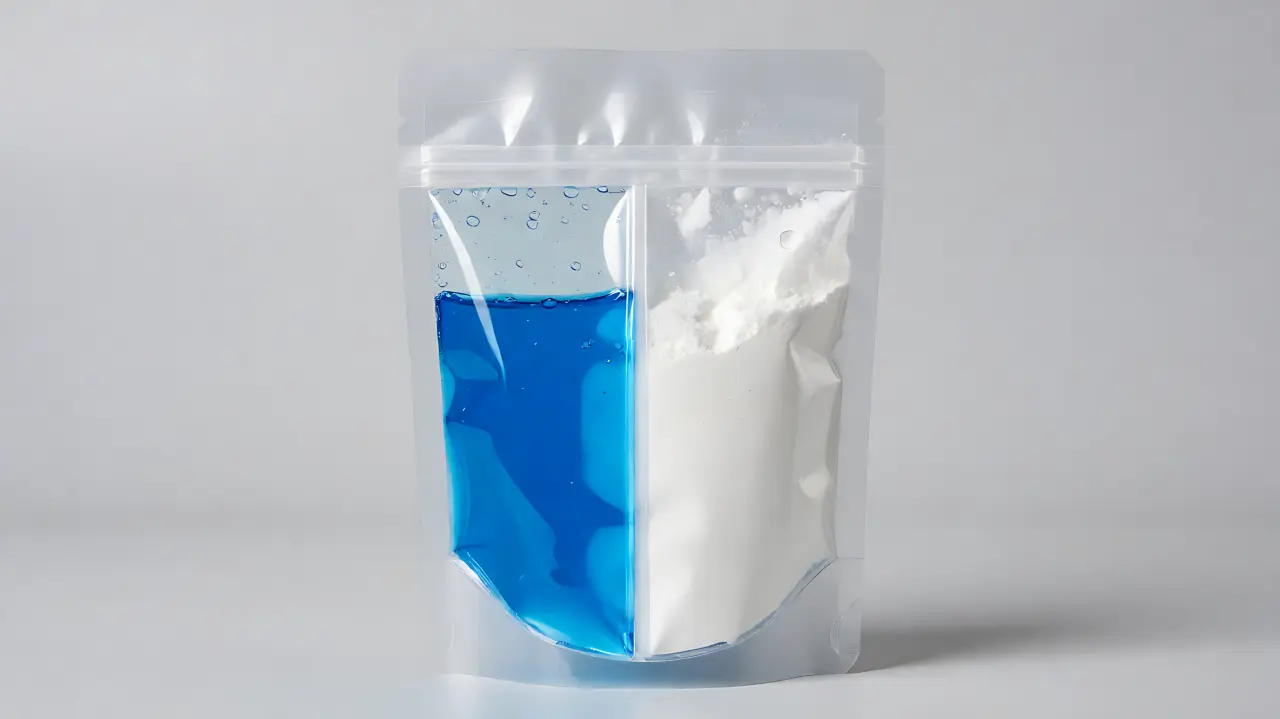
Dual-Chamber Flexible Pouches: Frangible Burst Seal Engineering Guide
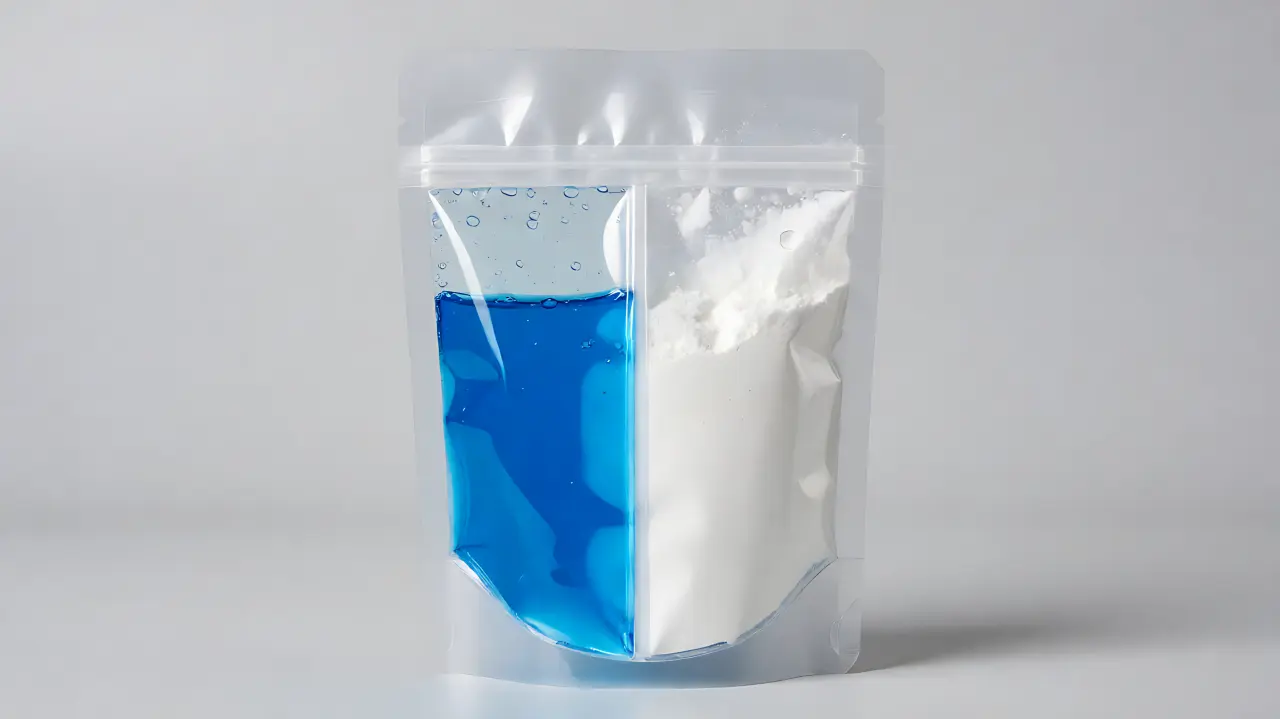
In advanced personal care, medical diagnostics, agrochemicals, and specialty nutrition, many high-potency formulations cannot be pre-mixed at the factory. Active ingredients—such as fresh vitamin C (L-ascorbic acid), live probiotic cultures, two-part epoxy resins, and hair dyes—degrade or react within days if suspended in aqueous solutions during shelf storage.
Traditionally, brands solved this instability using complex multi-bottle kits, plastic ampoules, or rigid dual-chamber bottles with specialized dual-dispensing pumps. However, rigid multi-container packaging is expensive, plastic-heavy, and prone to user measurement error.
The modern flexible packaging alternative is the Dual-Chamber Pouch with an Engineered Frangible Burst Seal.
By separating two unmixed components within independent hermetic compartments separated by a calibrated peelable partition seal, consumers can mix fresh ingredients instantaneously inside the closed pouch simply by applying palm pressure—eliminating external contamination, mess, and premature oxidation.
This technical guide provides an engineering analysis of Dual-Chamber Flexible Pouches, detailing frangible peel mechanics (ASTM F88), burst pressure calibration, heat seal thermomechanics, resin co-extrusion chemistry, and converting line quality control.
1. Technical Matrix: Dual-Chamber Frangible Pouches vs. Multi-Bottle Kits
| Engineering Metric | Dual-Chamber Frangible Pouch | Rigid Dual-Chamber Bottle | Blister Ampoule + Solution Bottle | Pre-Mixed Ready-to-Use (Legacy) |
|---|---|---|---|---|
| Separation Architecture | Internal calibrated peelable weld seam | Dual rigid HDPE/PET cylindrical chambers | Glass/plastic crushable vial | None (Requires heavy chemical stabilizers) |
| Mixing Mechanism | Consumer squeeze bursts partition seal | Dual dispensing actuator pump head | Manual pouring and shaking | Pre-blended |
| Frangible Seal Strength (ASTM F88) | 3.0 to 6.0 N/15mm (Peelable) | N/A (Rigid plastic partition) | N/A (Glass snap line) | N/A |
| Perimeter Hermetic Seal Strength | > 35.0 N/15mm (Permanent destructive weld) | Welded bottle seams | Crimp neck seal | Destructive weld |
| Ingredient Potency Preservation | 100% Unreacted until moment of use | High (Possible nozzle cross-contamination) | Excellent (Hermetic glass) | Degrades over 3–6 months shelf life |
| Plastic Mass / PPWR Packaging Tare | Ultra-Low (70% to 85% plastic reduction) | High (Heavy rigid pumps and walls) | High (Multiple packaging layers) | Moderate |
| Point-of-Use Cleanliness | 100% Contained (Zero skin contact / spill) | Clean pump dispensing | High spill and cut hazard | Standard |
| Packaging Unit Cost Index | Baseline (1.0× — Flexible Efficiency) | 3.5× to 5.5× Baseline | 2.8× to 4.2× Baseline | 0.70× Baseline (Active lifespan loss) |
To view our complete portfolio of customized flexible pouches and barrier formats, visit our Stand-up Pouches Category.
2. The Physics of the Frangible Seal: Peelable vs. Destructive Welds
The critical engineering core of a dual-chamber pouch is the differential seal strength:
$$\text{Perimeter Seal Strength } (\ge 35\text{ N/15mm}) \gg \text{Frangible Partition Seal Strength } (3.5\text{ to }5.5\text{ N/15mm})$$
Differential Seal Architecture in Dual-Chamber Pouches:
┌────────────────────────────────────────────────────────┐
│  Permanent Perimeter Hermetic Seal (>35 N/15mm)        │
│  ┌──────────────────────────────────────────────────┐  │
│  │                                                  │  │
│  │   Chamber A: Powder / Active Freeze-Dried Serum  │  │
│  │                                                  │  │
│  ├──────────────────────────────────────────────────┤  │
│  │  ═════ Frangible Peelable Burst Seal ══════════  │  │ <── Calibrated to burst at
│  │  (Peel strength: 3.5 – 5.0 N/15mm)               │  │     25–35 kPa squeeze
│  ├──────────────────────────────────────────────────┤  │
│  │                                                  │  │
│  │   Chamber B: Liquid Activator / Aqueous Solvent  │  │
│  │                                                  │  │
│  └──────────────────────────────────────────────────┘  │
│  Permanent Bottom Hermetic Seal (>35 N/15mm)           │
└────────────────────────────────────────────────────────┘
When a user squeezes Chamber B with their palms:
- Hydraulic Force Concentration: Pascal’s principle dictates that pressure applied to the liquid in Chamber B radiates equally in all directions.
- Selective Rupture: Because the outer perimeter seals possess a destructive thermal weld strength exceeding 35 N/15mm, they resist internal expansion. The frangible partition seal—formulated with a calibrated cohesive failure threshold of 3.5 to 5.5 N/15mm—ruptures cleanly under an internal pressure of 25 to 35 kPa.
- Instantaneous In-Pouch Mixing: The liquid surges into Chamber A, reconstituting the dry powder or second fluid inside the closed pouch with zero atmospheric contact or mess.
3. Seal Bar Thermomechanics: Achieving Peelability
How do flexible packaging converters achieve a peelable weld using standard polyethylene sealant films?
Two primary chemical and thermal methods are utilized:
Frangible Sealing Techniques:
Method 1: Sub-Fusion Temperature Window:        Method 2: Contaminant Resin Co-Ex (Peel Blend):
Heated Seal Bar                                 Polybutene-1 (PB-1) Droplets in PE Matrix
      │                                                │
┌─────▼──────────────────────────────┐          ┌──────▼───────────────────────────────┐
│ Outer PET Web (High Tm: 255°C)     │          │ Outer Barrier Web                    │
├────────────────────────────────────┤          ├──────────────────────────────────────┤
│ Polyethylene Sealant Layer         │          │ LLDPE Matrix (85%)                   │
│ Controlled Temp: 112°C – 118°C     │          │ Incompatible PB-1 Dispersions (15%)  │
│ (Partial molecular inter-diffusion)│          │ (Micelles create micro-void shear)   │
└────────────────────────────────────┘          └──────────────────────────────────────┘
Result: Reversible adhesive peel failure. Result: Predictable cohesive peel tear.-
Sub-Fusion Thermal Profiling (Narrow Process Window):
- Polyethylene typically forms a permanent destructive weld at $135^\circ\text{C}$ to $155^\circ\text{C}$.
- By precisely controlling the internal frangible seal bar to $114^\circ\text{C} \pm 2^\circ\text{C}$ with a dwell time of $0.6\text{ seconds}$ and reduced pneumatic pressure ($1.8\text{ bar}$ vs. standard $4.5\text{ bar}$), the PE polymer chains only partially diffuse across the interface.
- Limitation: This process is highly sensitive to line voltage fluctuations and ambient factory temperatures.
-
Peel-Blend Polybutene-1 (PB-1) Co-extrusion (Gold Standard):
- High-performance converters co-extrude a sealant layer containing a physical blend of 85% metallocene LLDPE and 15% Polybutene-1 (PB-1).
- Because PB-1 is thermodynamically incompatible with the polyethylene crystalline matrix, it forms microscopic, uniformly dispersed spherical micelles.
- When sealed at standard temperatures ($140^\circ\text{C}$), the seal bar creates a clean cohesive peel along the PB-1 boundary plane, delivering an unshakeable burst threshold of $4.0\text{ N/15mm}$ across a wide $\pm 10^\circ\text{C}$ operating window.
4. Barrier Integrity & Asymmetric Laminate Engineering
In many dual-chamber formulations, the two chambers have opposing barrier requirements:
- Chamber A (Dry Freeze-Dried Powder): Requires ultra-low water vapor transmission rate ($WVTR < 0.05\text{ g/m}^2/\text{day}$) to prevent powder caking, but minimal chemical resistance.
- Chamber B (Aggressive Essential Oil or Solvent): Requires aggressive chemical resistance against solvent delamination, but is insensitive to moisture ingress.
To optimize material costs, engineers can specify asymmetric laminated films or utilize continuous barrier substrates (PET / AlOx / OPA / Co-Ex Peel-PE) that resist chemical wicking along the cut frangible weld line while maintaining crystal-clear consumer product visibility.
5. Converting Quality Assurance: ASTM F88 & Burst Testing
To prevent premature transit bursting inside courier delivery boxes while ensuring easy consumer opening:
Quality Control Testing Protocol:
1. ASTM F88 Tensile Peel Test:
   - Cut 15mm test strips perpendicular to frangible seal line.
   - Pull at 300 mm/min on an Instron universal testing machine.
   - Acceptable peel force: Exactly 3.5 N to 5.5 N / 15mm.

2. ASTM F1140 Restrained Burst Test:
   - Inflate Chamber B with compressed air between parallel plates.
   - Frangible seal must pop between 20 kPa and 35 kPa.
   - Perimeter seals must hold without deformation up to > 80 kPa.

3. Drop Impact Simulation (ASTM D5276):
   - Filled dual-chamber pouches undergo 1.2m drop tests onto concrete.
   - 0% premature rupture rate allowable across 100 sample units.
Dual-chamber frangible pouches represent the pinnacle of functional flexible packaging design, transforming active cosmetic and healthcare applications from multi-component assemblies into sleek, single-pouch customer experiences.
To engineer custom dual-chamber prototypes, test frangible resin formulations, and optimize burst thresholds for your formulation, consult our materials laboratory via our Stand-up Pouches Engineering Center.