
Drip Coffee Bag Packaging: Ultrasonic Sealing & Nitrogen Guide
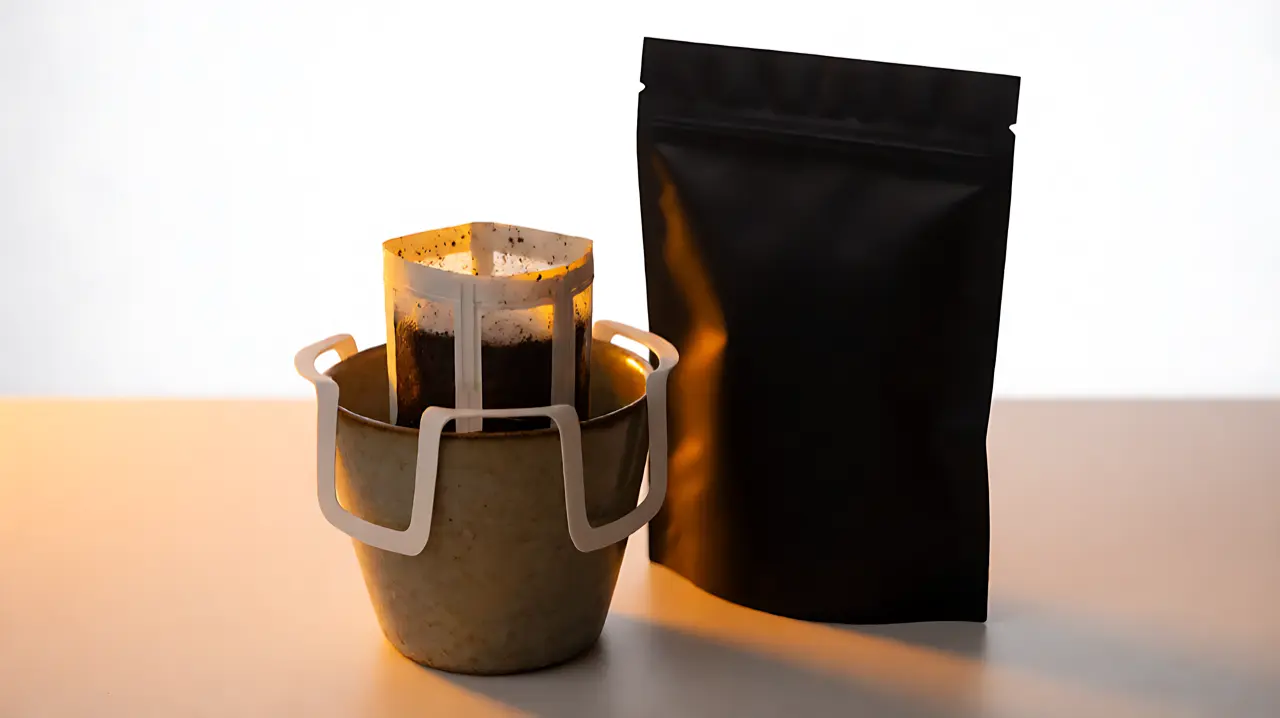
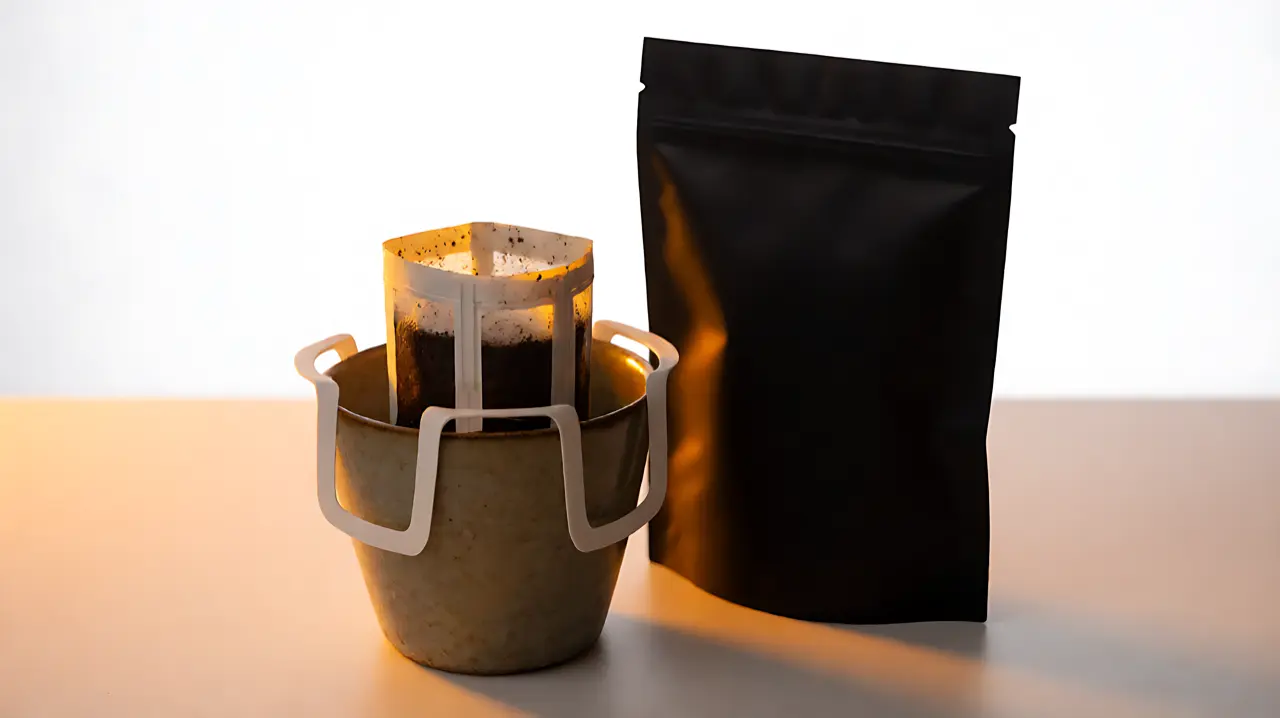
Single-serve drip coffee bags (frequently termed hanging-ear coffee pouches or pour-over filter bags) have transitioned from a niche Japanese innovation to one of the fastest-growing formats in global specialty coffee retail. By combining the fresh extraction of manual pour-over with the convenience of instant coffee, drip bags offer specialty roasters a high-margin product tier.
However, the physics of drip bag packaging presents extreme engineering hurdles. Freshly ground coffee exhibits a vast surface area—up to 1,000 times higher than whole roasted beans—triggering rapid loss of volatile aromatic terpenes and immediate vulnerability to oxygen degradation. Furthermore, filter papers must allow rapid gravity water percolation while retaining micro-fines without releasing adhesive chemical taints into boiling water.
Achieving a 12-month commercial shelf life requires precise coordination of ultrasonic filter horn welding, porous non-woven filter media, high-speed form-fill-seal (VFFS) machinery with nitrogen gas flushing, and multi-layer high-barrier outer envelopes.
1. Drip Bag Engineering Architecture: Filter vs. Outer Envelope
Single-Serve Drip Coffee Packaging Structure:
┌─────────────────────────────────────────────────────────────┐
│ Outer Hermetic Barrier Envelope (PET / VMPET / PE or Foil)  │
│ Headspace: Purified Nitrogen (N₂) Gas Flush (Residual O₂ <0.5%)│
│  ┌───────────────────────────────────────────────────────┐  │
│  │ Inner Hanging-Ear Filter Bag                          │  │
│  │ - Non-woven PLA / Polypropylene Micro-Mesh (180µm)    │  │
│  │ - Ultrasonic Welded Paperboard Suspension Arms        │  │
│  │ - 10g to 12g Nitrogen-Dosed Precision Ground Coffee   │  │
│  └───────────────────────────────────────────────────────┘  │
└─────────────────────────────────────────────────────────────┘| Component Layer | Material Formulation | Functional Specification | Critical Performance Threshold |
|---|---|---|---|
| Filter Web Body | Food-Grade PP or Biodegradable PLA Non-Woven Mesh | 100% glue-free spunbonded web; calibrated pore size | Flow rate: 150–200 mL water per 90–120 seconds |
| Hanging Ear Arms | Food-Grade Bleached Cardboard laminated with PE film | Rigid tensile paperboard with precision die-cut slots | Suspends securely across cups Ø65mm to Ø95mm without sagging |
| Filter-to-Cardboard Bond | High-Frequency Ultrasonic Fusion (20 kHz / 35 kHz) | Molecular interlocking without thermal scorch | Tensile shear strength > 18 N; zero adhesive extractables |
| Outer Pouch Film | Matte BOPP 19µm / VMPET 12µm / LLDPE 40µm |
Hermetic gas-tight barrier envelope | OTR < 0.5 cc/m²/day; WVTR < 0.5 g/m²/day |
| Headspace Gas | 99.999% High-Purity Nitrogen ($N_2$) | Atmospheric displacement in dosing tunnel | Residual Oxygen: strictly < 0.5% (typically 0.1%–0.3%) |
For traditional whole bean and ground coffee packaging formats, review our Stand-Up Pouches Category and Flat Bottom Bags.
2. Filter Porosity & Extraction Mechanics (TDS Optimization)
The sensory profile of a drip bag depends on the balance between hydraulic permeability and fines filtration:
1. Spunbonded Polypropylene vs. PLA Non-Woven
- Spunbonded Polypropylene (PP): The established industry benchmark. Offers exceptional wet tensile strength, zero flavor scalping, and precise micro-porosity (150–200 µm). It does not soften or deform when subjected to 95°C extraction water.
- Polylactic Acid (PLA) Cornstarch Fibers: An eco-friendly renewable alternative conforming to EN 13432 industrial compostability standards. PLA webs require tighter ultrasonic sealing temperature windows to prevent brittle crystallization around the horn perimeter.
2. Flow Rate vs. Total Dissolved Solids (TDS)
- If the filter pore distribution is too tight (<100 µm), fine coffee particles quickly clog the filtration boundary layer, causing water pooling, overflow, and bitter over-extraction.
- If pore size is too coarse (>300 µm), water funnels through in under 45 seconds, resulting in weak coffee with TDS < 1.0% and an extraction yield below the SCA standard target of 18% to 22%. High-performance drip filter paper is calibrated to achieve a steady 1.5 to 2.0 mL/second percolation rate under atmospheric gravity.
3. Ultrasonic Sealing vs. Thermal Heat Sealing
Attaching the rigid cardboard hanging arms to the delicate non-woven filter web is a critical quality checkpoint:
Sealing Technology Comparison for Drip Bags:
Thermal Conductive Bar:      Ultrasonic Acoustic Horn (35 kHz):
┌────────────────────────┐   ┌────────────────────────┐
│  Heat Penetration      │   │  Focused Acoustic Wave │
│  Scorched Fibers / Odor│   │  Instant Molecular Melt│
│  Adhesive Required     │   │  100% Glue-Free Bond   │
└────────────────────────┘ └────────────────────────┘- Why Conductive Heat Sealing Fails: Traditional heated metal sealing jaws require sustained contact dwell time (0.4 to 0.8s) to transmit heat through cardboard into the filter. This high thermal energy frequently scorches the polypropylene fibers, releases burnt plastic odors into the coffee grounds, and creates uneven brittle seams prone to tearing under the weight of wet coffee grounds.
- The Ultrasonic Advantage: A titanium or hardened steel acoustic sonotrode vibrates at 35,000 Hz (35 kHz) against an engraved anvil. Mechanical friction generates localized frictional heat exclusively at the interface between the thermoplastic PE coating and the non-woven fibers within 0.08 to 0.15 seconds. The result is a hermetic, fiber-reinforced bond with zero adhesive off-gassing, maintaining pristine cup aroma.
4. Nitrogen Gas Flushing (MAP) & Volatile Ester Preservation
Ground coffee releases up to 80% of its trapped carbon dioxide within the first 24 hours post-grinding, simultaneously exposing delicate aromatic aldehydes, pyrazines, and esters to immediate oxidation:
Gas Dosing Dynamics
High-speed automated packaging machines (running at 40 to 80 drip bags per minute) integrate an enclosed nitrogen dosing tunnel. Liquid nitrogen micro-dosing (or laminar gaseous $N_2$ curtains) purges the outer pouch envelope immediately before top-seal closure:
- Atmospheric Displacement: The system displaces ambient room air ($20.9% \text{ O}_2$) down to $< 0.5% \text{ O}_2$.
- Volatile Aroma Retention: Gas chromatography-mass spectrometry (GC-MS) analysis reveals that coffee ground in standard ambient air loses over 60% of key fruity and floral aroma volatiles within 7 days. Under $<0.5%$ nitrogen flush in metallized foil envelopes, aroma retention exceeds 92% after 12 months of storage at 25°C.
5. Outer Barrier Envelope Selection
Because the inner filter bag is completely open to gas exchange, the entire burden of environmental protection rests on the outer sealed envelope:
Outer Barrier Film Structure Cross-Section:
[Matte BOPP 19µm]    <-- High-End Tactile Feel & Premium Flexo Print
[PU Adhesive 2.5 gsm]<-- Solvent-Free Food Grade Lamination
[VMPET 12µm / Alu]   <-- Hermetic Gas & Moisture Barrier (OTR <0.5)
[LLDPE 40µm] <-- Low-Initiation Hermetic Heat Seal Layer- Matte BOPP / VMPET / PE: The premier commercial structure for retail coffee brands. Provides a luxurious matte tactile exterior with high-barrier vacuum metallization. Ensures complete light shielding to prevent UV-induced lipid degradation.
- Kraft Paper / Foil / PE: Popular for artisanal boutique branding. Combines authentic natural unbleached kraft paper with a solid 7µm aluminum foil core for zero OTR transmission.
- Easy-Open Tear Notches: All envelopes require precision mechanical or laser-scored tear notches positioned 15mm below the top seal, allowing effortless consumer opening without crushing the inner filter bag.
6. Roaster Procurement & Quality Verification Checklist
Before commissioning commercial drip coffee bag production, verify these operational specifications:
- Filter Web Compliance: Confirm FDA 21 CFR 177.1520 and EU 10/2011 food-grade migration certificates for hot beverage extraction at 100°C.
- Residual Oxygen SLA: Require packaging partners to guarantee $\le 0.5%$ residual headspace oxygen measured with an optical or electrochemical headspace analyzer (e.g., MOCON Dansensor).
- Filter Capacity: Select correct dimensions based on target dosage—standard 74 × 90 mm filters accommodate 8g to 10g; wide-body 75 × 100 mm filters handle 10g to 14g for specialty high-yield extractions.
- Hanging Arm Cup Grip: Verify that die-cut cardboard ear hooks maintain grip on mugs ranging from 65mm espresso cups up to 95mm wide travel mugs without slipping during pour-over.
To develop custom-printed nitrogen barrier envelopes and high-speed drip bag rollstock for your coffee brand, contact the CraftPack Global packaging specialists.