
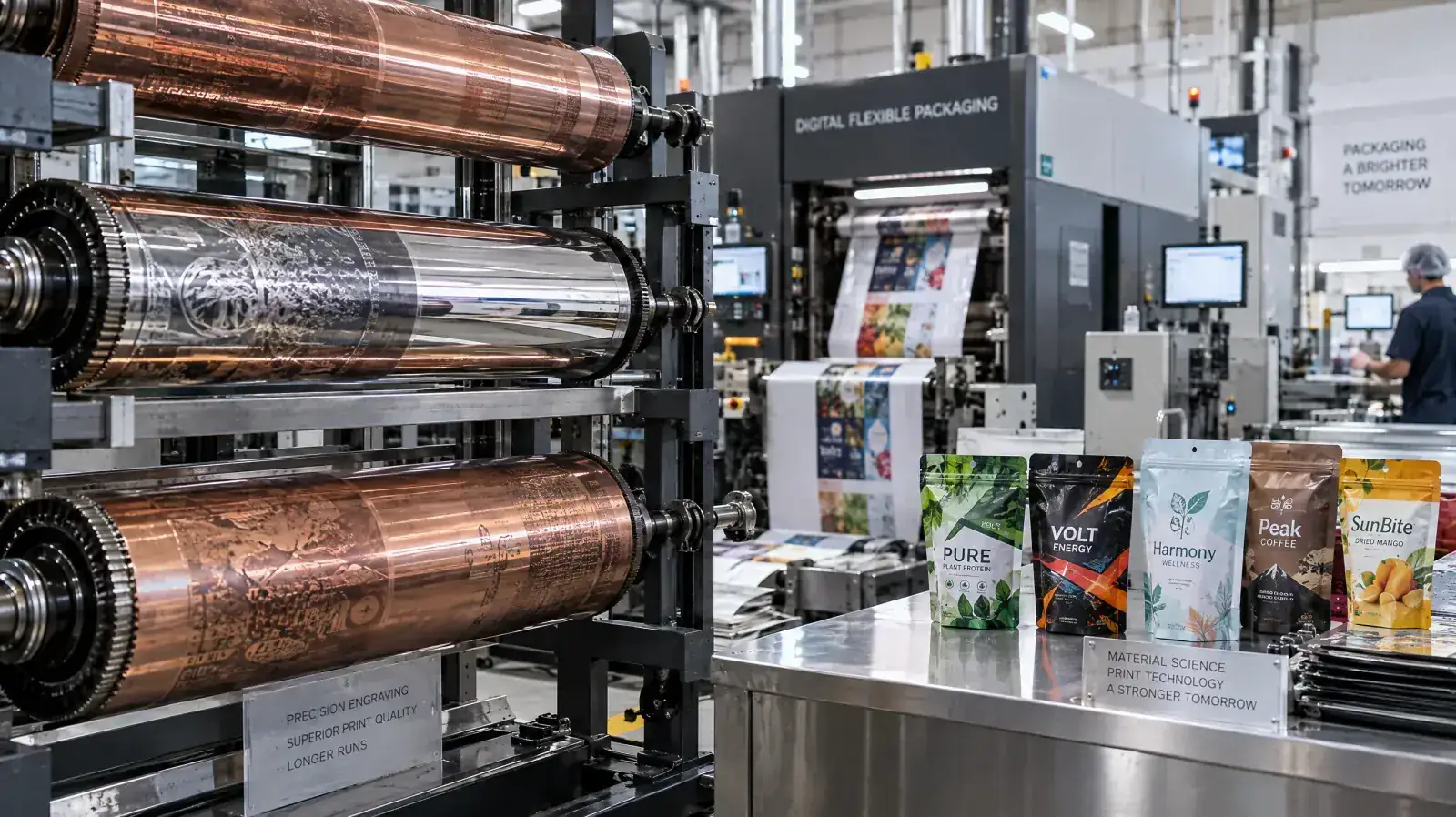
Digital vs Rotogravure Pouches: MOQ & Break-Even Guide
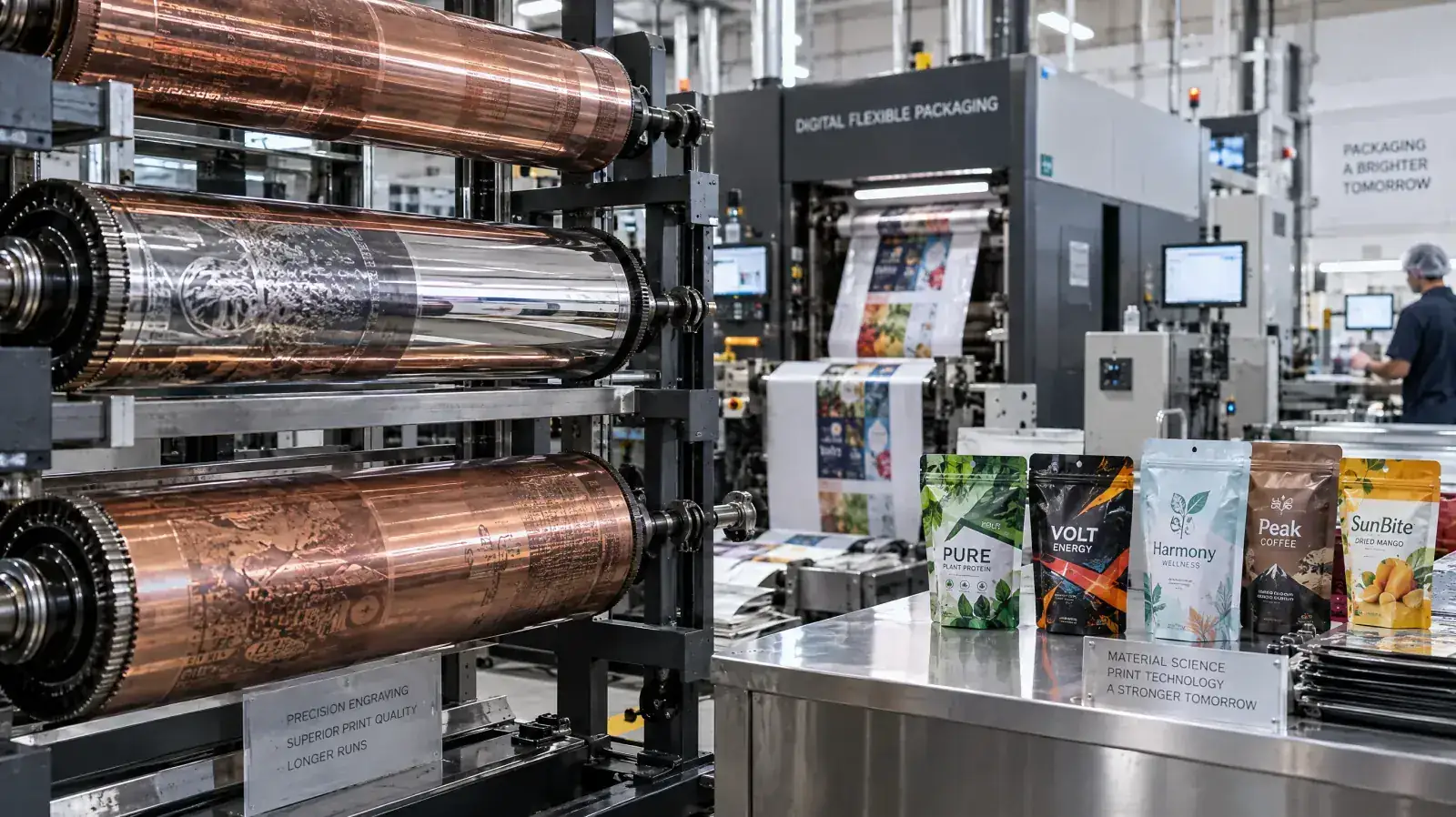
For growing consumer packaged goods (CPG) brands, specialty coffee roasters, and snack manufacturers, deciding between digital pouch printing and rotogravure (cylinder) printing is one of the most critical packaging decisions affecting cash flow, margin structure, and supply chain agility.
Online digital pouch converters often promote digital printing as the universal future of flexible packaging, emphasizing zero tooling fees and minimum order quantities (MOQs) as low as 500 units. Meanwhile, industrial packaging converters advocate for rotogravure printing as the gold standard for high-speed repeatability, superior barrier lamination, and dramatically lower unit costs.
The truth is that neither method is universally superior; each occupies a specific economic sweet spot. This guide delivers a transparent, engineering-driven analysis of both printing technologies, detailing cylinder costs, unit economics, quality nuances, and the exact mathematical break-even crossover point where scaling brands should transition from digital presses to rotogravure manufacturing.
1. Quick Answer: When to Choose Digital vs. Rotogravure
| Decision Factor | Digital Printing (e.g., HP Indigo) | Rotogravure Printing (Engraved Cylinders) |
|---|---|---|
| Initial Tooling / Plate Cost | $0 (Direct from digital PDF) | $150 – $250 per color cylinder ($1,200–$2,000 per artwork) |
| Typical Minimum Order (MOQ) | 500 – 2,000 pouches per SKU | 5,000 – 10,000 pouches per SKU |
| Average Unit Cost | High ($0.45 – $1.20+ per pouch) | Ultra-Low ($0.10 – $0.25 per pouch) |
| Turnaround Time | 5 – 12 business days | 18 – 25 business days (first run with tooling) |
| Multi-SKU Flavor Variants | Excellent (Ganged print runs on one web) | Requires separate plate sets unless shared common design |
| Metallic & Spot Color Accuracy | CMYK / OVG process emulation | True Pantone spot inks, metallics & tactile lacquers |
| High-Barrier & Retort Performance | Moderate (Thermal / solventless limitations) | Maximum bond strength across all film structures |
| Economic Crossover Point | Cost-effective below 5,000 units | Significantly cheaper above 8,000 – 10,000 units |
The Strategic Rule of Thumb:
- If you are validating product-market fit, testing 6 seasonal SKUs with small batches, or operating under strict capital constraints: start with digital printing.
- If you have an established core product line selling more than 5,000 pouches per quarter: rotogravure printing will slash your packaging cost of goods sold (COGS) by 40% to 65%, paying for the initial tooling investment within your very first production reorder.
2. Technical Comparison: How Both Technologies Work
Understanding the physical mechanics of each process explains why they carry such vastly different price and performance characteristics.
┌─────────────────────────────────────────────────────────────────────────┐
│                       PRINT PROCESS COMPARISON                          │
├─────────────────────────────────────┬───────────────────────────────────┤
│          DIGITAL PRINTING           │       ROTOGRAVURE PRINTING        │
├─────────────────────────────────────┼───────────────────────────────────┤
│  • Digital PDF direct to blanket    │  • Laser-etched copper cylinders  │
│  • ElectroInk or UV inkjet          │  • Fluid ink in micro-recessed    │
│  • Zero physical cylinders          │    intaglio cells                 │
│  • Web speed: 30 - 45 m/min         │  • Web speed: 250 - 350 m/min     │
│  • High ink cost per square meter   │  • Low commodity ink cost         │
│  • Short-run agility                │  • Industrial scale & repeatability│
└─────────────────────────────────────┴───────────────────────────────────┘
Digital Pouch Printing (Direct-to-Substrate)
Modern digital flexible packaging presses (predominantly HP Indigo liquid electrophotography or high-speed aqueous/UV inkjet) transfer liquid toner directly onto a corona-treated base film without printing plates.
- Agility: Every single frame printed along the web can be completely different, enabling variable data, unique sequential serialization, and effortless multi-SKU ganging (e.g., printing 1,000 bags each across 5 flavors on the same continuous roll).
- Setup Efficiency: Setup waste is remarkably low—often fewer than 30 to 50 meters of material are sacrificed during machine registration.
- Limitations: Machine throughput is constrained to roughly 30–45 meters per minute, and proprietary digital inks carry a cost up to 5x to 8x higher per kilogram than conventional liquid packaging inks.
Rotogravure Printing (High-Speed Rotary Intaglio)
Rotogravure is an industrial intaglio printing method where the graphic design is laser-engraved as microscopic cells into a solid steel roller electroplated with copper, and subsequently finished with a micro-thin layer of industrial hard chrome (HDC) for abrasion resistance.
- The Inking Mechanism: As the cylinder rotates through an ink bath, a doctor blade wipes excess ink from the non-image surface. The web substrate passes between the engraved cylinder and a rubber impression roller, transferring ink directly onto the film under high pressure.
- Throughput & Consistency: Gravure presses run between 250 and 350 meters per minute across 8 to 12 inline color stations. Once calibrated, color density remains microscopically uniform across millions of meters without drifting.
- Cylinder Durability: Chrome-plated gravure cylinders are industrial capital assets. A properly maintained cylinder easily yields 1,000,000 to 2,000,000 impressions, meaning the tooling cost is paid only once and amortized across years of repeat runs.
3. The Break-Even Economics: Detailed Cost Breakdown
To visualize where the economic balance tilts, let us examine a standard commercial specification: a 250g / 8oz Stand-Up Pouch with resealable press-to-close zipper and tear notches, utilizing a premium 3-ply high-barrier laminate structure (Matte PET 12µm / AL Foil 7µm / LLDPE 80µm), printed with 7 colors (CMYK + 2 Pantone Brand Spot Colors + Opaque White Backing).
Cost Comparison Matrix across Order Volumes
| Order Quantity (Per SKU) | Digital Printing Total Cost | Digital Unit Price | Rotogravure Total (Run + Tooling) | Rotogravure Unit Price (Effective) | Rotogravure Reorder Cost (No Tooling) |
|---|---|---|---|---|---|
| 1,000 pcs | $980 | $0.98 | $2,750 ($1,400 tooling + $1,350 run) | $2.75 | $1,350 ($1.35) |
| 2,500 pcs | $1,750 | $0.70 | $2,950 ($1,400 tooling + $1,550 run) | $1.18 | $1,550 ($0.62) |
| 5,000 pcs | $2,750 | $0.55 | $2,450 ($1,400 tooling + $1,050 run) | $0.49 | $1,050 ($0.21) |
| 10,000 pcs | $4,800 | $0.48 | $3,200 ($1,400 tooling + $1,800 run) | $0.32 | $1,800 ($0.18) |
| 25,000 pcs | $11,250 | $0.45 | $5,150 ($1,400 tooling + $3,750 run) | $0.206 | $3,750 ($0.15) |
| 50,000 pcs | $21,500 | $0.43 | $7,900 ($1,400 tooling + $6,500 run) | $0.158 | $6,500 ($0.13) |
Note: Indicative pricing reflecting global converting market benchmarks for custom aluminum-foil barrier stand-up pouches. Exact tooling and unit figures vary based on bag dimensions, film caliper, and special opening features.
Interpreting the Crossover Curve
Total Order Cost ($)
▲
│                                          / Digital Line ($0.45 - $0.55/unit)
│                                         /
│                                        /
│                                       /
│                                      /
│                                     /
│                                    /
│                                   X  <--- BREAK-EVEN CROSSOVER POINT (~5,000 - 6,000 units)
│                                  /  \
│                                 /    \
│    Cylinder Investment ($1,400)├──────\──────────────── Rotogravure Line ($0.15 - $0.21/unit)
│                                /       \
│                               /         \
│                              /           \
└─────────────────────────────┴─────────────┴────────────────────────────────►
0 2,500 5,000 10,000 25,000 Quantity (Units)- Under 3,000 units: Digital printing is the undisputed winner. Absorbing $1,400 in cylinder tooling across only 1,000 or 2,000 bags creates an unsustainable per-unit penalty.
- At 5,000 to 6,000 units (The Crossover Sweet Spot): Rotogravure achieves total order cost parity with digital printing even when paying 100% of cylinder engraving fees upfront.
- At 10,000+ units: The financial delta becomes massive. On a 25,000-unit production run, choosing rotogravure saves $6,100 (over 54%) on the first run, and $7,500 (over 66%) on every subsequent repeat order.
- The Repeat Reorder Advantage: Once cylinders are paid for, the true manufacturing cost of rotogravure drops to $0.13 to $0.18 per pouch, while digital unit prices remain high because digital converters must pay the same expensive ink, thermal laminate, and click-charge costs on every print run.
4. Print Quality, Color Matching & Finishing Capabilities
Beyond unit economics, packaging buyers must consider brand aesthetics, color repeatability, and structural barrier integrity.
1. Spot Colors and Brand Consistency
- Digital Emulation: Digital presses use a 4-color (CMYK) or extended 7-color (CMYK + Orange/Violet/Green) process ink set. While software algorithms can simulate up to 90% of the Pantone Solid Coated library, subtle process screening dots may be visible under magnification. Highly critical corporate brand colors (such as vibrant reflex blues, neon hues, or opaque metallics) can shift between print batches if press humidity or calibration fluctuates.
- Rotogravure Dedicated Stations: Rotogravure presses allocate individual print cylinders to dedicated, pre-mixed Pantone spot inks. If your brand specifies Pantone 186 C Red, the press operator fills an entire inking station with genuine Pantone 186 ink, ensuring exact optical density and zero dot rosette patterns.
2. Metallic Inks and Foil Effects
- Digital: To achieve metallic finishes on a digital press, converters typically print white ink selectively over a fully metallized substrate (BOPP-VM or VMPET). While effective, fine white lines can suffer from registration bleed, and true gold, bronze, or copper hues are emulated through yellow/magenta overprinting.
- Rotogravure: Modern gravure presses easily run formulated metallic aluminum flake inks, liquid gold bronzes, and cold-foil transfer stations inline, producing deep, reflective metallic accents with razor-sharp edge definition.
3. Combination Varnishes (Registered Matte & Gloss)
One of the most popular luxury packaging techniques is registering high-gloss highlights (such as a logo, product illustration, or brand pattern) over a soft matte or paper-touch background.
- On rotogravure presses, registered matte lacquer is applied inline via an engraved cylinder station in exact register (within ±0.15 mm) with the underlying graphic.
- On digital lines, tactile varnishes usually require a secondary offline embellishment pass, which increases lead times, creates secondary scrap, and adds substantial per-unit surcharge fees.
5. Barrier Lamination and Structural Demands
The choice between digital and rotogravure can directly impact packaging shelf life and seal integrity, especially for aggressive or demanding products.
Solventless Lamination vs. Thermal / Multi-Web Bonding
Rotogravure converters operate industrial solventless polyurethane lamination machinery capable of bonding challenging barrier substrates:
- Solid aluminum foil (
AL 7µm/AL 9µm) for absolute zero-oxygen transmission in whole bean coffee packaging. - Heavy-duty cast polypropylene (R-CPP) for retort sterilizable packaging (121°C / 250°F autoclaves).
- Recyclable mono-material structures, such as MDO-PE films paired with low-temperature heat-sealable PE.
Some digital pouch makers utilize thermal laminating films (pre-coated with heat-activated adhesive). While suitable for dry snacks, confectionery, and powders, thermal adhesives can exhibit lower interlayer bond strength when exposed to volatile organic oils (such as eucalyptus, liquid seasonings, or high-acid sauces), increasing the risk of delamination over prolonged shelf life.
6. The “Digital-to-Rotogravure” Migration Playbook
For growing brands, the most profitable strategy is rarely picking one method forever—it is orchestrating a phased hybrid migration:
PHASE 1: Product Inception & Market Validation (0 - 2,500 Units)
├── Use Digital Pouch Printing
├── Test 4-6 Flavor Variations / Label Designs
├── Fast Turnaround (7-10 Days) to capture trade shows or farmer's markets
└── Accept higher unit cost ($0.70 - $1.00) to preserve upfront working capital

PHASE 2: Product-Market Fit & SKU Rationalization (3,000 - 5,000 Units)
├── Analyze sales velocity per SKU
├── Identify the "Hero SKUs" generating 80% of repeat sales volume
└── Keep slow-moving or seasonal limited editions on digital printing

PHASE 3: Industrial Scaling & Margin Expansion (10,000+ Units)
├── Transition Hero SKUs to Rotogravure Printing
├── Invest $1,200 - $1,800 in precision engraved cylinders per core SKU
├── Drop unit cost from $0.60 to $0.16 (saving $4,400+ per order)
└── Lock in dedicated Pantone spot colors and inline registered matte varnish

PHASE 4: Sustained Reorders & Cylinder Stewardship
├── Amortize cylinder investment to $0 over subsequent production runs
└── Maintain cylinders in climate-controlled storage for immediate 15-day repeat runs
7. How CraftPack Global Solves the Cylinder Dilemma
Many brand owners hesitate to transition to rotogravure printing because they fear complex pre-press workflows, surprise plate charges, or damaged cylinders. At CraftPack Global, we eliminate friction through our integrated converter program:
- Transparent Tooling & Cylinder Ownership: You receive full, unencumbered ownership of your engraved cylinders. We provide high-resolution proofing and 1:1 color drawdowns on actual production film before a single cylinder is cut.
- Complimentary Cylinder Maintenance & Storage: Between production cycles, your cylinders are sonically cleaned, coated with anti-corrosion protective oil, and stored in our temperature-controlled facility. If a cylinder wears out during standard production, we replace it at no charge.
- Versatile Format Capabilities: Whether you require Stand-Up Pouches, Flat Bottom Box Pouches, or Side Gusset Bags, we optimize print cylinder circumferences to minimize web waste and reduce your minimum run requirements.
- Engineering Sizing & Barrier Guidance: Review our technical sizing formulas in our Stand-Up Pouch Sizing & Capacity Guide or consult our team to evaluate whether your barrier requirements warrant digital or gravure processing.
8. Summary Checklist: Which Method Fits Your Next Order?
Choose Digital Pouch Printing if:
- Your total order volume is under 3,000 pouches per SKU.
- You are launching multiple test flavors or seasonal limited releases.
- You require finished bags at your warehouse in fewer than 10 to 14 days.
- You require sequential numbering, personalized QR codes, or variable graphics.
Choose Rotogravure Printing if:
- Your order volume is 5,000 pouches or higher per SKU.
- Unit cost margin is critical to your wholesale distribution or retail slotting fees.
- Your packaging requires exact corporate Pantone spot colors, metallics, or tactile matte/gloss registration.
- You package aggressive liquids, hot-fill sauces, or require maximum foil barrier lamination bond strength.
- You plan to reorder the same artwork multiple times over the next 12 to 24 months.
Ready to Optimize Your Packaging Unit Economics?
Whether you are preparing a short pilot run or ready to transition your hero SKUs to high-speed rotogravure manufacturing to slash COGS, CraftPack Global’s packaging engineering team is ready to analyze your artwork and volume.
Contact Our Engineering Team today with your pouch dimensions, material structure, and SKU forecast for a detailed comparative quotation.