
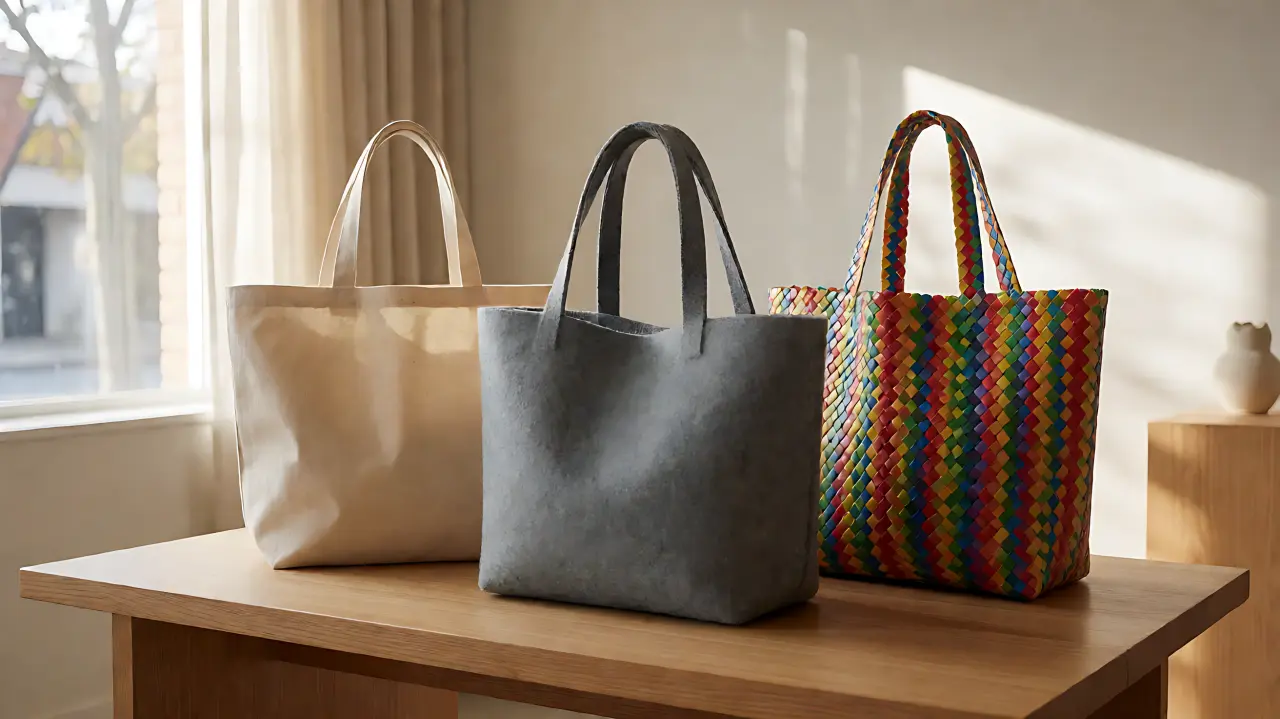
Cotton Canvas vs. RPET Felt vs. Woven PP Totes Guide
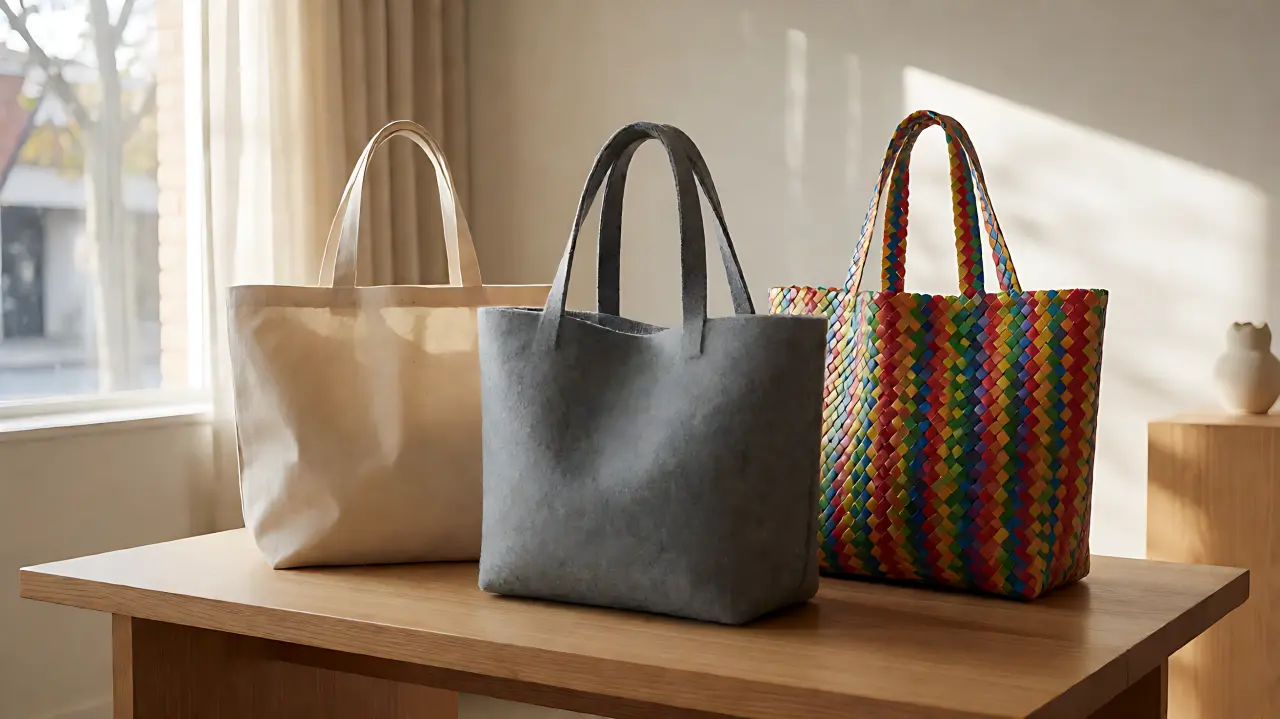
In retail merchandising, promotional branding, and grocery retail, Reusable Shopping Totes represent both an enduring consumer brand ambassador and a critical environmental compliance asset. As supermarket chains and luxury boutiques globally eliminate single-use plastic sacks, commercial procurement managers must select reusable textile materials that balance consumer aesthetic appeal, physical durability, and rigorous Life Cycle Assessment (LCA) carbon metrics.
The three primary commercial substrates dominating the reusable carrier category are Heavyweight Cotton Canvas (10oz–14oz), Recycled PET (RPET) Needle-Punched Felt, and BOPP Laminated Woven Polypropylene (Woven PP).
However, each substrate possesses distinct mechanical tensile strengths, water/stain resistance, laundering behavior, and manufacturing carbon footprints.
This technical guide provides a comparative engineering evaluation of Cotton Canvas vs. RPET Felt vs. Laminated Woven PP Totes, analyzing ASTM D5034 tensile breaking strength, handle Box-X stitch shear, full lifecycle carbon break-even thresholds, and cleaning hygiene.
1. Technical Matrix: Reusable Tote Bag Substrates
| Specification Metric | Heavy Cotton Canvas (12oz / 340 GSM) | Recycled PET Felt (2.0mm / 280 GSM) | Laminated Woven PP (140 GSM) | Non-Woven PP Bag (Legacy 80 GSM) |
|---|---|---|---|---|
| Material Construction | 100% Ring-spun cotton yarn plain weave | Needle-punched post-consumer rPET fibers | Woven PP tape fabric + BOPP film laminate | Spunbond thermal bonded polypropylene |
| Tensile Breaking Strength (ASTM D5034) | $> 650\text{ N}$ (Warp) / $> 480\text{ N}$ (Weft) | $> 420\text{ N}$ (Multidirectional) | $> 750\text{ N}$ (High-tensile tape matrix) | 120 N to 180 N (Puncture sensitive) |
| Maximum Safe Load Capacity | 18.0 kg to 25.0 kg | 12.0 kg to 18.0 kg | 25.0 kg to 35.0 kg (Extreme Duty) | 6.0 kg to 10.0 kg |
| Water & Stain Resistance | Poor (Absorbs liquids; stains easily) | Moderate (Water-resistant; absorbs oils) | 100% Waterproof & Wipe-Clean | Low to Moderate |
| Machine Laundering & Hygiene | Fully machine washable (40°C) | Spot-clean only (Can pill in wash) | Wipe clean with disinfectant sprays | Non-washable (Degrades in machine) |
| LCA Carbon Break-Even Threshold | 50 to 120 Reuses (High crop footprint) | 15 to 25 Reuses (Low recycled footprint) | 10 to 15 Reuses (Lowest energy per bag) | 8 to 12 Reuses |
| Eco Certification Standard | GOTS (Global Organic Textile Standard) | GRS 4.0 (Global Recycled Standard) | Recyclable #5 PP Stream | Recyclable #5 PP Stream |
| Relative Material Cost Index | 3.2× to 4.5× Baseline (Prestige luxury) | 1.8× to 2.5× Baseline (Modern eco) | Baseline (1.0× — Mass Grocery Standard) | 0.50× to 0.65× Baseline |
To view our full collection of durable and reusable commercial bags, visit our Reusable Bags Category and Paper Shopping Bags Category.
2. Structural Mechanics & Handle Box-X Stitch Engineering
The ultimate carrying capacity of a reusable tote is rarely governed by the fabric tearing across the body; catastrophic failure occurs at the handle anchor attachment:
Handle Box-X Stitch Engineering Architecture:
┌────────────────────────────────────────────────────────┐
│  Hem Turnover Fold (Double-Fold Top Lip, 30mm)         │
├────────────────────────────────────────────────────────┤
│  ┌──────────────────────────────────────────────────┐  │
│  │  Handle Webbing (38mm Cotton or Polypropylene)   │  │
│  │  ┌────────────────────────┐                      │  │
│  │  │ ╔════════════════════╗ │                      │  │
│  │  │ ║ ╲                ╱ ║ │                      │  │ <── Continuous Box-X
│  │  │ ║   ╲            ╱   ║ │                      │  │     Reinforcement Stitch
│  │  │ ║     ╳        ╳     ║ │                      │  │     with Bonded Nylon Thread
│  │  │ ║   ╱            ╲   ║ │                      │  │
│  │  │ ║ ╱                ╲ ║ │                      │  │
│  │  │ ╚════════════════════╝ │                      │  │
│  │  └────────────────────────┘                      │  │
│  └──────────────────────────────────────────────────┘  │
│  Tensile Pull-Off Failure Threshold: > 280 Newtons     │
└────────────────────────────────────────────────────────┘-
The Box-X Stitch Standard:
- A standard single straight stitch across a handle fails under dynamic pedestrian swinging at approximately 120 N (12 kg).
- High-grade commercial totes mandate a Box-X cross-stitch pattern sewn through both the bag body and an internal 30 mm reinforced top hem.
- Using high-tensile bonded nylon thread (Tex 70), the diagonal cross-lines distribute downward kinetic shear across 16 square centimeters, raising handle pull-off failure to $> 280\text{ Newtons}$ (equivalent to 28 kg dynamic load).
-
Substrate Tear Propagation:
- Woven Polypropylene: The cross-woven extruded PP tapes arrest tear propagation. If a puncture occurs from a sharp carton corner, the woven grid stops the tear from spreading.
- RPET Needle-Punched Felt: Made by interlocking millions of recycled polyester microfibers via barbed mechanical felting needles. Felt has no warp or weft grain, meaning it resists fraying at raw edges and distributes multidirectional loads evenly.
3. Life Cycle Assessment (LCA): The Carbon Break-Even Reality
In ESG procurement, evaluating a bag’s environmental footprint requires analyzing full cradle-to-grave Life Cycle Assessments (LCA):
Life Cycle Assessment (LCA) Carbon Break-Even Curve:
Total Environmental Impact Index
High ┼ ╭── Conventional Virgin Cotton Canvas (High irrigation & agricultural footprint)
     │ │
Med  ┼ │          ╭── Recycled RPET Felt (Post-consumer plastic diversion)
     │ │          │
Low  ┼ │          │          ╭── Laminated Woven PP (Low material mass, high durability)
 0.0 ┴─┴──────────┴──────────┴─────────────────────────
0 20 50 100 Uses to Offset Footprint- The Cotton Canvas Paradox: While cotton is 100% natural and biodegradable, cultivating raw cotton requires intensive water irrigation (roughly 2,700 liters per bag), agricultural fertilizers, and energy-dense textile weaving. Studies by the UK Environment Agency and Danish EPA show that a 12oz cotton tote must be reused between 50 and 120 times to neutralize its manufacturing carbon footprint relative to standard paper carriers.
- The Woven PP & RPET Efficiency: Laminated woven PP and RPET felt bags require minimal water during production and incorporate post-consumer recycled plastic bottles. They achieve full LCA carbon break-even after only 10 to 20 shopping cycles, making them mathematically superior for mass grocery distribution.
4. Sanitation, Hygiene & Cleaning Compliance
In grocery and fresh meat shopping, reusable bags encounter raw poultry juices, meat drip, and soil from unwashed root vegetables:
- Cotton Canvas Washing: Cotton absorbs liquids readily. To eliminate bacteria like E. coli or Salmonella, cotton canvas totes can be machine-washed in hot water (40°C to 60°C). However, cotton shrinks by 4% to 7% upon initial washing unless pre-shrunk, and heavy canvas takes over 12 hours to air-dry.
- Laminated Woven PP Sanitization: The non-porous BOPP outer lamination creates an impervious liquid barrier. Supermarket shoppers can sanitize the interior and exterior in 10 seconds using standard antibacterial wipes or damp cloth wiping, preventing cross-contamination between grocery trips.
5. Commercial Procurement Selection Framework
                      What is your brand positioning and use case?
                                     │
                     ┌───────────────┴───────────────┐
          High-End Fashion & Lifestyle             Supermarket & High-Volume Grocery
             (Prestige Retail Branding)               (Mass Durability & Spillage Proof)
                     │                               │
        Does your customer base prioritize   Do shoppers require a bag that can be
         organic natural fibers (GOTS)?       wiped clean of food spills in seconds?
                     │                               │
        ┌────────────┴────────────┐             ┌────┴──────────────────────────┐
       YES                        NO            │ Deploy Laminated Woven PP:    │
        │                          │            │ - 100% Waterproof wipe-clean  │
  Deploy 12oz Cotton Canvas:       │            │ - Extreme 30kg load capacity  │
  - Premium lifestyle appeal       │            │ - 10-cycle LCA carbon offset  │
  - Soft, comfortable shoulder drop│            │ - Edge-to-edge gravure print  │
  - Long-term keepsake utility     │            └───────────────────────────────┘
  - Screen or digital print        │
  - GOTS organic certification     └──────────> Deploy RPET Felt Totes for
                                                Modern Architectural Eco-Luxury
To configure custom tote dimensions, handle webbing styles, and certified GRS/GOTS recycled fabric blends, connect with our reusable packaging group through our Reusable Bags Division.