
Corrugated Flute Profiles: E-Flute vs B vs C vs BC Wall Guide
In industrial shipping logistics and retail secondary packaging, corrugated fiberboard serves as the fundamental load-bearing architecture. A shipping carton must simultaneously survive dynamic warehouse pallet stacking forces (compressive creep), withstand handling drops (puncture resistance), and—increasingly in direct-to-consumer e-commerce—deliver razor-sharp graphic printing without “washboarding” visual defects.
Selecting the appropriate corrugated flute geometry—E-Flute, B-Flute, C-Flute, or combined BC Double-Wall—requires balancing mechanical beam strength against surface caliper and converting efficiency governed by TAPPI T811 (Edge Crush Test) and TAPPI T810 (Mullen Burst Test).
Flute Architecture & Geometric Profiles
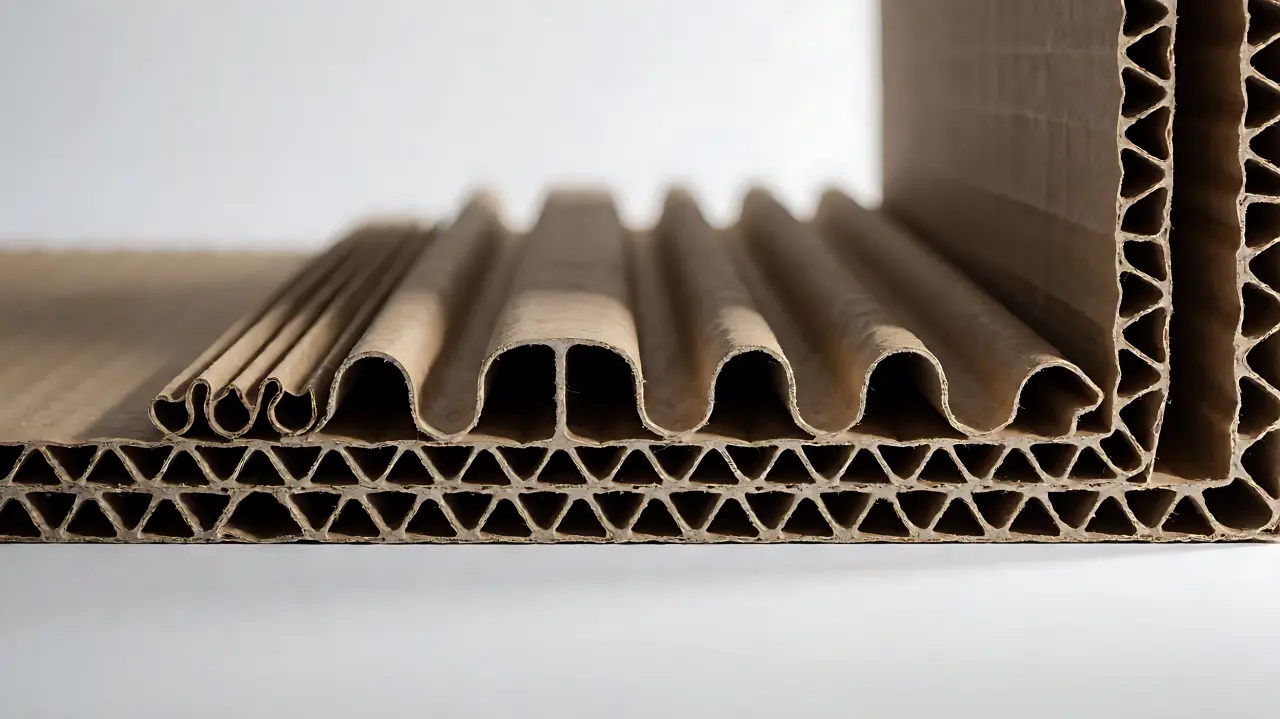
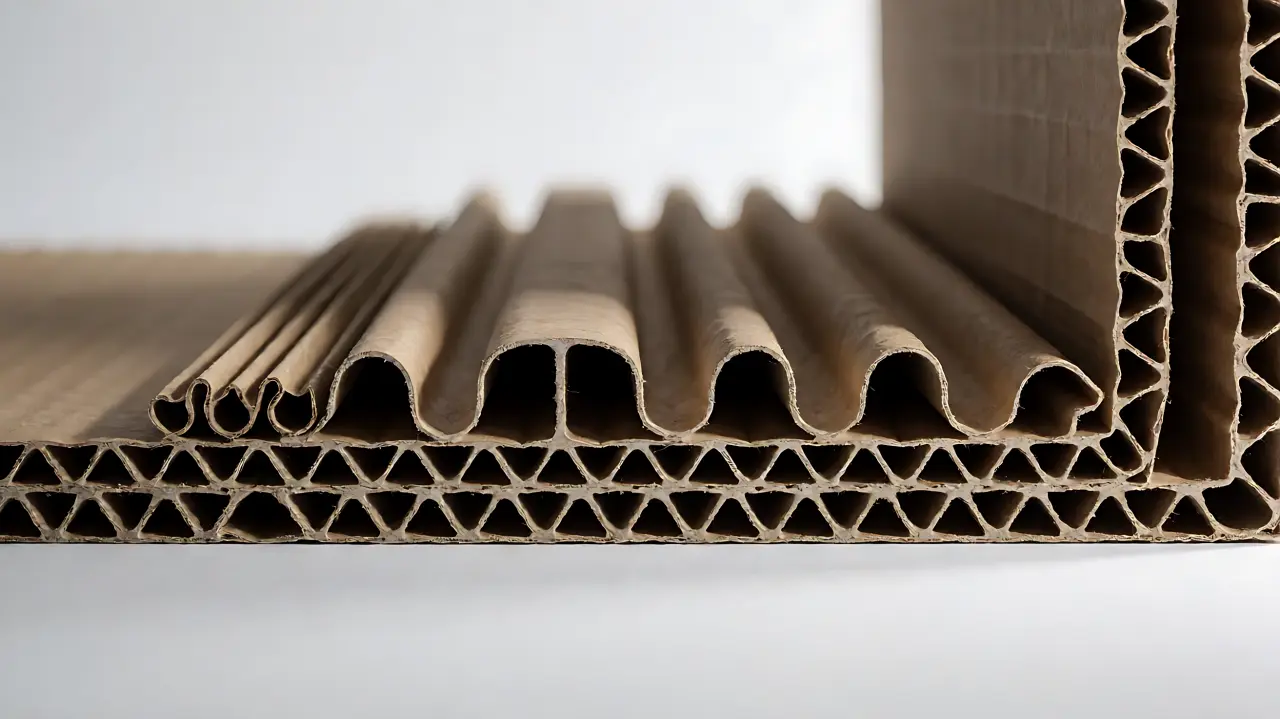
A corrugated board consists of one or two flat paper linerboards bonded with starch adhesive to an undulating, sinusoidal wave-shaped fluted medium. The height of the arch and the number of flutes per linear foot dictate its structural physics:
Flute Geometry Dimensions (Cross-Section)
┌────────────────────────────────────────────────────────┐ Liner
   ▲    ╭───╮       ╭───╮       ╭───╮       ╭───╮
   │   │     │     │     │     │     │     │     │         Fluted Medium
   h   │     │     │     │     │     │     │     │
   ▼    ╰───╯       ╰───╯       ╰───╯       ╰───╯
└────────────────────────────────────────────────────────┘ Liner
       ◄───── Pitch (p) ────►
1. E-Flute (Micro-Flute / Retail Folding Carton Replacement)
- Caliper: $1.1 - 1.8\text{ mm}$ ($1/16\text{ in}$).
- Flute Density: $90 \pm 4\text{ flutes per linear foot}$.
- Primary Characteristics: Exceptionally flat surface with minimal wave pitch. Because the arch peaks are packed tightly together, the linerboard does not sag between ridges, completely suppressing “washboarding” during direct flexographic or offset litho lamination. High crush resistance and foldability make it ideal for retail cosmetic mailers and subscription boxes.
2. B-Flute (Puncture Resistance & Counter Displays)
- Caliper: $2.5 - 3.0\text{ mm}$ ($1/8\text{ in}$).
- Flute Density: $47 \pm 3\text{ flutes per linear foot}$.
- Primary Characteristics: Excellent flat crush resistance ($> 280\text{ kPa}$) and lateral puncture strength. While B-flute provides less vertical top-to-bottom compression strength than C-flute, its compact thickness resists edge rollover during die-cutting and scoring.
3. C-Flute (Standard Master Shipping RSC Carton)
- Caliper: $3.6 - 4.2\text{ mm}$ ($5/32\text{ in}$).
- Flute Density: $39 \pm 3\text{ flutes per linear foot}$.
- Primary Characteristics: The universal standard for Regular Slotted Cartons (RSC). The taller flute height provides substantial vertical column strength, carrying the bulk of warehouse pallet stack compression loads.
4. BC Double-Wall (Heavy-Duty Industrial Logistics)
- Caliper: $6.0 - 7.2\text{ mm}$ ($1/4\text{ to }5/16\text{ in}$).
- Flute Architecture: A laminated composite bonding a C-flute interior to an exterior B-flute layer via a central linerboard.
- Primary Characteristics: Combines the high stacking compression of C-flute with the puncture resistance and smoother printing face of B-flute. Mandatory for gross package weights exceeding $30\text{ kg}$ or multi-tier warehouse pallet racking.
Engineering Comparison: Mechanical Specifications
| Corrugated Flute Profile | Flute Height ($h$) | Flutes / Meter | Flat Crush Resistance | Relative Stacking Strength | Ideal Application |
|---|---|---|---|---|---|
| E-Flute | $1.2 - 1.6\text{ mm}$ | $290 - 320$ | Ultra-High ($> 350\text{ kPa}$) | $45%$ of C-Flute | Premium D2C e-commerce mailers, cosmetics |
| B-Flute | $2.4 - 3.0\text{ mm}$ | $150 - 160$ | High ($260 - 320\text{ kPa}$) | $75%$ of C-Flute | Shelf-ready packaging, canned food trays |
| C-Flute | $3.6 - 4.2\text{ mm}$ | $120 - 130$ | Moderate ($180 - 240\text{ kPa}$) | Baseline ($100%$) | Standard freight shipping cartons (RSC) |
| BC Double-Wall | $6.2 - 7.2\text{ mm}$ | Compound ($280$) | Extreme ($> 480\text{ kPa}$) | $185%$ of C-Flute | Bulk industrial components, appliances |
Stacking Strength Calculation: McKee Formula
Predicting whether a corrugated box will survive long-term warehouse storage without buckling is calculated using the empirical McKee Equation for Box Compression Strength (BCT):
$$\text{BCT} = 5.876 \cdot \text{ECT} \cdot \sqrt{t \cdot P}$$
Where:
- $\text{BCT}$: Peak top-to-bottom compression strength of the assembled box (Newtons or lbf).
- $\text{ECT}$: Edge Crush Test value of the board in $\text{kN/m}$ (governed by TAPPI T811).
- $t$: Caliper (thickness) of the combined corrugated board (mm).
- $P$: Box perimeter in mm ($2 \times \text{Length} + 2 \times \text{Width}$).
Notice that box compression strength is directly proportional to the square root of board thickness ($\sqrt{t}$). This explains why a taller flute (C-flute, $t \approx 4\text{ mm}$) delivers vastly superior stacking compression compared to a thin E-flute ($t \approx 1.5\text{ mm}$) using identical basis weight kraft paper linerboards.
To calculate safe working stack heights in real-world supply chains, a Safety Factor ($SF = 3.0 - 5.0$) must be applied to account for pallet overhang ($30%$ loss), cyclic humidity softening ($90%,\text{RH}$ reduces paper strength by $50%$), and dynamic forklift vibration creep.
Selecting the Optimal Outer Shipper
- Specify E-Flute: When shipping luxury direct-to-consumer goods, high-end apparel, and beauty sets where unboxing tactile elegance and photographic flexo/litho printing take priority over tall pallet stacking.
- Specify C-Flute: For standard wholesale secondary shipping cartons holding flexible stand-up pouches, coffee bags, or dry food goods.
- Specify BC Double-Wall: When packaging heavy industrial components, bulk liquid bag-in-box systems, or shipping fragile glass containers across international sea freight.
Complement your shipping fleet with protective custom mailers and sustainable paper shopping bags. Contact CraftPack Global’s structural packaging engineers to run McKee box compression analyses and optimize palletization cube efficiency.