
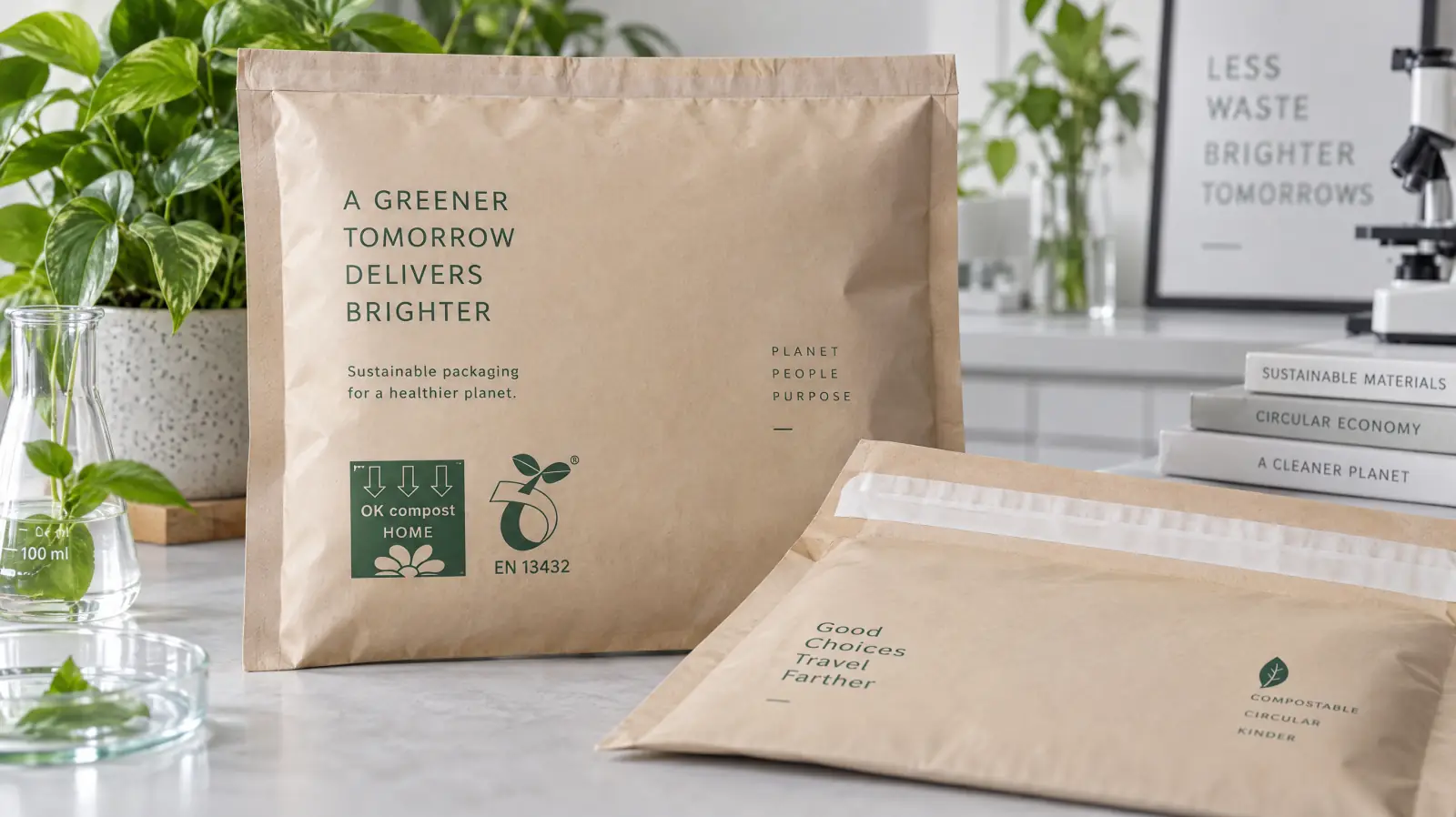
Compostable Mailers: PLA + PBAT Polymer Science & Standards Guide
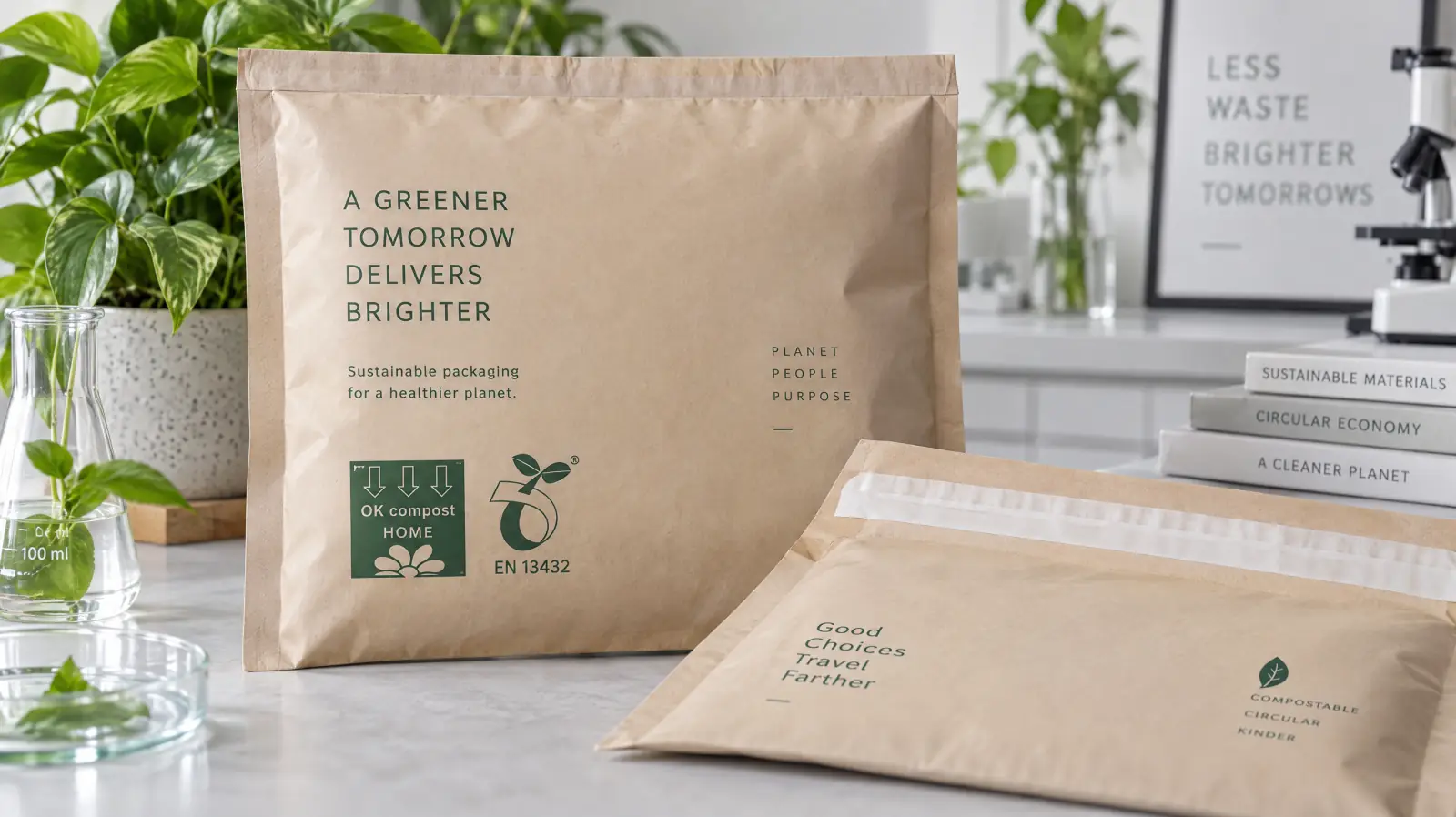
In direct-to-consumer (D2C) e-commerce, the single-use plastic shipping bag has faced intense environmental scrutiny. While traditional poly mailers made from low-density polyethylene (LDPE) are mechanically recyclable, real-world consumer recycling rates for flexible films remain below 12% globally. Most poly mailers end up in municipal landfills or marine environments, persisting for hundreds of years.
In response, sustainable fashion, apparel, and lifestyle brands are transitioning rapidly to certified compostable shipping mailers.
However, “compostable” is not a singular material. Formulating a flexible courier bag that survives automated sorting hubs, resists rain, and seals permanently—yet breaks down cleanly into organic humus in home garden soil—requires sophisticated polymer compounding.
This technical guide dissects the macromolecular chemistry of PLA and PBAT blends, certification standards under EN 13432, ASTM D6400, and TÜV Austria OK compost HOME, hydrolytic degradation kinetics, and warehouse shelf-life management.
1. Quick Engineering Comparison: Conventional LDPE vs. Compostable Mailers
| Technical Parameter | Standard LDPE Poly Mailer | Industrial Compostable Mailer | Home Compostable Mailer (OK HOME) |
|---|---|---|---|
| Primary Polymer Chemistry | 100% Virgin or Recycled LDPE/LLDPE | 70% PBAT + 30% PLA blend | 80% PBAT + 15% PLA + 5% Bio-Starch |
| Governing Standard | ASTM D882 / ISO 1183 | EN 13432 / ASTM D6400 | TÜV Austria OK compost HOME / AS 5810 |
| Composting Environment | Non-biodegradable (persists > 300 yrs) | Commercial facility: 58°C ± 2°C | Ambient garden compost: 20°C – 30°C |
| Time to 90% Biodegradation | Indefinite | < 180 days | < 365 days |
| Tensile Strength at Break | 22 – 30 MPa | 18 – 24 MPa | 15 – 20 MPa |
| Elongation at Break (%) | 450% – 600% | 350% – 450% | 400% – 550% |
| Warehouse Shelf Life | 36+ Months | 12 – 18 Months (dry storage) | 10 – 14 Months (temperature controlled) |
Explore certified options in our Compostable Shipping Mailers Product and E-Commerce Mailers Category.
2. Polymer Science: The Synergy of PLA + PBAT Compounding
A functional courier mailer cannot be made from pure Polylactic Acid (PLA) or pure Polybutylene Adipate Terephthalate (PBAT) alone:
┌────────────────────────────────────────────────────────────────────────┐
│                   PLA + PBAT POLYMER ALLOY DYNAMICS                    │
├───────────────────────────────────┬────────────────────────────────────┤
│      POLYLACTIC ACID (PLA)        │  POLYBUTYLENE ADIPATE TEREPHTHALATE│
│       (Bio-based Rigidity)        │       (PBAT - Ductile Matrix)      │
├───────────────────────────────────┼────────────────────────────────────┤
│                                   │                                    │
│   • Derived from fermented corn   │   • Aliphatic-aromatic co-polyester│
│     starch or sugarcane dextrose  │   • Highly flexible macromolecular │
│   • High tensile modulus (3.5 GPa)│     chains with low Tg (-30°C)     │
│   • Glass transition (Tg): 55-60°C│   • Elongation at break: > 600%    │
│   • DEFECT: Extremely brittle,    │   • DEFECT: Overly soft, prone to  │
│     cracks under postal folding   │     gumming blown film extruders   │
│                                   │                                    │
├───────────────────────────────────┴────────────────────────────────────┤
│   THE COMPOUNDED ALLOY (80% PBAT + 15% PLA + 5% Compatibilizer):       │
│   • PBAT forms the continuous flexible matrix (absorbing drop impact) │
│   • PLA forms dispersed nano-domains providing tensile body & stiffness│
│   • RESULT: Silky-soft hand feel with high dart-drop puncture strength │
└────────────────────────────────────────────────────────────────────────┘
Why Pure PLA Fails in Mailers
Pure PLA has an elongation at break of less than 10%. If extruded into a 60µm mailer film, inserting a shoe box or heavy hoodie would cause the bag to fracture and tear along fold creases.
The Role of Compatibilizers
Because PLA and PBAT are thermodynamically immiscible polymers, melt blending them without additives results in phase separation and delamination. Converting compounders introduce reactive compatibilizers (such as glycidyl methacrylate-functionalized polymers or bio-based maleic anhydride) that chemically link the polyester phases at the molecular boundary, boosting dart impact strength above 350 grams per ASTM D1709.
3. Industrial vs. Home Composting: Standards & Mechanisms
Brand marketers frequently confuse “industrial compostable” with “home compostable,” leading to greenwashing accusations:
┌────────────────────────────────────────────────────────────────────────┐
│              COMPOSTING REGIME & BIODEGRADATION MECHANISM              │
├───────────────────────────────────┬────────────────────────────────────┤
│      INDUSTRIAL COMPOSTING        │          HOME COMPOSTING           │
│     (EN 13432 / ASTM D6400)       │     (OK COMPOST HOME / AS 5810)    │
├───────────────────────────────────┼────────────────────────────────────┤
│                                   │                                    │
│   Operating Temp: 58°C ± 2°C      │   Operating Temp: 20°C – 30°C      │
│   Humidity: 60% – 65%             │   Humidity: Variable ambient soil  │
│   Biology: Thermophilic microbes  │   Biology: Mesophilic soil flora   │
│                                   │                                    │
│   Degradation Phase 1:            │   Degradation Phase 1:             │
│   Thermal hydrolysis breaks       │   Enzymatic surface erosion by     │
│   ester bonds in PLA rapidly      │   indigenous fungi and bacteria    │
│                                   │                                    │
│   Degradation Phase 2:            │   Degradation Phase 2:             │
│   Microbial assimilation into     │   Conversion into biomass & water  │
│   CO2 + H2O in < 180 days         │   within 365 days (max 60µm film)  │
│                                   │                                    │
└───────────────────────────────────┴────────────────────────────────────┘- Industrial Composting (EN 13432): Requires controlled thermophilic conditions (58°C). Under high heat, water molecules penetrate the crystalline regions of PLA, triggering rapid abiotic hydrolytic chain cleavage. Within 12 weeks, the material must disintegrate so that less than 10% remains on a 2mm sieve.
- Home Composting (TÜV Austria OK compost HOME): Backyard compost piles rarely exceed ambient temperature (20°C–28°C). Because PLA hydrolyzes extremely slowly at 25°C, home compostable mailers must increase PBAT content to 75%–85%, incorporate thermoplastic starches (TPS), and restrict total film thickness to ≤ 60–70 microns.
Ecotoxicity & Heavy Metal Testing
True certification guarantees that degrading mailers leave zero toxic ecotoxicity footprints:
- Plant Growth Bio-assays (OECD 208): Plants grown in compost infused with degraded mailer residue must achieve > 90% germination rate and biomass compared to control compost.
- Heavy Metals Limits: Strict maximum concentrations for Zinc, Copper, Nickel, Cadmium, Lead, and Fluorine (total fluorine < 100 ppm guarantees PFAS-free compliance).
4. Hydro-Degradation Kinetics & Warehouse Shelf Life
Because compostable polymers are designed to decompose in moist environments, they possess an inherent expiration clock:
MOLECULAR WEIGHT DECAY CURVE DURING STORAGE
Molecular Weight (Mw)
  │
100% ────┐
  │      └───────┐ [Safe Zone: 0–9 Months]
 70%             └─────────┐ [Critical Threshold: 12 Months]
  │                        └──────────\ Embrittlement Zone (> 15 Months)
0 ────────────────────────────────────────► Time (Months)- The Mechanism: Ambient atmospheric moisture slowly cleaves ester bonds along the PBAT and PLA backbone through slow hydrolysis. As average molecular weight ($M_w$) drops below 70,000 g/mol, the film loses ductility and becomes prone to brittle split lines.
- Storage Best Practices for Brands:
- Maintain warehouse temperature below 25°C (77°F) and relative humidity below 50%.
- Keep master cartons sealed in moisture-barrier PE liners until actual fulfillment.
- Plan procurement on a 6 to 9-month inventory cycle rather than ordering multi-year stock.
5. Closure Engineering: Self-Adhesive Peeling Systems
A shipping mailer is worthless if the flap pops open in transit. Formulating adhesives for compostable films presents unique challenges:
DUAL ADHESIVE RETURN STRIP ON COMPOSTABLE MAILER
┌──────────────────────────────────────────────────────────────┐
│  COMPOSTABLE FLAP                                            │
│  ┌────────────────────────────────────────────────────────┐  │
│  │ [PERMANENT TACK COMPOSTABLE HOT MELT 1] - Outbound     │  │
│  └────────────────────────────────────────────────────────┘  │
│  - - - - - - - - Laser Micro-Perforated Tear Strip - - - - -  │
│  ┌────────────────────────────────────────────────────────┐  │
│  │ [PERMANENT TACK COMPOSTABLE HOT MELT 2] - Customer Return│  │
│  └────────────────────────────────────────────────────────┘  │
└──────────────────────────────────────────────────────────────┘- Compostable Hot-Melt Adhesive: Standard petroleum EVA or rubber glues are not compostable and would fail EN 13432 ecotoxicity audits. CraftPack Global deploys biodegradable polycaprolactone (PCL) or modified bio-resin pressure-sensitive adhesives (PSA).
- Release Liners: Flaps are protected with glassine paper liners or certified compostable PLA release films.
- Return Logistics: Including a secondary peel-and-seal strip allows customers to reuse the compostable mailer for e-commerce returns, doubling utility before final composting. Learn more in our Double Peel-and-Seal Mailers Guide.
6. Sustainable Sourcing Checklist
When sourcing compostable courier mailers:
- Verify Certificate Numbers: Confirm genuine certificate numbers with TÜV Austria (e.g., “S0000” series for OK compost HOME) or BPI (Biodegradable Products Institute).
- Request PFAS-Free Lab Audits: Ensure total organic fluorine (TOF) is certified < 100 ppm to meet US state and EU chemical bans.
- Check Puncture and Tear Resistance: Specify ASTM D1922 Elmendorf Tear test values > 800 mN in machine direction.
- Inspect Inks: Ensure exterior branding uses non-toxic, heavy-metal-free water-based or soy-based flexographic printing inks.
Partner with CraftPack Global for Circular Packaging
CraftPack Global engineers certified home compostable and industrial compostable mailers with silky matte aesthetics, double peel-and-seal return strips, and laboratory-verified puncture resistance.
Contact Our Sustainable Packaging Specialists to request certified test reports, dielines, and custom branded samples.